Inquire: Call 0086-755-23203480, or reach out via the form below/your sales contact to discuss our design, manufacturing, and assembly capabilities.
Quote: Email your PCB files to Sales@pcbsync.com (Preferred for large files) or submit online. We will contact you promptly. Please ensure your email is correct.
Notes: For PCB fabrication, we require PCB design file in Gerber RS-274X format (most preferred), *.PCB/DDB (Protel, inform your program version) format or *.BRD (Eagle) format. For PCB assembly, we require PCB design file in above mentioned format, drilling file and BOM. Click to download BOM template To avoid file missing, please include all files into one folder and compress it into .zip or .rar format.
After designing relay-based control systems for industrial automation, home automation, and IoT devices for over fifteen years, I’ve learned that relays are both the simplest and most frequently misunderstood components in embedded systems. The relay module Arduino combination allows beginners to safely control high-voltage appliances, yet I consistently see the same dangerous wiring mistakes and misconceptions in online forums.
Understanding how to properly use a relay module with Arduino isn’t just about getting it to work—it’s about doing so safely and reliably. In this comprehensive guide, I’ll share critical insights from real-world implementations, including proper wiring techniques, optocoupler isolation, common failure modes, and troubleshooting strategies that will keep both your projects and yourself safe.
A relay is an electrically operated switch that uses a small control current to switch a much larger load current. At its heart, a relay consists of an electromagnet coil and a set of mechanical contacts. When current flows through the coil, it creates a magnetic field that physically moves the contacts to make or break a circuit.
The Critical Advantage: Complete electrical isolation between the control circuit (Arduino) and the load circuit (high-voltage appliance). The only connection between these circuits is magnetic—no shared electrical path exists. This isolation protects your Arduino from high voltages and provides safety in case of load circuit failures.
Most common relay modules use 5V coils (Arduino compatible) with contact ratings of:
10A at 250V AC: Suitable for most household appliances
10A at 30V DC: DC load switching capability
Common rating: 10A @ 250VAC / 30VDC (SPDT contacts)
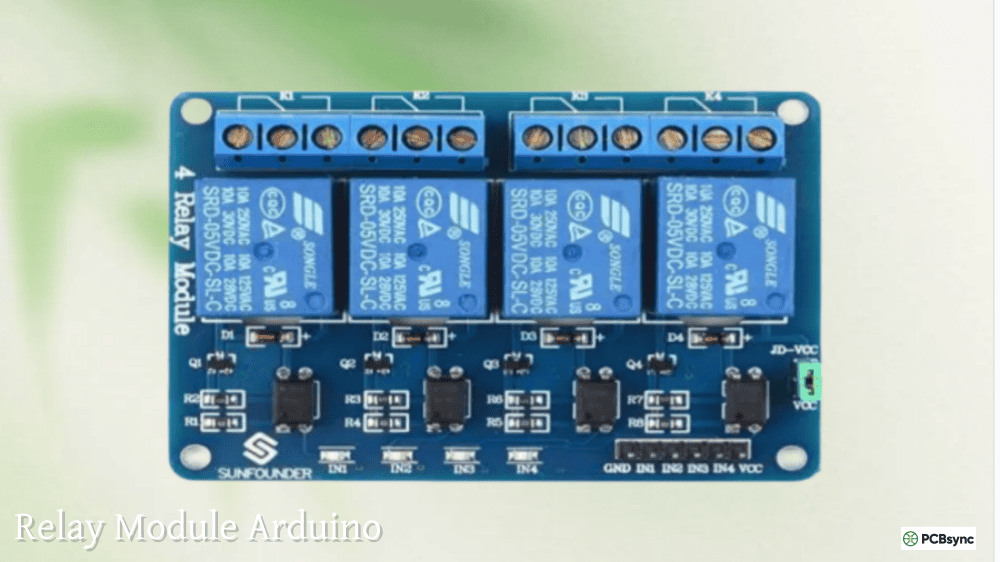
Relay Module Arduino Pin Configuration
Understanding the Control Side (Low Voltage)
Modern relay modules feature standardized pin configurations for Arduino interfacing:
Standard Control Pins:
Pin Name
Function
Arduino Connection
Voltage Level
VCC
Logic power
Arduino 5V
4.5-5.5V
GND
Ground reference
Arduino GND
0V
IN1, IN2…
Control inputs (active LOW)
Arduino digital pins
0V = ON, 5V = OFF
Critical Understanding: Most relay modules use active LOW triggering. This means:
digitalWrite(pin, LOW) → Relay ON (contacts close)
digitalWrite(pin, HIGH) → Relay OFF (contacts open)
This inversion confuses many beginners. Always verify your specific module’s trigger level.
JD-VCC Pin: The Isolation Mystery Explained
Many relay modules feature a confusing three-pin set: VCC, GND, JD-VCC with a removable jumper. Understanding this configuration is critical for safe, reliable operation.
With Jumper Installed (Default Configuration):
VCC and JD-VCC are connected
Arduino 5V powers both optocoupler logic AND relay coils
Simple wiring but NO electrical isolation
Current draw: ~70mA per active relay
Use when: Learning, prototyping, non-critical applications
With Jumper Removed (Isolated Configuration):
Separate power supplies for logic and relay coils
VCC powers optocoupler LEDs (Arduino 5V)
JD-VCC powers relay coils (external 5V supply)
TRUE electrical isolation achieved
Use when: Production systems, safety-critical applications, high-noise environments
Important: Even with jumper removed, grounds MUST be common. The optocoupler provides signal isolation, not ground isolation.
The Load Side (High Voltage)
Each relay provides three screw terminals for load connections:
Terminal
Full Name
Function
COM
Common
Always connected to power source or load
NO
Normally Open
Open when relay OFF, closed when relay ON
NC
Normally Closed
Closed when relay OFF, open when relay ON
Configuration Modes:
Normally Open (NO) Mode:
Power Source → COM terminal
Load Device → NO terminal
Load Return → Power Source Return
Result: Device OFF by default, ON when Arduino activates relay
Normally Closed (NC) Mode:
Power Source → COM terminal
Load Device → NC terminal
Load Return → Power Source Return
Result: Device ON by default, OFF when Arduino activates relay
Safety Consideration: For safety-critical applications, choose the configuration where relay FAILURE creates the safe state. For example, use NC mode if you want a device to shut off when the relay fails.
Wiring Relay Module Arduino Circuits
Basic Single-Channel Configuration
Components Required:
Arduino Uno or compatible
5V single-channel relay module
AC lamp or DC load for testing
Jumper wires
Power cord (if using AC)
Low-Voltage Connections:
// Arduino to Relay Module
Arduino 5V → Relay VCC
Arduino GND → Relay GND
Arduino Pin 7 → Relay IN
High-Voltage AC Load Connections (120V/240V):
⚠️ CRITICAL SAFETY WARNING: Always disconnect power completely before wiring. Never work on live circuits. If uncomfortable with mains voltage, consult a licensed electrician.
1. Cut the HOT wire (usually black/brown) of power cord
2. Wall Outlet HOT → Relay COM terminal
3. Relay NO terminal → Load Device (lamp) HOT terminal
Snubber circuits (RC networks for contact protection)
Screw terminal blocks for permanent installations
DIN rail mounting brackets for industrial use
Status indicator LEDs for visual feedback
Code Libraries
Arduino Relay Libraries:
No special library required (uses standard digitalWrite)
HomeSpan library for HomeKit integration
Blynk library for smartphone control
MQTT library for IoT applications
Frequently Asked Questions
1. Can I control AC appliances safely with Arduino relay modules?
Yes, relay modules provide safe AC appliance control when properly wired and used within their ratings. The key is understanding that relays provide electrical isolation—the Arduino controls the relay’s electromagnet with low voltage (5V DC), while the relay’s mechanical contacts switch the AC load completely separately. However, several safety rules are non-negotiable: (1) Always disconnect power before wiring, (2) Only switch the hot wire, never neutral or ground, (3) Ensure the relay’s contact rating exceeds your load (preferably by 2×), (4) Use proper wire gauge rated for your current, (5) Secure all connections in proper enclosures, and (6) if you’re uncomfortable with mains voltage, consult a licensed electrician. The relay module itself is safe—it’s the high-voltage wiring that requires expertise and caution.
2. What does the JD-VCC jumper do and should I remove it?
The JD-VCC jumper determines whether the relay coils and optocoupler logic share the same power supply. With jumper installed (default), both are powered from Arduino’s 5V, providing simple wiring but no true isolation. With jumper removed, you must supply separate 5V to JD-VCC for relay coils while VCC powers optocoupler from Arduino—this achieves true electrical isolation. Remove the jumper when: (1) Your Arduino is USB-powered and multiple relays cause voltage drops, (2) You need maximum safety in case of relay coil failures, (3) Building production equipment requiring isolation, or (4) Experiencing Arduino resets when relays switch. Keep jumper installed for: (1) Simple prototyping, (2) Single relay with adequate power supply, (3) Educational projects where simplicity matters. Remember, even with jumper removed, grounds must be common—the optocoupler provides signal isolation, not ground isolation.
3. Why does my relay activate when Arduino boots up?
This is the most common relay module complaint. During Arduino boot/reset, all digital pins default to INPUT (high-impedance), which many relay modules interpret as ACTIVE due to their active-LOW design. The relay briefly activates until your code executes and sets the pin HIGH. Solutions include: (1) Add external pull-up resistors (10kΩ) between control pins and 5V to ensure HIGH state during boot, (2) Modify relay module by cutting the LED trace and adding pull-down resistors (though this voids warranties), (3) Accept the brief activation and design systems where momentary activation is harmless, (4) Use high-level trigger relay modules (less common but available), or (5) Add RC delay circuits to delay relay power-up until Arduino stabilizes. For production systems, option 1 is most reliable—the pull-up resistor forces the control pin HIGH during the brief moment before your code executes.
4. Can I drive relay modules directly from Arduino without additional components?
Yes, modern relay modules include all necessary drive circuitry. Unlike bare relays that require transistor drivers, relay modules integrate optocouplers (for isolation), transistor drivers (for current amplification), flyback diodes (for coil protection), and LED indicators. Arduino pins can directly drive the optocoupler LED (typically requiring only 5-10mA), which then drives the internal transistor that activates the relay coil. This is why relay modules cost more than bare relays but save significant design time and circuit complexity. However, ensure your module actually includes these features—some very cheap “relay boards” are just relay holders requiring external driver circuits. Quality modules should have: (1) Optocoupler ICs visible on PCB, (2) Transistor driver (NPN or Darlington), (3) Flyback diode across coil, (4) LED indicators, and (5) Clear “VCC/GND/IN” markings.
5. What’s the difference between relay contact ratings for AC vs DC loads?
Relays always have higher AC ratings than DC ratings (e.g., 10A @ 250VAC but only 10A @ 30VDC) because of arc suppression differences. AC voltage naturally crosses zero 120 times per second (60Hz), extinguishing arcs each zero-crossing. DC voltage never crosses zero—when contacts open under load, the arc continues until physically interrupted by contact separation. This sustained arcing erodes contacts rapidly and can weld them together. Practical implications: (1) For DC loads above 15V, significantly derate the relay (use 50% of rated DC capacity), (2) For inductive DC loads (motors, solenoids), add snubber diodes across the load, (3) For high-current DC (>5A), consider solid-state relays or contactors designed for DC, (4) For switching speeds above 1Hz with DC, expect dramatically reduced contact life. If controlling DC loads regularly, verify the relay’s DC rating specifically—don’t assume the AC rating applies to DC.
Conclusion
The relay module Arduino combination provides an accessible, safe method for controlling high-power devices from microcontroller circuits. Understanding the principles of relay operation, proper wiring techniques, and safety considerations transforms this simple component into a powerful automation tool.
Key takeaways from this comprehensive guide emphasize the importance of electrical isolation for safety, proper power supply design to prevent Arduino resets, understanding active-LOW triggering that confuses many beginners, and never underrating relay capacity for your loads. The JD-VCC jumper configuration determines isolation level and should be removed for production systems requiring maximum safety.
Remember that relays are mechanical devices with finite lifetimes. Contact ratings assume specific switching conditions—inductive loads, high currents, and frequent switching dramatically reduce relay life. For applications requiring millions of switching cycles or silent operation, consider solid-state relays as alternatives.
Start with simple single-channel control of LED lighting or low-power devices to understand the basics. Progress to multi-channel configurations for complex automation. Always prioritize safety when working with mains voltage—when in doubt, consult a licensed electrician.
The relay module Arduino platform scales from simple beginner projects to complex industrial control systems. Master these fundamentals, follow safety guidelines rigorously, and you’ll have the foundation for virtually any switching application you can imagine—from home automation to industrial machinery control.
Inquire: Call 0086-755-23203480, or reach out via the form below/your sales contact to discuss our design, manufacturing, and assembly capabilities.
Quote: Email your PCB files to Sales@pcbsync.com (Preferred for large files) or submit online. We will contact you promptly. Please ensure your email is correct.
Notes: For PCB fabrication, we require PCB design file in Gerber RS-274X format (most preferred), *.PCB/DDB (Protel, inform your program version) format or *.BRD (Eagle) format. For PCB assembly, we require PCB design file in above mentioned format, drilling file and BOM. Click to download BOM template To avoid file missing, please include all files into one folder and compress it into .zip or .rar format.