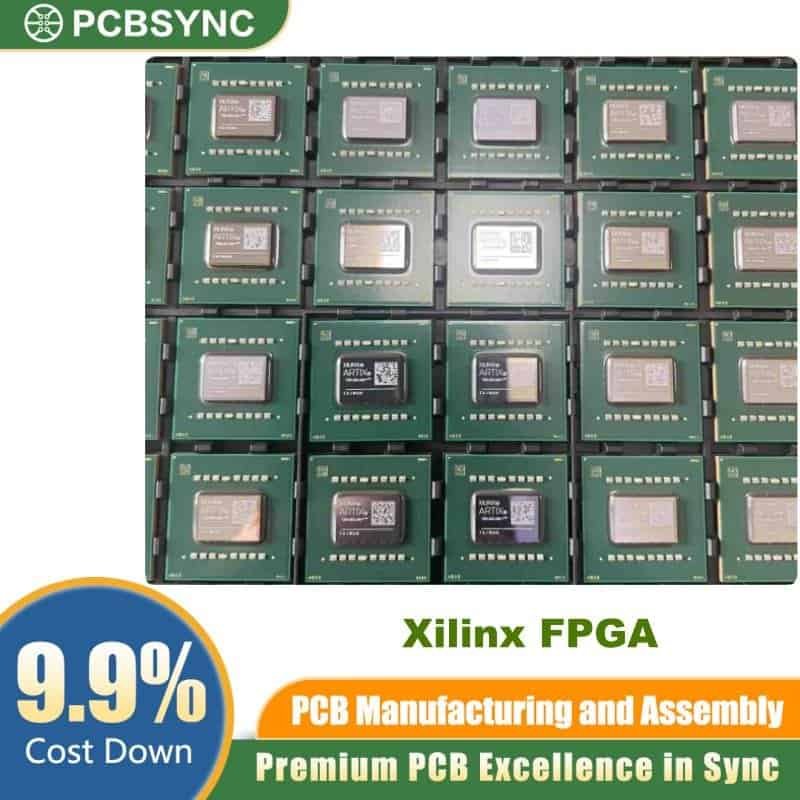
The XC2S200-6FGG1015C is a high-performance, cost-effective Field Programmable Gate Array (FPGA) manufactured by Xilinx (now AMD), part of the renowned Spartan-II family. With 200,000 system gates, a 1015-ball Fine-Pitch BGA (FBGA) package, and a commercial-grade -6 speed rating, this FPGA is engineered to deliver reliable programmable logic performance for a wide range of embedded and digital design applications. Whether you are designing communication systems, industrial control units, or signal processing hardware, the XC2S200-6FGG1015C offers the flexibility and gate density needed to bring your design to life.
What Is the XC2S200-6FGG1015C? Understanding the Part Number
Before diving into specifications, it helps to decode the part number itself:
| Code Segment |
Meaning |
| XC2S200 |
Xilinx Spartan-II, 200K system gates |
| -6 |
Speed Grade 6 (fastest available; commercial range only) |
| FGG |
Fine-Pitch BGA package, Pb-free (RoHS-compliant “G”) |
| 1015 |
1015-pin ball count |
| C |
Commercial temperature range (0°C to +85°C) |
The “G” in FGG denotes a Pb-free, RoHS-compliant package — an important distinction for designs targeting environmental compliance standards in the EU and other regulated markets.
XC2S200-6FGG1015C Key Specifications at a Glance
| Parameter |
Value |
| Manufacturer |
Xilinx (AMD) |
| Product Family |
Spartan-II |
| Part Number |
XC2S200-6FGG1015C |
| System Gates |
200,000 |
| Logic Cells |
5,292 |
| CLB Array |
28 × 42 |
| Total CLBs |
1,176 |
| Maximum User I/O |
284 |
| Distributed RAM Bits |
75,264 |
| Block RAM Bits |
56K |
| Package Type |
Fine-Pitch BGA (FGG) – Pb-free |
| Pin Count |
1015 |
| Speed Grade |
-6 (fastest in family) |
| Operating Voltage |
2.5V (VCCINT) |
| Temperature Range |
Commercial (0°C to +85°C) |
| Technology Node |
0.18µm |
| Configuration Bits |
1,335,840 |
XC2S200-6FGG1015C Core Architecture and Features
Configurable Logic Blocks (CLBs)
The XC2S200 features a 28 × 42 CLB array totaling 1,176 CLBs. Each CLB contains four logic cells organized into two slices, with each slice incorporating two function generators (look-up tables), two storage elements, and carry and control logic. This structure makes the device highly efficient for arithmetic operations, memory addressing, and complex logic functions.
Block RAM and Distributed Memory
One of the key differentiators of the XC2S200 is its generous on-chip memory architecture:
| Memory Type |
Total Capacity |
| Distributed RAM |
75,264 bits |
| Block RAM |
56K bits (56,000 bits) |
| Total On-Chip Memory |
~131K bits |
Two columns of dedicated Block RAM are placed symmetrically on opposite sides of the die, providing high-bandwidth, dual-port memory access without consuming CLB resources.
Input/Output Blocks (IOBs)
The XC2S200-6FGG1015C provides up to 284 user-configurable I/O pins, not counting the four dedicated global clock/user input pins. Each IOB supports:
- Programmable input delay (eliminates hold-time violations)
- 3.3V PCI-compliant I/O
- Multiple I/O standards including LVTTL, LVCMOS, PCI, GTL, SSTL, and more
- Slew rate and drive strength control
Delay-Locked Loops (DLLs)
The device includes four Delay-Locked Loops (DLLs), one at each corner of the die. DLLs enable:
- Zero-propagation-delay clock distribution
- Clock phase shifting and frequency synthesis
- Duty-cycle correction for clock signals
This makes the XC2S200-6FGG1015C especially suited for clocking-intensive applications and high-speed synchronous designs.
Configuration Modes Supported
The XC2S200-6FGG1015C supports multiple configuration modes, providing flexibility in how the device is programmed during system startup:
| Configuration Mode |
CCLK Direction |
Data Width |
Serial DOUT |
| Master Serial |
Output |
1-bit |
Yes |
| Slave Serial |
Input |
1-bit |
Yes |
| Slave Parallel |
Input |
8-bit |
No |
| Boundary-Scan (JTAG) |
N/A |
1-bit |
No |
All I/O drivers remain in a high-impedance state during power-on and throughout the configuration process, ensuring safe operation during system initialization.
Speed Grade -6: Why It Matters
The -6 speed grade is the fastest speed grade available in the Spartan-II family and is exclusively available in the commercial temperature range. A higher speed grade indicates lower propagation delays across logic paths, enabling:
- Higher maximum operating frequencies
- Tighter setup and hold time margins
- Superior performance in time-critical signal paths
For engineers designing high-throughput data pipelines, fast communication interfaces, or real-time processing systems, the -6 grade provides the performance headroom needed to close timing with ease.
XC2S200 Spartan-II Family Comparison
To give context on where the XC2S200 sits within the Spartan-II family:
| Device |
Logic Cells |
System Gates |
CLB Array |
Max User I/O |
Block RAM |
| XC2S15 |
432 |
15,000 |
8×12 |
86 |
16K |
| XC2S30 |
972 |
30,000 |
12×18 |
92 |
24K |
| XC2S50 |
1,728 |
50,000 |
16×24 |
176 |
32K |
| XC2S100 |
2,700 |
100,000 |
20×30 |
176 |
40K |
| XC2S150 |
3,888 |
150,000 |
24×36 |
260 |
48K |
| XC2S200 |
5,292 |
200,000 |
28×42 |
284 |
56K |
The XC2S200 is the largest and most capable device in the Spartan-II family, making it the ideal choice for applications demanding maximum logic capacity within the Spartan-II platform.
XC2S200-6FGG1015C Applications
Thanks to its large gate count, rich I/O complement, and high-speed -6 grade, the XC2S200-6FGG1015C is widely used across several industries:
#### Industrial Automation
Real-time sensor processing, motor control, and machine vision systems benefit from the FPGA’s parallel processing capability and flexible I/O.
#### Telecommunications and Networking
The on-chip DLLs and wide I/O bus support high-speed serial and parallel communication protocols including UART, SPI, I2C, and custom interfaces.
#### Digital Signal Processing (DSP)
The distributed RAM and CLB resources allow efficient implementation of FIR/IIR filters, FFT engines, and digital modulators/demodulators.
#### Embedded Systems and SoC Prototyping
Designers use the XC2S200-6FGG1015C to prototype complex SoC designs, soft-processor implementations (MicroBlaze-compatible), and co-processing accelerators.
#### Test and Measurement
The large I/O count and configurable logic make it ideal for logic analyzers, protocol testing, and hardware emulation platforms.
Why Choose the XC2S200-6FGG1015C Over Mask-Programmed ASICs?
The Spartan-II family, including the XC2S200-6FGG1015C, was designed by Xilinx as a superior alternative to mask-programmed ASICs. Key advantages include:
| Factor |
ASIC |
XC2S200-6FGG1015C FPGA |
| NRE Cost |
Very high |
None |
| Design Cycle |
Months |
Days to weeks |
| Field Upgradability |
Not possible |
Yes, in-system reprogrammable |
| Risk |
High (respin cost) |
Low (iterate freely) |
| Volume Flexibility |
High volume only |
Any volume |
The ability to reprogram the device in the field without hardware replacement makes the XC2S200-6FGG1015C especially valuable in products that require firmware updates or feature additions post-deployment.
Pb-Free and RoHS Compliance
The FGG package designation confirms this is a Pb-free (lead-free) package, making the XC2S200-6FGG1015C compliant with the EU RoHS Directive. This is critical for products sold in the European Union and other markets with strict environmental regulations on hazardous substances in electronic components.
Ordering Information and Availability
When sourcing the XC2S200-6FGG1015C, confirm the following identifiers with your distributor:
| Field |
Value |
| Full Part Number |
XC2S200-6FGG1015C |
| Manufacturer |
Xilinx / AMD |
| Package |
1015-ball Fine-Pitch BGA (Pb-free) |
| Speed Grade |
-6 (Commercial) |
| Temperature Range |
0°C to +85°C |
| RoHS Status |
Compliant (Pb-free) |
This component may also be sourced through authorized distributors such as Digi-Key, Mouser, and Arrow Electronics. Always verify authenticity when purchasing from the secondary market.
Frequently Asked Questions (FAQ)
Q: What is the difference between XC2S200-6FGG1015C and XC2S200-5FGG1015C?
A: The main difference is the speed grade. The -6 grade offers faster propagation delays and higher operating frequency than the -5 grade, and is available in the commercial temperature range only.
Q: Is the XC2S200-6FGG1015C still in production?
A: The Spartan-II family has reached end-of-life status with Xilinx/AMD. Units are available through authorized distributors and reputable component brokers. Always verify your source.
Q: What software tools does Xilinx support for programming this device?
A: Xilinx ISE Design Suite supports the Spartan-II family for design entry, synthesis, place-and-route, and bitstream generation. Note that Vivado does not support legacy Spartan-II devices.
Q: Can the XC2S200-6FGG1015C be configured via JTAG?
A: Yes. The device supports Boundary-Scan (JTAG) configuration mode, allowing programming through the standard JTAG interface.
Q: What are common replacement or alternative parts?
A: Designers migrating from Spartan-II may consider Xilinx Spartan-3 or Spartan-6 families for newer designs. For drop-in replacements within the same family, review XC2S150-6FGG456C for a lower gate count option.
Conclusion: Is the XC2S200-6FGG1015C Right for Your Design?
The XC2S200-6FGG1015C remains a capable and widely deployed FPGA for embedded, industrial, and communication applications. Its 200K system gates, 284 user I/Os, 56K Block RAM, and -6 speed grade in a 1015-ball Pb-free BGA package make it one of the most feature-rich devices in the Spartan-II lineup. If you are maintaining legacy hardware, prototyping a new digital system, or need a cost-effective programmable logic solution, this device deserves a close look.
For a broader overview of Xilinx programmable logic solutions and to explore the full range of available FPGA families, visit Xilinx FPGA for comprehensive product guides and sourcing support.