Inquire: Call 0086-755-23203480, or reach out via the form below/your sales contact to discuss our design, manufacturing, and assembly capabilities.
Quote: Email your PCB files to Sales@pcbsync.com (Preferred for large files) or submit online. We will contact you promptly. Please ensure your email is correct.
Notes: For PCB fabrication, we require PCB design file in Gerber RS-274X format (most preferred), *.PCB/DDB (Protel, inform your program version) format or *.BRD (Eagle) format. For PCB assembly, we require PCB design file in above mentioned format, drilling file and BOM. Click to download BOM template To avoid file missing, please include all files into one folder and compress it into .zip or .rar format.
After designing PCBs for robotic systems over the past decade, I’ve integrated hundreds of servo motors across various projects. The MG996R servo stands out as one of the most reliable high-torque solutions for Arduino applications. Whether you’re building a robotic arm, developing automated mechanisms, or creating precision positioning systems, understanding how to properly implement this servo can make the difference between a successful project and hours of troubleshooting.
The MG996R has earned its reputation in the maker community not just for its impressive 11 kg·cm torque output, but for its metal gear construction and reliable performance under demanding loads. In this guide, I’ll share practical insights from real-world implementations, including power supply design, control strategies, and common pitfalls that can compromise your project.
The MG996R represents an evolution from its predecessor, the MG995. From a hardware design perspective, several key improvements make this servo particularly suitable for heavy-duty applications. The redesigned PCB features improved IC control systems that deliver better accuracy and dead bandwidth performance.
The metal gear train is the defining feature of this servo. Unlike plastic-geared alternatives like the SG90, the MG996R’s all-metal gearing handles sustained torque without the wear issues that plague cheaper servos. This becomes critical in continuous-duty applications like robotic joints or automated positioning systems.
Internal Components Breakdown:
The servo contains a DC motor coupled to a gear reduction system, typically with a reduction ratio around 300:1. This high ratio converts the motor’s high-speed, low-torque output into the slow, high-torque movement needed for robotics. The internal potentiometer provides position feedback, enabling the closed-loop control that makes servos so precise.
Technical Specifications Table
Specification
MG996R Value
Engineering Notes
Operating Voltage
4.8V – 7.2V
Optimal performance at 6V
Stall Torque
9.4 kg·cm @ 4.8V<br>11 kg·cm @ 6V
Maximum load capacity
Operating Speed
0.17 sec/60° @ 4.8V<br>0.14 sec/60° @ 6V
Faster at higher voltage
Rotation Range
~180° (120° typical)
Mechanical stop limits
Operating Current
500mA – 900mA
Load-dependent
Stall Current
2.5A @ 6V
Critical for power supply design
Dead Band
5 µs
Excellent positioning accuracy
Weight
55g
Consider in mobile applications
Dimensions
40.7 × 19.7 × 42.9 mm
Standard servo mounting
Gear Material
Full Metal
High durability
Bearing Type
Dual Ball Bearing
Reduced friction, longer life
Temperature Range
-30°C to +60°C
Standard operating conditions
Why Metal Gears Matter
In my experience testing servos on continuous-duty robotic arms, plastic-geared servos typically fail within 50-100 hours of operation under moderate load. The MG996R’s metal gears handle the same workload for 500+ hours before showing measurable performance degradation. This makes the slightly higher upfront cost worthwhile for any serious application.
The dual ball bearing design reduces friction and wear on the output shaft. This becomes particularly important when side loads are present, such as in gripper mechanisms or pan-tilt assemblies where the load isn’t perfectly aligned with the shaft axis.
MG996R Servo Arduino Pinout and Connections
Wire Configuration and Standards
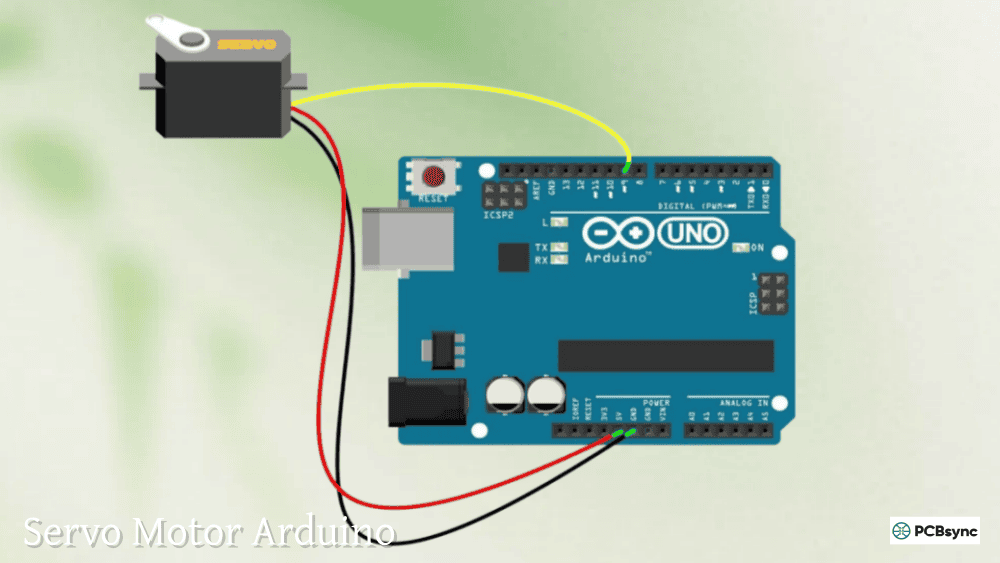
The MG996R follows the standard three-wire servo interface, though wire colors may vary between manufacturers. Understanding the correct connections is critical for both functionality and safety.
Critical Connection Rule: The ground connections must be common between the Arduino and the external power supply. This shared ground reference is essential for proper PWM signal interpretation. Many servo failures I’ve debugged trace back to floating ground connections.
Power Supply Requirements and Design
This is where many Arduino MG996R servo projects fail. The servo’s 2.5A stall current exceeds the Arduino’s 5V regulator capability by a factor of five. Attempting to power the MG996R directly from Arduino’s 5V pin will cause:
Arduino board resets due to voltage drops
Erratic servo behavior and jittering
Potential damage to Arduino’s voltage regulator
USB port overcurrent protection triggering
Proper Power Architecture:
For single servo applications:
Use a dedicated 5-6V power supply rated for at least 3A
Connect servo power directly to external supply
Connect Arduino and servo grounds together
Power Arduino separately (USB or VIN)
For multiple servos:
Calculate total current: Number of servos × 1.5A (safety margin)
Use switching power supply with adequate rating
Consider voltage drop in wiring (use 18-20 AWG wire for power)
Add 1000µF capacitor across power rails near servos
When designing custom boards with integrated MG996R control:
Separate analog and digital grounds, join at single point
Route power traces as wide as possible (50+ mil for 2A)
Place bulk capacitors (1000µF) close to servo connectors
Add TVS diodes across motor terminals for back-EMF protection
Use screw terminals or high-current connectors for power
Programming MG996R Servo Arduino Projects
Essential Software Libraries
The Arduino Servo library provides straightforward control but understanding its limitations helps avoid common issues.
Standard Servo Library:
#include <Servo.h>
This built-in library supports up to 12 servo objects on most Arduino boards (48 on Mega). It generates standard 50Hz PWM signals with pulse widths from 544µs to 2400µs by default.
Library Limitations to Know:
Disables PWM on pins 9 and 10 (on Uno)
Can interfere with tone() function
Limited to integer degree values
Default pulse width may not use full servo range
Basic Control Code
Here’s production-ready code with proper initialization:
#include <Servo.h>
Servo armServo; // Create servo object
const int servoPin = 9;
void setup() {
Serial.begin(9600);
armServo.attach(servoPin);
// Move to neutral position on startup
armServo.write(90);
delay(500); // Allow servo to reach position
Serial.println(“MG996R Servo Ready”);
}
void loop() {
// Sweep through range slowly
for(int angle = 0; angle <= 180; angle += 1) {
armServo.write(angle);
delay(20); // Smooth movement
}
delay(1000);
// Return to start
for(int angle = 180; angle >= 0; angle -= 1) {
armServo.write(angle);
delay(20);
}
delay(1000);
}
Advanced Control Techniques
Calibration for Maximum Range:
The MG996R often has a usable range beyond the default library settings. You can extend this with writeMicroseconds():
void setup() {
armServo.attach(servoPin, 500, 2500); // Extended pulse range
}
void loop() {
armServo.writeMicroseconds(1000); // Near minimum position
delay(1000);
armServo.writeMicroseconds(2000); // Near maximum position
delay(1000);
}
Smooth Acceleration Control:
Sudden position changes stress the gears and draw peak current. This code implements smooth motion:
void moveServoSmooth(int targetAngle, int moveTime) {
Position Mapping: 1500µs = center (90°), 1000µs = 0°, 2000µs = 180°
The internal control circuitry compares the pulse width to the potentiometer feedback. When they don’t match, the error amplifier drives the motor until equilibrium is reached.
The MG996R is the workhorse of DIY robotic arms. I’ve used them extensively in 4-6 DOF (Degrees of Freedom) arm designs.
Typical Robotic Arm Configuration:
Joint Position
Servo Load
Recommended Voltage
Notes
Base Rotation
Highest
6V
Supports entire arm weight
Shoulder
High
6V
Lifts forearm and gripper
Elbow
Medium
5-6V
Supports forearm only
Wrist Rotation
Low
5V
Minimal load
Gripper
Medium
6V
Needs torque for grip force
Power Budget Example (5-servo arm):
Base servo (continuous holding): 800mA
Shoulder servo (loaded): 1.2A
Elbow servo: 600mA
Wrist servo: 400mA
Gripper servo: 700mA
Total Draw: 3.7A typical, 12.5A peak (all stalled)
Recommended Supply: 6V, 15A
Automated Camera Pan-Tilt Systems
For camera tracking systems, the MG996R provides sufficient torque for DSLR cameras up to 1kg.
// Camera pan-tilt control with joystick input
Servo panServo;
Servo tiltServo;
const int joyXPin = A0; // Pan control
const int joyYPin = A1; // Tilt control
void setup() {
panServo.attach(9);
tiltServo.attach(10);
// Center position
panServo.write(90);
tiltServo.write(90);
}
void loop() {
int joyX = analogRead(joyXPin);
int joyY = analogRead(joyYPin);
// Map joystick values to servo angles
int panAngle = map(joyX, 0, 1023, 0, 180);
int tiltAngle = map(joyY, 0, 1023, 45, 135); // Limited tilt range
panServo.write(panAngle);
tiltServo.write(tiltAngle);
delay(15); // Smooth response
}
Solar Panel Tracking Mechanisms
The MG996R’s torque capability makes it suitable for small solar tracking systems. The servo can handle panel sizes up to 30×40cm with proper mechanical leverage.
Design Considerations:
Use 2:1 mechanical advantage through linkages
Limit movement to daylight hours (power saving)
Implement soft limits to prevent mechanical binding
Add weatherproofing (servo is not waterproof)
RC Vehicle Steering Systems
In 1/10 scale RC vehicles, the MG996R provides steering control with enough torque for off-road use.
Steering Application Specs:
Response time: Critical for handling
Center accuracy: Affects straight-line tracking
Power consumption: Impacts battery runtime
Durability: Vibration resistance essential
Troubleshooting Common MG996R Servo Arduino Issues
Problem 1: Servo Jittering or Hunting
Symptoms: Servo constantly vibrates or oscillates around target position.
Causes and Solutions:
Cause
Solution
Implementation
Insufficient power supply
Use dedicated 3A+ supply
Add bulk capacitors (1000µF)
PWM signal noise
Add signal filtering
100Ω resistor + 0.1µF cap at servo
Mechanical binding
Check load alignment
Reduce friction, add bearings
Defective potentiometer
Replace servo
Test with known-good unit
Ground loop issues
Common ground all components
Star ground topology
Problem 2: Arduino Resets When Servo Moves
Root Cause: Voltage drop from insufficient power supply capacity.
Solutions:
Never power MG996R from Arduino’s 5V pin
Use separate regulated supply for servo power
Connect grounds between Arduino and servo supply
Add 1000µF capacitor across servo power terminals
Use shorter, thicker wires for power distribution
Problem 3: Servo Won’t Reach Full Range
Diagnosis Steps:
Test with writeMicroseconds() using extended range (500-2500µs)
Check for mechanical obstructions
Verify power supply voltage under load
Confirm signal wire connection quality
Calibration Code:
// Find servo’s actual range
void calibrateServo() {
Serial.println(“Testing servo range…”);
// Test minimum
armServo.writeMicroseconds(500);
delay(2000);
Serial.println(“Min position”);
// Test maximum
armServo.writeMicroseconds(2500);
delay(2000);
Serial.println(“Max position”);
// Center
armServo.writeMicroseconds(1500);
Serial.println(“Calibration complete”);
}
Problem 4: Overheating During Operation
Symptoms: Servo becomes hot to touch, performance degradation.
Causes:
Continuous stall condition (blocked movement)
Excessive load beyond torque rating
Prolonged operation at maximum torque
Inadequate cooling in enclosed spaces
Solutions:
Verify load doesn’t exceed 11 kg·cm specification
Implement duty cycle limits in software
Add heat sinks to servo body if in enclosure
Reduce holding torque when position maintenance not critical
Use sleep mode between movements
Comparison with Alternative Servos
Understanding how the MG996R compares helps in component selection:
Servo Model
Torque @ 6V
Speed
Current Draw
Price Range
Best Application
MG996R
11 kg·cm
0.14s/60°
2.5A stall
$8-12
General robotics
SG90
1.8 kg·cm
0.12s/60°
500mA stall
$2-4
Light-duty positioning
MG995
10 kg·cm
0.16s/60°
2.5A stall
$7-10
Cost-effective alternative
DS3218
20 kg·cm
0.16s/60°
3A stall
$15-20
Heavy-duty applications
HS-422
4.8 kg·cm
0.21s/60°
800mA stall
$12-15
Precision applications
Essential Resources and Downloads
Official Documentation
MG996R Datasheet:
Download: Available from TowerPro official site and distributors
Arduino Servo Tester Sketch – Test servo range and functionality
Serial Monitor – Real-time position debugging
Oscilloscope/Logic Analyzer – Verify PWM signal integrity
Power Supply Calculators:
Online servo power calculators for multi-servo projects
Battery runtime estimators based on current draw
Recommended Development Boards
Board
Servo Control Pins
Power Options
Best For
Arduino Uno
12 servos max
External required
Learning, prototyping
Arduino Mega
48 servos max
External required
Multi-servo projects
Arduino Nano
12 servos max
External required
Compact designs
ESP32
16 channels
External required
IoT servo control
Additional Libraries
PWM Servo Driver (PCA9685): For controlling 16+ servos:
Adafruit PWM Servo Driver Library
Install via Arduino Library Manager. Enables I2C control of up to 16 servos with just 2 Arduino pins.
Performance Optimization Guidelines
Mechanical Design Best Practices
Lever Arm Calculations:
Torque requirements scale with distance from servo axis. The 11 kg·cm rating means:
11kg load at 1cm radius
5.5kg load at 2cm radius
2.75kg load at 4cm radius
1.1kg load at 10cm radius
Design mechanical linkages to keep load arms as short as possible while achieving required motion.
Software Optimization Strategies
Current Reduction Techniques:
// Detach servo when not actively moving
void moveToPosition(int angle) {
armServo.attach(servoPin);
armServo.write(angle);
delay(500); // Allow movement
armServo.detach(); // Reduces idle current
}
This technique saves power in battery applications but loses position holding torque.
Multiple Servo Coordination:
When controlling multiple servos, stagger movements to reduce peak current:
void moveServosSequential() {
servo1.write(90);
delay(300); // Wait for servo1 to move
servo2.write(90);
delay(300);
servo3.write(90);
}
Frequently Asked Questions
1. Can I power the MG996R directly from Arduino’s 5V pin?
No, this is not recommended and will cause problems. The MG996R draws up to 2.5A at stall, while Arduino’s 5V regulator provides only 500mA maximum. Attempting this will cause Arduino resets, erratic servo behavior, and potential damage to your board’s voltage regulator. Always use an external 5-6V power supply rated for at least 3A per servo, with grounds connected between Arduino and the external supply.
2. Why does my MG996R get hot during operation?
Servo heating is normal under load but excessive heat indicates problems. Common causes include continuous stall conditions where the servo fights against an obstruction, loads exceeding the 11 kg·cm torque specification, or prolonged operation at maximum torque. Solutions include verifying your mechanical load doesn’t exceed specifications, implementing duty cycle limits in code, ensuring the servo isn’t mechanically blocked, and adding heat dissipation if operating in enclosed spaces. Brief warmth during movement is normal, but too-hot-to-touch temperatures indicate an issue requiring attention.
3. How many MG996R servos can one Arduino control?
From a signal perspective, Arduino Uno can control up to 12 servos simultaneously using the Servo library (Arduino Mega supports 48). However, the practical limitation is power supply capacity, not signal generation. Each servo requires its own external power (not from Arduino), and you must calculate total current requirements. For example, four servos might draw 10A peak, requiring a 6V/15A power supply. The Arduino only provides PWM control signals while a separate power supply handles the high-current motor loads.
4. What’s the difference between MG996R and MG995 servos?
The MG996R is an improved version of the MG995. Key improvements include a redesigned PCB and IC control system providing better accuracy, upgraded gearing for improved dead bandwidth and centering precision, enhanced shock-proofing for durability, and slightly better torque specifications. For new projects, the MG996R offers better performance at a minimal price difference. However, the MG995 remains a viable budget alternative if the improved specifications aren’t critical for your application.
5. Can the MG996R be used for continuous rotation applications?
Standard MG996R servos are designed for 180° positional control, not continuous rotation. The internal mechanical stop prevents full 360° rotation. However, you can modify the servo for continuous rotation by removing the mechanical stop and replacing the potentiometer with fixed resistors to create a continuous rotation servo. Alternatively, purchase pre-modified continuous rotation versions. Keep in mind that modified servos lose position control and become speed-controlled motors, which changes their application from positioning (robotic joints) to driving (wheels, conveyor belts).
Conclusion
The MG996R servo Arduino combination provides an excellent platform for high-torque robotics and automation projects. Through proper power supply design, correct wiring practices, and optimized code, you can achieve reliable performance in demanding applications.
The key takeaways from my engineering experience with these servos:
Power Supply is Critical: Never compromise on power supply specifications. The difference between a 2A and 5A supply often determines project success or failure.
Mechanical Design Matters: Understanding torque-distance relationships helps you design efficient mechanisms that work within the servo’s capabilities rather than fighting against its limitations.
Software Optimization Pays Off: Implementing smooth motion control, proper timing, and intelligent power management extends servo life and improves system reliability.
Whether you’re building your first robotic arm or designing a production automation system, the MG996R offers the performance and reliability needed for serious applications. Its metal gear construction provides durability that plastic-geared alternatives simply cannot match, making it worth the modest additional cost.
For projects requiring even higher torque, consider the DS3218 (20 kg·cm) or explore DYNAMIXEL servos for precision robotics. However, for the vast majority of hobbyist and professional applications, the MG996R hits the sweet spot of performance, cost, and availability.
Remember that successful servo integration requires attention to power supply design, proper wiring techniques, and thoughtful mechanical design. Master these fundamentals with the MG996R, and you’ll have skills that transfer directly to more advanced actuator systems.
Inquire: Call 0086-755-23203480, or reach out via the form below/your sales contact to discuss our design, manufacturing, and assembly capabilities.
Quote: Email your PCB files to Sales@pcbsync.com (Preferred for large files) or submit online. We will contact you promptly. Please ensure your email is correct.
Notes: For PCB fabrication, we require PCB design file in Gerber RS-274X format (most preferred), *.PCB/DDB (Protel, inform your program version) format or *.BRD (Eagle) format. For PCB assembly, we require PCB design file in above mentioned format, drilling file and BOM. Click to download BOM template To avoid file missing, please include all files into one folder and compress it into .zip or .rar format.