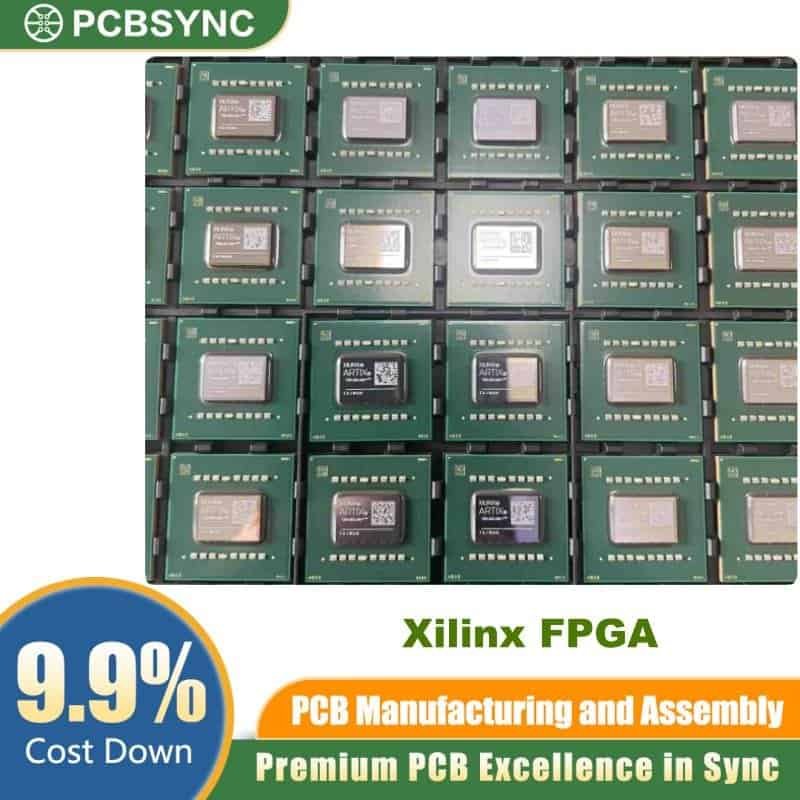
The XC2S200-6FGG1007C is a high-performance Field Programmable Gate Array (FPGA) from Xilinx’s trusted Spartan-II family. Engineered for cost-sensitive, high-volume applications, this 2.5V programmable logic device offers 200,000 system gates, 5,292 logic cells, and a fine-pitch BGA package — making it a reliable solution for digital design engineers who need flexibility without the non-recurring engineering costs of an ASIC.
Whether you are developing embedded systems, communications hardware, or industrial control logic, the XC2S200-6FGG1007C delivers the speed, density, and I/O capability to meet demanding project requirements.
What Is the XC2S200-6FGG1007C?
The part number breaks down as follows:
| Field |
Value |
Description |
| XC2S200 |
Device |
Xilinx Spartan-II, 200K system gates |
| -6 |
Speed Grade |
Fastest commercial speed grade (-6); commercial temp only |
| FGG |
Package Type |
Fine-Pitch Ball Grid Array (Pb-free variant) |
| 1007 |
Pin Count |
1007-ball BGA package |
| C |
Temperature |
Commercial temperature range (0°C to +85°C) |
This device belongs to the Spartan-II FPGA family, a product line that Xilinx designed as a superior alternative to mask-programmed ASICs — offering field re-programmability, fast time-to-market, and significant BOM cost advantages.
XC2S200-6FGG1007C Key Specifications
Core Logic Resources
| Parameter |
XC2S200 Value |
| Logic Cells |
5,292 |
| System Gates (Logic + RAM) |
200,000 |
| CLB Array |
28 × 42 |
| Total CLBs |
1,176 |
| Maximum User I/O |
284 |
| Total Distributed RAM |
75,264 bits |
| Total Block RAM |
56K bits |
Electrical & Timing Characteristics
| Parameter |
Value |
| Core Supply Voltage |
2.5V |
| I/O Supply Voltage |
2.5V (5V tolerant with series resistor) |
| Speed Grade |
-6 (fastest available) |
| Configuration Bits |
1,335,840 |
| Delay-Locked Loops (DLLs) |
4 (one per corner) |
| Operating Temperature |
0°C to +85°C (Commercial) |
Package Information
| Parameter |
Value |
| Package Type |
Fine-Pitch Ball Grid Array (FGG) |
| Pin Count |
1007 |
| Pb-Free |
Yes (“G” suffix in ordering code) |
| Mounting |
Surface Mount |
XC2S200-6FGG1007C Architecture Overview
Configurable Logic Blocks (CLBs)
The Spartan-II architecture centers around a symmetric array of Configurable Logic Blocks (CLBs). Each CLB contains four logic cells, and each logic cell includes a 4-input Look-Up Table (LUT), a storage element (flip-flop), and dedicated carry logic. The 28×42 CLB array in the XC2S200 provides ample logic density for complex digital functions, state machines, and data path designs.
Input/Output Blocks (IOBs)
The XC2S200 supports up to 284 user I/O pins (excluding the four dedicated global clock inputs). Each IOB supports:
- Programmable input delay compensation
- Optional output slew rate control (Fast/Slow)
- Configurable pull-up or pull-down resistors
- 3-state output control
- Compatibility with multiple I/O standards
Block RAM
Two columns of dedicated Block RAM are embedded on opposite sides of the die. Each block provides 4K bits of synchronous RAM, totaling 56K bits of Block RAM across the XC2S200. This is ideal for FIFO buffers, lookup tables, and local data storage without consuming CLB resources.
Delay-Locked Loops (DLLs)
Four Delay-Locked Loops, placed at each corner of the die, enable precise clock edge alignment, duty cycle correction, and clock multiplication/division. DLLs eliminate clock distribution skew, making the XC2S200-6FGG1007C well-suited for high-speed, synchronous designs.
Configuration Modes
The XC2S200-6FGG1007C supports four standard FPGA configuration modes:
| Configuration Mode |
M[2:0] |
CCLK Direction |
Data Width |
DOUT |
| Master Serial |
000 |
Output |
1-bit |
Yes |
| Slave Serial |
110 |
Input |
1-bit |
Yes |
| Slave Parallel |
010 |
Input |
8-bit |
No |
| Boundary-Scan (JTAG) |
101 |
N/A |
1-bit |
No |
During power-on and throughout configuration, all I/O pins remain in a high-impedance state, protecting connected circuitry.
XC2S200 Spartan-II Family Comparison
To help you select the right device, here is how the XC2S200 compares within the Spartan-II lineup:
| Device |
Logic Cells |
System Gates |
CLB Array |
Max User I/O |
Block RAM |
| XC2S15 |
432 |
15,000 |
8×12 |
86 |
16K |
| XC2S30 |
972 |
30,000 |
12×18 |
92 |
24K |
| XC2S50 |
1,728 |
50,000 |
16×24 |
176 |
32K |
| XC2S100 |
2,700 |
100,000 |
20×30 |
176 |
40K |
| XC2S150 |
3,888 |
150,000 |
24×36 |
260 |
48K |
| XC2S200 |
5,292 |
200,000 |
28×42 |
284 |
56K |
The XC2S200 is the largest and most capable device in the Spartan-II family, offering the highest gate count, I/O count, and memory resources.
Top Applications for the XC2S200-6FGG1007C
The XC2S200-6FGG1007C is widely used across multiple industries due to its combination of logic density, speed, and programmability:
- Embedded Processing – Soft-core processors (MicroBlaze, PicoBlaze) and co-processor acceleration
- Communications – Protocol bridging, line-rate logic, and serializer/deserializer interfaces
- Industrial Control – Motor drives, PLC replacement, and real-time sensor processing
- Consumer Electronics – Video processing, display controllers, and image capture pipelines
- Test & Measurement – Pattern generators, logic analyzers, and data acquisition front-ends
- Prototyping & ASIC Emulation – Pre-production design validation before tape-out
Advantages Over Competing Solutions
Why Choose Spartan-II Over an ASIC?
| Criterion |
Spartan-II FPGA |
Mask-Programmed ASIC |
| NRE Cost |
None |
$500K–$5M+ |
| Time-to-Market |
Days/Weeks |
6–18 months |
| Field Upgradeability |
Yes |
No |
| Minimum Order Quantity |
1 unit |
Thousands |
| Design Risk |
Low |
High |
| Unit Cost (High Volume) |
Moderate |
Lower |
Why the -6 Speed Grade?
The -6 speed grade is the fastest available for the XC2S200 and is exclusively offered in the commercial temperature range. For timing-critical paths, the -6 grade maximizes operating frequency and minimizes propagation delays across all logic and interconnect paths.
Design Tools & Software Support
The XC2S200-6FGG1007C is supported by Xilinx’s legacy ISE Design Suite, which includes:
- XST – Xilinx Synthesis Technology for RTL-to-netlist compilation
- ISE Project Navigator – Complete project management and flow integration
- ChipScope Pro – In-system debug and signal capture via JTAG
- iMPACT – JTAG-based device programming and configuration
- PACE / PlanAhead – Floorplanning and pin assignment tools
Designers working in VHDL or Verilog will find full language support within the ISE environment. Third-party synthesis tools such as Synplify Pro are also compatible.
Ordering & Availability
The XC2S200-6FGG1007C is available through authorized electronic component distributors worldwide. When sourcing this part, verify:
- Authenticity – Purchase only from authorized or reputable sources to avoid counterfeit components
- Date Code – Check the manufacturing date code to ensure freshness for production use
- RoHS Status – The “G” in “FGG” denotes the Pb-free (RoHS-compliant) package variant
- Temperature Grade – The “C” suffix confirms commercial temperature range (0°C to +85°C)
For a broad selection of Xilinx programmable logic solutions, including Spartan, Virtex, Artix, and Kintex families, visit Xilinx FPGA.
Frequently Asked Questions
What does the -6 in XC2S200-6FGG1007C mean?
The -6 refers to the speed grade. In the Spartan-II family, -6 is the fastest available speed grade and is offered exclusively for the commercial temperature range (0°C to +85°C).
Is the XC2S200-6FGG1007C RoHS compliant?
Yes. The “G” character in the package code (FGG) indicates a Pb-free, RoHS-compliant package option.
What configuration interface does this FPGA support?
The XC2S200 supports Master Serial, Slave Serial, Slave Parallel, and Boundary-Scan (JTAG) configuration modes.
How many I/O pins does the XC2S200-6FGG1007C have?
The XC2S200 supports up to 284 user I/O pins plus four dedicated global clock/user input pins.
What design software is used with this device?
The XC2S200-6FGG1007C is designed for use with the Xilinx ISE Design Suite. Vivado does not support the Spartan-II series.
Can the XC2S200 replace an ASIC?
Yes. Xilinx designed the Spartan-II family specifically as a cost-effective, re-programmable ASIC alternative, eliminating NRE costs and enabling in-field design updates.