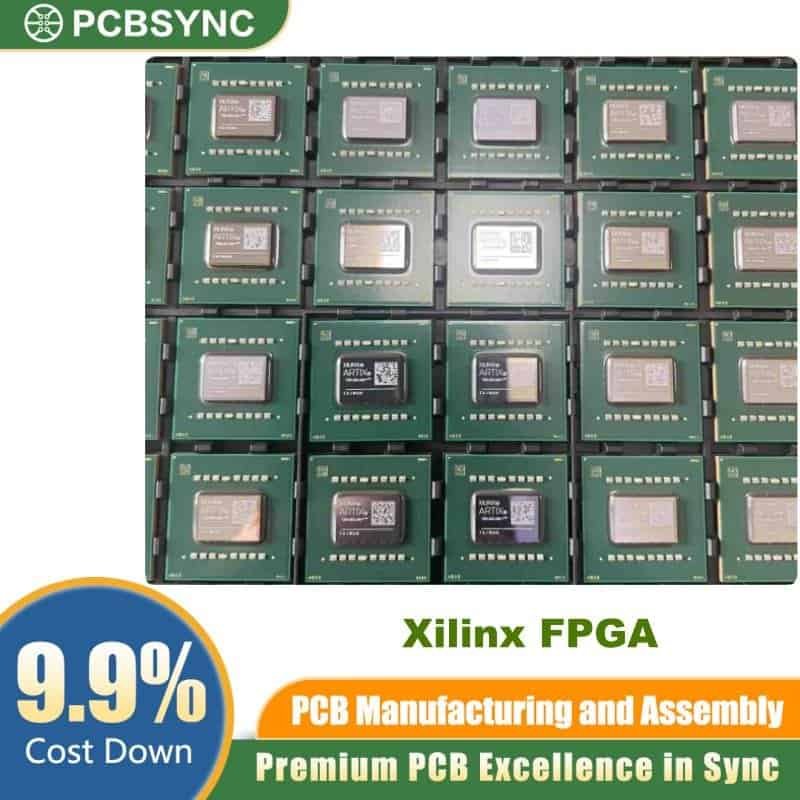
The XC2S200-6FGG1002C is a high-performance Field Programmable Gate Array from Xilinx’s Spartan-II family. Featuring 200,000 system gates, 5,292 logic cells, and housed in a 1002-ball Fine Pitch BGA (FBGA) Pb-free package, this FPGA delivers a powerful combination of logic density, I/O flexibility, and cost-effective programmability. Whether you are designing industrial control systems, embedded processors, or telecommunications equipment, the XC2S200-6FGG1002C provides a reliable and scalable programmable logic solution.
For engineers seeking a broader portfolio of programmable logic devices, explore our full range of Xilinx FPGA products.
What Is the XC2S200-6FGG1002C?
The XC2S200-6FGG1002C is part of Xilinx’s Spartan-II 2.5V FPGA family — a product line engineered as a cost-effective alternative to mask-programmed ASICs. Unlike fixed-function ASICs, the XC2S200-6FGG1002C can be reprogrammed in the field, dramatically reducing development risk, time-to-market, and non-recurring engineering (NRE) costs.
Part Number Breakdown
Understanding the ordering code helps engineers quickly identify the exact configuration:
| Code Segment |
Meaning |
| XC2S200 |
Spartan-II family, 200K system gates |
| -6 |
Speed Grade 6 (fastest available for this family) |
| FGG |
Fine Pitch Ball Grid Array, Pb-Free (G = RoHS compliant) |
| 1002 |
1002-pin package |
| C |
Commercial temperature range (0°C to +85°C) |
XC2S200-6FGG1002C Key Specifications
Core Logic & Memory Resources
The XC2S200 is the largest device in the Spartan-II family, offering 5,292 logic cells, 200,000 system gates, a 28×42 CLB array with 1,176 total CLBs, 284 maximum user I/O pins, 75,264 bits of distributed RAM, and 56K bits of block RAM.
| Parameter |
XC2S200 Value |
| Logic Cells |
5,292 |
| System Gates (Logic + RAM) |
200,000 |
| CLB Array |
28 × 42 |
| Total CLBs |
1,176 |
| Max User I/O Pins |
284 |
| Distributed RAM |
75,264 bits |
| Block RAM |
56K bits |
| Configuration Bits |
1,335,840 |
Electrical & Performance Specifications
| Parameter |
Value |
| Core Voltage (VCCINT) |
2.5V |
| I/O Voltage (VCCO) |
2.5V / 3.3V (multi-standard) |
| Speed Grade |
-6 (Commercial only) |
| Maximum Frequency |
Up to 263 MHz |
| Process Technology |
0.18 µm |
| Temperature Range |
0°C to +85°C (Commercial) |
Package Information
| Parameter |
Value |
| Package Type |
Fine Pitch BGA (FBGA) |
| Package Code |
FGG1002 |
| Total Ball Count |
1,002 |
| RoHS Compliance |
Yes (Pb-Free, “G” in part number) |
| Moisture Sensitivity Level |
MSL 3 |
XC2S200-6FGG1002C Architecture Overview
Configurable Logic Blocks (CLBs)
The CLB array forms the core of the XC2S200-6FGG1002C. Each CLB contains four logic cells, and each logic cell includes a 4-input function generator (LUT), a carry chain for fast arithmetic, and a flip-flop. This architecture enables efficient implementation of complex combinational and sequential logic.
Input/Output Blocks (IOBs)
The XC2S200-6FGG1002C supports a wide range of single-ended and differential I/O standards, including LVCMOS, LVTTL, SSTL, and GTL+. The large 1002-ball package provides significantly more I/O connectivity than smaller package variants, making it ideal for pin-intensive designs requiring maximum interface flexibility.
Block RAM
The device includes two columns of dedicated block RAM, providing 56K bits of true dual-port synchronous memory. Block RAM is ideal for FIFOs, lookup tables, shift registers, and on-chip data buffers.
Delay-Locked Loops (DLLs)
The XC2S200 features four Delay-Locked Loops (DLLs), one placed at each corner of the die. DLLs eliminate clock distribution skew, multiply/divide clock frequencies, and phase-shift clocks for precise timing control.
Configuration Modes
The XC2S200-6FGG1002C supports multiple configuration methods to suit different system architectures:
| Configuration Mode |
CCLK Direction |
Data Width |
Serial DOUT |
| Master Serial |
Output |
1-bit |
Yes |
| Slave Serial |
Input |
1-bit |
Yes |
| Slave Parallel (SelectMAP) |
Input |
8-bit |
No |
| Boundary-Scan (JTAG) |
N/A |
1-bit |
No |
Configuration data is stored externally in a serial PROM or parallel flash memory and loaded into the device at power-up or on demand.
Spartan-II Family Comparison
The table below shows how the XC2S200 compares to other devices within the Spartan-II family, helping engineers select the right density for their design requirements:
| Device |
Logic Cells |
System Gates |
CLB Array |
Max I/O |
Block RAM |
| XC2S15 |
432 |
15,000 |
8 × 12 |
86 |
16K |
| XC2S30 |
972 |
30,000 |
12 × 18 |
92 |
24K |
| XC2S50 |
1,728 |
50,000 |
16 × 24 |
176 |
32K |
| XC2S100 |
2,700 |
100,000 |
20 × 30 |
176 |
40K |
| XC2S150 |
3,888 |
150,000 |
24 × 36 |
260 |
48K |
| XC2S200 |
5,292 |
200,000 |
28 × 42 |
284 |
56K |
The XC2S200 is the largest and most capable device in the Spartan-II family, making it the preferred choice for designs that demand maximum gate density and I/O count within this product generation.
XC2S200-6FGG1002C Package Variants Comparison
Xilinx offered the XC2S200 in multiple package options. The FGG1002 package provides the highest I/O availability:
| Part Number |
Package |
Pins |
I/O Available |
Pb-Free |
| XC2S200-6PQ208C |
PQFP |
208 |
140 |
No |
| XC2S200-6FG256C |
FBGA |
256 |
176 |
No |
| XC2S200-6FGG256C |
FBGA |
256 |
176 |
Yes |
| XC2S200-6FG456C |
FBGA |
456 |
284 |
No |
| XC2S200-6FGG456C |
FBGA |
456 |
284 |
Yes |
| XC2S200-6FGG1002C |
FBGA |
1002 |
284 |
Yes |
Note: The FGG1002 package offers improved board routing flexibility and thermal performance over smaller ball-count packages due to its larger footprint and reduced ball pitch congestion.
Typical Applications for XC2S200-6FGG1002C
The XC2S200-6FGG1002C is well-suited for a broad spectrum of applications:
Industrial Automation
Motor control, programmable logic controllers (PLCs), sensor data acquisition, and real-time process monitoring benefit from the device’s deterministic timing and flexible I/O capabilities.
Telecommunications & Networking
The XC2S200-6FGG1002C handles high-speed data path processing, protocol bridging, and line-card control functions in switches, routers, and access equipment.
Embedded Systems & SoC Prototyping
Designers use the XC2S200-6FGG1002C to prototype soft-core processor systems (such as Xilinx’s PicoBlaze), accelerate algorithm development, and validate SoC architectures before taping out silicon.
Consumer Electronics & Video Processing
With ample CLB resources and block RAM, the device supports pixel-pipeline implementations, display controllers, and image processing engines.
Automotive Electronics (Legacy Designs)
Where legacy design support is required, the XC2S200-6FGG1002C continues to serve in automotive body control modules and gateway ECUs.
Design Tools & Software Support
Xilinx ISE Design Suite
The XC2S200-6FGG1002C is supported by Xilinx ISE (Integrated Software Environment), which provides synthesis, place-and-route, timing analysis, and bitstream generation. ISE is the recommended tool for all Spartan-II FPGA designs.
Third-Party Synthesis Tools
The device is also compatible with leading third-party EDA tools including Synplify Pro (Synopsys) and Precision RTL (Mentor Graphics) for HDL synthesis.
Simulation
Simulation models are available in VHDL and Verilog to support functional and timing verification in simulation environments such as ModelSim and Vivado Simulator.
Ordering & Compliance Information
Regulatory Compliance
| Standard |
Status |
| RoHS Directive (2011/65/EU) |
Compliant (Pb-Free package) |
| REACH Regulation |
Compliant |
| ECCN Classification |
3A001.a.2 |
| HTS Code |
8542.39.0001 |
Recommended Handling
- ESD Sensitivity: JEDEC Class 2 — handle at an ESD-protected workstation
- Moisture Sensitivity: MSL 3 — bake before use if storage conditions have been exceeded
- Storage: Dry bag with desiccant, sealed at ≤30°C / 60% RH
Frequently Asked Questions (FAQ)
What is the difference between XC2S200-6FGG1002C and XC2S200-6FGG456C?
Both parts are identical in logic density and electrical performance. The primary difference is the package: the FGG1002 has 1,002 solder balls versus 456, offering a larger PCB footprint that can ease routing for high-pin-count board designs.
Is the XC2S200-6FGG1002C still in production?
The Spartan-II family has reached end-of-life status. Engineers designing new systems should consider migrating to more recent Xilinx (AMD) FPGA families such as Spartan-7 or Artix-7. However, the XC2S200-6FGG1002C remains available through authorized distributors and component brokers for legacy system support and production continuity.
What speed grade options are available for the XC2S200?
The XC2S200 is available in -5 and -6 speed grades. The -6 speed grade is the fastest and is exclusively available in the Commercial temperature range (0°C to +85°C).
Can I use Vivado to program the XC2S200-6FGG1002C?
No. The Spartan-II family is not supported in Xilinx Vivado Design Suite. Use Xilinx ISE 14.7 (the final ISE release) for all XC2S200 device programming and design implementation.