Inquire: Call 0086-755-23203480, or reach out via the form below/your sales contact to discuss our design, manufacturing, and assembly capabilities.
Quote: Email your PCB files to Sales@pcbsync.com (Preferred for large files) or submit online. We will contact you promptly. Please ensure your email is correct.
Notes: For PCB fabrication, we require PCB design file in Gerber RS-274X format (most preferred), *.PCB/DDB (Protel, inform your program version) format or *.BRD (Eagle) format. For PCB assembly, we require PCB design file in above mentioned format, drilling file and BOM. Click to download BOM template To avoid file missing, please include all files into one folder and compress it into .zip or .rar format.
If you’ve ever finished an Arduino project and thought “this is great, but I really don’t need all this extra hardware,” you’re not alone. The ATmega328P microcontroller that powers the Arduino Uno can run perfectly fine on its own with just a handful of external components. After designing custom PCBs for years, I can tell you that moving from a full Arduino board to a standalone ATmega328P saves space, reduces power consumption, and drops your per-unit cost significantly.
This guide walks you through everything you need to know about running the ATmega328P independently, from understanding the minimum circuit requirements to programming the chip without an Arduino board attached.
The Arduino Uno is fantastic for prototyping, but when you’re ready to make your project permanent, carrying along all that extra hardware becomes impractical. Here’s what you gain by going standalone:
Cost Reduction: An official Arduino Uno costs over $20, while a standalone ATmega328P-PU chip runs about $2-3. For production projects or when you need multiple units, this difference adds up quickly.
Size Optimization: The ATmega328P in its DIP-28 package measures roughly 35mm x 10mm. Compare that to the Arduino Uno’s 68mm x 53mm footprint. You’re looking at about a 90% reduction in board space.
Power Efficiency: Without the USB interface chip, voltage regulators, and LEDs constantly drawing current, a standalone ATmega328P can achieve deep sleep currents in the microamp range. Battery-powered projects benefit enormously.
Design Flexibility: You control every aspect of the circuit. Need a different crystal frequency? Different power supply arrangement? No problem. You’re not locked into Arduino’s design choices.
ATmega328P Technical Specifications
Before building your standalone circuit, let’s review what you’re working with. The ATmega328P is an 8-bit AVR RISC-based microcontroller from Microchip (formerly Atmel).
ATmega328P Core Specifications Table
Specification
Value
Architecture
8-bit AVR RISC
Flash Memory
32 KB (0.5 KB bootloader)
SRAM
2 KB
EEPROM
1 KB
Clock Speed
Up to 20 MHz
Operating Voltage
1.8V – 5.5V
GPIO Pins
23
ADC Channels
6 (10-bit resolution)
PWM Channels
6
Timers
3 (two 8-bit, one 16-bit)
Communication
USART, SPI, I2C
Package Options
28-pin PDIP, 32-pin TQFP/QFN
The ATmega328P runs up to 20 MHz at 5V, though the Arduino Uno uses it at 16 MHz. Interestingly, when operating at lower voltages (1.8V-2.7V), the maximum reliable clock speed drops to 4 MHz. This voltage-frequency relationship is crucial for battery-powered designs.
ATmega328P Pinout for Standalone Operation
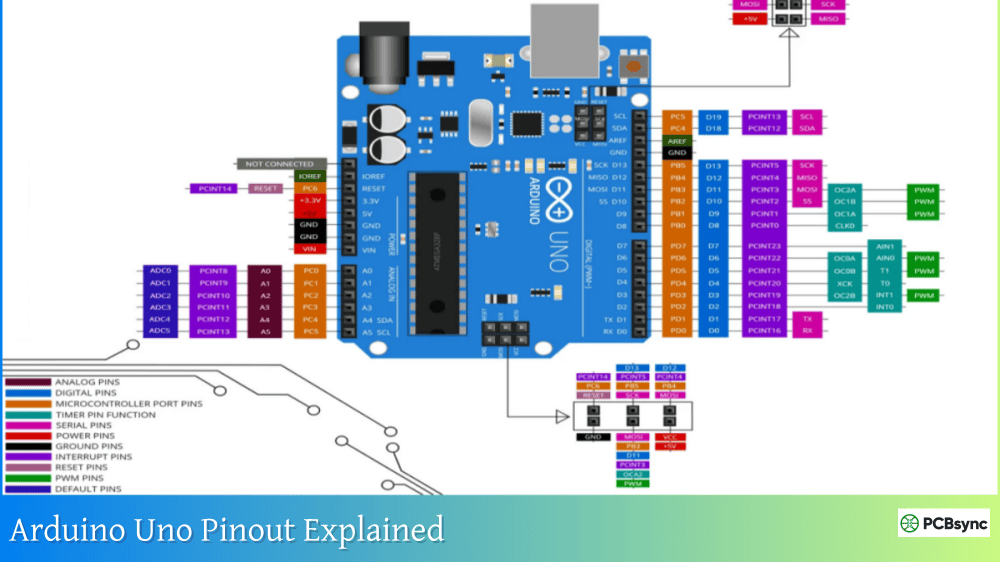
Understanding the pinout is essential for building your circuit. The ATmega328P-PU (DIP-28 package) is the most common choice for breadboard prototyping and through-hole PCB designs.
ATmega328P Pin Functions Table
Pin
Name
Function
Arduino Pin
1
PC6/RESET
Reset (active low)
Reset
2
PD0/RXD
UART Receive
D0
3
PD1/TXD
UART Transmit
D1
4
PD2/INT0
External Interrupt 0
D2
5
PD3/INT1/OC2B
External Interrupt 1, PWM
D3
6
PD4/T0
Timer 0 External Clock
D4
7
VCC
Power Supply (+)
–
8
GND
Ground
–
9
PB6/XTAL1
Crystal Oscillator
–
10
PB7/XTAL2
Crystal Oscillator
–
11
PD5/OC0B/T1
PWM, Timer 1 External
D5
12
PD6/OC0A/AIN0
PWM, Analog Comparator
D6
13
PD7/AIN1
Analog Comparator
D7
14
PB0/ICP1/CLKO
Input Capture, Clock Out
D8
15
PB1/OC1A
PWM (16-bit)
D9
16
PB2/OC1B/SS
PWM, SPI Slave Select
D10
17
PB3/MOSI/OC2A
SPI MOSI, PWM
D11
18
PB4/MISO
SPI MISO
D12
19
PB5/SCK
SPI Clock
D13
20
AVCC
ADC Power Supply
–
21
AREF
ADC Reference
AREF
22
GND
Ground
–
23
PC0/ADC0
Analog Input 0
A0
24
PC1/ADC1
Analog Input 1
A1
25
PC2/ADC2
Analog Input 2
A2
26
PC3/ADC3
Analog Input 3
A3
27
PC4/ADC4/SDA
Analog Input 4, I2C Data
A4
28
PC5/ADC5/SCL
Analog Input 5, I2C Clock
A5
Note that the semicircular notch on the chip indicates the side where pins 1 and 28 are located. Getting this orientation wrong is a common beginner mistake that leads to confused troubleshooting sessions.
Minimum ATmega328P Circuit Requirements
The beauty of the ATmega328P is how little external circuitry it actually needs. At minimum, you need power and a clock source. Let’s build up from the absolute basics.
Essential Power Connections
Every ATmega328P circuit needs these connections:
VCC (Pin 7): Connect to your positive power supply (typically 5V or 3.3V)
GND (Pins 8 and 22): Both ground pins must be connected to ground. Yes, both.
AVCC (Pin 20): This powers the ADC and Port C pins. Connect it to VCC, ideally through a small LC filter (10µH inductor and 0.1µF capacitor) for noise-sensitive analog applications. For basic projects, connecting directly to VCC works fine.
AREF (Pin 21): The ADC reference voltage. For most applications, leave this unconnected or add a 0.1µF decoupling capacitor to ground. Don’t connect it directly to VCC unless you understand the implications.
Decoupling Capacitors
Place a 0.1µF ceramic capacitor between VCC and GND, as close to the chip as physically possible. This filters high-frequency noise and prevents the processor from glitching during rapid current changes. I typically add a 10µF electrolytic capacitor on the power rail for bulk decoupling as well.
Reset Circuit
The RESET pin (Pin 1) needs to stay high during normal operation. The ATmega328P has an internal pull-up resistor on this pin, but adding an external 10kΩ pull-up resistor to VCC is recommended for reliable operation, especially in noisy environments.
For manual reset capability, add a momentary push button between RESET and GND. When pressed, it pulls RESET low and restarts the processor.
ATmega328P Clock Source Options
The clock source determines how fast your ATmega328P runs and affects timing-sensitive operations like serial communication. You have several options:
External Crystal Oscillator (16 MHz)
This is what the Arduino Uno uses. Connect a 16 MHz crystal between XTAL1 (Pin 9) and XTAL2 (Pin 10), with two 22pF capacitors from each crystal pin to ground. This provides the most accurate and stable timing.
Internal RC Oscillator (8 MHz)
The ATmega328P has a built-in 8 MHz oscillator that requires no external components. This is my preferred choice for many standalone projects because it eliminates two components (crystal and capacitors) and simplifies the layout. The trade-off is slightly less timing accuracy (typically ±1-2%), which doesn’t matter for most applications.
Internal RC Oscillator (1 MHz Default)
Factory-fresh ATmega328P chips come configured with an internal 8 MHz oscillator divided by 8, resulting in 1 MHz operation. This is the default state before any bootloader or fuse configuration.
Clock Source Comparison Table
Clock Source
Frequency
Components Needed
Accuracy
Best For
External Crystal
16 MHz
Crystal + 2 capacitors
±0.005%
Serial comms, precise timing
External Crystal
8 MHz
Crystal + 2 capacitors
±0.005%
Lower power, precise timing
Internal RC
8 MHz
None
±1-2%
Simple projects, fewer parts
Internal RC
1 MHz (default)
None
±10%
Ultra-low power
External Clock
Any (up to 20 MHz)
Clock signal source
Varies
Synchronizing multiple chips
Understanding ATmega328P Fuse Bits
Fuse bits configure fundamental ATmega328P behavior including clock source, boot size, and brown-out detection. These settings persist through power cycles and program uploads. Getting fuses wrong can make your chip unresponsive, so understanding them is critical.
Low Fuse Byte
The low fuse byte primarily controls clock settings:
CKDIV8 (Bit 7): When programmed (0), divides the clock by 8. Default is 0 (programmed), which is why fresh chips run at 1 MHz instead of 8 MHz.
CKOUT (Bit 6): Outputs the system clock on PB0 when programmed. Usually left unprogrammed (1).
SUT1:0 (Bits 5-4): Startup time selection. Determines delay after power-on or reset before executing code.
CKSEL3:0 (Bits 3-0): Clock source selection. Values vary based on the oscillator type you’re using.
Common Fuse Settings Table
Configuration
Low Fuse
High Fuse
Extended Fuse
Arduino Uno (16 MHz external)
0xFF
0xDE
0xFD
8 MHz internal (no divide)
0xE2
0xD9
0xFF
8 MHz internal (with bootloader)
0xE2
0xDA
0xFD
16 MHz external (no bootloader)
0xFF
0xDF
0xFF
Warning: Setting incorrect fuse values can make your ATmega328P impossible to program without a high-voltage programmer. If you configure the chip to use an external clock that isn’t connected, for example, it won’t respond to programming attempts.
You have several options for getting code onto your standalone ATmega328P. Each method has its advantages depending on your setup and requirements.
Method 1: Using Arduino as ISP Programmer
This is the most accessible method if you already have an Arduino board.
Step 1: Upload the ArduinoISP sketch to your Arduino Uno. Go to File → Examples → ArduinoISP and upload it.
Step 2: Wire the connections between your Arduino and the target ATmega328P:
Arduino Pin
ATmega328P Pin
Function
10
1 (RESET)
Reset
11
17 (MOSI)
SPI MOSI
12
18 (MISO)
SPI MISO
13
19 (SCK)
SPI Clock
5V
7, 20 (VCC, AVCC)
Power
GND
8, 22 (GND)
Ground
Step 3: Add a 10µF capacitor between RESET and GND on the Arduino (not the target chip). This prevents the Arduino from resetting during programming.
Step 4: In Arduino IDE, select “Arduino as ISP” as the programmer (Tools → Programmer).
Step 5: Select the appropriate board. If using the 8 MHz internal oscillator, you need to install the breadboard configuration first.
Method 2: FTDI/USB-Serial Adapter
If your ATmega328P already has a bootloader, you can program it through serial using an FTDI adapter or similar USB-to-serial converter.
Connect TX→RX, RX→TX, and add a 0.1µF capacitor between DTR and RESET for automatic reset during programming. This mimics how the Arduino Uno programs its onboard chip.
Method 3: Dedicated ISP Programmer
Tools like the USBasp, Atmel-ICE, or AVR ISP mkII connect directly to the ATmega328P’s ISP pins. These are faster and more reliable than using an Arduino as a programmer, especially for production programming.
Burning the Bootloader to ATmega328P
If you purchased a blank ATmega328P chip, you’ll need to burn a bootloader before you can program it via serial. The bootloader is a small program that runs at startup and checks for incoming program uploads.
Step 1: Set up your Arduino as ISP as described above.
Step 2: Install the breadboard hardware configuration in Arduino IDE if using internal oscillator:
Download the breadboard package for your Arduino version
Create a “hardware” folder in your Arduino sketchbook directory
Extract the breadboard folder into the hardware folder
Restart Arduino IDE
Step 3: Select the appropriate board:
For 8 MHz internal: “ATmega328 on a breadboard (8 MHz internal clock)”
For 16 MHz external: “Arduino Uno”
Step 4: Select “Arduino as ISP” as the programmer.
Step 5: Go to Tools → Burn Bootloader.
The bootloader burning process also sets the fuse bits according to your board selection. This is important because it configures the clock source and other fundamental settings.
ATmega328P Standalone Circuit Schematic
Here’s the complete minimal circuit for a standalone ATmega328P using the 8 MHz internal oscillator:
Component List for Minimal Circuit
Component
Value
Quantity
Purpose
ATmega328P-PU
–
1
Microcontroller
Ceramic Capacitor
0.1µF
2
Decoupling
Electrolytic Capacitor
10µF
1
Bulk decoupling
Resistor
10kΩ
1
RESET pull-up
Push Button
Momentary
1
Reset switch (optional)
Additional Components for External Crystal
Component
Value
Quantity
Purpose
Crystal
16 MHz
1
Clock source
Ceramic Capacitor
22pF
2
Crystal load capacitors
The internal oscillator option is particularly attractive for simple projects. You save three components (crystal and two capacitors) and two PCB traces, while gaining more robust operation since there’s nothing external that can fail or pick up interference.
Common ATmega328P Troubleshooting Issues
After building dozens of standalone circuits, I’ve encountered these issues repeatedly:
Chip Not Responding to Programmer
Check power: Verify 5V between VCC and GND using a multimeter. A common mistake is forgetting to connect both GND pins.
Check connections: The ISP connections (MOSI, MISO, SCK, RESET) must be correct. Double-check against your pinout reference.
Check clock source: If fuses are set for external crystal but no crystal is connected, the chip won’t respond. You may need a high-voltage programmer to recover.
Code Uploads But Doesn’t Run
Verify RESET pull-up: Without proper pull-up, the chip may stay in reset or reset randomly.
Check oscillator: If using external crystal, verify both capacitors are present and correctly valued.
Confirm fuse settings: The clock source configured in fuses must match your actual hardware.
Erratic Behavior or Random Resets
Add decoupling capacitors: Insufficient decoupling causes voltage droops during high-current operations.
Check brown-out detection: If BOD is enabled at a threshold above your supply voltage, the chip will continuously reset.
Verify power supply: Inadequate power supplies sag under load, causing resets.
ATmega328P vs ATmega328 (Without “P”)
You’ll notice two variants in the market: ATmega328P and ATmega328 (no P). The “P” stands for picoPower, indicating enhanced power-saving features. More importantly, they have different device signatures:
Variant
Device Signature
Difference
ATmega328P
0x1E 0x95 0x0F
Lower power, most common
ATmega328
0x1E 0x95 0x14
Original, less efficient
The Arduino IDE expects ATmega328P. Using an ATmega328 (without P) will cause signature mismatch errors during programming. While this can be bypassed by modifying avrdude settings, I recommend simply buying the correct chip.
Useful ATmega328P Resources and Downloads
Here are the essential resources I reference regularly:
Can I use all my existing Arduino code on a standalone ATmega328P?
Yes, with minor considerations. All standard Arduino functions work identically because you’re using the same microcontroller. The main differences involve timing if you’re using a different clock speed. Code written for 16 MHz Arduino may run slower at 8 MHz internal oscillator. Functions like delay() will still work correctly since the Arduino core compensates for clock speed, but timing-critical code you wrote manually needs adjustment.
What’s the minimum voltage the ATmega328P can operate at?
The ATmega328P operates from 1.8V to 5.5V, but maximum clock speed depends on voltage. At 1.8V-2.7V, the maximum reliable speed is 4 MHz. At 2.7V-5.5V, you can run up to 10 MHz. Full 20 MHz operation requires 4.5V-5.5V. For most projects using the 8 MHz internal oscillator, anything above 2.7V works reliably.
Do I need an external crystal oscillator?
Not necessarily. The internal 8 MHz oscillator works well for most applications including LED control, sensor reading, I2C/SPI communication, and many serial communication scenarios. External crystals are important when you need precise timing (like USB communication) or when your application requires exact baud rates over long serial connections. For typical hobby projects, internal oscillator saves cost and complexity.
How do I recover an ATmega328P with wrong fuse settings?
If you configured fuses for an external clock that isn’t present, the chip becomes unresponsive to normal programming. Solutions include: providing the expected clock signal externally during programming, using a high-voltage parallel programmer (HVPP) that can reset fuses regardless of clock settings, or using the rescue clock feature of some ISP programmers like USBasp. Prevention is best—always double-check fuse settings before burning.
Can I program the ATmega328P without a bootloader?
Absolutely. Using an ISP programmer (including Arduino as ISP), you can upload code directly to the chip without any bootloader. This actually gives you an extra 512 bytes of flash memory (the space normally occupied by the bootloader) and eliminates the brief bootloader delay at startup. The trade-off is that you always need an ISP programmer to update the code—you can’t use a simple serial connection.
Final Thoughts on ATmega328P Standalone Projects
Moving from Arduino prototypes to standalone ATmega328P circuits is a natural progression for anyone serious about embedded development. The process teaches you fundamental concepts about microcontroller operation that remain hidden when using development boards.
Start simple: build a minimal circuit with the internal 8 MHz oscillator, get your programming workflow sorted out, and then add complexity as needed. Once you’ve successfully blinked an LED on a breadboard with just the bare chip, you’ll have the confidence to design custom PCBs around the ATmega328P for any project.
The ATmega328P has powered millions of Arduino projects and continues to be relevant despite newer microcontrollers entering the market. Its documentation is extensive, the community knowledge base is enormous, and the chip itself is reliable and forgiving of beginner mistakes. That makes it an excellent choice for learning standalone microcontroller design and for production projects where simplicity and cost matter.
Inquire: Call 0086-755-23203480, or reach out via the form below/your sales contact to discuss our design, manufacturing, and assembly capabilities.
Quote: Email your PCB files to Sales@pcbsync.com (Preferred for large files) or submit online. We will contact you promptly. Please ensure your email is correct.
Notes: For PCB fabrication, we require PCB design file in Gerber RS-274X format (most preferred), *.PCB/DDB (Protel, inform your program version) format or *.BRD (Eagle) format. For PCB assembly, we require PCB design file in above mentioned format, drilling file and BOM. Click to download BOM template To avoid file missing, please include all files into one folder and compress it into .zip or .rar format.