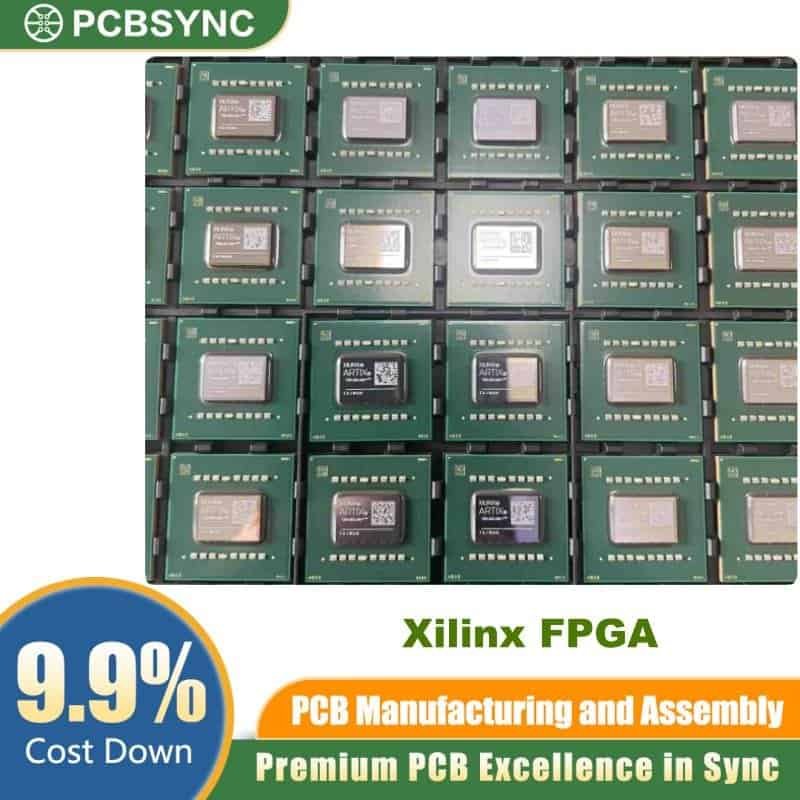
The XCV1000E-6BG560C is a high-performance Field Programmable Gate Array (FPGA) from AMD Xilinx’s Virtex-E family, engineered to deliver exceptional programmable logic capabilities for demanding digital design applications. This powerful FPGA combines advanced 0.18µm CMOS process technology with extensive logic resources, making it an ideal solution for telecommunications, industrial automation, aerospace, and high-performance computing applications.
Product Overview: XCV1000E-6BG560C FPGA Specifications
The XCV1000E-6BG560C represents a sophisticated programmable logic solution featuring 1,569,178 system gates and 404 user I/O pins in a compact 560-pin LBGA package. This Xilinx FPGA delivers robust performance with a maximum operating frequency of 357MHz, providing designers with the flexibility and processing power needed for complex digital systems.
Key Technical Specifications
| Parameter |
Specification |
Details |
| Part Number |
XCV1000E-6BG560C |
Full manufacturer part designation |
| Manufacturer |
AMD (formerly Xilinx) |
Industry-leading FPGA provider |
| FPGA Family |
Virtex-E |
1.8V Field Programmable Gate Arrays |
| System Gates |
1,569,178 gates |
Massive logic capacity |
| Logic Cells/Elements |
27,648 cells |
Advanced configurable logic blocks |
| Configurable Logic Blocks |
6,144 CLBs |
High-density programmable resources |
| User I/O Pins |
404 I/O |
Extensive connectivity options |
| RAM Bits |
393,216 bits |
Embedded memory for data storage |
| Distributed RAM |
48kB |
Fast on-chip memory resources |
| Maximum Frequency |
357MHz |
High-speed operation capability |
Package and Physical Characteristics
| Feature |
Specification |
Benefits |
| Package Type |
560-LBGA (Land Grid Ball Array) |
Compact, high-density packaging |
| Package Style |
Exposed Pad, Metal |
Enhanced thermal dissipation |
| Total Pins |
560 pins |
Comprehensive signal routing |
| Mounting Type |
Surface Mount Technology (SMT) |
Modern PCB assembly compatible |
| Pitch |
1.27mm |
Fine-pitch for high-density designs |
| RoHS Compliance |
Lead-free / RoHS Compliant |
Environmentally responsible |
Electrical Characteristics and Power Requirements
Voltage Specifications
| Supply |
Voltage Range |
Typical |
Purpose |
| Vcc (Core Supply) |
1.71V – 1.89V |
1.8V |
Internal logic operation |
| Vcco (I/O Supply) |
1.5V – 3.3V |
Variable |
I/O interface voltage |
| Operating Temperature |
0°C to +85°C (TJ) |
Commercial grade |
Standard operating conditions |
Power Management Features
The XCV1000E-6BG560C incorporates advanced power management capabilities, allowing designers to optimize power consumption while maintaining high performance. The dual voltage architecture separates core logic power (1.8V) from I/O power (1.5V-3.3V), enabling flexible interfacing with various logic families and reducing overall system power consumption.
Architecture and Performance Features
Advanced Virtex-E FPGA Architecture
The Virtex-E architecture represents an evolutionary advancement in programmable logic design, built on experience gained from previous FPGA generations. This architecture delivers:
Silicon Efficiency Optimization
- 6-layer metal 0.18µm CMOS process technology
- Optimized place-and-route efficiency
- Enhanced silicon utilization compared to previous generations
- Competitive alternative to mask-programmed gate arrays
Hierarchical Interconnect Resources
- Fast, flexible routing architecture
- Optimized signal propagation delays
- Multiple routing tracks for enhanced performance
- Dedicated clock distribution networks
Configurable Logic Blocks (CLBs)
Each of the 6,144 CLBs in the XCV1000E-6BG560C contains:
- Look-Up Tables (LUTs) for combinational logic
- Flip-flops for sequential logic elements
- Distributed RAM capability
- Flexible arithmetic carry chains
- Dedicated multiplexers for routing efficiency
Embedded Memory Architecture
| Memory Type |
Capacity |
Applications |
| Total RAM Bits |
393,216 bits |
Data buffering, FIFO, packet processing |
| Distributed RAM |
48kB |
Fast lookup tables, small buffers |
| Block RAM |
Configurable |
Large data arrays, frame buffers |
Application Areas and Use Cases
Telecommunications and Networking
The XCV1000E-6BG560C excels in telecommunications applications requiring:
- Protocol processing and conversion
- High-speed data packet routing
- Digital signal processing (DSP)
- Software-defined radio (SDR) implementations
- Base station controllers
- Network interface cards
Industrial Automation and Control
Industrial applications benefit from the FPGA’s reliability and flexibility:
- Programmable Logic Controllers (PLC) enhancement
- Machine vision processing systems
- Motion control algorithms
- Real-time data acquisition systems
- Industrial communication protocols (Profibus, EtherCAT)
- Sensor fusion and processing
Aerospace and Defense
Mission-critical applications leverage the FPGA’s performance:
- Radar signal processing
- Avionics control systems
- Secure communications
- Image processing for reconnaissance
- Navigation system implementations
- Electronic warfare systems
Medical Equipment
Healthcare technology implementations include:
- Medical imaging processing (ultrasound, MRI)
- Patient monitoring systems
- Diagnostic equipment controllers
- Waveform generation and analysis
- Real-time signal processing
Communications Equipment
The FPGA supports various communication standards:
- Wireless infrastructure base stations
- Optical transport network equipment
- 4G/LTE protocol implementation
- Digital video broadcasting
- Satellite communication systems
Programming and Configuration Options
JTAG Configuration Interface
The XCV1000E-6BG560C supports industry-standard JTAG programming:
- TDI (Test Data In): Serial data input
- TDO (Test Data Out): Serial data output
- TCK (Test Clock): JTAG clock signal
- TMS (Test Mode Select): Mode control signal
JTAG Benefits:
- In-system programmability
- Boundary scan testing capability
- Chain multiple devices for programming
- Standard interface for development tools
SelectMAP Configuration
For faster configuration times:
- Parallel data interface
- 8-bit or 16-bit data bus options
- Higher configuration throughput
- Ideal for partial reconfiguration scenarios
Configuration Memory Requirements
The bitstream size for the XCV1000E-6BG560C requires appropriate configuration memory selection for standalone operation. Designers can use:
- Platform Flash PROMs
- Serial Flash memory
- External microcontroller-based configuration
Design Tools and Software Support
Xilinx ISE Design Suite
The XCV1000E-6BG560C is fully supported by Xilinx ISE (Integrated Software Environment) Design Suite, providing:
- Synthesis tools: XST (Xilinx Synthesis Technology)
- Implementation tools: Place and route optimization
- Simulation: ModelSim integration
- Timing analysis: Static timing analyzer
- Programming: iMPACT configuration tool
Alternative Development Options
While Xilinx Vivado Design Suite focuses on newer device families, the ISE Design Suite remains the recommended toolchain for Virtex-E devices, offering:
- Comprehensive IP core libraries
- ChipScope Pro for in-system debugging
- PlanAhead for floorplanning
- EDK for embedded processor integration
Design Considerations and Best Practices
Power Supply Design
Critical Requirements:
- Separate core (Vcc) and I/O (Vcco) power planes
- Low-ESR decoupling capacitors near power pins
- Power supply sequencing (Vcc before Vcco recommended)
- Adequate current capacity for dynamic switching
Recommended Decoupling:
- 0.1µF ceramic capacitors at each power pin
- 10µF bulk capacitance per power supply
- Power plane design with minimal inductance
Thermal Management
Operating at 357MHz with 27,648 logic cells generates significant heat:
- Thermal resistance: Junction-to-ambient (θJA)
- Cooling solutions: Heat sinks, thermal vias, forced air
- Temperature monitoring: Internal temperature sensors
- Airflow requirements: Based on power consumption
Signal Integrity
High-Speed Design Guidelines:
- Controlled impedance routing for critical signals
- Proper termination strategies
- Ground plane continuity
- Via optimization for reduced inductance
- EMI/EMC compliance considerations
ESD Protection Requirements
The XCV1000E-6BG560C is sensitive to electrostatic discharge:
- Handling: Use ESD wrist straps and grounded work surfaces
- Storage: Anti-static bags with <60% humidity
- Assembly: ESD-safe tools and equipment
- PCB design: ESD protection circuits on external interfaces
Clock Distribution and Timing
Global Clock Resources
The Virtex-E architecture provides dedicated global clock networks:
- Multiple global clock buffers (BUFGMUXs)
- Low-skew clock distribution
- Clock domain crossing capabilities
- Programmable clock managers
Timing Performance
Achieving 357MHz maximum frequency requires:
- Proper constraint definition in UCF files
- Pipeline stage optimization
- Critical path analysis and optimization
- Timing closure methodology
Comparison with Alternative FPGAs
XCV1000E vs. Modern Alternatives
| Feature |
XCV1000E-6BG560C |
Modern Equivalents |
| Technology |
0.18µm |
7nm-28nm |
| Power Efficiency |
Standard |
Significantly improved |
| Logic Density |
27,648 cells |
100K+ cells available |
| DSP Resources |
Soft logic |
Hard DSP blocks |
| Memory |
393Kb |
Multi-Mb block RAM |
| Status |
Legacy/Obsolete |
Current production |
Migration Considerations
For new designs, consider:
- Spartan-7: Cost-effective alternative
- Artix-7: Enhanced performance and efficiency
- Kintex-7: Higher performance applications
- Legacy support: XCV1000E for existing design maintenance
Quality and Reliability
Product Status
Important Notice: The XCV1000E-6BG560C is classified as obsolete by AMD Xilinx and is NOT RECOMMENDED for NEW DESIGNS. This designation means:
- Limited or discontinued manufacturing
- Availability primarily through authorized distributors’ existing inventory
- Last-time-buy opportunities may be available
- No new product developments or enhancements
Warranty and Quality Assurance
Authorized distributors typically provide:
- 100% functionality testing before shipment
- 365-day warranty coverage
- Original manufacturer packaging
- Full datasheet compliance verification
- Anti-static packaging for safe transport
Compliance and Certifications
- RoHS Directive: Compliant (Lead-free)
- REACH Regulation: Compliant
- ECCN Code: EAR99 (for export control)
- Conflict Minerals: Responsibly sourced
Purchasing and Availability
Authorized Distribution Channels
The XCV1000E-6BG560C is available through:
- Authorized electronic component distributors
- Surplus and excess inventory specialists
- Independent distribution channels
- Direct manufacturer obsolete product programs
Package Options
Standard packaging includes:
- Tray packaging: Industrial standard for surface mount devices
- Anti-static protection: ESD-safe packaging materials
- Moisture sensitivity: Proper handling for moisture-sensitive devices
- Shelf life: Storage condition dependent
Lead Time Considerations
As an obsolete product:
- Stock availability varies by distributor
- No manufacturer lead time for new production
- Recommend securing long-term supply for existing designs
- Consider lifecycle management for critical applications
Technical Support Resources
Documentation
Essential design resources include:
- Datasheet: Complete electrical and timing specifications
- User Guide: Architecture and design methodology
- Application Notes: Design best practices and solutions
- Package Information: Mechanical dimensions and pinout
- Characterization Reports: Detailed performance data
Development Boards
While dedicated XCV1000E development boards are rare:
- Custom PCB design typically required
- Reference designs may be available
- Academic institutions may have legacy boards
- Consider development boards from the same family
Community Support
Resources for designers:
- Xilinx Forums: Community discussions and solutions
- Application notes: Proven design techniques
- Third-party tutorials: Educational resources
- Design examples: Reference implementations
Environmental and Storage Conditions
Optimal Storage Requirements
To maintain product integrity:
- Temperature: 15°C to 35°C ambient
- Humidity: <60% relative humidity, non-condensing
- Packaging: Original anti-static bags until use
- Shelf life: Moisture Sensitivity Level (MSL) dependent
- Handling: ESD precautions mandatory
Operating Environment
Designed for commercial temperature range:
- Junction temperature: 0°C to +85°C (TJ)
- Ambient consideration: Account for self-heating
- Altitude: Standard atmospheric pressure
- Vibration/shock: Per package specifications
Frequently Asked Questions (FAQ)
Q: Is the XCV1000E-6BG560C suitable for new designs? A: No, this device is obsolete and NOT RECOMMENDED for new designs. Modern alternatives like Spartan-7 or Artix-7 offer better performance and availability.
Q: What development tools support this FPGA? A: Xilinx ISE Design Suite (version 14.7 or earlier) is the recommended toolchain. Vivado does not support Virtex-E devices.
Q: What is the difference between XCV1000E-6BG560C and XCV1000E-7BG560C? A: The speed grade (-6 vs -7) indicates performance tiers, with -6 offering higher maximum operating frequency than -7.
Q: Can I replace this FPGA with a modern equivalent? A: Direct pin-compatible replacements are not available. Design migration to newer FPGA families requires redesign and verification.
Q: Where can I purchase the XCV1000E-6BG560C? A: Authorized distributors, surplus electronics suppliers, and independent distributors may have limited stock available.
Conclusion: XCV1000E-6BG560C FPGA Summary
The XCV1000E-6BG560C Virtex-E FPGA represents mature FPGA technology offering 27,648 logic cells, 404 I/O pins, and 357MHz performance in a 560-pin LBGA package. While classified as obsolete for new designs, it continues to serve existing applications in telecommunications, industrial control, aerospace, and medical equipment.
For legacy system maintenance and production, authorized distributors provide quality-assured stock with comprehensive testing and warranty support. Designers maintaining existing products benefit from the extensive documentation, proven reliability, and established design methodologies associated with the Virtex-E family.
Organizations with long-term XCV1000E-6BG560C requirements should evaluate inventory availability, consider last-time-buy opportunities, and develop migration strategies to current-generation FPGAs for future product development.