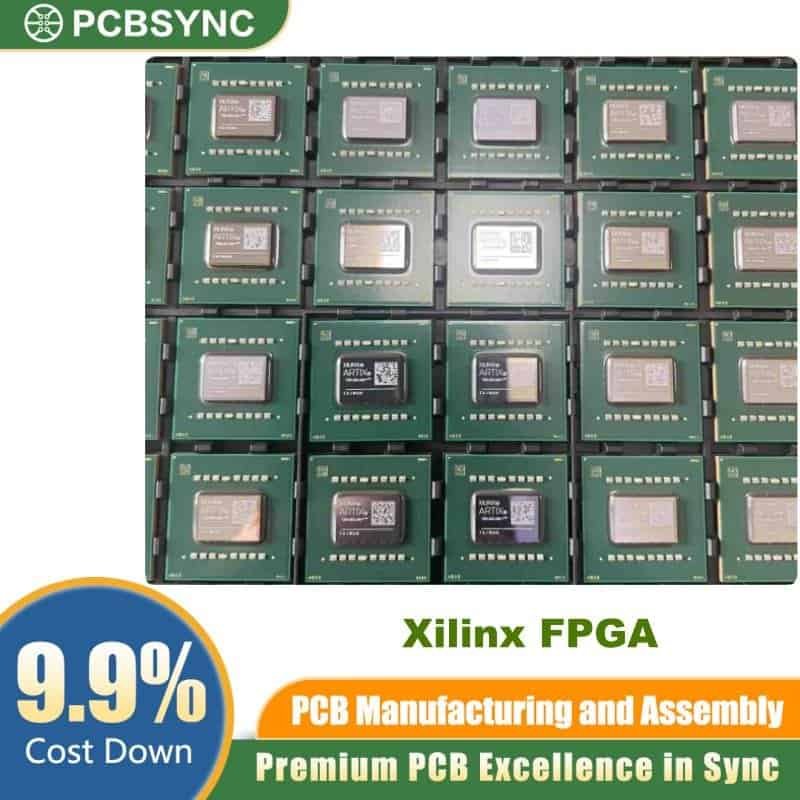
Overview of XCV100E-6FG256C Field Programmable Gate Array
The XCV100E-6FG256C is a sophisticated field-programmable gate array (FPGA) manufactured by AMD (formerly Xilinx), designed to deliver exceptional performance for complex digital logic applications. This Virtex-E series FPGA combines advanced 0.18 μm CMOS process technology with a robust architecture, making it an ideal solution for industrial automation, telecommunications, and enterprise systems.
As a member of the renowned Virtex-E family, the XCV100E-6FG256C represents a significant advancement in programmable logic technology, offering engineers and designers a powerful alternative to traditional ASIC solutions with greater flexibility and faster time-to-market.
Key Specifications and Features
Technical Specifications Table
| Parameter |
Specification |
| Part Number |
XCV100E-6FG256C |
| Manufacturer |
AMD (Xilinx) |
| Product Family |
Virtex-E |
| Package Type |
256-FBGA (Fine Pitch Ball Grid Array) |
| I/O Count |
176 User I/O Pins |
| Total Pins |
256 Pins |
| System Gates |
100,000 Gates |
| Logic Cells/Elements |
2,700 Logic Cells |
| Configurable Logic Blocks (CLBs) |
600 CLBs |
| RAM Size |
10 kB Embedded Block RAM |
| Operating Voltage |
1.8V Core Voltage |
| Speed Grade |
-6 (Industrial Grade) |
| Operating Temperature Range |
0°C to +85°C |
| Mounting Type |
Surface Mount Technology (SMT) |
| RoHS Status |
RoHS Non-Compliant |
| ECCN Code |
EAR99 |
| Product Status |
Obsolete (Legacy Support Available) |
Core Features and Capabilities
Advanced FPGA Architecture
The XCV100E-6FG256C leverages Xilinx’s proven Virtex-E architecture, featuring:
- High-density logic integration with 100,000 system gates
- Optimized place-and-route efficiency for faster design implementation
- Six-layer metal interconnect utilizing 0.18 μm CMOS process technology
- Flexible routing resources enabling complex signal distribution
- Embedded block RAM for efficient data storage and buffering
Performance Characteristics
Speed and Timing
The -6 speed grade designation indicates this FPGA offers:
- Industrial-grade performance specifications
- Optimized timing characteristics for demanding applications
- Reliable operation across the commercial temperature range
- Consistent performance in industrial environments
Logic Resources Breakdown
| Resource Type |
Quantity |
Description |
| Logic Cells |
2,700 |
Configurable logic elements for custom functions |
| CLBs (Configurable Logic Blocks) |
600 |
Primary building blocks for logic implementation |
| System Gates |
100,000 |
Equivalent gate capacity for complex designs |
| Block RAM |
10 kB |
Dedicated memory resources |
| User I/O Pins |
176 |
Available for external interfacing |
Package and Pin Configuration
256-FBGA Package Details
The XCV100E-6FG256C utilizes a 256-pin Fine Pitch Ball Grid Array (FBGA) package that provides:
- Compact footprint for space-constrained PCB designs
- Superior thermal performance through direct substrate contact
- Enhanced signal integrity with shorter interconnect paths
- Reliable solder ball connections for industrial applications
- Optimized pin-out arrangement for efficient routing
Pin Distribution
| Pin Category |
Count |
Purpose |
| User I/O |
176 |
General-purpose input/output |
| Power/Ground |
48 |
Supply voltage and ground |
| Configuration |
16 |
Device programming and setup |
| Special Function |
16 |
Clock, reset, and dedicated pins |
Application Areas
Industrial Automation and Control
The XCV100E-6FG256C excels in industrial environments:
- Programmable Logic Controllers (PLCs) for factory automation
- Motion control systems with real-time processing requirements
- Industrial networking protocols implementation
- Sensor interfacing and data acquisition systems
- Process monitoring and control applications
Enterprise and Communication Systems
Ideal for business-critical infrastructure:
- Network switching and routing equipment
- Data center infrastructure components
- Telecommunications equipment for signal processing
- Video processing and distribution systems
- High-speed data converters and interfaces
Power Delivery and Energy Management
Supporting modern power systems:
- Smart grid monitoring and control
- Power quality analyzers with real-time processing
- Renewable energy converters and inverters
- Battery management systems for energy storage
- Motor drive controllers for variable frequency applications
Design Advantages
Why Choose XCV100E-6FG256C?
Flexibility and Reconfigurability
Unlike fixed-function ASICs, this Xilinx FPGA offers:
- In-field reprogrammability for design updates and bug fixes
- Rapid prototyping capabilities to accelerate development
- Design iteration flexibility without hardware changes
- Future-proof architecture adaptable to changing requirements
- Cost-effective development for low to medium volume production
Proven Virtex-E Technology
Building on Xilinx’s industry-leading FPGA heritage:
- Mature and stable architecture with extensive documentation
- Broad third-party IP core support for faster development
- Comprehensive development tools including Vivado and ISE
- Strong community support and knowledge base
- Extensive reference designs and application notes
Development and Programming
Software Tool Support
| Tool Category |
Supported Solutions |
| Design Entry |
Xilinx ISE, Vivado (legacy), VHDL, Verilog |
| Simulation |
ModelSim, ISim, Vivado Simulator |
| Synthesis |
XST, Synplify Pro |
| Implementation |
Place & Route, Timing Analysis |
| Programming |
iMPACT, ChipScope Pro |
| Debug |
Integrated Logic Analyzer (ILA) |
Configuration Methods
The XCV100E-6FG256C supports multiple configuration approaches:
- JTAG boundary scan for in-system programming
- Master serial mode for standalone operation
- Slave serial mode for multi-device configurations
- Master parallel mode for high-speed loading
- Configuration memory support including Flash and PROM devices
Electrical Characteristics
Power Requirements
| Voltage Rail |
Nominal |
Min |
Max |
Purpose |
| VCCINT (Core) |
1.8V |
1.71V |
1.89V |
Internal logic |
| VCCO (I/O) |
2.5V/3.3V |
Variable |
Variable |
I/O banks |
| VCCAUX (Auxiliary) |
2.5V |
2.375V |
2.625V |
DLLs and auxiliary |
Power Consumption Estimates
Power consumption varies based on design utilization:
- Static power: Approximately 200-400 mW (typical)
- Dynamic power: Dependent on switching activity and clock frequency
- Total power: Design-specific, requires analysis tools for accuracy
Thermal Management
Operating Conditions
| Parameter |
Commercial Grade |
| Operating Temperature |
0°C to +85°C |
| Junction Temperature (Max) |
+100°C |
| Recommended Θ-JA |
< 35°C/W with adequate airflow |
Thermal Design Considerations
For reliable operation:
- Use adequate PCB copper planes for heat dissipation
- Implement thermal vias under the package for enhanced cooling
- Consider heatsinks or forced airflow for high-utilization designs
- Monitor junction temperature during operation
- Follow thermal design guidelines in the datasheet
Quality and Compliance
Environmental and Regulatory Status
| Standard |
Status |
| RoHS Compliance |
Non-Compliant (contains lead) |
| REACH |
Not Compliant |
| Lead-Free |
No |
| Halogen-Free |
No |
| ECCN |
EAR99 |
| HS/TARIC Code |
8542390001 |
Quality Assurance
AMD/Xilinx maintains strict quality standards:
- ISO 9001 certified manufacturing processes
- Comprehensive testing and validation procedures
- Reliability testing to industry standards
- Traceability and authenticity verification
- Extended product lifecycle support
Purchasing and Availability
Current Status and Alternatives
Important Notice: The XCV100E-6FG256C is classified as obsolete by the manufacturer. While existing inventory may be available through distributors, AMD recommends:
Recommended Migration Paths
For new designs, consider these modern alternatives:
- Artix-7 Series – Cost-optimized, lower power consumption
- Spartan-7 Series – Budget-friendly, pin-compatible options
- Kintex-7 Series – Enhanced performance and features
- Zynq-7000 Series – Integrated ARM processor for SoC applications
Where to Buy
Authorized distributors and legacy component specialists:
- DigiKey Electronics – Remaining stock availability
- Mouser Electronics – Industrial component supplier
- Authorized Xilinx/AMD distributors – Verified authentic parts
- Electronic component brokers – Last-time buy and excess inventory
Caution: When purchasing obsolete components, ensure supplier authenticity and product verification to avoid counterfeit devices.
Technical Support Resources
Documentation
Essential resources for development:
- Product Datasheet – Detailed electrical and mechanical specifications
- User Guide – Architecture overview and design guidelines
- Application Notes – Design best practices and examples
- Reference Designs – Pre-verified starting points
- Errata Documents – Known issues and workarounds
Design Tools and IP
Access comprehensive development resources:
- Xilinx ISE Design Suite (legacy tool for Virtex-E)
- ChipScope Pro for in-system debugging
- CORE Generator for IP core integration
- Timing Analyzer for performance verification
- Power Estimator for thermal planning
Comparison with Similar FPGAs
Virtex-E Family Comparison
| Part Number |
System Gates |
Logic Cells |
I/O Pins |
Package |
Speed Grade |
| XCV50E-6FG256C |
50,000 |
1,728 |
176 |
256-FBGA |
-6 |
| XCV100E-6FG256C |
100,000 |
2,700 |
176 |
256-FBGA |
-6 |
| XCV200E-6FG456C |
200,000 |
5,292 |
308 |
456-FBGA |
-6 |
| XCV300E-6FG456C |
300,000 |
8,064 |
316 |
456-FBGA |
-6 |
Design Best Practices
Optimization Tips
Maximize performance and reliability:
- Clock Management
- Use dedicated clock buffers (BUFG) for global distribution
- Implement clock domain crossing techniques properly
- Minimize clock skew through careful placement
- Resource Utilization
- Optimize logic to fit within available CLBs
- Use block RAM efficiently for data storage
- Balance I/O distribution across banks
- Signal Integrity
- Follow PCB layout guidelines for high-speed signals
- Implement proper termination for critical nets
- Minimize crosstalk through appropriate spacing
- Power Management
- Use appropriate decoupling capacitors near power pins
- Implement power sequencing as specified
- Monitor current consumption during operation
Conclusion
The XCV100E-6FG256C represents a proven solution in field-programmable gate array technology, offering 100,000 system gates in a compact 256-FBGA package. While designated as obsolete, this Xilinx Virtex-E FPGA continues to serve in legacy systems and maintenance applications across industrial automation, telecommunications, and enterprise infrastructure.
For engineers maintaining existing designs, the XCV100E-6FG256C provides reliable performance with extensive development tool support. New projects should evaluate modern FPGA families that offer enhanced features, lower power consumption, and improved performance while potentially maintaining pin compatibility for easier migration paths.
Key Takeaways
- Industrial-grade reliability with 0°C to +85°C operation
- 176 user I/O pins for extensive interfacing capabilities
- 2,700 logic cells supporting complex digital designs
- 10 kB block RAM for efficient data management
- Mature development ecosystem with comprehensive tools
- Legacy support available through authorized channels
Whether you’re maintaining existing systems or evaluating upgrade paths, understanding the XCV100E-6FG256C’s capabilities ensures informed decision-making for your programmable logic requirements.
Frequently Asked Questions
What is the difference between XCV100E-6FG256C and XCV100E-6FGG256C?
The primary difference is the package variant. The “FG” designation refers to the standard fine-pitch BGA, while “FGG” may indicate a specific package grade or qualification level. Functionally, they are equivalent in terms of logic resources and electrical characteristics.
Can I still purchase the XCV100E-6FG256C?
While the device is obsolete, remaining inventory may be available through authorized distributors, surplus component suppliers, and electronic component brokers. Always verify authenticity when purchasing obsolete components.
What programming software do I need?
The XCV100E-6FG256C requires Xilinx ISE Design Suite (legacy version), which supports the Virtex-E family. The modern Vivado Design Suite does not support this legacy device family.
Is there a pin-compatible replacement?
Direct pin-compatible replacements are limited due to the obsolete status. Contact AMD/Xilinx or authorized distributors for migration guidance to modern FPGA families with similar capabilities.
What is the typical lead time for this component?
As an obsolete product, lead times vary significantly based on remaining distributor inventory. Expect anywhere from immediate availability to extended search times for last-time buy opportunities.