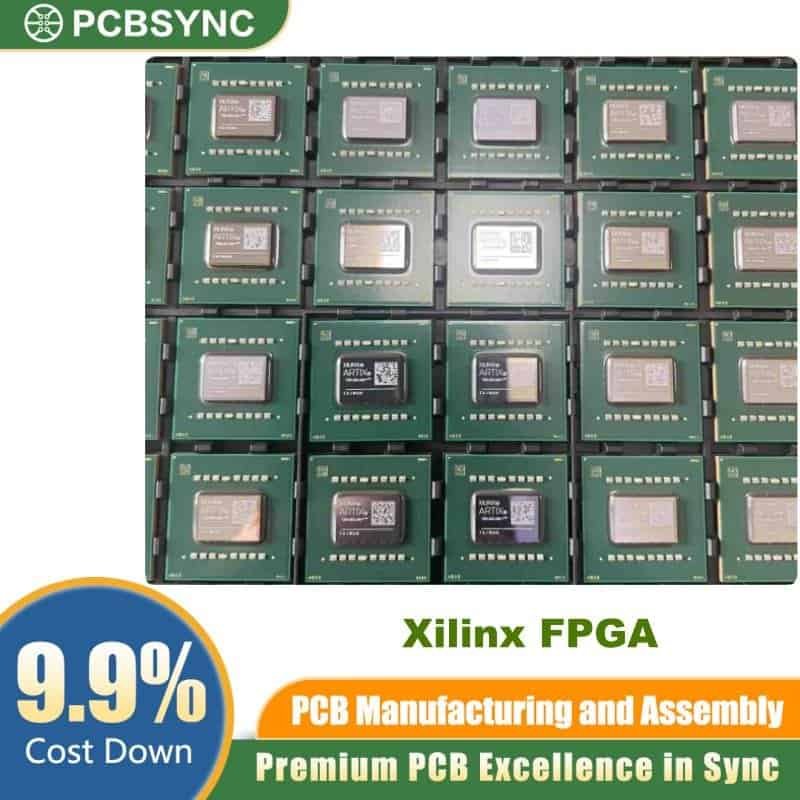
The XCV100E-6PQG240C is a high-performance Xilinx FPGA from the Virtex-E family, manufactured using advanced 0.18 µm CMOS process technology. Designed for demanding programmable logic applications, this device delivers 32,400 system gates, 2,700 logic cells, and operates at up to 357 MHz — all in a compact 240-pin PQFP (Plastic Quad Flat Pack) package. Whether you are prototyping a new embedded design or sourcing a proven legacy component, the XCV100E-6PQG240C offers the flexibility and performance that engineers rely on.
What Is the XCV100E-6PQG240C?
The XCV100E-6PQG240C belongs to Xilinx’s Virtex-E series — an evolutionary advancement over the original Virtex family. Built on a 6-layer metal, 0.18 µm CMOS process, the Virtex-E line was engineered for superior place-and-route efficiency. The “E” suffix denotes the enhanced generation, while the part number breaks down as follows:
| Part Number Segment |
Meaning |
| XCV100E |
Virtex-E family, 100K-gate equivalent |
| -6 |
Speed grade 6 (commercial) |
| PQG |
Plastic Quad Flat Pack (Green/RoHS compliant) |
| 240 |
240-pin package |
| C |
Commercial temperature range (0°C to +85°C) |
XCV100E-6PQG240C Key Specifications
Core Device Specifications
| Parameter |
Value |
| Manufacturer |
Xilinx (AMD) |
| Series |
Virtex-E |
| Part Number |
XCV100E-6PQG240C |
| Device Type |
FPGA (Field Programmable Gate Array) |
| System Gates |
32,400 |
| Logic Cells / CLBs |
2,700 cells / 600 CLBs |
| Maximum Frequency |
357 MHz |
| Core Supply Voltage |
1.8 V |
| Process Technology |
0.18 µm 6-layer metal CMOS |
| Configuration Type |
SRAM-based |
Package & Mounting Information
| Parameter |
Value |
| Package Type |
PQFP (Plastic Quad Flat Pack) |
| Package Variant |
PQG (Green/RoHS) |
| Pin Count |
240 |
| User I/O Pins |
Up to 166 |
| Mounting Type |
Surface Mount (SMD) |
| Pin Pitch |
0.5 mm |
Memory & Logic Resources
| Resource |
Quantity |
| Block RAM |
10 Kbits |
| Distributed RAM |
Available via LUTs |
| CLBs (Configurable Logic Blocks) |
600 |
| Slices |
~1,200 |
| DLLs (Delay-Locked Loops) |
4 |
Electrical & Environmental Parameters
| Parameter |
Value |
| Core Supply Voltage (VCCINT) |
1.8 V |
| I/O Supply Voltage (VCCO) |
1.5 V – 3.3 V (multi-standard) |
| Operating Temperature Range |
0°C to +85°C (Commercial) |
| ESD Protection |
Built-in |
| RoHS Compliance |
Yes (PQG variant) |
XCV100E-6PQG240C Architecture Overview
## CLB and Slice Architecture
The XCV100E-6PQG240C features a CLB-based (Configurable Logic Block) architecture that forms the backbone of its programmable logic capability. Each CLB contains four slices, and each slice includes two 4-input look-up tables (LUTs), two flip-flops, and dedicated carry logic. This architecture enables efficient implementation of combinational and sequential logic, arithmetic operations, and small distributed RAM functions.
## SelectRAM and Block RAM
The device supports two forms of on-chip memory. Distributed SelectRAM is embedded within the CLB fabric, allowing flexible memory allocation without consuming block RAM resources. The dedicated 10 Kbits of Block RAM provides synchronous, dual-port memory suitable for FIFOs, buffers, and lookup tables in signal processing applications.
## SelectI/O Technology
All I/O blocks (IOBs) in the XCV100E-6PQG240C support Xilinx SelectI/O technology, enabling compatibility with a wide range of I/O standards. Each IOB can be independently configured for voltage levels between 1.5 V and 3.3 V. Supported standards include:
| I/O Standard |
Description |
| LVTTL |
Low-Voltage TTL (3.3 V) |
| LVCMOS |
Low-Voltage CMOS (1.5 V – 3.3 V) |
| GTL / GTL+ |
Gunning Transceiver Logic |
| HSTL |
High-Speed Transceiver Logic (1.5 V) |
| SSTL2 / SSTL3 |
Stub-Series Terminated Logic |
| CTT |
Center-Tap Terminated Logic |
| PCI |
PCI bus compatible |
## Delay-Locked Loops (DLL)
Four on-chip DLLs provide clock management capabilities including clock deskewing, frequency synthesis, and phase shifting. These enable the XCV100E-6PQG240C to support zero-hold-time designs and reduce clock distribution skew across the FPGA fabric — critical for high-speed synchronous designs.
## IEEE 1149.1 Boundary Scan (JTAG)
The XCV100E-6PQG240C fully supports IEEE 1149.1 JTAG boundary scan for board-level testing and in-system programming. This simplifies PCB debug and allows configuration via JTAG without additional programming hardware.
XCV100E-6PQG240C Configuration Modes
The Virtex-E FPGA supports multiple configuration modes to suit different system designs:
| Configuration Mode |
Description |
| Master Serial |
Uses external serial PROM (most common) |
| Slave Serial |
Controlled by external microprocessor |
| Master Parallel (SelectMAP) |
Fast parallel configuration |
| Slave Parallel (SelectMAP) |
Parallel mode driven by host processor |
| JTAG / Boundary Scan |
IEEE 1149.1 TAP controller |
Configuration data is stored in external non-volatile memory (such as Xilinx XCF PROM series), and the device loads its bitstream on power-up or on demand via JTAG.
Ordering Information & Part Number Variants
The XCV100E is available in multiple speed grades and packages. The table below shows the most common variants:
| Part Number |
Speed Grade |
Package |
Pins |
Temp Range |
| XCV100E-6PQG240C |
-6 (357 MHz) |
PQFP Green |
240 |
Commercial (0°C–85°C) |
| XCV100E-7PQG240C |
-7 (400 MHz) |
PQFP Green |
240 |
Commercial |
| XCV100E-8PQG240C |
-8 (416 MHz) |
PQFP Green |
240 |
Commercial |
| XCV100E-6FG256C |
-6 (357 MHz) |
Fine-Pitch BGA |
256 |
Commercial |
| XCV100E-6PQG240I |
-6 |
PQFP Green |
240 |
Industrial (-40°C–100°C) |
Note: The XCV100E-6PQG240C is Not Recommended for New Designs (NRND). Xilinx has designated this part as a legacy product. Engineers starting new projects are encouraged to evaluate modern Xilinx families such as Artix-7, Spartan-7, or Kintex-7 for new development.
Applications of the XCV100E-6PQG240C
The XCV100E-6PQG240C has been widely deployed across a broad range of industries and applications, thanks to its combination of speed, I/O flexibility, and compact form factor:
| Application Area |
Use Case |
| Telecommunications |
Line card logic, protocol bridging, multiplexing |
| Industrial Control |
Motor control interfaces, sensor data acquisition |
| Test & Measurement |
Pattern generation, data capture, protocol analysis |
| Embedded Computing |
Custom processor extensions, bus interfaces |
| Networking |
Packet processing, switching logic |
| Medical Devices |
Signal conditioning, data processing pipelines |
| Defense & Aerospace |
Legacy system maintenance and repair |
| Consumer Electronics |
Video processing, display controllers |
Design Tools & Software Support
## Xilinx ISE Design Suite
The XCV100E-6PQG240C is supported by the Xilinx ISE Design Suite, specifically the legacy ISE version. ISE provides:
- HDL synthesis (VHDL and Verilog)
- Place and route implementation
- Timing analysis and constraint management
- Bitstream generation and download
The XCV100E is not supported in Xilinx Vivado Design Suite, which targets 7-Series and newer devices. Users must use ISE for design implementation.
## Simulation and Verification
Standard third-party simulators including ModelSim, Active-HDL, and Synopsys VCS are compatible with Xilinx Virtex-E simulation models. EDIF (Electronic Design Interchange Format) netlist support allows seamless integration with most EDA toolchains.
PCB Design Considerations for the XCV100E-6PQG240C
## Decoupling and Power Supply
Proper power supply decoupling is essential for reliable FPGA operation. The 1.8 V VCCINT rail requires low-ESR capacitors placed as close to the power pins as possible. A typical decoupling strategy includes:
- 100 nF ceramic capacitors at each VCC pin
- 10 µF bulk capacitors per power domain
- Dedicated power planes for VCCINT and VCCO
## Signal Integrity at High Speeds
At the maximum 357 MHz operating frequency, signal integrity becomes a key design concern. Engineers should apply controlled impedance routing (typically 50 Ω for single-ended), minimize stub lengths, and use series termination resistors on high-speed outputs where appropriate.
## Thermal Management
The XCV100E-6PQG240C in the PQFP package operates within the commercial temperature range (0°C to +85°C junction temperature). In high-power dissipation scenarios, a small heatsink or adequate PCB copper pour beneath the package can help maintain safe operating temperatures.
Frequently Asked Questions
## Is the XCV100E-6PQG240C still in production?
The XCV100E-6PQG240C is designated Not Recommended for New Designs (NRND) by AMD/Xilinx. While it may still be available through authorized distributors and the secondary market, production quantities are limited. It remains a viable option for legacy system repair and replacement.
## What is the difference between XCV100E-6PQG240C and XCV100E-6PQ240C?
The PQG variant indicates a Green/RoHS-compliant package using halogen-free materials and lead-free solder finish. The standard PQ variant uses a conventional tin-lead finish. The electrical and functional performance is identical between both.
## Can the XCV100E-6PQG240C be programmed in-circuit?
Yes. The device supports in-system configuration via JTAG (IEEE 1149.1) or through external serial/parallel PROM. JTAG programming is the most convenient method for development and field updates.
## What replaces the XCV100E-6PQG240C for new designs?
For new designs requiring similar logic capacity, Xilinx (AMD) recommends considering the Spartan-7 (XC7S15/XC7S25) or Artix-7 (XC7A12T/XC7A25T) families. These newer devices offer significantly more resources, higher performance, lower power consumption, and full Vivado tool support.
Summary: XCV100E-6PQG240C at a Glance
| Feature |
Detail |
| Part Number |
XCV100E-6PQG240C |
| Family |
Xilinx Virtex-E |
| Gates |
32,400 system gates |
| Speed |
357 MHz |
| Package |
240-pin PQFP (Green) |
| Supply Voltage |
1.8 V core |
| Temperature |
0°C to +85°C (Commercial) |
| Mounting |
Surface Mount |
| Status |
NRND (Legacy / Maintenance) |
| Supported Tool |
Xilinx ISE |
The XCV100E-6PQG240C remains a trusted component for engineers maintaining legacy embedded systems, telecommunications equipment, and industrial platforms. Its robust Virtex-E architecture, multi-standard I/O support, and mature design ecosystem make it a reliable choice for sourcing replacement parts or sustaining existing production designs.