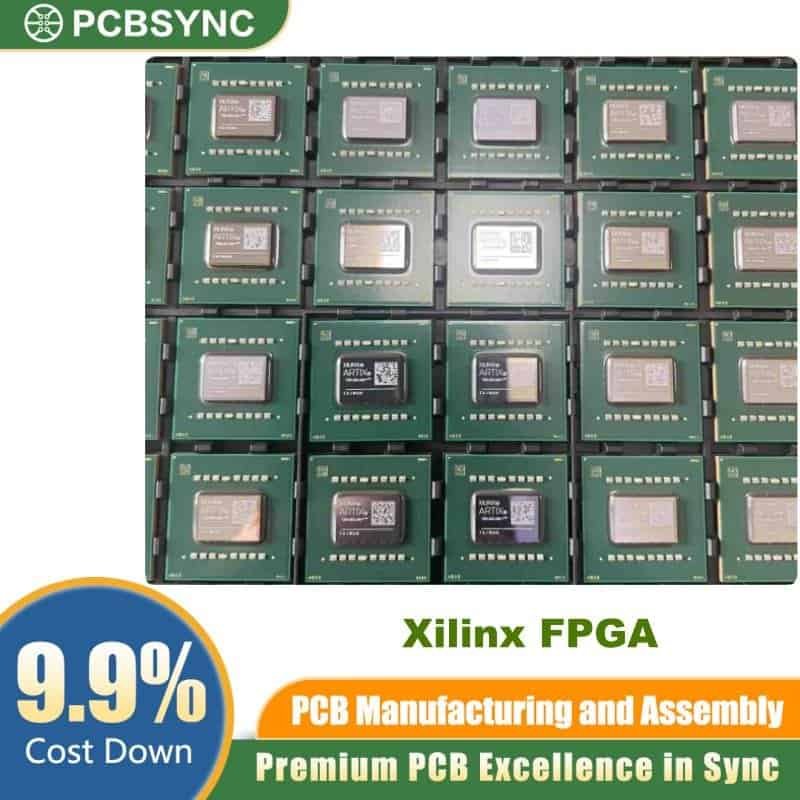
The XCV100E-7FG256C is a high-performance Field Programmable Gate Array (FPGA) from Xilinx’s Virtex-E family, built on advanced 0.18 µm CMOS process technology. Designed for engineers and system architects demanding flexible, reliable programmable logic, this device delivers 32,400 equivalent system gates, 2,700 logic cells, and a maximum operating frequency of 400 MHz — all in a compact 256-pin FBGA package with a 1.8 V supply voltage.
Whether you are designing digital signal processing systems, data encryption engines, or high-speed networking equipment, the XCV100E-7FG256C provides the programmable fabric and I/O density to meet demanding project requirements. For a wider selection of programmable logic solutions, visit our Xilinx FPGA product catalog.
XCV100E-7FG256C Key Specifications at a Glance
The table below summarizes the most important electrical and physical parameters of the XCV100E-7FG256C, making it easy to compare with alternative devices during your component selection process.
| Parameter |
Value |
| Manufacturer |
Xilinx (AMD) |
| Series |
Virtex-E |
| Part Number |
XCV100E-7FG256C |
| Logic Cells |
2,700 |
| Equivalent System Gates |
32,400 |
| Total Gate Count |
128,236 |
| CLBs (Configurable Logic Blocks) |
600 |
| Total RAM Bits |
81,920 (10 kB) |
| Maximum Operating Frequency |
400 MHz |
| Number of User I/Os |
176 |
| Supply Voltage (Nominal) |
1.8 V |
| Supply Voltage (Range) |
1.71 V – 1.89 V |
| Process Technology |
0.18 µm CMOS (6-layer metal) |
| Package / Case |
256-FBGA (BGA) |
| Mounting Type |
Surface Mount (SMT) |
| Operating Temperature |
0°C to +85°C (TJ) |
| Packaging |
Tray |
| Lifecycle Status |
Obsolete (legacy support available) |
What Is the XCV100E-7FG256C? An Overview of the Virtex-E Family
The XCV100E-7FG256C belongs to Xilinx’s Virtex-E FPGA family — an evolutionary advancement over the original Virtex architecture. The Virtex-E series was engineered to push the boundaries of programmable logic performance through the use of a 6-layer metal, 0.18 µm CMOS manufacturing process that significantly improved silicon area efficiency and switching speeds.
The architecture of the XCV100E-7FG256C is optimized for place-and-route efficiency, meaning designs can achieve tighter timing closure compared to older FPGA generations. The device’s rich hierarchy of fast, flexible interconnect resources and its diverse set of programmable system features make it a compelling choice for both new development work and long-lifecycle production applications that require continued sourcing of proven components.
As an AMD (formerly Xilinx) component, the XCV100E-7FG256C is fully supported by Xilinx’s legacy ISE Design Suite toolchain, ensuring that existing design files and intellectual property (IP) cores remain compatible.
XCV100E-7FG256C Detailed Technical Specifications
Logic Resources and Fabric Architecture
The programmable logic fabric of the XCV100E-7FG256C is built around its 600 Configurable Logic Blocks (CLBs), each containing multiple look-up tables (LUTs), flip-flops, and carry logic. This architecture results in 2,700 logic cells and supports designs with up to 128,236 usable gate equivalents, giving designers substantial capacity for moderate-complexity digital systems.
| Resource |
Quantity |
| Configurable Logic Blocks (CLBs) |
600 |
| Logic Cells |
2,700 |
| Equivalent System Gates |
32,400 |
| Total Gate Count (with RAM) |
128,236 |
| Distributed RAM Bits (in CLBs) |
Included in 81,920 total |
| Total On-Chip RAM |
81,920 bits (10 kB) |
I/O and Package Information
With 176 user-configurable I/O pins in a 256-pin Fine-pitch Ball Grid Array (FBGA) package, the XCV100E-7FG256C provides robust external connectivity for data buses, control signals, and high-speed interfaces. The 1 mm ball pitch of the BGA package enables a compact PCB footprint while maintaining reliable solder joint quality.
| I/O Attribute |
Detail |
| Total I/O Pins |
256 |
| User I/O |
176 |
| Package |
256-FBGA |
| Ball Pitch |
1 mm |
| Mounting |
Surface Mount Technology (SMT) |
Power and Electrical Characteristics
The XCV100E-7FG256C operates from a 1.8 V core supply voltage, representative of the low-power design philosophy of the Virtex-E family. The acceptable supply range of 1.71 V to 1.89 V allows for standard voltage regulator tolerances in production systems.
| Electrical Parameter |
Value |
| Core Supply Voltage (VCC) |
1.8 V |
| Supply Voltage Range |
1.71 V – 1.89 V |
| I/O Standards Supported |
LVTTL, LVCMOS, SSTL, GTL, PCI, and more |
| Max Clock Frequency |
400 MHz |
Timing and Speed Grade
The “-7” speed grade in the part number XCV100E-7FG256C indicates the device’s timing performance tier within the Virtex-E family. A lower speed grade number represents faster propagation delays and support for higher system clock frequencies, making the -7 grade one of the performance-optimized variants of the XCV100E silicon.
| Speed Parameter |
Value |
| Speed Grade |
-7 |
| Maximum System Clock |
400 MHz |
| Process Node |
0.18 µm (180 nm) |
| Metal Layers |
6-layer metal CMOS |
XCV100E-7FG256C Part Number Decoder
Understanding the part number structure helps engineers quickly identify the correct variant for their design requirements. The table below decodes each segment of XCV100E-7FG256C.
| Segment |
Meaning |
| XCV |
Xilinx Virtex FPGA family |
| 100 |
Approximate gate density (100K gates equivalent) |
| E |
Virtex-E enhanced architecture |
| -7 |
Speed grade (-7 = faster timing) |
| FG |
Fine-pitch Ball Grid Array (FBGA) package type |
| 256 |
256 package pins |
| C |
Commercial temperature range (0°C to +85°C) |
Key Features of the XCV100E-7FG256C
High-Performance Programmable Logic
The XCV100E-7FG256C delivers a powerful combination of programmable logic density and switching speed. Running at up to 400 MHz, it is capable of executing complex pipelined digital functions — from arithmetic-intensive DSP kernels to high-throughput state machines — without the long development cycles associated with custom ASICs.
Advanced 0.18 µm Process Technology
Fabricated on a 6-layer metal 0.18 µm CMOS process, the Virtex-E architecture benefits from smaller transistor geometries that translate directly into lower power consumption, higher integration density, and improved operating margins compared to older 0.22 µm or 0.35 µm FPGA processes.
Flexible Interconnect Architecture
The Virtex-E interconnect hierarchy includes local, long-line, and global routing resources. This rich fabric reduces routing congestion in complex designs and contributes to the place-and-route efficiency that is central to the Virtex-E value proposition. Designs that are timing-critical benefit particularly from the predictable routing delays.
On-Chip Block RAM
With 81,920 bits (10 kB) of total on-chip RAM, the XCV100E-7FG256C supports on-chip data buffering, FIFO queues, lookup tables, and small embedded memories without requiring external SRAM components. This reduces BOM cost and PCB complexity in many system designs.
Wide I/O Standard Support
The 176 user I/Os are configurable to support a broad range of industry-standard logic levels including LVTTL, LVCMOS (1.8 V, 2.5 V, 3.3 V), SSTL, GTL+, and PCI. This multi-standard I/O capability simplifies interfacing with mixed-voltage system environments and legacy components.
Low-Voltage 1.8 V Core
Operating from a 1.8 V core voltage, the XCV100E-7FG256C reduces power supply complexity compared to older 5 V or 3.3 V FPGAs, and is well-suited for battery-powered or power-budget-constrained applications.
XCV100E-7FG256C Applications
The combination of logic density, I/O flexibility, and operating speed makes the XCV100E-7FG256C suitable for a wide range of applications across multiple industries.
Digital Signal Processing (DSP)
The high clock frequency and large number of CLBs make this FPGA well-suited for implementing FIR and IIR filters, FFT engines, decimation and interpolation functions, and other DSP workloads common in communications and instrumentation systems.
Data Encryption and Security
The XCV100E-7FG256C’s programmable fabric can implement hardware-accelerated encryption algorithms such as AES, DES, and RSA. Hardware-based cryptographic engines offer substantially higher throughput and lower latency than equivalent software implementations on microprocessors.
High-Speed Data Acquisition
With 176 I/O pins and 400 MHz operational capability, the device is appropriate for interfacing with high-speed ADCs and DACs in data acquisition systems, scientific instrumentation, and radar front-end processing.
Image and Video Processing
The on-chip RAM and CLB resources support pixel pipeline implementations for real-time image enhancement, edge detection, compression, and video format conversion in embedded vision applications.
Embedded Systems and SoC Prototyping
The XCV100E-7FG256C can host soft processor cores such as Xilinx’s MicroBlaze, enabling full system-on-chip (SoC) prototyping and accelerating hardware/software co-design workflows before committing to an ASIC.
Networking and Communications
FPGA-based networking solutions benefit from the device’s support for serialization/deserialization (SERDES) functions, line-rate packet processing, and protocol bridging across multiple interface standards simultaneously.
| Application Area |
Relevant Capability |
| Digital Signal Processing |
400 MHz clock, 600 CLBs, pipelined arithmetic |
| Data Encryption |
Parallel logic fabric, deterministic latency |
| High-Speed Data Acquisition |
176 I/Os, wide I/O standard support |
| Image & Video Processing |
On-chip RAM, parallel pipeline support |
| Embedded Systems / SoC |
MicroBlaze soft processor support |
| Networking & Communications |
Protocol bridging, SERDES functions |
| Industrial Control |
Reliable SMT packaging, wide temp options |
| Medical Equipment |
Deterministic real-time processing |
XCV100E-7FG256C vs. Related Virtex-E Variants
Engineers sourcing the XCV100E-7FG256C often evaluate similar Virtex-E family members to find the best fit for their gate count and package requirements. The table below compares the XCV100E-7FG256C with closely related parts.
| Part Number |
Gates |
Logic Cells |
I/O Pins |
Package |
Speed Grade |
| XCV50E-7FG256C |
~16,200 |
1,350 |
176 |
256-FBGA |
-7 |
| XCV100E-7FG256C |
32,400 |
2,700 |
176 |
256-FBGA |
-7 |
| XCV100E-6FGG256C |
32,400 |
2,700 |
176 |
256-FBGA |
-6 |
| XCV200E-7FG256C |
64,800 |
5,400 |
176 |
256-FBGA |
-7 |
| XCV300E-7FG256C |
~97,200 |
8,100 |
176 |
256-FBGA |
-7 |
Note: The XCV100E-7FG256C (speed grade -7) is the faster-timed variant compared to the XCV100E-6FGG256C (speed grade -6). The “-7” suffix indicates tighter propagation delay specifications and higher achievable clock frequencies.
Ordering and Sourcing the XCV100E-7FG256C
Part Number and Packaging Details
| Ordering Attribute |
Detail |
| Full Part Number |
XCV100E-7FG256C |
| Manufacturer |
Xilinx Inc. (AMD) |
| Package |
256-FBGA, Tray |
| Lifecycle |
Obsolete (available through authorized distributors and brokers) |
| RoHS Status |
Contact distributor for RoHS compliance documentation |
Sourcing Considerations
As the XCV100E-7FG256C has been classified as obsolete by Xilinx/AMD, procurement teams should be aware of the following:
- Authorized distributors such as Mouser Electronics and Digi-Key may carry remaining inventory.
- Independent component brokers and electronic component marketplace platforms can supplement supply for legacy production runs.
- Counterfeit risk is elevated for obsolete components; always request traceability documentation and consider third-party testing for large quantity purchases.
- Lifetime buy strategies are strongly recommended for production programs that depend on this device over multiple years.
Design Support and Development Tools
ISE Design Suite
The XCV100E-7FG256C is fully supported by Xilinx’s ISE Design Suite, the legacy design environment for Virtex-E and other older Xilinx families. ISE provides synthesis, implementation, simulation, and bitstream generation capabilities for this device.
Vivado Design Suite
While Vivado is Xilinx’s modern toolchain, Vivado does not natively support Virtex-E devices. Engineers should use ISE 14.7 (the final ISE release) for XCV100E-7FG256C design implementation.
JTAG Configuration and Boundary Scan
The XCV100E-7FG256C supports IEEE 1149.1 JTAG for boundary scan testing and device configuration, simplifying board-level debug and in-system programming workflows.
Frequently Asked Questions About the XCV100E-7FG256C
What is the difference between XCV100E-7FG256C and XCV100E-6FGG256C?
The primary difference is the speed grade: the XCV100E-7FG256C is rated at speed grade -7 (faster), while the XCV100E-6FGG256C is speed grade -6 (slower timing). Both devices share identical logic resources (2,700 cells, 600 CLBs, 176 I/Os) and the same 256-pin FBGA package. Note also the slight package code variation (FG256 vs. FGG256), which may affect PCB land pattern compatibility.
Is the XCV100E-7FG256C still in production?
No. The XCV100E-7FG256C has been designated as obsolete by Xilinx (AMD). However, inventory remains available through authorized distributors and independent brokers. Engineers designing new systems should consider migrating to a supported Xilinx device family such as Spartan-7, Artix-7, or Kintex-7.
What design software supports the XCV100E-7FG256C?
The XCV100E-7FG256C is supported by Xilinx ISE Design Suite version 14.7. Xilinx Vivado does not support Virtex-E devices. The ISE 14.7 installer remains available for download from the AMD/Xilinx support website.
What are the storage and handling requirements?
As a moisture-sensitive BGA device, the XCV100E-7FG256C should be stored in its original ESD-protective packaging in a controlled environment (temperature 5°C–35°C, humidity <70% RH) until ready for assembly. Follow JEDEC J-STD-020 guidelines for moisture sensitivity level (MSL) handling.
Can the XCV100E-7FG256C implement a soft processor?
Yes. The XCV100E-7FG256C supports soft processor implementations such as Xilinx’s PicoBlaze 8-bit processor, which fits comfortably within its logic resources. The more resource-intensive MicroBlaze 32-bit processor may be achievable depending on the complexity of surrounding logic in the design.
Summary: Why Choose the XCV100E-7FG256C?
The XCV100E-7FG256C remains a relevant component for legacy system maintenance, long-lifecycle industrial applications, and proof-of-concept designs where Virtex-E IP already exists. Its 400 MHz operating speed, 2,700 logic cells, 81,920 bits of on-chip RAM, and 176 configurable I/Os in a surface-mount 256-FBGA package make it a capable, well-proven FPGA for a broad range of embedded and digital processing applications.
| Advantage |
Detail |
| High Speed |
400 MHz maximum operating frequency |
| Proven Architecture |
Virtex-E, optimized place-and-route efficiency |
| On-Chip Memory |
81,920 bits (10 kB) RAM |
| I/O Flexibility |
176 user I/Os, multi-standard support |
| Compact Package |
256-FBGA, 1 mm pitch, SMT |
| Wide Availability |
Stocked by global electronic distributors |
| Tool Support |
ISE Design Suite 14.7 |
For a comprehensive range of programmable logic devices including current-generation and legacy Xilinx products, explore our Xilinx FPGA catalog.