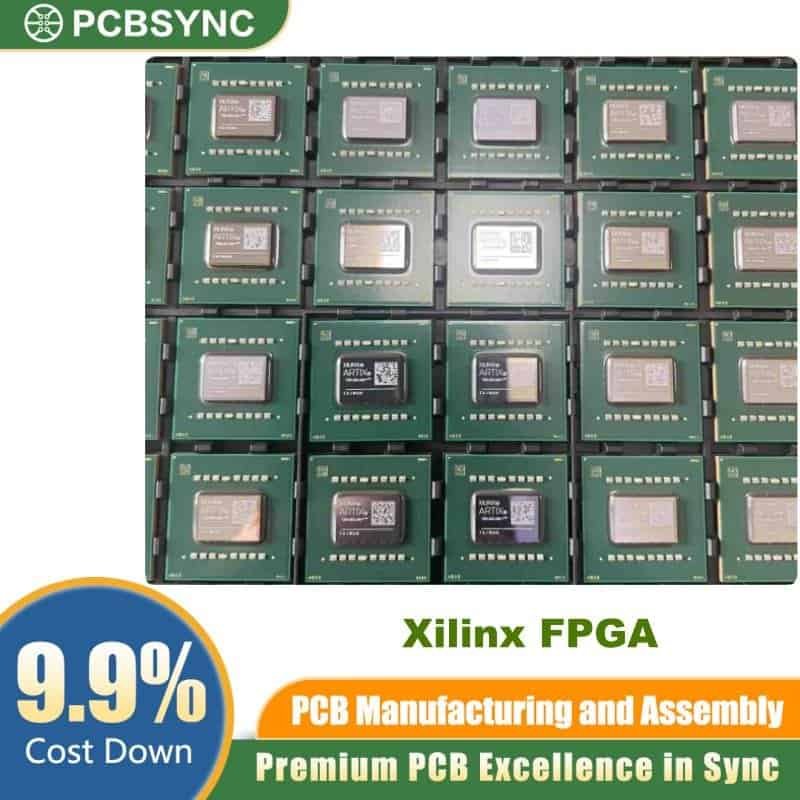
The XCV100E-7FG256I is a high-performance Field Programmable Gate Array (FPGA) from Xilinx’s Virtex-E family, now part of AMD’s product portfolio. Designed for demanding industrial and embedded applications, this device combines 32,400 system gates, 2,700 logic cells, and 176 user I/O pins in a compact 256-pin Fine-pitch Ball Grid Array (FBGA) package. Built on an advanced 0.18 μm six-layer metal CMOS process and operating at 1.8V, the XCV100E-7FG256I is a proven solution for engineers who need high-speed, reconfigurable logic in industrial-grade environments.
If you are looking for a reliable Xilinx FPGA for DSP, networking, data acquisition, or embedded processing, the XCV100E-7FG256I delivers the speed and flexibility to meet your design goals.
XCV100E-7FG256I Key Specifications at a Glance
| Parameter |
Value |
| Manufacturer |
AMD Xilinx (formerly Xilinx Inc.) |
| Part Number |
XCV100E-7FG256I |
| Series / Family |
Virtex®-E |
| Product Category |
Embedded FPGA (Field Programmable Gate Array) |
| Logic Cells |
2,700 |
| System Gates |
32,400 (32.4K) |
| CLBs (Configurable Logic Blocks) |
600 |
| Total RAM Bits |
81,920 bits (10 KB) |
| User I/O Pins |
176 |
| Package / Case |
256-FBGA (17 × 17 mm) |
| Speed Grade |
-7 |
| Maximum Frequency |
400 MHz |
| Supply Voltage (VCCINT) |
1.71 V – 1.89 V (nominal 1.8 V) |
| Technology Node |
0.18 μm, 6-layer metal CMOS |
| Mounting Type |
Surface Mount (SMT) |
| Operating Temperature |
–40°C to +100°C (TJ) — Industrial Grade |
| Temperature Grade |
Industrial (“I” suffix) |
| RoHS Status |
Non-RoHS compliant (contains lead) |
| Product Status |
Obsolete / Last-Time-Buy |
| Packaging |
Tray |
What Is the XCV100E-7FG256I? Understanding the Part Number
Decoding the part number helps engineers quickly validate compatibility:
| Part Number Segment |
Meaning |
| XCV |
Xilinx Virtex family prefix |
| 100E |
100K-gate equivalent Virtex-E device |
| -7 |
Speed grade 7 (400 MHz max frequency) |
| FG |
Fine-pitch Ball Grid Array (FBGA) package type |
| 256 |
256-pin package |
| I |
Industrial temperature range (–40°C to +100°C) |
The “I” suffix is critical for procurement teams: it confirms the device is rated for industrial environments, distinguishing it from the commercial-grade “C” variant (0°C to +85°C). Always verify the suffix when sourcing to avoid application mismatch.
XCV100E-7FG256I Detailed Technical Specifications
Logic Architecture
The XCV100E-7FG256I is built on Xilinx’s Virtex-E architecture, which organizes programmable logic into Configurable Logic Blocks (CLBs). Each CLB contains four slices, and each slice holds two 4-input Look-Up Tables (LUTs) and two flip-flops. This arrangement supports efficient implementation of combinatorial and sequential logic.
| Architecture Feature |
Detail |
| Configurable Logic Blocks (CLBs) |
600 |
| Slices per CLB |
4 |
| Logic Cells |
2,700 |
| 4-Input LUTs |
2,700 (one per logic cell) |
| Flip-Flops |
5,400 (2 per slice) |
| System Gate Equivalent |
32,400 gates |
Memory Resources
The device includes dedicated on-chip block RAM resources organized as 4Kbit synchronous dual-port RAM blocks. These provide fast, deterministic read/write latency independent of the routing fabric — ideal for buffering and data path applications.
| Memory Parameter |
Value |
| Total RAM Bits |
81,920 bits |
| Total RAM Capacity |
10 KB |
| Block RAM Type |
4Kbit synchronous dual-port SRAM |
| Block RAM Count |
20 blocks |
I/O and Electrical Characteristics
| I/O Parameter |
Value |
| User I/O Pins |
176 |
| I/O Banks |
Multiple (supports per-bank VCCO) |
| Supported I/O Standards |
LVTTL, LVCMOS 3.3V/2.5V/1.8V, GTL, GTL+, HSTL, SSTL, PCI, AGP |
| Core Supply Voltage (VCCINT) |
1.71 V – 1.89 V |
| I/O Supply Voltage (VCCO) |
1.5 V – 3.3 V (bank-dependent) |
| IEEE 1149.1 JTAG |
Yes (boundary scan supported) |
| DLL (Delay-Locked Loop) |
Yes (for clock deskew and synthesis) |
Timing and Performance
| Timing Parameter |
Value |
| Speed Grade |
-7 |
| Maximum System Frequency |
400 MHz |
| Process Technology |
0.18 μm CMOS |
| Metal Layers |
6-layer |
Package and Physical Dimensions
| Physical Parameter |
Value |
| Package Type |
FBGA (Fine-pitch Ball Grid Array) |
| Pin Count |
256 |
| Package Body Size |
17 mm × 17 mm |
| Ball Pitch |
1.0 mm |
| Mounting |
Surface Mount Technology (SMT) |
| Device Package Code |
256-FBGA (17×17) |
Industrial Temperature Grade: Why the “I” Suffix Matters
The XCV100E-7FG256I carries an industrial temperature rating of –40°C to +100°C junction temperature (TJ). This makes it suitable for deployment in environments where commercial-grade components fail, including:
- Outdoor or exposed electronics subject to temperature extremes
- Industrial control panels and automation systems
- Military and defense-adjacent applications
- Transportation and automotive-adjacent embedded systems
- Telecommunications infrastructure in non-climate-controlled enclosures
Engineers specifying components for industrial environments should always confirm the temperature grade suffix. The commercial equivalent of this device is the XCV100E-7FG256C, rated from 0°C to +85°C — an important distinction when reviewing datasheets and BOM (Bill of Materials) documents.
Virtex-E Family Overview: Where the XCV100E-7FG256I Fits
The XCV100E is one of nine members in the Virtex-E family. The table below shows where this device sits relative to its siblings, helping engineers select the right device for their density and I/O requirements.
| Device |
System Gates |
Logic Cells |
Max User I/O |
Block RAM (bits) |
| XCV50E |
16,200 |
1,350 |
176 |
40,960 |
| XCV100E |
32,400 |
2,700 |
176 |
81,920 |
| XCV200E |
65,600 |
4,704 |
284 |
163,840 |
| XCV300E |
98,304 |
6,912 |
316 |
196,608 |
| XCV600E |
199,680 |
15,360 |
514 |
327,680 |
| XCV1000E |
340,992 |
26,112 |
660 |
655,360 |
| XCV1600E |
530,432 |
40,960 |
784 |
851,968 |
| XCV2000E |
666,624 |
51,840 |
868 |
983,040 |
| XCV3200E |
1,077,248 |
73,728 |
1,108 |
1,376,256 |
The XCV100E-7FG256I occupies the second-smallest tier in the family, making it well-suited for applications that need more logic capacity than the XCV50E but do not require the higher density or pin count of larger members.
Package Comparison: FG256 vs. Other XCV100E Packages
The XCV100E is available in multiple packages. The FG256 (FBGA) is the most compact option, making it ideal for space-constrained PCB designs.
| Package Option |
Package Type |
Pin Count |
User I/O |
Body Size |
| FG256 |
FBGA |
256 |
176 |
17 × 17 mm |
| PQ240 |
QFP |
240 |
158 |
Standard LQFP |
| BG352 |
MBGA |
352 |
176 |
Larger BGA |
| CS144 |
CSBGA |
144 |
94 |
Smallest option |
The 256-FBGA offers the best balance of I/O density and PCB footprint for designs requiring the full 176 user I/O count in a surface-mount BGA form factor.
Top Applications for the XCV100E-7FG256I FPGA
The combination of 400 MHz maximum speed, 10 KB of block RAM, 176 I/O pins, and industrial temperature rating makes the XCV100E-7FG256I a strong candidate for the following application domains:
Digital Signal Processing (DSP)
The flexible LUT-based architecture and dedicated block RAM enable efficient implementation of FIR filters, FFT cores, and custom arithmetic pipelines without relying on external memory.
High-Speed Data Acquisition
With 176 I/O pins capable of supporting LVDS, HSTL, and SSTL signaling standards, the XCV100E-7FG256I can interface directly with high-speed ADCs and DACs in data acquisition systems.
Embedded Systems and Custom Processors
The 600 CLBs provide enough fabric to instantiate small soft-core processors (such as PicoBlaze) alongside application-specific logic, supporting custom embedded control systems.
Networking and Protocol Processing
Support for industry-standard I/O levels and the Virtex-E DLL (Delay-Locked Loop) for precise clock management make this device suitable for implementing packet processing pipelines and custom network interfaces.
Image and Video Processing
On-chip block RAM buffers and high-speed I/O enable line-buffer based image processing algorithms, making the device practical for machine vision and camera interface designs.
Industrial Control and Automation
The industrial temperature grade (–40°C to +100°C) ensures reliable operation in factory automation controllers, motor drives, and industrial I/O expansion modules.
Design Tool Support: Programming the XCV100E-7FG256I
As a legacy Virtex-E device, the XCV100E-7FG256I is supported by Xilinx’s ISE Design Suite (not Vivado, which targets 7-series and newer families). Key tools include:
| Tool / Resource |
Description |
| Xilinx ISE Design Suite |
Primary synthesis, implementation, and programming environment |
| FPGA Foundation |
Legacy HDL-based design entry and synthesis |
| XDM Software |
Configuration and readback |
| EDIF |
Standard interchange format for third-party synthesis tools |
| Synopsys FPGA Express |
Third-party synthesis tool supported by Virtex-E flow |
| JTAG (IEEE 1149.1) |
Boundary scan for board-level test and in-system programming |
| Bitstream (.bit) |
Configuration file format for programming the device |
Engineers migrating from ISE to Vivado should note that the XCV100E-7FG256I is not supported in Vivado. New designs targeting Xilinx FPGAs are encouraged to use the 7-series (Artix-7, Kintex-7, Virtex-7) or UltraScale families for long-term tool support.
Ordering Information and Variants
XCV100E-7FG256I vs. Related Part Numbers
| Part Number |
Speed Grade |
Package |
Temp Grade |
Notes |
| XCV100E-7FG256I |
-7 (400 MHz) |
256-FBGA |
Industrial (–40 to +100°C) |
This part |
| XCV100E-7FG256C |
-7 (400 MHz) |
256-FBGA |
Commercial (0 to +85°C) |
Commercial equivalent |
| XCV100E-6FG256I |
-6 (357 MHz) |
256-FBGA |
Industrial |
Lower speed grade |
| XCV100E-8FG256C |
-8 (400 MHz+) |
256-FBGA |
Commercial |
Higher speed grade |
| XCV100E-7PQ240I |
-7 (400 MHz) |
240-QFP |
Industrial |
Through-hole compatible package |
Product Status Note
The XCV100E-7FG256I is classified as Obsolete / Last-Time-Buy by AMD Xilinx. Engineers designing new products should consider migrating to a current-generation Xilinx device. For legacy board maintenance, authorized distributors and independent component suppliers may still carry stock.
XCV100E-7FG256I Environmental and Compliance Information
| Classification |
Status |
| RoHS Compliance |
Non-RoHS compliant (contains lead) |
| Lead-Free |
No — standard Sn/Pb solder balls |
| REACH |
Consult distributor for current SVHC declarations |
| Export Classification |
Consult distributor/manufacturer for current ECCN |
| Halogen-Free |
Not specified (legacy product) |
Note: Due to the lead-containing BGA balls, the XCV100E-7FG256I requires standard tin-lead soldering profiles. It is not compatible with lead-free (SAC) reflow profiles without risk of damage. Always confirm PCB assembly process compatibility during board bring-up.
Frequently Asked Questions About the XCV100E-7FG256I
What is the XCV100E-7FG256I?
The XCV100E-7FG256I is a Virtex-E series FPGA manufactured by Xilinx (AMD). It contains 2,700 logic cells, 600 CLBs, 10 KB of block RAM, and 176 user I/O pins in a 256-pin FBGA package, rated for industrial temperatures from –40°C to +100°C.
What does the “-7” speed grade mean on the XCV100E-7FG256I?
The -7 speed grade indicates the device’s timing performance. For the XCV100E-7FG256I, speed grade -7 corresponds to a maximum system frequency of 400 MHz. Higher speed grade numbers (e.g., -8) are faster, while lower numbers (e.g., -6) are slower.
What is the difference between XCV100E-7FG256I and XCV100E-7FG256C?
The only difference between these two parts is the temperature grade. The XCV100E-7FG256I is the industrial grade version (–40°C to +100°C TJ), while the XCV100E-7FG256C is the commercial grade version (0°C to +85°C TJ). All logic architecture, package, and electrical specifications are otherwise identical.
What design software is used with the XCV100E-7FG256I?
The XCV100E-7FG256I is programmed using the Xilinx ISE Design Suite. It is not supported in Vivado, which only targets 7-series and later Xilinx FPGA families.
Is the XCV100E-7FG256I still in production?
No. The XCV100E-7FG256I is classified as obsolete by AMD Xilinx. Engineers designing new systems should evaluate current Xilinx FPGA families. For maintenance of existing designs, last-time-buy quantities may be available through authorized and independent distributors.
What is the supply voltage for the XCV100E-7FG256I?
The XCV100E-7FG256I requires a core (VCCINT) supply of 1.71 V to 1.89 V (nominal 1.8 V). The I/O voltage (VCCO) varies per bank depending on the selected I/O standard, ranging from 1.5 V to 3.3 V.
Summary: Is the XCV100E-7FG256I Right for Your Design?
The XCV100E-7FG256I is a mature, well-characterized FPGA for industrial applications requiring compact packaging and temperature robustness. Its 400 MHz speed grade, 176 user I/O pins, and –40°C to +100°C operating range make it a reliable fit for legacy system maintenance, repair, and low-to-mid density industrial embedded designs.
Choose the XCV100E-7FG256I when:
- You need industrial temperature operation (–40°C to +100°C)
- Your design requires 256-FBGA package footprint
- Logic requirements fall within the 2,700 logic cell / 10 KB RAM capacity
- Your design flow uses Xilinx ISE and targets the Virtex-E architecture
Consider a current-generation device when:
- Starting a new design that requires long-term component availability
- Your system needs greater logic density, higher I/O count, or hard IP blocks (PCIe, SERDES)
- Tool support under Vivado is required
For more information on the broader Xilinx FPGA product portfolio, including current-generation devices, visit Xilinx FPGA.