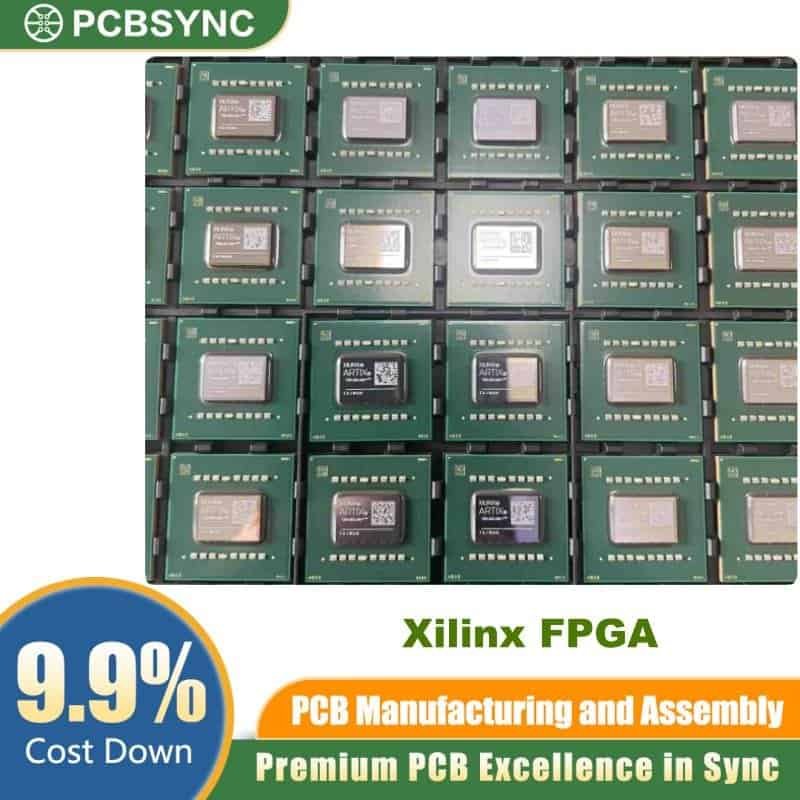
The XCV300E-7FG456C is a high-performance Xilinx FPGA from the Virtex®-E family, designed for demanding programmable logic applications. Built on a 6-layer metal 0.18 µm CMOS process and powered at 1.8V, this device delivers up to 82,944 system gates in a compact 456-pin Fine-pitch Ball Grid Array (FBGA) package. Whether you are designing for telecommunications, industrial automation, or high-speed data processing, the XCV300E-7FG456C offers the speed, density, and I/O flexibility to meet your needs.
What Is the XCV300E-7FG456C?
The XCV300E-7FG456C is a Field Programmable Gate Array (FPGA) manufactured by Xilinx Inc. (now AMD). It belongs to the Virtex-E 1.8V series, which represents an evolutionary step forward from the original Virtex family, incorporating optimizations for place-and-route efficiency and advanced process technology.
The part number breaks down as follows:
| Part Number Element |
Meaning |
| XCV300E |
Virtex-E device with ~300K system gates |
| -7 |
Speed grade (higher = faster; -7 is the standard commercial grade) |
| FG456 |
456-pin Fine-pitch Ball Grid Array (FBGA) package |
| C |
Commercial temperature range (0°C to 85°C) |
XCV300E-7FG456C Key Specifications
The table below summarizes the complete technical specifications for the XCV300E-7FG456C as listed on DigiKey and the official Xilinx datasheet.
General Device Parameters
| Parameter |
Value |
| Manufacturer |
Xilinx Inc. (AMD) |
| Series |
Virtex®-E |
| Part Number |
XCV300E-7FG456C |
| Programmable Logic Type |
Field Programmable Gate Array (FPGA) |
| Number of System Gates |
82,944 (approximately 300K equivalent gates) |
| Number of Logic Cells |
6,912 |
| Number of CLBs (Configurable Logic Blocks) |
1,536 |
| Number of I/O Pins |
312 |
| Total RAM Bits |
131,072 (16 KB) |
| Operating Frequency (Max) |
400 MHz |
| Supply Voltage (VCC) |
1.8V |
| Process Technology |
0.18 µm CMOS, 6-layer metal |
Package & Mechanical Specifications
| Parameter |
Value |
| Package / Case |
456-BBGA (Ball Grid Array) |
| Supplier Device Package |
456-FBGA (23mm × 23mm) |
| Mounting Type |
Surface Mount Technology (SMT) |
| Moisture Sensitivity Level (MSL) |
3 (168 Hours) |
| Standard Pack Quantity |
60 units (Tray) |
| RoHS Status |
Contains Lead / RoHS Non-Compliant |
Electrical & Thermal Specifications
| Parameter |
Value |
| Operating Temperature |
0°C to +85°C (TJ) — Commercial Grade |
| Core Supply Voltage |
1.8V |
| I/O Supply Voltage |
3.3V (LVTTL, LVCMOS33, etc.) |
| I/O Standards Supported |
LVTTL, LVCMOS, GTL, GTL+, HSTL, SSTL, PCI |
| Maximum Toggle Frequency |
400 MHz (internal) |
XCV300E-7FG456C Architecture Overview
Configurable Logic Blocks (CLBs)
The core of the XCV300E-7FG456C consists of 1,536 Configurable Logic Blocks, each containing four logic cells (slices). Every slice includes two 4-input Look-Up Tables (LUTs), two flip-flops, and dedicated carry and control logic. This structure allows the device to implement a wide range of arithmetic, logic, and memory functions with high efficiency.
Block RAM
The XCV300E-7FG456C integrates dedicated on-chip block RAM totaling 131,072 bits (16 KB). Block RAM resources are dual-port, supporting simultaneous read and write operations at independent clock domains — a feature critical for FIFO buffers, data caches, and co-processor memory.
Clock Management: DLLs
The device includes four Delay-Locked Loop (DLL) modules that provide:
- Zero propagation delay clock distribution
- Clock phase shifting and frequency synthesis
- Duty-cycle correction
- Clock multiplication and division
These DLLs are essential for meeting strict timing requirements in synchronous designs.
Programmable I/O
With 312 user I/O pins, the XCV300E-7FG456C supports a wide range of single-ended and differential I/O standards. Each I/O bank can be independently configured, making the device compatible with multiple interface standards within a single design.
XCV300E-7FG456C I/O Standards Compatibility Table
| I/O Standard |
Description |
Typical Application |
| LVTTL |
Low Voltage TTL (3.3V) |
General-purpose logic |
| LVCMOS33 |
Low Voltage CMOS 3.3V |
MCU/MPU interfaces |
| LVCMOS18 |
Low Voltage CMOS 1.8V |
On-board FPGA interconnect |
| GTL / GTL+ |
Gunning Transceiver Logic |
Backplane buses |
| HSTL |
High-Speed Transceiver Logic |
DDR memory interfaces |
| SSTL2 / SSTL3 |
Stub Series Terminated Logic |
SDRAM, DDR SDRAM |
| PCI |
Peripheral Component Interconnect |
PCI bus interfaces |
| AGP |
Accelerated Graphics Port |
Graphics applications |
XCV300E-7FG456C vs. Other Virtex-E Variants
Engineers often compare the XCV300E-7FG456C against nearby family members or alternate package options. The table below provides a quick comparison.
| Part Number |
Gates |
I/O Pins |
Package |
Speed Grade |
Temp Range |
| XCV300E-7FG456C |
82,944 |
312 |
456-FBGA |
-7 |
Commercial |
| XCV300E-8FG456C |
82,944 |
312 |
456-FBGA |
-8 (faster) |
Commercial |
| XCV300E-6FG456C |
82,944 |
312 |
456-FBGA |
-6 (slower) |
Commercial |
| XCV300E-7FG256C |
82,944 |
172 |
256-FBGA |
-7 |
Commercial |
| XCV300E-7FG456I |
82,944 |
312 |
456-FBGA |
-7 |
Industrial |
| XCV400E-7FG456C |
110,592 |
312 |
456-FBGA |
-7 |
Commercial |
Speed Grade Note: A higher numeric speed grade (e.g., -8 vs. -7) indicates a faster device with tighter timing specifications. The -7 grade represents the standard commercial offering for the XCV300E in the FG456 package.
Typical Applications of the XCV300E-7FG456C
The XCV300E-7FG456C is a mature, proven device widely used across multiple industries. Common application areas include:
Telecommunications & Networking
High-speed data path processing, protocol bridging (ATM, SONET, Ethernet framing), and line-rate packet classification are well-suited to the device’s 400 MHz capability and flexible I/O.
Industrial Automation & Control
Programmable motor control, real-time sensor data acquisition, and machine vision front-end logic benefit from the device’s deterministic timing and configurable I/O voltage standards.
Military & Aerospace (Legacy Systems)
The XCV300E family was widely deployed in defense applications requiring high gate density in a compact surface-mount package. Many legacy systems continue to use this part for MRO (Maintenance, Repair & Overhaul).
Medical Equipment
Signal processing for imaging equipment and diagnostic instruments has leveraged the Virtex-E’s high-density logic and reliable block RAM architecture.
ASIC Prototyping
Designers use the XCV300E-7FG456C to prototype gate-array logic before committing to an ASIC tape-out, validating design functionality and timing.
Design Tool Support
Xilinx ISE Design Suite
The XCV300E-7FG456C is fully supported by the Xilinx ISE Design Suite, the legacy design environment for Virtex, Virtex-E, Spartan, and related families. ISE provides synthesis, place-and-route, simulation, and programming file generation.
Important: The Virtex-E family is not supported by Vivado. All design work for the XCV300E-7FG456C must use ISE (recommended version: ISE 14.7, the final release).
HDL Language Support
| Language |
Supported? |
| VHDL |
✅ Yes |
| Verilog |
✅ Yes |
| EDIF Netlist |
✅ Yes |
| SystemVerilog |
⚠️ Partial (ISE 14.x) |
| HLS (High-Level Synthesis) |
❌ No (requires Vivado) |
Ordering & Procurement Information
DigiKey Part Details
| Field |
Value |
| DigiKey Part Number |
122-1064-ND |
| Manufacturer Part Number |
XCV300E-7FG456C |
| Manufacturer |
AMD (Xilinx) |
| Category |
Embedded – FPGAs (Field Programmable Gate Array) |
| Unit of Measure |
Each |
| Packaging |
Tray |
| Standard Pack Quantity |
60 |
Substitute & Alternate Parts
If the XCV300E-7FG456C is not available, the following alternatives may be considered depending on design constraints:
| Alternate Part |
Notes |
| XCV300E-8FG456C |
Same device, faster speed grade |
| XCV300E-6FG456C |
Same device, slower speed grade (lower cost) |
| XCV300E-7FG256C |
Smaller pin-count package (256-FBGA, fewer I/Os) |
| XCV300E-7BG432C |
BGA 432 package option |
| XCV400E-7FG456C |
Larger gate count in same footprint |
PCB Design Tip: The 456-FBGA package has a 1.0mm ball pitch. Ensure your PCB stackup and via-in-pad design rules are compatible with this fine-pitch BGA before committing to layout.
XCV300E-7FG456C Frequently Asked Questions (FAQ)
Is the XCV300E-7FG456C still in production?
The XCV300E-7FG456C is classified as Not Recommended for New Designs (NRND) by AMD Xilinx. It remains available through authorized distributors and the secondary market but is no longer in active production. Engineers designing new systems should evaluate newer Xilinx families such as Spartan-7, Artix-7, or Kintex-7.
What programming file format does the XCV300E-7FG456C use?
The device uses a bitstream (.bit) file generated by Xilinx ISE. It is configured via JTAG (boundary-scan programming) or through a SelectMAP/Serial configuration mode using an external configuration memory device.
What is the configuration storage mechanism?
The XCV300E-7FG456C is SRAM-based, meaning its configuration is volatile — the bitstream must be reloaded after every power cycle. A companion configuration PROM (such as the Xilinx XCF series) or a microcontroller/processor is typically used to store and reload the configuration at startup.
What is the difference between -7 and -8 speed grades?
The -7 speed grade indicates maximum system clock frequency and propagation delay specifications at the standard commercial process corner. The -8 grade is faster (tighter timing margins), while the -6 grade is slower and typically lower cost. For the FG456C package, the -7 represents the most commonly stocked and cost-effective commercial variant.
Is this device RoHS compliant?
No. The XCV300E-7FG456C contains lead and is RoHS non-compliant. Designs targeting RoHS-compliant end products should seek lead-free (Pb-free) variants or consider a newer FPGA family that ships in lead-free packages.