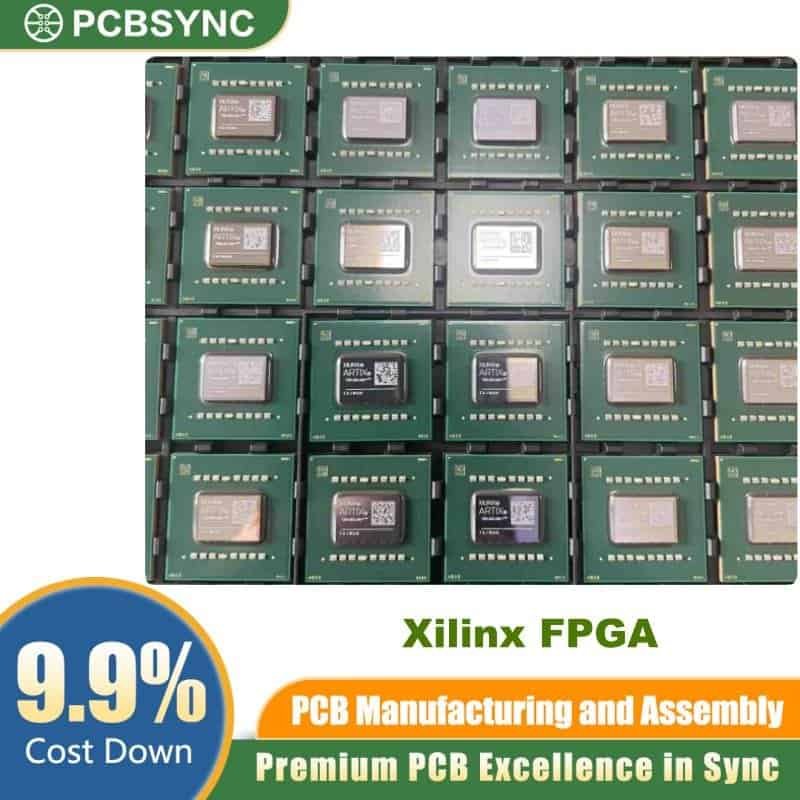
The XCV300E-7FG456I is a high-performance, industrial-grade Field Programmable Gate Array (FPGA) from Xilinx (now AMD), part of the acclaimed Virtex-E family. Designed for demanding embedded, communications, and signal-processing applications, the XCV300E-7FG456I delivers 300K system gates, 6,912 logic cells, and operates at a blazing-fast 400 MHz — all in a compact 456-pin FBGA package. Whether you’re designing for telecommunications, industrial automation, or high-speed data processing, this component offers the programmable flexibility and performance that engineers rely on.
If you’re looking for a broader selection of programmable logic solutions, explore our full range of Xilinx FPGA devices.
What Is the XCV300E-7FG456I?
The XCV300E-7FG456I is a member of the Xilinx Virtex-E 1.8V FPGA series, manufactured using an advanced 0.18 µm, 6-layer metal CMOS process technology. The “E” in Virtex-E denotes an enhanced generation of the original Virtex architecture, delivering significant gains in logic density, speed, and on-chip memory capacity.
The part number decodes as follows:
| Code Element |
Meaning |
| XCV300E |
Virtex-E family, 300K equivalent gate device |
| -7 |
Speed grade (faster = higher number; -7 is mid-tier) |
| FG456 |
456-ball Fine-pitch Ball Grid Array (FBGA) package |
| I |
Industrial temperature range (–40°C to +100°C) |
This industrial temperature suffix makes the XCV300E-7FG456I especially suitable for ruggedized environments where consumer-grade components would fail.
XCV300E-7FG456I Key Specifications
General Electrical Specifications
| Parameter |
Value |
| Manufacturer |
Xilinx Inc. (AMD) |
| Product Family |
Virtex-E |
| Part Status |
Obsolete / Legacy (Not Recommended for New Designs) |
| Technology Node |
0.18 µm CMOS |
| Number of Metal Layers |
6 |
| Core Supply Voltage (VCCINT) |
1.8V (nominal) |
| Supply Voltage Range |
1.71V – 1.89V |
| I/O Supply Voltage (VCCO) |
3.3V / 2.5V / 1.8V (multi-standard I/O) |
| Maximum Clock Frequency |
400 MHz |
Logic Resources
| Resource |
Quantity |
| Equivalent System Gates |
82,944 (usable); up to ~411,955 (maximum) |
| Configurable Logic Blocks (CLBs) |
1,536 |
| Logic Cells / Elements |
6,912 |
| Flip-Flops |
13,824 |
| 4-Input LUTs |
13,824 |
Memory Resources
| Memory Type |
Capacity |
| Total RAM Bits (Block RAM) |
131,072 bits (128 Kbits / 16 KB) |
| Block SelectRAM Resources |
16 × 4Kbit dual-port RAM blocks |
I/O and Package Information
| Parameter |
Value |
| Number of User I/Os |
312 |
| Package Type |
456-FBGA (Fine-pitch Ball Grid Array) |
| Package Designation |
FG456 (23 × 23 mm body) |
| Ball Pitch |
1.0 mm |
| Mounting Type |
Surface Mount Technology (SMT) |
| Total Pin Count |
456 |
Operating Conditions
| Parameter |
Value |
| Temperature Range (TJ) |
–40°C to +100°C (Industrial grade) |
| Temperature Suffix |
“I” = Industrial |
| ESD Protection |
Industry-standard on all I/O pins |
XCV300E-7FG456I Package Dimensions
The XCV300E-7FG456I uses a 456-ball Fine-pitch BGA (FBGA) package, sometimes also listed as 456-BBGA in distributor databases. Key physical attributes are:
| Attribute |
Detail |
| Package Code |
FG456 |
| Body Size |
23 mm × 23 mm |
| Ball Pitch |
1.0 mm |
| Ball Rows × Columns |
Approx. 22 × 22 array |
| PCB Land Pattern |
Requires controlled-impedance BGA footprint |
| Recommended Solder |
SAC305 lead-free or Sn63Pb37 |
Designers should refer to the Xilinx Virtex-E packaging specification document for precise mechanical drawings and PCB land pattern recommendations before layout.
Virtex-E Architecture Overview
Understanding the internal architecture of the Virtex-E family helps explain why the XCV300E-7FG456I performs so well across a wide range of applications.
Configurable Logic Blocks (CLBs)
Each CLB in the Virtex-E architecture contains two slices, and each slice contains:
- Two 4-input Look-Up Tables (LUTs) — used as logic functions or distributed RAM
- Two D-type Flip-Flops
- Fast carry and arithmetic logic chains
This gives the XCV300E-7FG456I 1,536 CLBs × 2 slices × 2 LUTs = 6,144 LUT resources, providing enormous flexibility for combinatorial and sequential logic designs.
Block SelectRAM
The on-chip Block SelectRAM resources are true dual-port 4096-bit SRAM blocks configurable as:
- 4096 × 1-bit
- 2048 × 2-bit
- 1024 × 4-bit
- 512 × 8-bit
- 256 × 16-bit
All 16 blocks can operate independently and simultaneously, making them ideal for FIFOs, LUT-based RAM, and data buffering.
Digital Clock Management (DCM)
The Virtex-E family includes Digital Clock Managers (DCMs) that provide:
- Clock multiplication and division
- Phase shifting (fine and coarse)
- Clock deskewing
- Duty-cycle correction
These are essential for high-speed synchronous designs and multi-clock domain applications.
Programmable I/O Standards
The XCV300E-7FG456I supports a rich set of programmable I/O voltage standards:
| I/O Standard |
Description |
| LVTTL |
Low-Voltage TTL (3.3V) |
| LVCMOS25 / LVCMOS18 |
Low-Voltage CMOS (2.5V / 1.8V) |
| SSTL2 / SSTL3 |
Stub-Series Terminated Logic |
| GTL / GTL+ |
Gunning Transceiver Logic |
| HSTL |
High-Speed Transceiver Logic (1.5V) |
| PCI / PCI-X |
3.3V and 5V tolerant PCI compliant |
| AGP |
Accelerated Graphics Port compatible |
| CTT |
Center Tap Terminated |
This multi-standard I/O capability makes the XCV300E-7FG456I highly interoperable in mixed-voltage system designs.
XCV300E-7FG456I Applications
The XCV300E-7FG456I is used across a wide range of industries and design types:
Telecommunications & Networking
- Line card processing in SONET/SDH systems
- ATM cell processing and traffic management
- Protocol bridging and conversion
- High-speed serial data interfaces
Industrial Automation & Control
- Motor drive control with PWM generation
- Industrial Ethernet (EtherCAT, PROFINET)
- Real-time sensor data acquisition
- PLC (Programmable Logic Controller) coprocessing
Defense & Aerospace (Legacy Systems)
- Radar signal processing (legacy platforms)
- Image processing for targeting systems
- Secure communication hardware interfaces
Medical Equipment
- Ultrasound signal processing
- Patient monitoring data aggregation
- Imaging system control logic
Digital Signal Processing (DSP)
- FIR/IIR filter implementations
- FFT processing engines
- Software Defined Radio (SDR) hardware back-ends
- Baseband processing
Programming & Design Tools for XCV300E-7FG456I
Since the XCV300E-7FG456I is a legacy Virtex-E device, it is supported by Xilinx ISE Design Suite (not Vivado, which dropped support for older devices):
| Tool |
Details |
| Design Tool |
Xilinx ISE Design Suite (v14.7 final version recommended) |
| HDL Languages Supported |
VHDL, Verilog, ABEL |
| Simulation |
ISim (ISE integrated), ModelSim, QuestaSim |
| Constraints File |
UCF (User Constraints File) format |
| Configuration File |
Bitstream (.bit) or PROM file (.mcs) |
| Configuration Interfaces |
JTAG (boundary scan), SelectMAP, Serial Slave/Master |
Configuration Memory Options
| Mode |
Description |
| JTAG |
Direct PC-to-chip via JTAG cable (Xilinx Platform Cable USB) |
| Master Serial |
EEPROM / XCFxxS PROM auto-loads on power-up |
| Slave Serial |
External microcontroller sends bitstream serially |
| SelectMAP (Parallel) |
8-bit or 16-bit byte-wide configuration bus |
XCV300E-7FG456I Ordering Information
Part Number Variants
| Part Number |
Speed Grade |
Package |
Temperature |
| XCV300E-6FG456C |
-6 (slower) |
456-FBGA |
Commercial (0°C to +85°C) |
| XCV300E-7FG456C |
-7 |
456-FBGA |
Commercial (0°C to +85°C) |
| XCV300E-7FG456I |
-7 |
456-FBGA |
Industrial (–40°C to +100°C) |
| XCV300E-8FG456C |
-8 (faster) |
456-FBGA |
Commercial (0°C to +85°C) |
| XCV300E-7FGG456I |
-7 |
456-MBGA |
Industrial |
Note: The “I” suffix designates the industrial temperature grade, making XCV300E-7FG456I the preferred choice for harsh-environment deployments. The “C” suffix denotes commercial temperature range only.
Alternative / Compatible Package Options
The XCV300E core is also available in smaller packages for lower I/O count requirements:
| Device |
Package |
User I/Os |
Gates |
| XCV300E |
256-FBGA (FG256) |
176 |
82,944 |
| XCV300E |
352-MBGA (FG352) |
260 |
82,944 |
| XCV300E |
456-FBGA (FG456) |
312 |
82,944 |
| XCV300E |
432-MBGA (FG432) |
316 |
82,944 |
The logic resources remain identical across all package options — only the accessible I/O count changes.
Compliance & Certifications
| Standard |
Compliance |
| RoHS |
Non-RoHS (legacy part; RoHS-compliant variants may exist under revised part numbers) |
| JEDEC |
JEDEC standard FBGA package outline |
| JTAG |
IEEE 1149.1 Boundary Scan compliant |
| PCI Compliance |
3.3V PCI 2.2 compliant (with appropriate bank configuration) |
Always verify RoHS status with your distributor at time of purchase for regulatory compliance purposes.
Why Choose the XCV300E-7FG456I?
Strengths at a Glance
| Feature |
Advantage |
| Industrial temperature grade |
Operates reliably in –40°C to 100°C environments |
| 0.18 µm process |
Lower power consumption vs. older CMOS nodes |
| 1.8V core voltage |
Reduced dynamic power compared to 2.5V Virtex |
| 312 user I/Os |
Maximum connectivity in the FG456 package |
| 6,912 logic cells |
Sufficient for mid-size to large control/DSP functions |
| 400 MHz max frequency |
High-speed synchronous design support |
| Multi-standard I/O |
Plug into any voltage-level ecosystem |
| Dual-port block RAM |
Efficient data buffering and memory architecture |
Limitations to Consider
| Consideration |
Detail |
| Legacy / Obsolete Status |
Not recommended for new designs by AMD |
| ISE-only toolchain |
Not supported in Vivado; ISE 14.7 is the final version |
| No embedded hard processors |
Unlike Zynq devices; soft-core (MicroBlaze) required |
| Configuration volatility |
SRAM-based; loses configuration on power-off without external PROM |
For new design starts, consider migrating to current Xilinx/AMD families such as Spartan-7, Artix-7, or Kintex-7, which offer better performance-per-watt and active tool support.