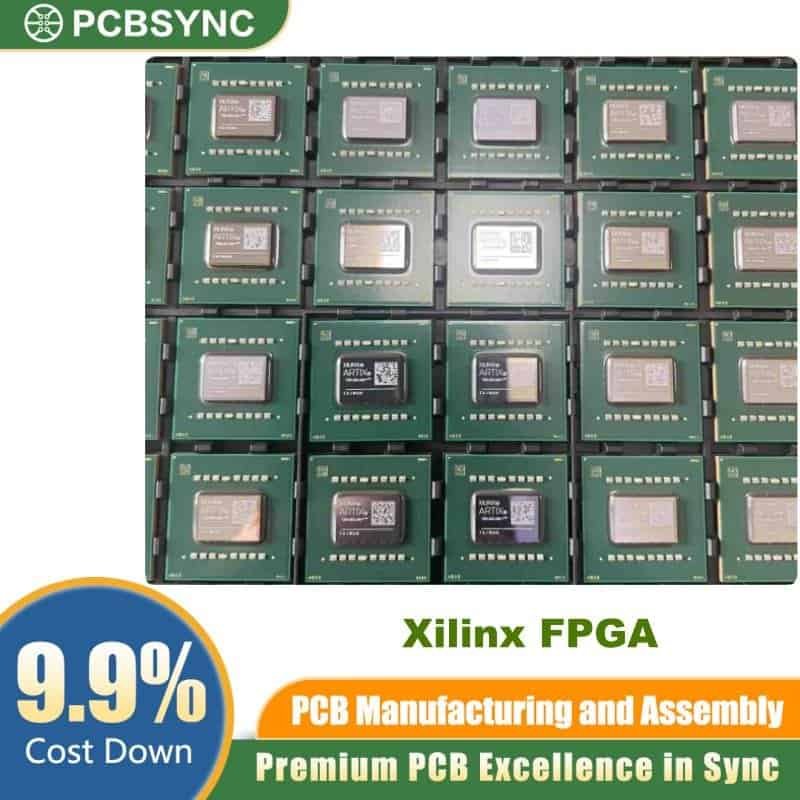
The XCV2000E-7FG1156I is a high-performance, high-capacity Xilinx FPGA from the Virtex-E family, designed for demanding programmable logic applications. Built on an advanced 0.18 μm 6-layer metal CMOS process and operating at 1.8V, this device delivers exceptional logic density and speed for industrial, telecommunications, and signal processing applications.
Whether you are designing a new embedded system or sourcing a replacement for a legacy design, understanding the full specifications of the XCV2000E-7FG1156I is essential. This guide covers everything from core electrical parameters to package details, pin configuration, and typical application use cases.
What Is the XCV2000E-7FG1156I?
The XCV2000E-7FG1156I is a member of Xilinx’s Virtex-E family of 1.8V Field Programmable Gate Arrays (FPGAs). It belongs to the industrial-grade temperature range variant (the “I” suffix), making it suitable for operation in harsh environments where extended thermal performance is required.
The Virtex-E family was an evolutionary advancement over the original Virtex FPGA family, featuring dramatic increases in silicon efficiency through an optimized architecture and the use of a 0.18 μm CMOS process. The XCV2000E specifically targets designs that require high gate counts, extensive on-chip memory, and flexible I/O standards — making it a powerful and flexible alternative to mask-programmed gate arrays.
XCV2000E-7FG1156I Key Specifications at a Glance
| Parameter |
Value |
| Part Number |
XCV2000E-7FG1156I |
| Manufacturer |
Xilinx (AMD) |
| Family |
Virtex-E |
| Number of Gates (System Gates) |
518,400 equivalent gates |
| Total Gates |
2,541,952 |
| Logic Cells / CLBs |
43,200 cells / 9,600 CLBs |
| Total RAM Bits |
655,360 bits |
| Configuration RAM |
~80 KB |
| Number of I/O Pins |
804 |
| Maximum Operating Frequency |
400 MHz |
| Internal Performance |
130 MHz (4 LUT levels) |
| Supply Voltage (Nominal) |
1.8V |
| Supply Voltage Range |
1.71V – 1.89V |
| Operating Temperature (TJ) |
–40°C to +100°C |
| Package |
1156-FBGA (Fine-Pitch Ball Grid Array) |
| Package Dimensions |
35mm × 35mm, 1mm pitch |
| Mounting Type |
Surface Mount |
| Process Technology |
0.18 μm, 6-layer metal CMOS |
| Product Status |
Not Recommended for New Design (NRND) |
XCV2000E-7FG1156I Package Information
The XCV2000E-7FG1156I is housed in a 1156-FBGA (Fine Ball Grid Array) package — sometimes referenced as 1156-BBGA. This surface-mount package is designed for high-density PCB integration.
| Package Detail |
Specification |
| Package Type |
FBGA (Fine Ball Grid Array) |
| Total Pin Count |
1156 |
| User I/O Pins |
804 |
| Package Body Size |
35mm × 35mm |
| Ball Pitch |
1.0mm |
| Height |
2.6mm |
| Mounting Method |
Surface Mount Technology (SMT) |
| Packaging (Shipping) |
Tray |
The high pin count and fine-pitch BGA packaging make the XCV2000E-7FG1156I ideal for high-density PCB designs requiring maximum I/O routing flexibility. Proper reflow soldering and PCB design rules must be followed to ensure reliable solder joint formation across all 1156 balls.
XCV2000E-7FG1156I Electrical Characteristics
Power Supply Specifications
| Electrical Parameter |
Value |
| Core Supply Voltage (VCCINT) |
1.8V (nominal) |
| Operating Voltage Range |
1.71V – 1.89V |
| I/O Supply Voltage (VCCO) |
Configurable per bank |
| Max Junction Temperature |
100°C |
| Min Operating Temperature |
–40°C |
I/O and Interface Capabilities
The XCV2000E-7FG1156I supports Xilinx’s SelectI/O+™ technology, providing a highly flexible interface fabric capable of supporting a broad range of single-ended and differential I/O standards.
| I/O Standard Supported |
Details |
| LVTTL / LVCMOS |
1.8V, 2.5V, 3.3V |
| PCI Compliant |
33 MHz / 66 MHz |
| GTL / GTL+ |
Gunning Transceiver Logic |
| HSTL |
High-Speed Transceiver Logic (Class I, II, III, IV) |
| SSTL |
Stub Series Terminated Logic (2 and 3.3) |
| AGP |
Accelerated Graphics Port compatible |
| CTT |
Center-Tap Terminated |
| Differential Pairs |
Supported (LVDS, LVPECL) |
Speed Grade – “7” Designation Explained
The -7 in the part number indicates the device’s speed grade. A speed grade of -7 is the slowest grade in the XCV2000E series, meaning it is rated for lower maximum clock frequencies compared to the -6 or -5 variants. This grade is typically appropriate for designs that do not require maximum performance but benefit from lower power consumption and improved timing margins.
XCV2000E-7FG1156I Logic Architecture
Configurable Logic Blocks (CLBs)
The logic fabric of the XCV2000E-7FG1156I is built around Configurable Logic Blocks (CLBs). Each CLB contains:
- Four-input Look-Up Tables (LUTs) for logic implementation
- Storage elements (flip-flops) for sequential logic
- Fast carry logic for arithmetic operations
- Wide function multiplexers for efficient logic packing
With 9,600 CLBs and 43,200 logic cells, the XCV2000E-7FG1156I provides substantial resources for complex state machines, data paths, and control logic.
Block RAM (BRAM)
The XCV2000E-7FG1156I integrates 655,360 total RAM bits of distributed and block RAM. This on-chip memory is essential for applications that require:
- FIFOs for data buffering
- Lookup tables for high-speed computation
- Local data storage for processing pipelines
- Dual-port memory for multi-clock domain designs
Dedicated Multipliers and DSP Support
The Virtex-E family includes dedicated resources that accelerate common digital signal processing operations, reducing the need to consume CLB resources for arithmetic-intensive operations.
Temperature Grade: Industrial “I” Suffix
The “I” suffix in XCV2000E-7FG1156I designates the industrial temperature grade, specifying a junction temperature range of –40°C to +100°C TJ. This is a critical distinction from the commercial-grade variants, which are typically rated from 0°C to 85°C.
| Temperature Grade |
Suffix |
Operating Range (TJ) |
| Commercial |
C |
0°C to +85°C |
| Industrial |
I |
–40°C to +100°C |
| Extended |
E |
–55°C to +125°C (where applicable) |
The industrial-grade XCV2000E-7FG1156I is suited for equipment deployed in environments subject to temperature extremes, such as outdoor telecommunications enclosures, industrial automation machinery, automotive test systems, and aerospace support equipment.
Typical Applications for the XCV2000E-7FG1156I
Thanks to its large gate count, flexible I/O, and industrial temperature rating, the XCV2000E-7FG1156I is well-suited for a variety of demanding applications:
| Application Area |
How the XCV2000E-7FG1156I Is Used |
| Digital Signal Processing (DSP) |
High-throughput filtering, FFT engines, and custom arithmetic pipelines |
| Telecommunications |
Line-card FPGAs for protocol processing, framing, and switching |
| Data Encryption / Security |
Hardware accelerators for AES, DES, RSA, and other cryptographic algorithms |
| Video and Image Processing |
Frame buffering, real-time image filtering, video scaling |
| Network Packet Processing |
High-speed packet inspection, traffic shaping, and classification |
| Embedded Control |
Custom processor implementations, control logic for industrial equipment |
| Test and Measurement |
Logic analyzers, pattern generators, and signal capture systems |
| Military / Aerospace (Support) |
Industrial-grade temperature range supports demanding environments |
XCV2000E-7FG1156I vs. Other XCV2000E Variants
The XCV2000E device is offered in multiple speed grades and packages. Understanding the variant naming convention helps engineers select the right part for their design.
Speed Grade Comparison
| Part Number |
Speed Grade |
Max Frequency |
Temp Grade |
Package |
| XCV2000E-5FG1156C |
–5 (Fastest) |
Highest |
Commercial |
1156-FBGA |
| XCV2000E-6FG1156C |
–6 |
Medium |
Commercial |
1156-FBGA |
| XCV2000E-7FG1156C |
–7 (Slowest) |
Lower |
Commercial |
1156-FBGA |
| XCV2000E-5FG1156I |
–5 (Fastest) |
Highest |
Industrial |
1156-FBGA |
| XCV2000E-6FG1156I |
–6 |
Medium |
Industrial |
1156-FBGA |
| XCV2000E-7FG1156I |
–7 (Slowest) |
Lower |
Industrial |
1156-FBGA |
Part Number Decoder
Breaking down the full part number XCV2000E-7FG1156I:
| Segment |
Meaning |
| XCV |
Xilinx Virtex family prefix |
| 2000 |
Device density (approximately 2,000 system gates equivalent in thousands) |
| E |
Virtex-E generation (enhanced/extended) |
| -7 |
Speed grade (–7 = slower timing, better margins) |
| FG |
Package type code (Fine-pitch Ball Grid Array) |
| 1156 |
Pin count (1156 total balls) |
| I |
Temperature grade (Industrial: –40°C to +100°C) |
Design Tools and Programming Support
Supported Xilinx Design Software
The XCV2000E-7FG1156I is supported by the legacy Xilinx ISE Design Suite, which provides:
- Synthesis and place-and-route tools
- Timing analysis and simulation
- iMPACT for device programming and boundary scan
- ChipScope Pro for in-system debugging
Note: As of its NRND (Not Recommended for New Designs) status, Xilinx’s newer Vivado Design Suite does not support the Virtex-E family. Engineers working with this device should ensure they maintain access to an appropriate version of ISE Design Suite (version 14.x is typically the last to support Virtex-E devices).
JTAG Configuration and Programming
The XCV2000E-7FG1156I supports JTAG boundary scan and multiple configuration modes:
| Configuration Mode |
Description |
| Slave Serial |
Driven by an external controller |
| Master Serial |
Device reads from external serial PROM |
| Slave Parallel (SelectMAP) |
High-speed parallel configuration |
| JTAG (IEEE 1149.1) |
In-circuit programming and boundary scan |
Ordering Information and Product Status
Product Status: Not Recommended for New Design (NRND)
The XCV2000E-7FG1156I carries an NRND (Not Recommended for New Design) designation from the manufacturer. This means:
- The part is no longer in active production
- It remains available through authorized distributors and the secondary market
- No further silicon or IP enhancements are planned
- Long-term availability is not guaranteed by the manufacturer
Engineers designing new systems should consider migrating to modern Xilinx FPGA families such as the Virtex-7, UltraScale, or UltraScale+ series for better performance, power efficiency, and long-term support.
Where to Source the XCV2000E-7FG1156I
| Source Type |
Notes |
| Authorized Distributors |
Digikey, Mouser, Arrow, Avnet |
| Independent Distributors |
May offer stock for legacy designs; verify authenticity |
| Secondary Market |
Available but requires careful counterfeit screening |
| Manufacturer (AMD/Xilinx) |
Direct purchase may be available in limited quantities |
Recommended Replacement / Upgrade Paths
For engineers planning new designs, the following modern Xilinx FPGA families offer significant performance, power, and tooling improvements over the Virtex-E:
| Replacement Family |
Key Advantages Over Virtex-E |
| Artix-7 |
Lower cost, lower power, Vivado support |
| Kintex-7 |
Higher performance, transceiver capabilities |
| Virtex-7 |
Maximum performance, advanced I/O, Vivado |
| Kintex UltraScale |
Next-gen DSP, high-speed transceivers |
| UltraScale+ |
AI-optimized DSP, HBM options, modern tooling |
Frequently Asked Questions (FAQ)
What does the “I” suffix mean in XCV2000E-7FG1156I?
The “I” designates the industrial temperature grade, specifying reliable operation from –40°C to +100°C junction temperature (TJ). This makes the device suitable for use in industrial, telecommunications, and other harsh-environment applications where commercial-grade temperature ranges (0°C to 85°C) are insufficient.
What is the difference between XCV2000E-7FG1156I and XCV2000E-7FGG1156I?
The XCV2000E-7FG1156I and XCV2000E-7FGG1156I refer to the same device. The double “GG” in the package code is sometimes used in Xilinx documentation and distributor listings interchangeably with “FG” for this FBGA package variant. Always cross-reference the full datasheet to confirm package compatibility.
Is the XCV2000E-7FG1156I RoHS compliant?
RoHS compliance status varies by manufacturing date and lot. Buyers sourcing this component for RoHS-compliant designs should confirm the specific lot’s compliance certificate with their distributor, as legacy FPGA components may not always meet current RoHS requirements without verification.
What configuration PROM is compatible with the XCV2000E-7FG1156I?
Compatible Xilinx Platform Flash PROMs for this device include the XCF08P, XCF16P, and XCF32P (Platform Flash with JTAG). The required PROM size depends on the bitstream size generated by ISE for your specific design.
Can the XCV2000E-7FG1156I be used in safety-critical designs?
The XCV2000E-7FG1156I is a commercial FPGA and has not been qualified for safety-critical applications such as automotive functional safety (ISO 26262) or aerospace DO-254. Engineers working in these domains should consult Xilinx’s radiation-hardened or automotive-qualified product lines.
Summary: XCV2000E-7FG1156I Complete Specifications
| Category |
Detail |
| Part Number |
XCV2000E-7FG1156I |
| Manufacturer |
Xilinx (Now AMD) |
| Series / Family |
Virtex-E |
| Logic Cells |
43,200 |
| CLBs |
9,600 |
| Equivalent System Gates |
518,400 |
| Total Gates |
2,541,952 |
| On-Chip RAM |
655,360 bits (~80 KB configuration) |
| I/O Count |
804 |
| Max Frequency |
400 MHz |
| Internal Performance |
130 MHz (4 LUT levels) |
| Core Voltage |
1.8V (1.71V–1.89V) |
| Process Node |
0.18 μm CMOS, 6-layer metal |
| Package |
1156-FBGA |
| Package Size |
35mm × 35mm, 1mm pitch |
| Mounting |
Surface Mount |
| Temperature Range |
–40°C to +100°C TJ (Industrial) |
| Speed Grade |
–7 |
| Product Status |
NRND (Not Recommended for New Design) |
| Design Tool |
Xilinx ISE Design Suite (14.x) |
| Configuration Interface |
JTAG, Serial, Parallel SelectMAP |
The XCV2000E-7FG1156I remains a capable device for legacy system maintenance, industrial replacements, and designs where NRND status is acceptable. Its large gate count, high I/O capacity, industrial temperature grade, and proven Virtex-E architecture make it a reliable choice for engineers supporting existing deployments and production systems.