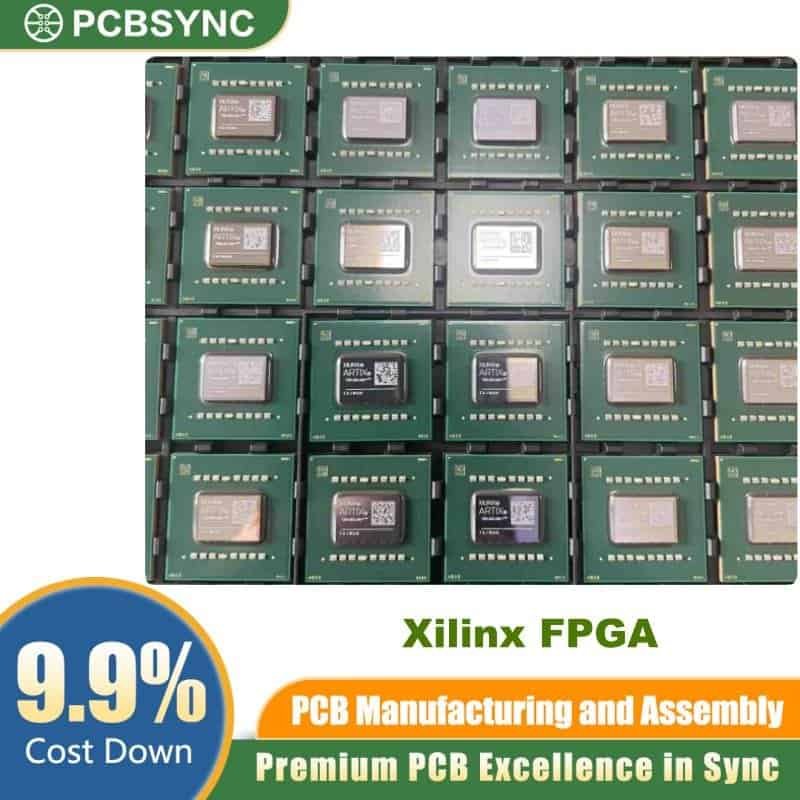
Overview of the XCV50E-7CS144C FPGA
The XCV50E-7CS144C is a high-performance Field Programmable Gate Array (FPGA) from AMD Xilinx’s renowned Virtex-E family. Designed for demanding digital signal processing and embedded system applications, this FPGA combines advanced processing capabilities with flexible programmability. Whether you’re developing telecommunications equipment, industrial control systems, or advanced computing solutions, the XCV50E-7CS144C delivers the performance and versatility your project demands.
As a member of the Virtex-E series, this Xilinx FPGA represents cutting-edge reconfigurable logic technology, offering engineers and designers a robust platform for innovative electronic solutions.
Key Specifications and Technical Features
Core Architecture Specifications
| Specification |
Value |
| Part Number |
XCV50E-7CS144C |
| Manufacturer |
AMD Xilinx (formerly Xilinx) |
| Product Family |
Virtex-E |
| Package Type |
144-TFBGA (Thin Fine-Pitch Ball Grid Array) |
| Total Pins |
144 |
| Operating Voltage |
2.5V Core |
| Speed Grade |
-7 (Commercial) |
| Temperature Range |
0°C to +85°C (Commercial) |
Performance Characteristics
| Feature |
Specification |
| Logic Cells |
512 CLBs (Configurable Logic Blocks) |
| System Gates |
Approximately 50,000 gates |
| Maximum Frequency |
Up to 200 MHz (design-dependent) |
| I/O Pins |
97 user I/O pins |
| Embedded Memory |
Block RAM available |
| Configuration |
SelectRAM, JTAG, Serial modes |
Product Features and Benefits
Advanced FPGA Architecture
The XCV50E-7CS144C FPGA delivers exceptional performance through its sophisticated architecture:
- High-Speed Processing: Commercial speed grade -7 ensures reliable operation for time-critical applications
- Compact Package: 144-pin TFBGA format provides excellent signal integrity in a space-efficient footprint
- Flexible I/O: Nearly 100 user-programmable I/O pins support various interface standards
- Robust Design: Commercial temperature grade suitable for industrial and professional applications
Programmable Logic Capabilities
This Virtex-E device excels in applications requiring:
- Digital Signal Processing (DSP): Fast arithmetic operations and data path implementations
- Protocol Implementation: Communication protocols including Ethernet, USB, and custom standards
- System Control: Complex state machines and control logic
- Data Processing: High-speed data manipulation and transformation
Memory and Configuration Options
The XCV50E-7CS144C includes:
- Block RAM: Embedded memory blocks for efficient data storage
- Distributed RAM: CLB-based memory for small, fast storage needs
- Multiple Configuration Modes: JTAG, SelectMAP, and serial configuration support
- In-System Reconfiguration: Update FPGA configuration without removing from circuit
Technical Specifications Table
Electrical Characteristics
| Parameter |
Min |
Typ |
Max |
Unit |
| Core Voltage (VCCINT) |
2.375 |
2.5 |
2.625 |
V |
| I/O Voltage (VCCO) |
– |
3.3/2.5 |
– |
V |
| Junction Temperature |
0 |
– |
85 |
°C |
| Static Power |
– |
TBD |
– |
mW |
Package Dimensions
| Measurement |
Value (mm) |
| Package Length |
12.0 |
| Package Width |
12.0 |
| Ball Pitch |
0.8 |
| Package Height |
1.2 (max) |
Applications and Use Cases
Primary Applications
The XCV50E-7CS144C FPGA is ideal for:
Telecommunications and Networking
- Protocol converters and bridges
- Network packet processing
- Software-defined radio (SDR) components
- Baseband processing
Industrial Automation
- Motor control systems
- PLC (Programmable Logic Controller) implementations
- Machine vision processing
- Sensor fusion applications
Embedded Systems
- Custom computing architectures
- Hardware acceleration
- System-on-Chip (SoC) prototyping
- Real-time control systems
Digital Signal Processing
- Audio/video processing
- Image processing pipelines
- Filter implementations
- Data acquisition systems
Design and Implementation Advantages
Development Ecosystem
Working with the XCV50E-7CS144C provides access to:
- ISE Design Suite: Xilinx’s comprehensive development environment
- IP Core Library: Pre-verified intellectual property blocks
- Simulation Tools: ModelSim, ISim integration
- ChipScope: On-chip debugging and analysis
Design Flexibility
Engineers benefit from:
- Rapid Prototyping: Quick design iterations through reconfiguration
- Hardware/Software Co-Design: Integration with embedded processors
- Scalability: Easy migration to larger Virtex-E devices
- Standards Support: Common I/O standards including LVTTL, LVCMOS, SSTL
Pin Configuration and Package Information
144-TFBGA Package Details
The compact TFBGA package offers:
- High Pin Density: Maximum functionality in minimal space
- Excellent Signal Integrity: Controlled impedance and low inductance
- Thermal Performance: Efficient heat dissipation
- PCB Compatibility: Standard 0.8mm ball pitch for manufacturability
I/O Banking Structure
| Bank |
I/O Pins |
Voltage |
| Bank 0 |
24 |
VCCO0 |
| Bank 1 |
24 |
VCCO1 |
| Bank 2 |
25 |
VCCO2 |
| Bank 3 |
24 |
VCCO3 |
Comparison with Related FPGA Models
XCV50E Series Variants
| Part Number |
Package |
Pins |
Speed Grade |
Temp Range |
| XCV50E-7CS144C |
TFBGA |
144 |
-7 |
Commercial |
| XCV50E-8CS144C |
TFBGA |
144 |
-8 |
Commercial |
| XCV50E-7FG256C |
FBGA |
256 |
-7 |
Commercial |
| XCV50E-7PQ240C |
PQFP |
240 |
-7 |
Commercial |
Selection Criteria
Choose the XCV50E-7CS144C when you need:
- Compact Form Factor: Space-constrained designs
- Balanced Performance: Speed grade -7 for most applications
- Cost Efficiency: Optimal price-to-performance ratio
- Standard Operating Conditions: Commercial temperature range
Quality and Reliability
Manufacturing Standards
The XCV50E-7CS144C meets:
- RoHS Compliance: Lead-free manufacturing
- ISO 9001: Quality management standards
- Moisture Sensitivity: MSL 3 rating
- ESD Protection: HBM and CDM tested
Lifecycle and Support
- Long-Term Availability: Established product with stable supply
- Technical Documentation: Comprehensive datasheets and application notes
- Design Support: Access to Xilinx forums and FAE assistance
- Reference Designs: Multiple proven implementations available
Getting Started with XCV50E-7CS144C
Required Development Tools
To begin working with this FPGA:
- Software: Xilinx ISE Design Suite (version 14.7 or compatible)
- Programming Cable: Platform Cable USB or compatible JTAG programmer
- Development Board: Evaluation board or custom PCB design
- Simulation: ModelSim or ISim for verification
Basic Design Flow
- Design Entry: Schematic or HDL (VHDL/Verilog) creation
- Synthesis: Convert design to netlist
- Implementation: Place and route for XCV50E-7CS144C
- Bitstream Generation: Create configuration file
- Programming: Load configuration via JTAG or other method
Power Management Considerations
Supply Requirements
| Power Rail |
Voltage |
Typical Current |
Notes |
| VCCINT |
2.5V |
Design-dependent |
Core logic supply |
| VCCO |
3.3V/2.5V |
Design-dependent |
I/O supply (per bank) |
| VCCAUX |
3.3V |
~50mA |
Auxiliary circuits |
Power Optimization Strategies
- Clock Gating: Disable unused clock domains
- Selective I/O: Power down unused I/O pins
- Core Voltage Optimization: Use lowest voltage meeting timing
- Design Partitioning: Isolate high-power blocks
Thermal Management
Thermal Characteristics
- Junction Temperature (TJ): 0°C to +85°C
- Theta JA: Varies with PCB design and airflow
- Power Dissipation: Calculated based on toggle rates and utilization
Cooling Recommendations
For optimal thermal performance:
- Adequate PCB copper pour for heat spreading
- Thermal vias connecting to ground planes
- Forced air cooling for high-utilization designs
- Temperature monitoring during operation
Ordering Information and Availability
Part Number Breakdown
XCV50E-7CS144C
- XCV: Virtex-E family designation
- 50E: 50,000 equivalent system gates
- 7: Speed grade (commercial)
- C: Commercial temperature range
- S144: 144-pin TFBGA package
- C: RoHS compliant
Where to Purchase
The XCV50E-7CS144C is available through:
- Authorized Xilinx distributors
- Major electronic component suppliers
- Direct from AMD/Xilinx for volume orders
- Online marketplaces for immediate availability
Frequently Asked Questions
What is the difference between speed grades -7 and -8?
Speed grade -7 offers standard performance suitable for most applications, while -8 provides enhanced timing performance for more demanding designs. Both operate within commercial temperature ranges.
Can this FPGA be reprogrammed?
Yes, the XCV50E-7CS144C is fully reprogrammable. You can reconfigure it unlimited times using JTAG, SelectMAP, or serial configuration methods.
What development tools are compatible?
The XCV50E-7CS144C is supported by Xilinx ISE Design Suite 14.7 and earlier versions. Note that newer Vivado tools do not support Virtex-E devices.
What is the recommended PCB footprint?
The 144-TFBGA package requires a footprint with 0.8mm ball pitch. Reference the Xilinx packaging specifications for detailed land pattern recommendations.
Is technical support available?
Yes, AMD Xilinx provides comprehensive technical documentation, application notes, and community support through forums. Additional support is available through authorized distributors.
Conclusion
The XCV50E-7CS144C represents a proven solution for engineers requiring high-performance programmable logic in a compact package. With its robust Virtex-E architecture, comprehensive I/O capabilities, and extensive development tool support, this FPGA enables rapid implementation of complex digital designs across telecommunications, industrial, and embedded system applications.
Whether you’re prototyping a new concept or deploying a production solution, the XCV50E-7CS144C delivers the reliability, performance, and flexibility needed for today’s demanding electronic systems.