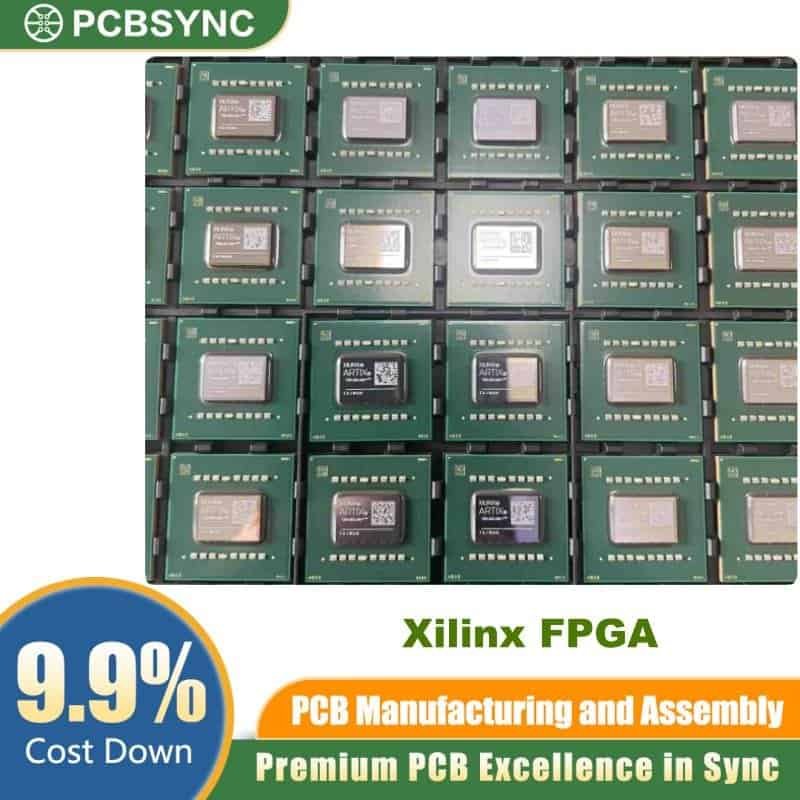
Overview of XCV600E-6FG680C FPGA Technology
The XCV600E-6FG680C represents a powerful solution in AMD Xilinx’s Virtex-E family of Field Programmable Gate Arrays. This advanced FPGA delivers exceptional programmable logic performance with 512 I/O pins in a compact 680-ball Fine-Pitch Ball Grid Array (FBGA) package. Designed for demanding applications in telecommunications, aerospace, industrial automation, and data processing, this component offers the flexibility and performance engineers need for complex digital designs.
As part of the renowned Xilinx FPGA product line, the XCV600E-6FG680C combines high-density logic resources with advanced architectural features that enable rapid prototyping and deployment of sophisticated digital systems.
Key Technical Specifications of XCV600E-6FG680C
Core FPGA Architecture Features
| Specification |
Details |
| Part Number |
XCV600E-6FG680C |
| Manufacturer |
AMD (formerly Xilinx Inc.) |
| Product Family |
Virtex-E Series |
| Logic Cells |
15,552 cells |
| Configurable Logic Blocks |
3,456 CLBs |
| System Gates |
186,624 gates |
| Block RAM |
294,912 bits (36 KB) |
| Maximum Operating Frequency |
357 MHz |
| I/O Pins |
512 user I/O |
Physical and Electrical Characteristics
| Parameter |
Specification |
| Package Type |
680-LBGA (Low-profile Ball Grid Array) |
| Package Configuration |
Fine-Pitch BGA with Exposed Pad |
| Mounting Type |
Surface Mount Technology (SMT) |
| Operating Temperature Range |
Commercial: 0°C to +85°C |
| Supply Voltage |
Core: 1.8V; I/O: 3.3V/2.5V compatible |
| Process Technology |
0.22 μm CMOS, 5-layer metal |
| RoHS Status |
Non-compliant (Legacy product) |
Understanding Virtex-E FPGA Technology
What Makes the XCV600E-6FG680C Stand Out
The Virtex-E architecture revolutionized FPGA design by introducing several breakthrough features:
Advanced Silicon Efficiency: The XCV600E-6FG680C leverages an optimized architecture that maximizes place-and-route efficiency, allowing designers to implement more complex logic within the same silicon footprint. This efficiency translates directly to reduced development time and improved system performance.
High-Speed Performance: With a maximum operating frequency of 357 MHz, this FPGA excels in time-critical applications including digital signal processing, real-time data acquisition, and high-speed communication protocols.
Flexible I/O Architecture: The 512 I/O pins support multiple voltage standards, making the XCV600E-6FG680C compatible with a wide range of interfacing requirements. This flexibility simplifies board design and enables seamless integration with various peripheral components.
XCV600E-6FG680C Application Areas
Primary Applications
The versatility of the XCV600E-6FG680C makes it suitable for numerous high-performance applications:
Telecommunications Infrastructure: Network routers, switches, and base station controllers benefit from the high gate count and flexible I/O capabilities. The FPGA’s ability to implement custom protocols and signal processing algorithms makes it ideal for next-generation communication systems.
Industrial Control Systems: Factory automation, machine vision, and motor control applications leverage the real-time processing capabilities and extensive I/O resources. The deterministic behavior of FPGA logic ensures precise timing control for critical industrial processes.
Medical Device Electronics: Medical imaging equipment, diagnostic instruments, and patient monitoring systems utilize the high-speed data processing and reliable performance characteristics of this FPGA.
Aerospace and Defense: Radar signal processing, avionics systems, and secure communication devices take advantage of the radiation-tolerant design principles inherent in the Virtex-E architecture.
Secondary Use Cases
| Application Domain |
Benefits |
| Data Encryption/Decryption |
Hardware-accelerated cryptographic operations |
| Video Processing |
Real-time video encoding, decoding, and transformation |
| Test & Measurement |
High-speed data acquisition and signal generation |
| Automotive Electronics |
Advanced driver assistance systems (ADAS) prototyping |
| Research & Development |
Algorithm prototyping and hardware acceleration |
Design Advantages of XCV600E-6FG680C
Enhanced Design Flexibility
The configurable nature of the XCV600E-6FG680C offers significant advantages over fixed-function ASICs:
- Rapid Prototyping: Designers can implement and test complex digital designs in hours rather than weeks, dramatically accelerating product development cycles.
- In-Field Upgradability: The reconfigurable architecture allows firmware updates to enhance functionality or fix bugs without hardware changes.
- Cost-Effective Development: Lower non-recurring engineering (NRE) costs compared to ASIC development make the XCV600E-6FG680C economical for low to medium production volumes.
- Design Reuse: Intellectual property (IP) cores can be easily ported and reused across different projects, maximizing return on development investment.
Performance Optimization Features
| Feature |
Description |
Benefit |
| Dedicated Multipliers |
Hardware multiplication blocks |
Accelerated DSP operations |
| Distributed RAM |
LUT-based memory |
Low-latency local storage |
| Block RAM |
36 KB embedded memory |
Efficient large buffer implementation |
| DLL (Delay-Locked Loop) |
Clock management resources |
Reduced clock skew and jitter |
| Tri-state Buffers |
Bidirectional I/O support |
Flexible bus architectures |
XCV600E-6FG680C Package Information
680-FBGA Package Details
The Fine-Pitch Ball Grid Array (FBGA) package provides optimal thermal and electrical performance:
Thermal Management: The exposed pad design facilitates efficient heat dissipation, crucial for high-performance operation. This feature enables the FPGA to maintain stable operation even under continuous heavy computational loads.
Signal Integrity: The short electrical paths inherent in BGA packages minimize parasitic inductance and capacitance, supporting high-speed signal transmission with reduced electromagnetic interference.
Board Space Efficiency: The compact 680-ball footprint delivers maximum I/O density while maintaining manageable pitch for reliable PCB manufacturing.
PCB Design Considerations
| Design Aspect |
Recommendation |
| PCB Layers |
Minimum 6 layers recommended |
| Power Plane Design |
Separate planes for core and I/O supplies |
| Decoupling Capacitors |
Multiple values (0.1μF, 1μF, 10μF) near power pins |
| Thermal Via Array |
Under exposed pad for heat transfer |
| Impedance Control |
50Ω single-ended, 100Ω differential |
| Ball Pitch |
1.0 mm (verify with manufacturer datasheet) |
Comparing XCV600E-6FG680C with Contemporary FPGAs
Virtex-E Family Position
| Model |
Logic Cells |
System Gates |
Block RAM |
I/O Pins |
Package |
| XCV400E |
10,240 |
124,416 |
196,608 bits |
404 |
432-FBGA |
| XCV600E-6FG680C |
15,552 |
186,624 |
294,912 bits |
512 |
680-FBGA |
| XCV812E |
24,576 |
294,912 |
491,520 bits |
556 |
680-FBGA |
| XCV1000E |
32,768 |
393,216 |
655,360 bits |
660 |
896-FBGA |
The XCV600E-6FG680C occupies a mid-range position in the Virtex-E family, offering an optimal balance of logic resources, memory, and I/O capability for many mainstream applications.
Development Tools and Resources
Software Support
ISE Design Suite: The XCV600E-6FG680C is supported by Xilinx ISE (Integrated Software Environment), providing comprehensive tools for:
- HDL synthesis (VHDL and Verilog)
- Place and route optimization
- Timing analysis and constraint management
- Power estimation and analysis
- Bitstream generation and configuration
Third-Party IP Cores: A vast ecosystem of pre-verified IP cores is available, including:
- Communication protocols (PCIe, Ethernet, USB)
- DSP functions (FIR filters, FFT, DDS)
- Video processing (codecs, scaling, format conversion)
- Memory controllers (DDR, SDRAM, SRAM)
Programming and Configuration
| Configuration Mode |
Description |
Use Case |
| JTAG |
Boundary scan interface |
Development and debugging |
| Master Serial |
SPI flash boot |
Production embedded systems |
| Slave Serial |
External controller mode |
System-level configuration |
| SelectMAP |
Parallel configuration |
Fast reconfiguration applications |
Quality and Reliability Specifications
Manufacturing Standards
The XCV600E-6FG680C adheres to stringent quality standards:
- ESD Protection: Human Body Model (HBM) > 2000V
- Latch-up Immunity: > 200mA per JESD78
- MTBF: Mean Time Between Failures exceeds industry standards for commercial applications
- Moisture Sensitivity Level: MSL 3 per J-STD-020
Testing and Validation
Every XCV600E-6FG680C undergoes comprehensive testing:
- Functional Testing: Complete logic and memory verification
- Speed Grading: Performance binning to guarantee -6 speed grade specifications
- I/O Testing: Pin-level electrical parameter validation
- Thermal Cycling: Temperature stress testing for reliability assurance
Procurement and Availability Information
Current Market Status
Lifecycle Status: The XCV600E-6FG680C is classified as an obsolete product by the manufacturer. While new production has ceased, the component remains available through:
- Authorized distributors with remaining inventory
- Franchise distributors specializing in legacy components
- Independent electronic component brokers
- Excess inventory suppliers
Sourcing Considerations
| Factor |
Consideration |
| Lead Time |
Varies significantly; stock availability limited |
| Minimum Order Quantity |
Depends on supplier; ranges from 1 to full reels |
| Pricing |
Subject to supply/demand; quote-based |
| Authenticity Verification |
Critical for secondary market purchases |
| Long-Term Availability |
Consider last-time-buy opportunities |
Alternative and Successor Products
For new designs, engineers should consider modern alternatives:
- Spartan-7 Series: Cost-optimized with improved power efficiency
- Artix-7 Series: Enhanced performance in similar density range
- Kintex-7 Series: Superior performance for demanding applications
- Zynq-7000 SoC: Integrated ARM processors with FPGA fabric
Technical Support and Documentation
Available Resources
Official Documentation:
- Complete datasheet with electrical specifications
- User guide detailing architecture and features
- Application notes for common design scenarios
- IBIS models for signal integrity simulation
- Package mechanical drawings
Community Support:
- Active online forums with experienced FPGA developers
- Open-source project repositories demonstrating reference designs
- Video tutorials covering basic to advanced topics
- University research papers utilizing Virtex-E technology
Best Practices for XCV600E-6FG680C Implementation
Design Guidelines
Power Supply Design: Implement a robust power distribution network with:
- Low-ESR capacitors for high-frequency noise filtering
- Adequate current capacity for dynamic power consumption
- Separate power domains for core and I/O with proper sequencing
- Power-on-reset circuitry to ensure clean FPGA initialization
Clock Distribution: Utilize dedicated clock resources effectively:
- Leverage global clock buffers for low-skew distribution
- Implement clock domain crossing protocols for asynchronous interfaces
- Use Digital Clock Managers (DCMs) for frequency synthesis and phase alignment
- Maintain clean clock edges through proper PCB routing techniques
I/O Bank Configuration: Optimize I/O utilization by:
- Grouping signals by voltage standard within I/O banks
- Minimizing simultaneous switching noise through staggered transitions
- Implementing proper termination for high-speed interfaces
- Using differential signaling for noise-sensitive applications
Common Design Pitfalls to Avoid
- Insufficient Power Supply Decoupling: Leads to voltage droop and unreliable operation
- Inadequate Thermal Management: Causes performance degradation and potential failure
- Poor Clock Domain Crossing: Results in metastability and functional errors
- Ignoring Timing Constraints: Creates race conditions and timing violations
- Overlooking Configuration Security: Exposes intellectual property to cloning
Environmental and Compliance Information
Regulatory Compliance
| Standard |
Status |
Notes |
| RoHS |
Non-compliant |
Legacy product; exemptions may apply |
| REACH |
Pre-REACH product |
Verify specific requirements |
| WEEE |
Subject to regulations |
Proper disposal required |
| UL Recognition |
File E11623 |
Component recognition available |
| FCC Compliance |
Class A digital device |
Board-level testing required |
Operating Environment
Temperature Ranges:
- Commercial (C) grade: 0°C to +85°C junction temperature
- Extended temperature variants may be available in specific models
- Recommend operation with adequate airflow or heatsinking
Storage Conditions:
- Temperature: -55°C to +125°C
- Humidity: < 90% RH non-condensing
- Anti-static precautions mandatory
Conclusion: Is the XCV600E-6FG680C Right for Your Project?
The XCV600E-6FG680C Virtex-E FPGA delivers proven performance for a wide range of digital design applications. While classified as an obsolete product, it continues to serve existing designs and offers a cost-effective solution for applications where cutting-edge process technology is not essential.