Inquire: Call 0086-755-23203480, or reach out via the form below/your sales contact to discuss our design, manufacturing, and assembly capabilities.
Quote: Email your PCB files to Sales@pcbsync.com (Preferred for large files) or submit online. We will contact you promptly. Please ensure your email is correct.
Notes: For PCB fabrication, we require PCB design file in Gerber RS-274X format (most preferred), *.PCB/DDB (Protel, inform your program version) format or *.BRD (Eagle) format. For PCB assembly, we require PCB design file in above mentioned format, drilling file and BOM. Click to download BOM template To avoid file missing, please include all files into one folder and compress it into .zip or .rar format.
The Portenta H7 isn’t competing with the Uno or the MKR series. It’s competing with industrial PLCs, custom ARM designs, and embedded Linux solutions—and in many scenarios, it wins. The combination of dual-core processing power, industrial temperature rating, and the familiar Arduino development environment creates something genuinely unique in the embedded world.
What Sets the Arduino Portenta H7 Apart from Other Boards
Meta:Arduino Portenta H7 complete guide: dual-core ARM processing, machine learning at the edge, Vision Shield integration, and industrial IoT deployment tips.
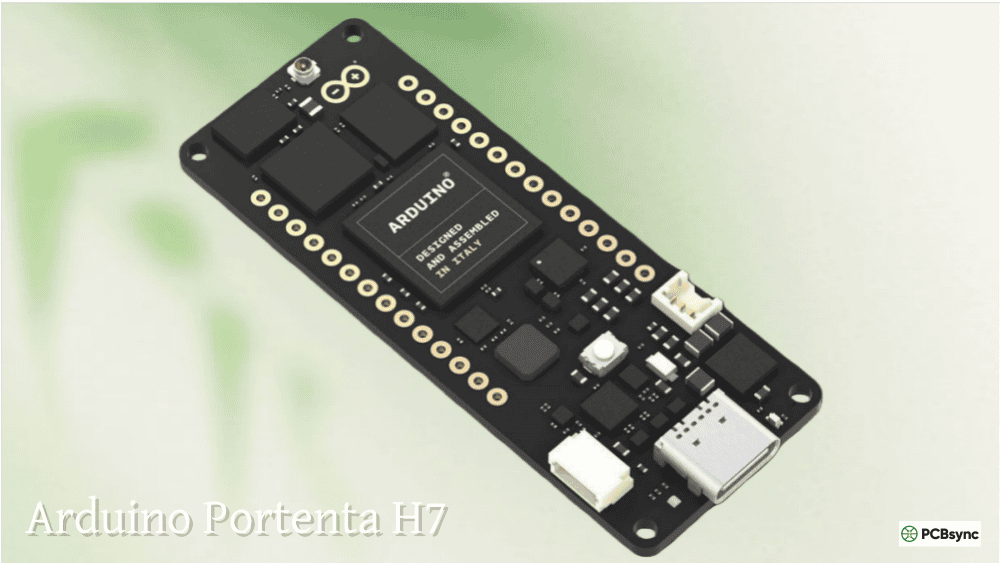
The Arduino Portenta H7 represents Arduino’s first serious entry into the industrial embedded market. While previous boards targeted education and prototyping, the Portenta H7 was designed from the ground up for production deployment in demanding environments.
At its core sits the STMicroelectronics STM32H747XI—a dual-core processor combining a Cortex-M7 running at 480MHz with a Cortex-M4 at 240MHz. These cores aren’t just faster versions of what you’d find in other Arduino boards; they’re fundamentally different architectures designed for asymmetric processing. The M7 handles computationally intensive tasks like machine learning inference, while the M4 manages real-time operations like motor control or sensor acquisition with deterministic timing.
What truly distinguishes the Portenta H7 is its industrial pedigree. The board carries a -40°C to +85°C operating temperature rating, hardware security through the NXP SE050C2 crypto chip, and connectivity options that span WiFi, Bluetooth, Ethernet, and optional LoRa or cellular. This isn’t a board you’ll outgrow—it’s designed to go directly from prototype to production.
Understanding the Portenta H7’s specifications reveals why it commands premium pricing:
Specification
Details
Microcontroller
STM32H747XI (Dual-core)
Primary Core
Arm Cortex-M7 @ 480 MHz
Secondary Core
Arm Cortex-M4 @ 240 MHz
Flash Memory
2 MB internal + 16 MB QSPI external
SRAM
1 MB internal + 8 MB SDRAM external
Operating Voltage
3.3V
Input Voltage
5V (USB-C or VIN)
Operating Temperature
-40°C to +85°C (Industrial grade)
Dimensions
66.04 × 25.4 mm (MKR form factor)
High-Density Connectors
2× 80-pin (160 total)
Crypto Chip
NXP SE050C2 (Common Criteria certified)
Graphics
Chrom-ART Accelerator (2D GPU)
USB
USB-C with DisplayPort Alt Mode
The expandable memory architecture deserves particular attention. While the default configuration includes 8MB SDRAM and 16MB QSPI Flash, custom orders can specify up to 64MB SDRAM and 128MB Flash—enough for sophisticated embedded applications or large neural network models.
The STM32H747’s dual-core design enables genuinely parallel processing that single-core systems simply cannot match. This asymmetric architecture was specifically chosen for IoT applications requiring both computational power and real-time responsiveness.
Cortex-M7 Core (480 MHz)
The M7 serves as the primary processing unit, handling:
Machine learning inference (TensorFlow Lite)
Complex algorithm processing
High-level application logic
Network protocol stacks
Graphics rendering via Chrom-ART
Cortex-M4 Core (240 MHz)
The M4 operates as a dedicated real-time processor:
Motor control with deterministic timing
Sensor data acquisition
Low-latency I/O operations
Time-critical interrupt handling
Audio processing pipelines
Inter-Core Communication
The two cores communicate through a Remote Procedure Call (RPC) mechanism that makes calling functions across cores as simple as local function calls. This abstraction means you can write code for either core without managing the underlying communication complexity.
Programming Mode
M7 Core
M4 Core
Arduino Sketch
Yes
Yes
MicroPython
Yes
No
JavaScript
Yes
No
Native Mbed OS
Yes
Yes
TensorFlow Lite
Yes
Limited
This flexibility allows running Arduino compiled code alongside MicroPython scripts, with both cores communicating seamlessly. You could have Python handling high-level IoT logic while Arduino code manages real-time motor control—something impossible on traditional single-core boards.
Connectivity Options for Industrial IoT
The Portenta H7’s connectivity suite addresses virtually every industrial communication requirement:
Wireless Connectivity
Interface
Specification
WiFi
802.11 b/g/n, up to 65 Mbps
WiFi Modes
Station, Access Point, Dual AP/STA
Bluetooth
Classic + BLE 5.0
Antenna
Ceramic onboard or external U.FL
Wired Connectivity
Interface
Specification
Ethernet
10/100 Mbps with Wake-on-LAN
USB
High-Speed (480 Mbps), Host/Device
CAN Bus
Via carrier boards
UART/SPI/I2C
Multiple instances available
The simultaneous WiFi and Bluetooth operation is particularly valuable for IoT gateways that need to communicate with both cloud services and local BLE sensors without switching modes. I’ve deployed this configuration in factory settings where the Portenta acts as a bridge between legacy BLE equipment and modern cloud infrastructure.
Graphics and Display Capabilities
Perhaps the Portenta H7’s most unexpected feature is its embedded graphics capability. The STM32H747 includes the Chrom-ART Accelerator—a dedicated 2D graphics processor that handles:
Hardware-accelerated 2D graphics primitives
JPEG encoding and decoding
Alpha blending and color format conversion
DMA-based display updates
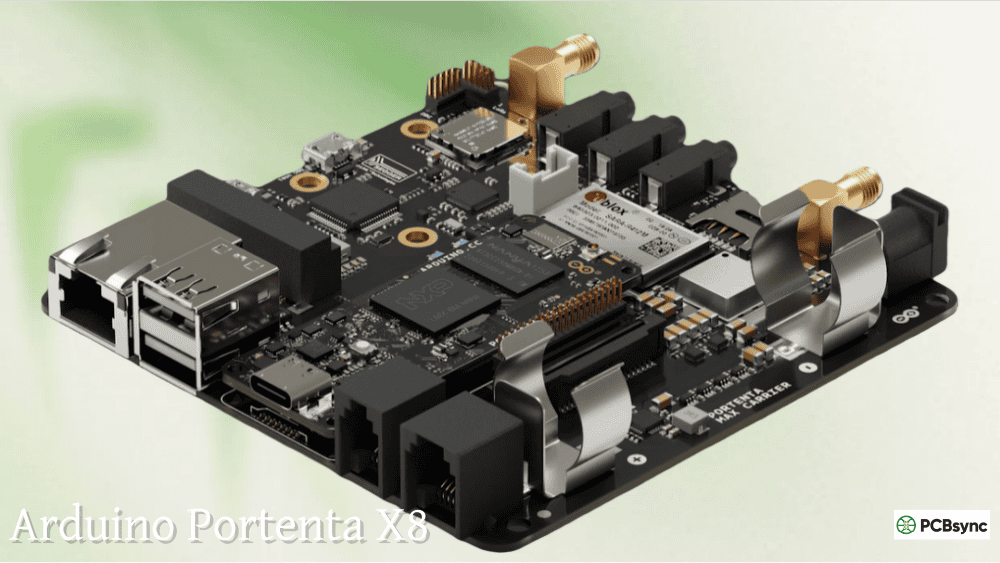
The USB-C port supports DisplayPort Alternate Mode, meaning you can connect an external monitor and build genuine embedded computers with graphical user interfaces. Combined with the Portenta Breakout Board or Max Carrier, you gain access to HDMI output and camera interfaces for full multimedia applications.
This transforms the Portenta H7 from a microcontroller into something resembling a small single-board computer—but with real-time capabilities that Linux-based systems can’t match.
Portenta H7 Expansion Ecosystem
Arduino designed the Portenta family around a modular expansion system using two 80-pin high-density connectors:
Expansion Board
Key Features
Primary Use Case
Portenta Vision Shield
HM-01B0 camera, dual microphones
Machine vision, voice recognition
Portenta Breakout Board
Full pin access, prototyping-friendly
Development and testing
Portenta Max Carrier
Mini-PCIe, SATA, full I/O breakout
Industrial deployment
Portenta Machine Control
24V I/O, industrial protocols
PLC replacement
Portenta Cat.M1/NB-IoT Shield
Cellular connectivity with GNSS
Remote deployments
Portenta Vision Shield Deep Dive
The Vision Shield transforms the Portenta H7 into an intelligent camera platform. The Himax HM-01B0 camera module was specifically designed for always-on vision applications with remarkably low power consumption.
Vision Shield Feature
Specification
Camera Resolution
324 × 324 pixels
Pixel Size
3.6 µm (high sensitivity)
Power Consumption
<2 mW in always-on mode
Microphones
2× omnidirectional (beamforming capable)
Connectivity Options
Ethernet or LoRa variants
Storage
MicroSD card slot
The combination of low-power vision sensing with edge AI processing enables applications like predictive maintenance, gesture recognition, and quality inspection without cloud dependency. The camera can autonomously detect motion and wake the main processor only when needed—a massive power savings for battery-powered deployments.
Machine Learning and AI at the Edge
The Portenta H7 was explicitly designed for edge AI applications. The processing power, memory resources, and software support combine to enable sophisticated machine learning deployment.
TensorFlow Lite Integration
Running TensorFlow Lite models on the Portenta H7 follows a straightforward workflow:
Train a model using TensorFlow on a desktop or cloud system
Convert to TensorFlow Lite format
Quantize for efficient inference (INT8 recommended)
Deploy via Arduino sketch using Arduino_TensorFlowLite library
The dual-core architecture shines here—the M7 can run inference while the M4 handles real-time sensor input, enabling continuous predictions on streaming data without frame drops or timing issues.
Edge Impulse Integration
Arduino has partnered with Edge Impulse to provide an end-to-end machine learning development platform specifically optimized for Portenta hardware. This integration simplifies the entire ML pipeline from data collection through deployment, with direct firmware export to Arduino format.
The Portenta H7 supports multiple programming paradigms, making it accessible to developers with different backgrounds:
Arduino IDE
The familiar Arduino environment works as expected, with the Arduino Mbed OS Core providing hardware abstraction. Standard Arduino functions, libraries, and workflows apply, though the dual-core architecture introduces new concepts like core-specific execution.
MicroPython
Full MicroPython support enables rapid prototyping and scripting-style development. The M7 core runs the Python interpreter while the M4 handles real-time tasks—you can even run Arduino code on M4 simultaneously with MicroPython on M7.
OpenMV IDE
For computer vision applications, OpenMV IDE provides a Python-based environment specifically optimized for image processing. Combined with the Vision Shield, this enables quick development of vision applications without deep embedded expertise. Arduino partnered with OpenMV to add full Portenta support starting with version 2.6.4.
Native Mbed OS
For maximum performance and control, direct Mbed OS development bypasses Arduino abstraction layers. This approach suits production firmware where every CPU cycle matters and deterministic behavior is critical.
STM32CubeIDE
Engineers familiar with STMicroelectronics toolchains can use STM32CubeIDE for bare-metal or RTOS-based development with full access to ST’s HAL libraries and peripheral drivers.
Power Management for Industrial Deployment
The Portenta H7’s power architecture reflects its industrial intent:
Power Source
Voltage Range
Notes
USB-C
5V
Primary development power
VIN
5V-5.5V
External supply input
Battery
3.7V Li-Po
Via JST connector
80-pin HDC
Various
Carrier-dependent
Power Management IC
The onboard NXP PF1550 PMIC handles all power conversion and sequencing with automatic source selection between USB, VIN, and battery. Multiple regulated outputs (3.3V, 3.1V, 2.8V, 1.8V, 1.2V, 1.0V) power different subsystems with appropriate voltage levels.
Power Consumption Profiles
Operating Mode
Typical Current
Full operation (both cores, WiFi)
~500 mA
Single core, WiFi disabled
~200 mA
Deep sleep
<1 mA
Vision Shield always-on
<2 mW additional
Security Features for Production IoT
Industrial deployments demand robust security, and the Portenta H7 delivers through multiple layers:
Hardware Security Module
The NXP SE050C2 crypto chip provides Common Criteria EAL 6+ certified security:
The STM32H747 supports secure boot chains that verify firmware authenticity before execution. Combined with Arduino IoT Cloud or third-party platforms, secure over-the-air updates enable remote maintenance without physical access to deployed devices.
Real-World Industrial Applications
The Portenta H7 finds applications across diverse industrial sectors:
Industry
Application Example
Manufacturing
Real-time quality inspection with Vision Shield
Energy
Smart grid edge computing and monitoring
Agriculture
Autonomous irrigation and crop monitoring
Logistics
Asset tracking with cellular connectivity
Building Automation
HVAC optimization with AI-based control
Robotics
Motion control with ML-based path planning
Healthcare
Medical device monitoring and analysis
A typical predictive maintenance deployment might combine the Portenta H7 running vibration analysis algorithms, Vision Shield for visual inspection, Ethernet connectivity for data upload, and edge AI models detecting anomalies locally. The dual-core architecture enables continuous sensor monitoring while running inference—something impossible on single-core alternatives.
Is the Arduino Portenta H7 worth the price compared to cheaper alternatives?
The Portenta H7’s approximately $100 price point reflects its industrial specifications—dual-core processing, hardware security, industrial temperature rating, and expansion ecosystem. For hobbyist projects, it’s genuinely overkill. But for professional applications requiring reliable long-term deployment, the cost is easily justified. Consider that designing equivalent functionality on a custom PCB would cost significantly more in engineering time, component sourcing, certification, and minimum order quantities. The Portenta pays for itself when you need production-ready hardware without custom board development, or when you’re prototyping for eventual custom hardware but need immediate deployment capability.
Can I run both cores simultaneously with different programming languages?
Yes, this is one of the Portenta H7’s most powerful features. You can run Arduino compiled code on the M4 core while executing MicroPython or JavaScript on the M7 core. The RPC mechanism handles inter-core communication transparently. This enables scenarios like having a Python script handling high-level IoT logic and cloud communication while Arduino code manages real-time motor control with microsecond precision. However, some combinations work better than others—MicroPython’s interpreter is resource-intensive and benefits from the M7’s processing power.
What’s the difference between Portenta H7, H7 Lite, and H7 Lite Connected?
The three variants address different cost/feature trade-offs. The full Portenta H7 includes everything: WiFi, Bluetooth, Ethernet PHY, crypto chip, DisplayPort output, and maximum memory configuration. The H7 Lite removes wireless connectivity, video output, and security features—ideal for cost-sensitive applications in wired environments where radio communication isn’t needed. The H7 Lite Connected adds back WiFi and Bluetooth but keeps other cost optimizations, hitting a middle ground for wireless IoT applications that don’t require video output or hardware security.
How does the Portenta H7 compare to Raspberry Pi for industrial IoT?
These platforms serve fundamentally different needs. The Raspberry Pi runs Linux—great for complex software stacks but terrible for real-time control due to OS scheduling unpredictability. The Portenta H7 provides deterministic real-time performance essential for motor control, safety systems, and precise timing applications. The Portenta also offers industrial temperature ratings (-40°C to +85°C versus 0°C to 50°C for Pi), hardware security certification, and a path to custom production hardware. Choose Raspberry Pi when you need full Linux capability and timing isn’t critical; choose Portenta H7 when you need industrial reliability with real-time performance.
Can I use the Portenta H7 for battery-powered applications?
Yes, but with realistic expectations. The Portenta H7 draws approximately 500mA at full operation with WiFi active—not suitable for coin-cell powered sensors. However, the deep sleep current under 1mA combined with the Vision Shield’s 2mW always-on camera enables practical battery-powered edge AI devices that wake only when interesting events occur. For truly low-power sensing, you might consider the Nicla series for data acquisition paired with Portenta H7 as a gateway. The battery charging circuit via the PMIC supports LiPo batteries for portable or backup power configurations.
Final Thoughts on Arduino Portenta H7 for Professional Development
The Arduino Portenta H7 represents a genuine paradigm shift in how we can approach industrial embedded development. It’s not just a more powerful Arduino—it’s a fundamentally different class of device that happens to be programmable through familiar Arduino tools.
For engineers accustomed to the painful process of designing custom industrial boards, the Portenta H7 offers an attractive alternative: production-ready hardware with industrial certifications, a proven ecosystem of expansion boards, and the flexibility to start with Arduino simplicity and migrate to native Mbed or bare-metal code as projects mature.
The dual-core architecture isn’t just a marketing bullet point—it’s a genuinely useful capability that enables application patterns impossible on single-core systems. Running machine learning inference while maintaining real-time control isn’t a theoretical exercise; it’s exactly what modern industrial IoT demands.
Is it the right choice for every project? Absolutely not. Simple sensor nodes don’t need this much capability, and cost-sensitive high-volume products will eventually migrate to custom hardware. But for professional prototyping, low-to-medium volume production, and applications where development speed matters more than per-unit cost optimization, the Portenta H7 delivers capabilities that would otherwise require significant custom engineering effort.
After deploying multiple Portenta-based systems in industrial environments, I can confidently say this platform has earned its place in the professional embedded engineer’s toolkit. It’s expensive for an Arduino, but remarkably affordable for what it actually delivers.
Inquire: Call 0086-755-23203480, or reach out via the form below/your sales contact to discuss our design, manufacturing, and assembly capabilities.
Quote: Email your PCB files to Sales@pcbsync.com (Preferred for large files) or submit online. We will contact you promptly. Please ensure your email is correct.
Notes: For PCB fabrication, we require PCB design file in Gerber RS-274X format (most preferred), *.PCB/DDB (Protel, inform your program version) format or *.BRD (Eagle) format. For PCB assembly, we require PCB design file in above mentioned format, drilling file and BOM. Click to download BOM template To avoid file missing, please include all files into one folder and compress it into .zip or .rar format.