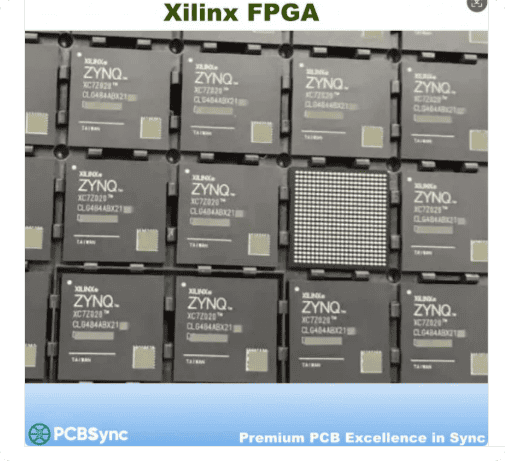
Overview of XC2S200-6FGG958C Xilinx FPGA
The XC2S200-6FGG958C is a powerful field-programmable gate array (FPGA) from Xilinx’s renowned Spartan-II family, designed to deliver exceptional performance for cost-sensitive digital design applications. This advanced programmable logic device combines 200,000 system gates with 5,292 logic cells, making it an ideal solution for telecommunications, industrial automation, consumer electronics, and embedded systems development.
As a member of the Spartan-II FPGA family, the XC2S200-6FGG958C represents a superior alternative to traditional ASICs, offering designers the flexibility to implement complex digital circuits without the high upfront costs and lengthy development cycles associated with custom silicon solutions.
Key Technical Specifications of XC2S200-6FGG958C
Core Performance Features
| Specification |
Value |
| Device Family |
Xilinx Spartan-II |
| Part Number |
XC2S200-6FGG958C |
| System Gates |
200,000 gates |
| Logic Cells |
5,292 cells |
| CLB Array Configuration |
28 x 42 (1,176 total CLBs) |
| Speed Grade |
-6 (Commercial temperature range) |
| Core Voltage |
2.5V |
| Package Type |
FGG958 (Fine-Pitch Ball Grid Array) |
| Operating Frequency |
Up to 263 MHz |
| Process Technology |
0.18µm CMOS |
Memory Resources and I/O Capabilities
| Feature |
Specification |
| Distributed RAM |
75,264 bits |
| Block RAM |
56 Kbits (7 KB) |
| Maximum User I/O |
284 pins (package dependent) |
| Global Clock Inputs |
4 dedicated pins |
| Delay-Locked Loops (DLLs) |
4 units |
| Temperature Range |
Commercial (0°C to +85°C) |
Advanced Architecture of Spartan-II XC2S200 FPGA
Configurable Logic Blocks (CLBs)
The XC2S200-6FGG958C features a robust architecture built around 1,176 Configurable Logic Blocks arranged in a 28 x 42 array. Each CLB contains four logic slices with look-up tables (LUTs), flip-flops, and multiplexers, enabling efficient implementation of complex combinational and sequential logic functions.
Memory Architecture
The dual-memory architecture provides designers with flexible data storage options:
- Distributed RAM: 75,264 bits of distributed RAM integrated within CLBs for small, fast memory requirements
- Block RAM: 56 Kbits organized in dedicated memory blocks for larger data buffering and storage applications
- Configurable Memory Modes: Support for single-port RAM, dual-port RAM, and ROM configurations
Clock Management System
Four Delay-Locked Loops (DLLs) positioned at each corner of the die provide advanced clock management capabilities, including:
- Clock de-skewing and distribution
- Frequency synthesis and multiplication
- Phase shifting for timing optimization
- Low-jitter clock generation
Primary Applications for XC2S200-6FGG958C
Telecommunications and Networking
The XC2S200-6FGG958C excels in telecommunications applications requiring high-speed data processing:
- Protocol converters and network routers
- Digital signal processing (DSP) for voice and data
- Baseband processing units
- Channel encoding/decoding systems
- Software-defined radio (SDR) implementations
Industrial Control and Automation
Industrial applications benefit from the FPGA’s reliability and reconfigurability:
- Programmable logic controllers (PLCs)
- Motor control systems
- Process monitoring and control
- Machine vision processing
- Robotics control interfaces
Consumer Electronics
The cost-effective nature of the Spartan-II family makes it ideal for high-volume consumer products:
- Digital video/audio processing
- Display controllers and graphics acceleration
- Gaming console peripherals
- Smart home automation hubs
- IoT gateway devices
Medical and Scientific Instrumentation
Medical device manufacturers leverage the XC2S200 for:
- Medical imaging systems
- Patient monitoring equipment
- Diagnostic instrument controllers
- Laboratory automation systems
- Biosensor data acquisition
Design Advantages and Benefits
Cost-Effective Development
| Traditional ASIC |
XC2S200-6FGG958C FPGA |
| High NRE costs ($100K+) |
Minimal upfront investment |
| 6-12 month development cycle |
Rapid prototyping (weeks) |
| No field updates possible |
Reconfigurable in-system |
| High risk of design errors |
Iterative design refinement |
| Minimum order quantities |
Single-unit purchases available |
Design Flexibility and Time-to-Market
The programmable nature of the XC2S200-6FGG958C enables:
- Rapid Prototyping: Implement and test designs within days instead of months
- In-Field Updates: Deploy firmware upgrades without hardware replacement
- Design Iteration: Refine logic without silicon re-spins
- Future-Proofing: Adapt to changing standards and protocols
- Risk Mitigation: Validate functionality before committing to volume production
Package Information: FGG958 Ball Grid Array
Package Characteristics
The FGG958 package designation indicates a Fine-Pitch Ball Grid Array with the following typical characteristics:
- Ball Count: 958 solder balls for board-level connections
- Pitch: Fine-pitch spacing for high-density routing
- Thermal Performance: Enhanced heat dissipation capabilities
- Signal Integrity: Shorter interconnect paths reduce parasitic effects
- Board Space Efficiency: Compact footprint for space-constrained designs
PCB Design Considerations
When designing with the XC2S200-6FGG958C, consider:
- Multi-layer PCB requirements for proper signal routing
- Controlled impedance traces for high-speed signals
- Adequate power plane design for clean power distribution
- Thermal vias for improved heat transfer
- BGA-compatible assembly processes
Programming and Configuration Options
Configuration Methods
| Method |
Description |
Use Case |
| JTAG |
IEEE 1149.1 boundary scan |
Development and debugging |
| SelectMAP |
8-bit parallel configuration |
Fast boot times |
| Serial PROM |
Serial configuration memory |
Standalone operation |
| Slave Serial |
Serial configuration mode |
Microcontroller-based systems |
Development Tool Support
The XC2S200-6FGG958C is fully supported by Xilinx development tools:
- ISE Design Suite: Complete design entry, synthesis, and implementation
- ChipScope Pro: Real-time in-system debugging
- HDL Support: VHDL and Verilog design entry
- IP Core Library: Pre-verified functional blocks
- Timing Analysis: Static timing analysis tools
Comparing XC2S200 with Other Xilinx FPGA Options
Spartan-II Family Comparison
| Device |
System Gates |
Logic Cells |
CLBs |
Block RAM |
Max I/O |
| XC2S50 |
50,000 |
1,728 |
384 |
32K |
176 |
| XC2S100 |
100,000 |
2,700 |
600 |
40K |
176 |
| XC2S150 |
150,000 |
3,888 |
864 |
48K |
260 |
| XC2S200 |
200,000 |
5,292 |
1,176 |
56K |
284 |
Migration Path to Modern FPGAs
While the XC2S200-6FGG958C remains a capable device, designers may consider these upgrade paths:
- Spartan-3 Family: Lower power consumption (1.2V core)
- Spartan-6 Family: Enhanced DSP capabilities
- Spartan-7 Family: Current-generation with advanced features
- Artix-7 Family: High-performance 7-series architecture
Power Management and Thermal Considerations
Power Consumption Profile
The XC2S200-6FGG958C operates at 2.5V core voltage with power consumption varying based on:
- Static Power: Quiescent current when idle
- Dynamic Power: Clock frequency and toggle rates
- I/O Power: I/O standard and loading conditions
- Configuration Power: Power during FPGA configuration
Thermal Management Strategies
For reliable operation in demanding environments:
- Calculate junction temperature based on ambient conditions
- Implement adequate heatsinking for high-utilization designs
- Consider airflow requirements for enclosed systems
- Monitor die temperature using internal temperature sensors
- Design thermal test points for validation
Quality and Reliability Standards
Manufacturing Quality
The XC2S200-6FGG958C is manufactured to Xilinx’s stringent quality standards:
- ISO 9001 Certified manufacturing facilities
- Automotive-grade options available (AEC-Q100)
- Extended temperature variants for industrial applications
- Comprehensive testing including burn-in and environmental stress screening
RoHS Compliance and Environmental Standards
- RoHS compliant (lead-free) versions available (indicated by “G” in part number)
- REACH regulation compliance
- Conflict minerals reporting available
- Recyclable packaging materials
Ordering Information and Part Number Breakdown
Understanding the Part Number: XC2S200-6FGG958C
XC2S200 - 6 - FGG958 - C
   │      │     │      │
   │      │     │      └─ Temperature range (C = Commercial 0°C to +85°C)
   │      │     └──────── Package type and pin count
   │      └────────────── Speed grade (6 = fastest commercial grade)
   └───────────────────── Device family and gate count
Available Variants
Common XC2S200 package options include:
- PQ208/PQG208: 208-pin Plastic Quad Flat Pack
- FG256/FGG256: 256-ball Fine-Pitch BGA
- FG456/FGG456: 456-ball Fine-Pitch BGA
- Custom packages: Contact manufacturer for special requirements
Getting Started with XC2S200-6FGG958C Development
Essential Development Resources
- Development Board: Acquire or design a custom PCB with the XC2S200
- Programming Cable: JTAG or Platform Cable USB for configuration
- Software Tools: Download Xilinx ISE Design Suite (Legacy)
- IP Cores: Access Xilinx CORE Generator for common functions
- Reference Designs: Study example projects and application notes
Design Flow Overview
1. Design Entry (HDL or Schematic)
      ↓
2. Behavioral Simulation
      ↓
3. Synthesis (XST or third-party)
      ↓
4. Implementation (Map, Place, Route)
      ↓
5. Timing Analysis
      ↓
6. Bitstream Generation
      ↓
7. Configuration and Testing
Technical Support and Resources
Documentation and Application Notes
Comprehensive technical documentation is available from Xilinx/AMD:
- DS001: Spartan-II Family Complete Data Sheet
- UG002: Spartan-II FPGA User Guide
- XAPP: Application notes for specific design scenarios
- Answer Records: Online database of technical solutions
- Community Forums: Active FPGA design community
Training and Educational Resources
- Online webinars and tutorials
- University program materials
- Design examples and reference projects
- Video training courses
- Hands-on workshop opportunities
Frequently Asked Questions About XC2S200-6FGG958C
What is the difference between speed grades -5 and -6?
The -6 speed grade offers faster timing performance than -5, enabling higher operating frequencies. The -6 grade is exclusively available in commercial temperature range.
Can I use 3.3V I/O standards with the 2.5V core?
Yes, the Spartan-II architecture supports multiple I/O standards including 3.3V LVTTL, LVCMOS, and various differential standards through configurable I/O blocks.
Is the XC2S200 suitable for new designs?
While the Spartan-II family is mature technology, it remains viable for cost-sensitive applications. For new high-performance designs, consider newer Spartan-7 or Artix-7 families.
What configuration memory is required?
Configuration memory size depends on the device. The XC2S200 typically requires a configuration PROM of approximately 2 Mbit capacity.
How do I migrate from XC2S200 to a newer FPGA?
Xilinx provides migration guides and compatibility documentation. Most HDL code can be reused, though some primitives may require updating for newer architectures.
Conclusion: Why Choose XC2S200-6FGG958C for Your Next Project
The XC2S200-6FGG958C represents an excellent balance of performance, features, and cost-effectiveness for FPGA-based digital designs. With 200,000 system gates, 5,292 logic cells, and comprehensive memory resources, this Spartan-II device delivers the capabilities needed for telecommunications, industrial control, consumer electronics, and medical instrumentation applications.
Key advantages include rapid time-to-market through programmable logic, field upgradeability for future enhancements, lower development costs compared to ASICs, and proven reliability in high-volume production environments.
Whether you’re prototyping a new concept, developing a production system, or seeking a cost-effective alternative to custom silicon, the XC2S200-6FGG958C provides the flexibility and performance to bring your digital design vision to reality.
For comprehensive FPGA solutions and expert technical guidance, explore our full range of Xilinx FPGA products and development resources.