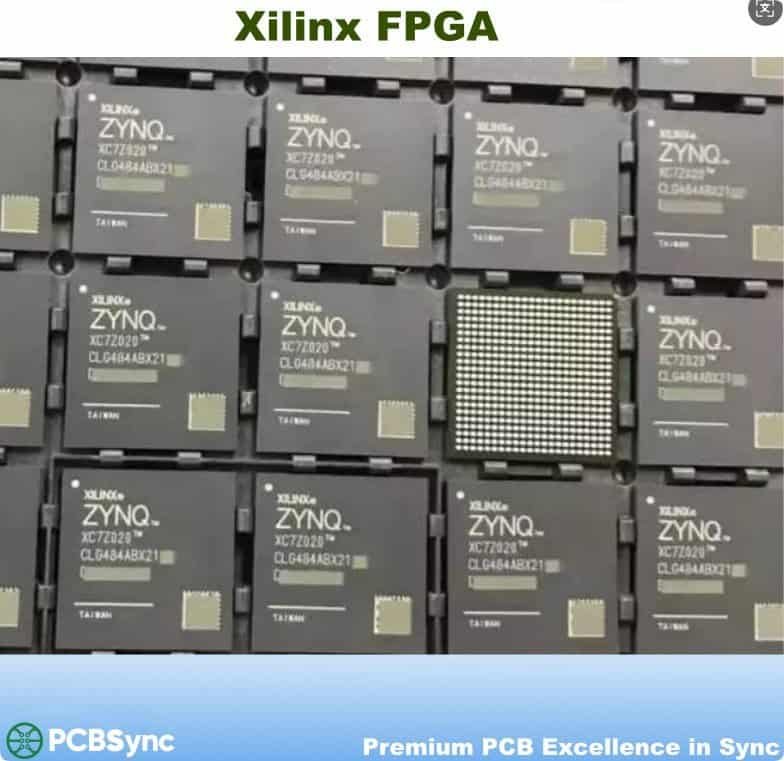
Overview of XCV50E-7FG256I Field Programmable Gate Array
The XCV50E-7FG256I is a premium industrial-grade field programmable gate array (FPGA) from AMD’s renowned Virtex-E family. This advanced FPGA solution delivers exceptional performance with 50,000 system gates and operates reliably across an extended industrial temperature range of -40°C to 100°C, making it ideal for demanding embedded system applications.
Key Features and Specifications
Core FPGA Capabilities
The XCV50E-7FG256I FPGA stands out in the market with its robust feature set designed for industrial and commercial applications. This Xilinx FPGA combines high-speed performance with reliable operation in challenging environments.
| Feature |
Specification |
| Logic Gates |
50,000 System Gates |
| Logic Elements/Cells |
1,728 |
| Total RAM Bits |
65,536 |
| I/O Count |
176 |
| Voltage Supply |
1.8V, 2.5V, 3.3V |
| Operating Temperature |
-40°C to 100°C (Industrial) |
| Package Type |
256-FBGA (17×17) |
| Mounting Style |
Surface Mount |
Advanced Architecture Design
| Architecture Feature |
Details |
| LABs/CLBs |
432 Configurable Logic Blocks |
| Maximum Distributed RAM |
27K bits |
| Number of Block RAMs |
16 blocks |
| Maximum User I/O |
176 pins |
| Speed Grade |
-7 (high performance) |
Technical Specifications in Detail
Electrical Characteristics
The XCV50E-7FG256I operates with multiple voltage rails ensuring compatibility with various system architectures:
- Core Voltage: 1.8V (VCCINT)
- I/O Voltage: 2.5V and 3.3V (VCCO)
- Low power consumption in standby modes
- ESD protection on all pins
Package Information
| Package Details |
Value |
| Package Type |
Fine-Pitch Ball Grid Array (FBGA) |
| Pin Count |
256 pins |
| Package Dimensions |
17mm x 17mm |
| Ball Pitch |
1.0mm |
| Moisture Sensitivity Level |
MSL 3 |
| Lead-Free Status |
RoHS Compliant |
Applications and Use Cases
Industrial Control Systems
The XCV50E-7FG256I excels in industrial automation applications where reliability and extended temperature operation are critical. Its robust design makes it suitable for:
- Manufacturing automation controllers
- Process control systems
- Industrial robotics interfaces
- Factory floor monitoring systems
Embedded System Development
This FPGA provides an excellent platform for embedded systems requiring:
- Custom logic implementation
- High-speed data processing
- Protocol conversion
- Real-time control algorithms
Communication Infrastructure
The device supports various communication protocols and interfaces:
- Network switching applications
- Data routing systems
- Protocol bridges
- Signal processing modules
Automotive and Transportation
With its industrial temperature range and reliability:
- Automotive control units
- Railway signaling systems
- Avionics support equipment
- Vehicle diagnostic tools
Performance Characteristics
Speed and Timing
| Performance Metric |
Specification |
| Maximum Operating Frequency |
Up to 200 MHz (design dependent) |
| Toggle Rate |
High-speed I/O capable |
| Speed Grade |
-7 (fastest commercial grade) |
| Propagation Delay |
Optimized for low latency |
Memory Architecture
The XCV50E-7FG256I features a sophisticated memory hierarchy:
- Block RAM: 16 dual-port RAM blocks (4,096 bits each)
- Distributed RAM: Up to 27K bits using CLB resources
- Total RAM: 65,536 bits for data buffering and storage
- Flexible configuration for FIFO, RAM, or ROM implementations
Design and Development Tools
Software Support
Developers can leverage comprehensive design tools:
- ISE Design Suite for FPGA development
- Vivado Design Suite compatibility (legacy support)
- ChipScope Pro for debugging
- ModelSim for simulation
Development Resources
- Reference designs and IP cores available
- Evaluation boards for prototyping
- Comprehensive documentation library
- Application notes and technical guides
Comparison with Similar FPGAs
Virtex-E Family Positioning
| Device |
Logic Cells |
RAM Bits |
I/O |
Application Focus |
| XCV50E |
1,728 |
65,536 |
176 |
Entry industrial |
| XCV100E |
3,456 |
131,072 |
196 |
Mid-range industrial |
| XCV200E |
6,912 |
262,144 |
284 |
High-density industrial |
Quality and Reliability
Industrial Grade Certification
The XCV50E-7FG256I meets stringent industrial standards:
- Extended temperature range: -40°C to 100°C operation
- Enhanced screening for industrial reliability
- Long-term availability for production designs
- Quality management per ISO standards
Environmental Compliance
- RoHS compliant (lead-free)
- REACH regulation compliant
- Halogen-free options available
- Environmental stress testing certified
Installation and Implementation
PCB Design Considerations
When integrating the XCV50E-7FG256I:
- Power supply decoupling: Place bypass capacitors close to power pins
- Thermal management: Ensure adequate airflow or heatsinking
- Signal integrity: Follow high-speed design guidelines
- Clock distribution: Use dedicated clock resources
- Ground planes: Implement solid ground planes
Programming and Configuration
Multiple configuration options available:
- JTAG boundary scan programming
- SelectMAP parallel configuration
- Serial configuration modes
- Master/Slave configuration support
Ordering Information and Availability
Part Number Breakdown
XCV50E-7FG256I decodes as:
- XC: Xilinx Commercial FPGA
- V50E: Virtex-E, 50K gates
- 7: Speed grade (-7)
- FG256: Fine-pitch BGA, 256 pins
- I: Industrial temperature range
Package Variants
| Suffix |
Temperature Range |
Application |
| C |
0°C to 85°C |
Commercial |
| I |
-40°C to 100°C |
Industrial (this variant) |
Frequently Asked Questions
What is the main difference between XCV50E-7FG256I and XCV50E-7FG256C?
The primary difference is the operating temperature range. The “I” grade operates from -40°C to 100°C (industrial), while the “C” grade operates from 0°C to 85°C (commercial).
How many logic resources are available in the XCV50E?
The XCV50E provides 1,728 logic cells organized in 432 configurable logic blocks (CLBs), equivalent to approximately 50,000 system gates.
What power supply voltages does the XCV50E-7FG256I require?
The device requires three voltage rails: 1.8V for the core (VCCINT), and 2.5V or 3.3V for I/O (VCCO), depending on your interface requirements.
Is the XCV50E-7FG256I suitable for high-temperature environments?
Yes, with its industrial temperature rating of -40°C to 100°C, this FPGA is specifically designed for demanding high-temperature industrial applications.
What development tools are needed to program this FPGA?
You’ll need Xilinx ISE Design Suite or compatible tools, along with a JTAG programming cable for configuration and debugging.
Advantages of Choosing XCV50E-7FG256I
Proven Technology
- Mature platform with extensive deployment history
- Reliable performance in industrial environments
- Broad ecosystem of IP cores and reference designs
- Long-term support from AMD/Xilinx
Cost-Effective Solution
- Competitive pricing for 50K gate density
- Reduced development time with available tools
- Lower total cost of ownership
- Scalable to other Virtex-E family members
Technical Excellence
- High-speed operation with -7 speed grade
- Flexible I/O standards support
- Robust memory architecture
- Excellent signal integrity
Technical Support and Resources
Documentation Available
- Datasheet with complete electrical specifications
- User guides for configuration and operation
- Application notes for common implementations
- PCB layout guidelines
Community and Support
- Active user community forums
- Technical support from AMD/Xilinx
- Third-party IP vendor ecosystem
- Training materials and webinars
Conclusion
The XCV50E-7FG256I represents an excellent choice for engineers developing industrial-grade embedded systems requiring reliable FPGA performance. With its combination of 50,000 system gates, industrial temperature operation, comprehensive I/O capabilities, and proven Virtex-E architecture, this device delivers exceptional value for demanding applications.
Whether you’re designing industrial control systems, communication infrastructure, or embedded processing solutions, the XCV50E-7FG256I provides the performance, reliability, and flexibility needed for successful product development. Its extensive development tool support and mature technology platform ensure reduced time-to-market while maintaining the quality standards required for industrial deployments.
For detailed technical specifications, design resources, and purchasing information, consult the official AMD/Xilinx documentation or contact authorized distributors.