Inquire: Call 0086-755-23203480, or reach out via the form below/your sales contact to discuss our design, manufacturing, and assembly capabilities.
Quote: Email your PCB files to Sales@pcbsync.com (Preferred for large files) or submit online. We will contact you promptly. Please ensure your email is correct.
Notes: For PCB fabrication, we require PCB design file in Gerber RS-274X format (most preferred), *.PCB/DDB (Protel, inform your program version) format or *.BRD (Eagle) format. For PCB assembly, we require PCB design file in above mentioned format, drilling file and BOM. Click to download BOM template To avoid file missing, please include all files into one folder and compress it into .zip or .rar format.
Arduino I2C Tutorial: Complete Communication Guide
Serial communication protocols form the backbone of modern embedded systems, enabling microcontrollers to interface with sensors, displays, memory chips, and other peripherals using minimal wiring. Among these protocols, I2C (Inter-Integrated Circuit) stands out for its elegant simplicity and widespread adoption. The Arduino I2C implementation through the Wire library has made this powerful protocol accessible to makers and engineers alike, transforming what was once a challenging low-level interface into straightforward function calls.
As someone who has debugged countless I2C bus failures on prototype PCBs and production boards, I’ve learned that successful Arduino I2C communication requires understanding both the underlying protocol mechanics and practical implementation details. This comprehensive guide examines Arduino I2C from ground level through advanced multi-device configurations, covering everything from basic two-wire connections to troubleshooting mysterious address conflicts and signal integrity issues that plague longer bus lengths.
Before connecting wires and writing code, understanding the I2C protocol architecture prevents common implementation mistakes and enables effective troubleshooting when problems arise.
What Makes I2C Different
I2C, developed by Philips (now NXP Semiconductors) in 1982, uses a master-slave architecture with only two bidirectional signal lines:
SDA (Serial Data): Bidirectional data transfer line SCL (Serial Clock): Clock signal generated by master device
This two-wire design contrasts sharply with SPI’s four-wire minimum (MISO, MOSI, SCK, SS) and UART’s point-to-point connections. The efficiency comes from I2C’s addressing scheme – each device on the bus has a unique 7-bit or 10-bit address, allowing the master to communicate with specific slaves without additional chip select lines.
Bus Topology and Device Roles
Device Type
Description
Quantity Allowed
Primary Functions
Master
Initiates communication, generates clock
1 (typically on Arduino)
Request data, send commands, control timing
Slave
Responds to master requests
Up to 112 (7-bit) or 1008 (10-bit)
Provide sensor data, accept configuration
Multi-Master
Multiple masters share bus
2+ masters possible
Advanced applications requiring arbitration
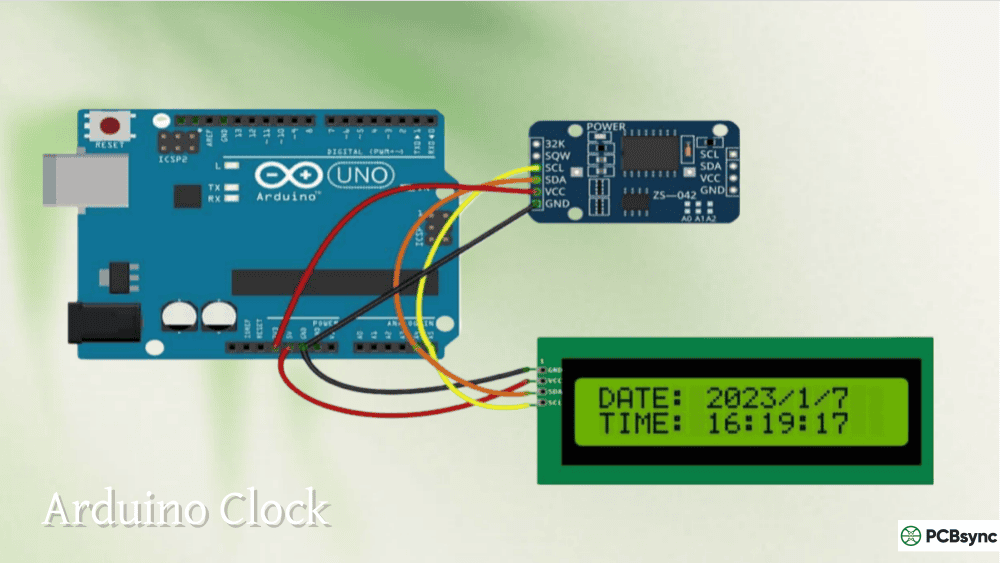
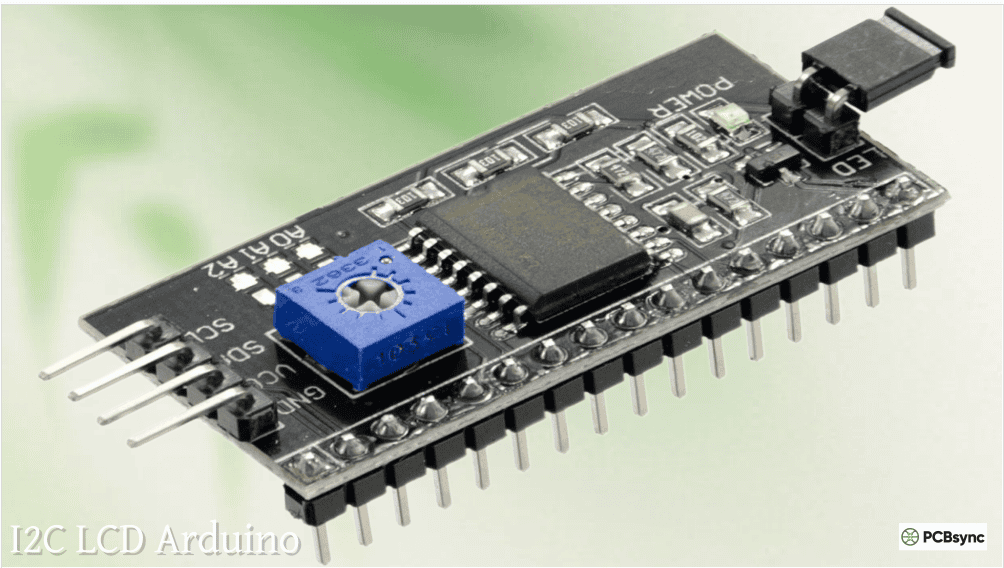
In most Arduino projects, the Arduino board functions as the sole master, communicating with multiple slave devices such as sensors (MPU6050, BMP180), displays (OLED, LCD with I2C backpack), and memory chips (EEPROM, RTC modules).
Clock Speed and Data Rates
The I2C specification defines multiple speed grades:
Mode
Clock Frequency
Typical Use Case
Arduino Support
Standard Mode
100 kHz
Legacy devices, simple sensors
Full support
Fast Mode
400 kHz
Modern sensors, displays
Full support
Fast Mode Plus
1 MHz
High-speed data acquisition
Limited (depends on board)
High Speed Mode
3.4 MHz
Specialized applications
Not supported on AVR
Most Arduino I2C implementations default to 100 kHz, providing excellent compatibility with the vast majority of available I2C devices. The speed can be increased using Wire.setClock() when faster data transfer is required.
Arduino I2C Hardware Configuration
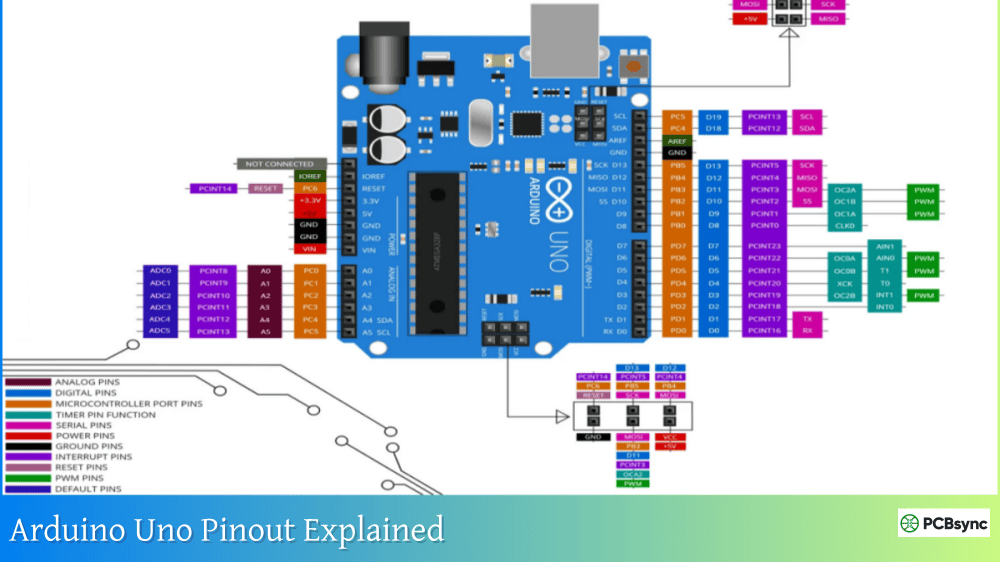
Pin Assignments Across Arduino Boards
Different Arduino boards designate specific pins for I2C communication. Understanding your board’s pin allocation is essential for proper wiring.
Arduino Board
SDA Pin
SCL Pin
Alternative Pins
Notes
Uno
A4
A5
SDA/SCL near AREF
Connect to either location
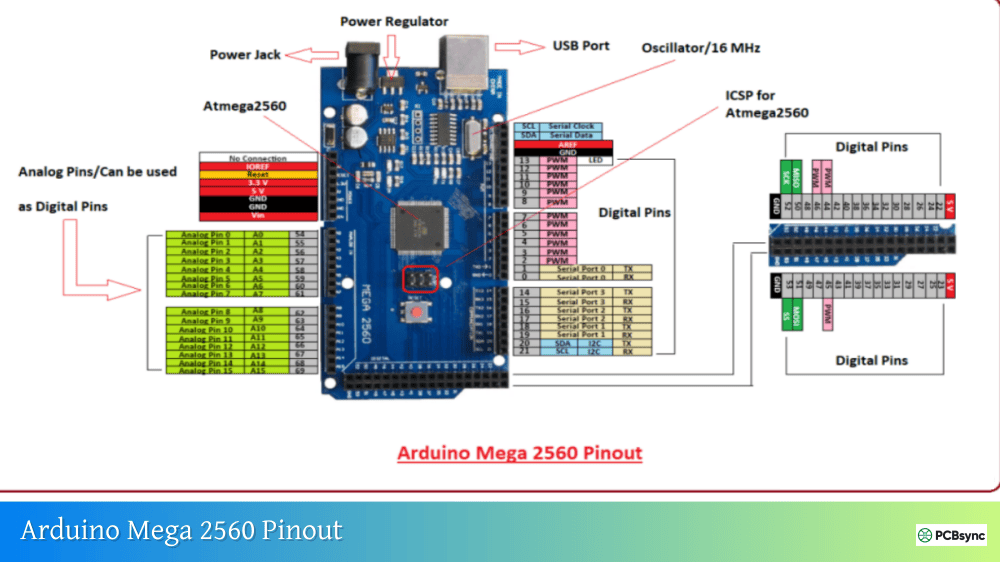
Mega 2560
20 (SDA)
21 (SCL)
None
Separate from analog pins
Leonardo
2 (SDA)
3 (SCL)
None
Different from Uno!
Due
20 (SDA)
21 (SCL)
SDA1/SCL1 (pins 70/71)
Two I2C interfaces
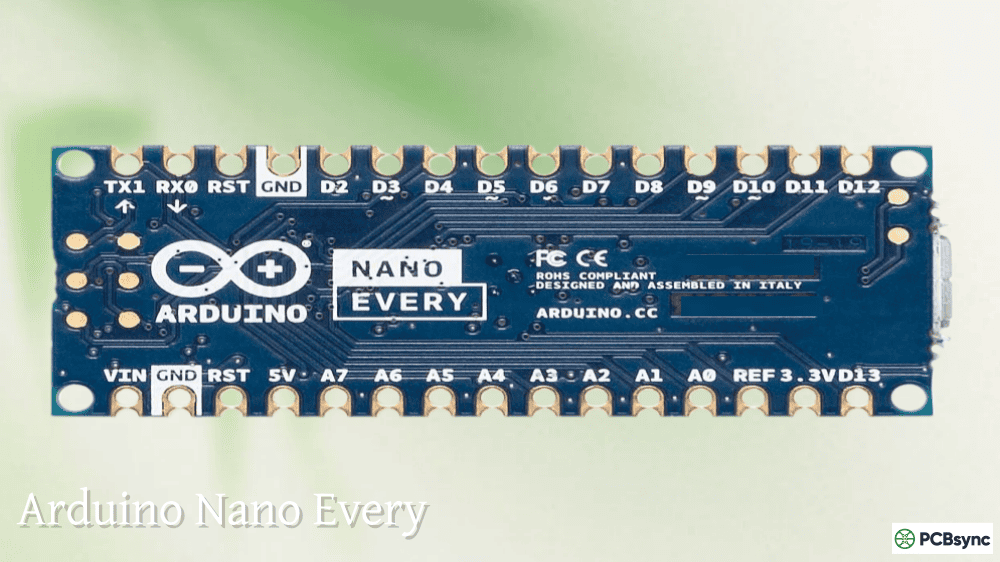
Nano
A4
A5
None
Same as Uno
ESP32
GPIO 21 (SDA)
GPIO 22 (SCL)
Configurable
Software-selectable pins
Critical Design Note: Arduino Uno R3 and newer include dedicated SDA/SCL pins near the AREF pin for shield compatibility, but these connect internally to A4/A5. You can use either location but not both simultaneously.
Pull-Up Resistor Requirements
I2C uses open-drain signaling, meaning devices can only pull the bus lines LOW. Pull-up resistors connected to VCC return the lines to HIGH when no device is actively driving them LOW. This architecture enables multiple devices to share the bus without electrical conflicts.
Pull-Up Resistor Selection:
Bus Condition
Recommended Resistor Value
Reasoning
Short wires (<30cm), single device
4.7kΩ
Standard value, good starting point
Multiple devices (3-5)
2.2kΩ – 3.3kΩ
Lower resistance compensates for increased capacitance
Long wires (>1m)
1.5kΩ – 2.2kΩ
Strong pull-up fights capacitive loading
Very short PCB traces, 400kHz
2.2kΩ
Sharper edges at higher speeds
Calculating Pull-Up Current:
The pull-up resistor determines current flow when a device pulls the line LOW:
I = VCC / R_pullup
For 5V and 4.7kΩ: I = 5V / 4700Ω ≈ 1.06mA
For 3.3V and 4.7kΩ: I = 3.3V / 4700Ω ≈ 0.7mA
Most I2C devices comfortably sink 1-3mA, making 4.7kΩ universally safe. Lower resistance values (stronger pull-ups) improve signal quality but increase power consumption – critical for battery-powered applications.
Internal Pull-Ups: The ATmega328P (Arduino Uno/Nano) includes internal pull-ups around 20-50kΩ. The Wire library enables these automatically, but they’re too weak for reliable operation above 100kHz or with multiple devices. Always add external 4.7kΩ pull-ups for production designs.
Voltage Level Compatibility
I2C operates at the VCC logic level of connected devices, creating challenges when mixing 5V Arduino boards with 3.3V sensors.
5V Arduino with 3.3V I2C Device – Safe Options:
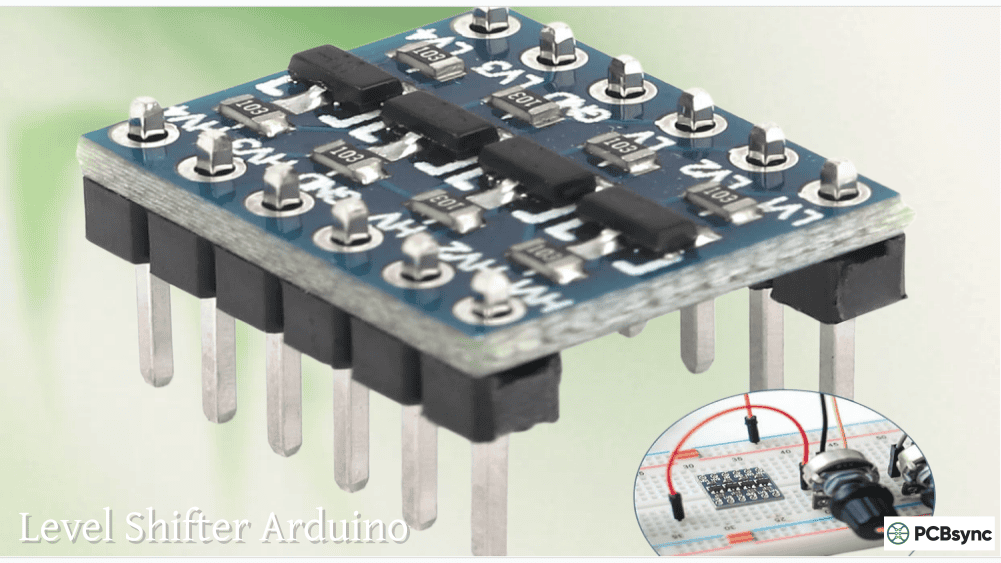
Bidirectional Level Shifter: Dedicated ICs (PCA9306, TXS0102) provide safe voltage translation
Pull-Ups to 3.3V: Connect pull-up resistors to 3.3V instead of 5V (works for many devices)
Resistor Divider on SCL: Simple resistor divider on clock line (SDA benefits from level shifter)
3.3V Arduino with 5V I2C Device: Generally not recommended. The 5V device may not recognize 3.3V logic levels as valid HIGH signals. Use level shifters or 5V Arduino boards.
sensorValue = analogRead(A0) / 4; // Scale to 0-255
delay(50);
}
// Callback when master sends data
void receiveData(int byteCount) {
while(Wire.available()) {
command = Wire.read();
Serial.print(“Received command: “);
Serial.println(command);
}
}
// Callback when master requests data
void sendData() {
Wire.write(sensorValue);
Serial.print(“Sent value: “);
Serial.println(sensorValue);
}
I2C Device Addressing
Finding I2C Device Addresses
Each I2C device requires a unique address. Most devices use preset addresses (often found in datasheets), but some allow address configuration through jumper pins or solder bridges.
Common I2C Device Addresses:
Device
Default Address
Alternative Addresses
Configurable?
MPU6050 (Gyro/Accel)
0x68
0x69
Via AD0 pin
BMP180/BMP280 (Pressure)
0x77
0x76
Via SDO pin
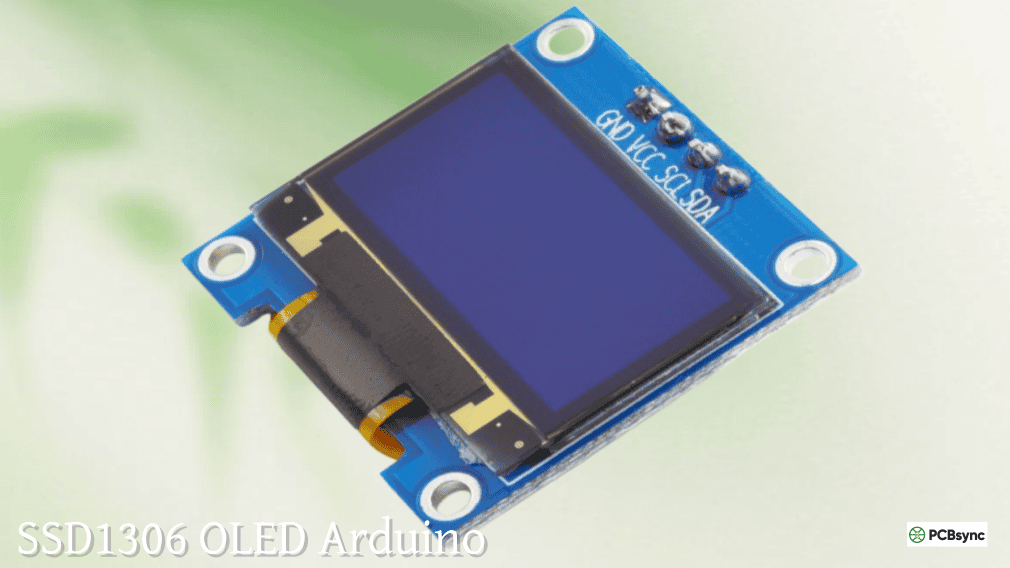
OLED Display (SSD1306)
0x3C
0x3D
Via resistor/jumper
PCF8574 (I2C I/O Expander)
0x20-0x27
0x38-0x3F
Via A0-A2 pins
DS3231 (RTC)
0x68
None
Fixed address
Address Conflicts: If two devices share the same address, they cannot coexist on the same I2C bus without using an I2C multiplexer (TCA9548A) to create separate bus segments.
I2C Scanner Sketch
When device addresses are unknown or uncertain, the I2C scanner sketch identifies all connected devices:
#include <Wire.h>
void setup() {
Wire.begin();
Serial.begin(9600);
while (!Serial);
Serial.println(“\nI2C Scanner”);
}
void loop() {
byte error, address;
int nDevices;
Serial.println(“Scanning…”);
nDevices = 0;
for(address = 1; address < 127; address++ ) {
Wire.beginTransmission(address);
error = Wire.endTransmission();
if (error == 0) {
Serial.print(“I2C device found at address 0x”);
if (address < 16)
Serial.print(“0”);
Serial.print(address, HEX);
Serial.println(” !”);
nDevices++;
}
else if (error == 4) {
Serial.print(“Unknown error at address 0x”);
if (address < 16)
Serial.print(“0”);
Serial.println(address, HEX);
}
}
if (nDevices == 0)
Serial.println(“No I2C devices found\n”);
else
Serial.println(“done\n”);
delay(5000);
}
This scanner iterates through all 127 possible addresses, attempting communication with each and reporting which addresses respond successfully.
Practical Arduino I2C Examples
Example 1: Reading MPU6050 Accelerometer
The MPU6050 combines a 3-axis accelerometer and gyroscope in a single I2C package, commonly used for motion sensing and orientation tracking.
#include <Wire.h>
const int MPU_ADDR = 0x68; // MPU6050 default address
void setup() {
Wire.begin();
Serial.begin(9600);
// Wake up MPU6050 (it starts in sleep mode)
Wire.beginTransmission(MPU_ADDR);
Wire.write(0x6B); // PWR_MGMT_1 register
Wire.write(0); // Set to zero (wakes up MPU6050)
Wire.endTransmission(true);
Serial.println(“MPU6050 Initialized”);
}
void loop() {
int16_t AcX, AcY, AcZ;
// Request accelerometer data
Wire.beginTransmission(MPU_ADDR);
Wire.write(0x3B); // Starting register for accel data
Some I2C slaves need extra time to prepare data. They hold the SCL line LOW, “stretching” the clock until ready. The Arduino Wire library supports this automatically, but extremely long stretches (>1 second) may appear as timeouts.
Multi-Master Configurations
While rare in Arduino projects, multiple masters can share an I2C bus using arbitration. The Wire library supports this by checking if the bus is busy before transmitting. Implementation requires careful coordination to prevent collisions.
Using I2C Multiplexers
When multiple devices share the same address (common with identical sensors), I2C multiplexers like TCA9548A create separate bus segments:
DroneBot Workshop I2C Series – Video tutorials with demonstrations
Frequently Asked Questions
1. Do I need pull-up resistors if my sensor module already has them?
Most breakout boards include pull-up resistors (typically 10kΩ). However, having multiple pull-ups in parallel isn’t harmful – they combine to create a lower total resistance. If your module has 10kΩ pull-ups and you add external 4.7kΩ resistors, the effective resistance becomes approximately 3.2kΩ, which is perfectly acceptable for I2C operation. Problems only occur when too many parallel pull-ups create excessively low resistance (<1.5kΩ), potentially exceeding device current sink capabilities.
2. Why does my I2C communication work at short distances but fail with longer wires?
Every wire adds capacitance (approximately 30-50pF per meter), which slows signal rise/fall times and can cause bit errors. At 100 kHz with 1 meter of wire, you’re near the practical limit. Solutions include: reducing clock speed to 50 kHz or lower, using stronger pull-ups (2.2kΩ instead of 4.7kΩ), implementing active I2C extenders/repeaters for distances beyond 2 meters, or using twisted-pair or shielded cables to reduce capacitance and noise pickup.
3. Can I connect 3.3V I2C devices directly to 5V Arduino boards?
This is risky and depends on the specific device. Most modern 3.3V chips tolerate 5V inputs, but many (especially older sensors) can be permanently damaged. The safest approach uses bidirectional level shifters designed for I2C. A budget-friendly alternative connects pull-up resistors to 3.3V instead of 5V, which works for many devices because the 3.3V HIGH signal often meets the Arduino’s HIGH threshold (minimum 3.0V). Always consult device datasheets for absolute maximum voltage ratings before connecting.
4. What does “NACK on address” mean and how do I fix it?
NACK (Negative Acknowledge) on address means no device responded to the specified address. Common causes: incorrect address (verify with I2C scanner), device not powered (check VCC and GND connections), wiring error (swapped SDA/SCL, missing pull-ups), device in sleep/shutdown mode (some sensors require initialization), or device failure. Run the I2C scanner first to identify all connected devices, then verify your code uses the correct hexadecimal address from the scanner output.
5. How many devices can I connect to a single I2C bus?
Theoretically, 112 devices with 7-bit addressing (addresses 0x08-0x77 are usable). Practically, limitations appear around 8-10 devices due to: increased bus capacitance requiring stronger pull-ups, address conflicts (many devices use the same default addresses), current limitations of pull-up resistors, and timing challenges with many devices. For networks exceeding 10 devices, consider using I2C multiplexers to create separate bus segments, implementing multiple I2C buses (if your Arduino has multiple interfaces), or switching to alternative protocols like RS-485 for longer distances and more nodes.
Conclusion
The Arduino I2C implementation through the Wire library has democratized inter-integrated circuit communication, making sophisticated sensor networks accessible to makers and embedded engineers alike. Understanding the protocol fundamentals – open-drain signaling, pull-up requirements, master-slave architecture, and addressing schemes – transforms I2C from mysterious to manageable. Success with Arduino I2C communication requires attention to both hardware details (proper pull-up resistor values, voltage level matching, wire length limitations) and software implementation (correct addressing, proper data sequencing, error handling).
From simple single-sensor projects to complex multi-device networks, I2C provides an elegant solution for Arduino peripheral communication using minimal pins and straightforward code. The extensive ecosystem of I2C-compatible sensors, displays, and modules ensures that mastering Arduino I2C communication opens doors to countless project possibilities. While troubleshooting can occasionally frustrate (particularly with mysterious address conflicts or signal integrity issues), systematic debugging using I2C scanners and understanding common failure modes resolves most problems quickly.
Whether building weather stations, motion tracking systems, or data logging applications, Arduino I2C communication provides the foundation for reliable, scalable embedded systems. The two-wire simplicity, widespread device support, and robust Wire library implementation make I2C an essential skill for anyone serious about Arduino development.
Inquire: Call 0086-755-23203480, or reach out via the form below/your sales contact to discuss our design, manufacturing, and assembly capabilities.
Quote: Email your PCB files to Sales@pcbsync.com (Preferred for large files) or submit online. We will contact you promptly. Please ensure your email is correct.
Notes: For PCB fabrication, we require PCB design file in Gerber RS-274X format (most preferred), *.PCB/DDB (Protel, inform your program version) format or *.BRD (Eagle) format. For PCB assembly, we require PCB design file in above mentioned format, drilling file and BOM. Click to download BOM template To avoid file missing, please include all files into one folder and compress it into .zip or .rar format.