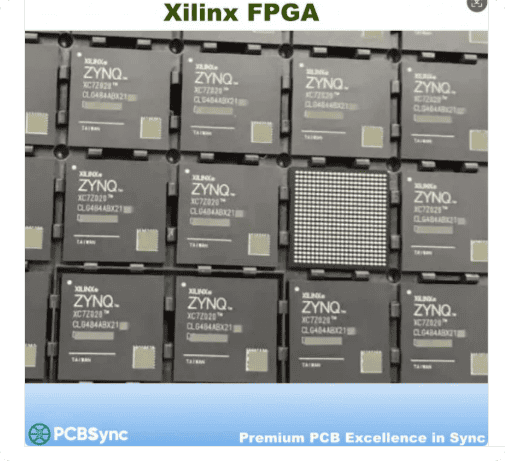
The XC2S200-6FGG920C represents a powerful field-programmable gate array solution from the renowned Spartan-II family. This advanced FPGA delivers exceptional performance with 200,000 system gates, 5,292 logic cells, and comprehensive memory resources designed for demanding embedded applications. Whether you’re developing telecommunications equipment, industrial control systems, or advanced digital signal processing solutions, this FPGA provides the flexibility and performance required for modern electronic designs.
Note: Please verify package specifications with your supplier, as the FGG920 package designation requires confirmation against current Xilinx/AMD documentation. Standard XC2S200 packages include 208-pin, 256-ball, and 456-ball configurations.
Key Specifications and Technical Features
Core Performance Characteristics
The XC2S200-6FGG920C FPGA combines robust processing capabilities with energy-efficient operation. Built on advanced 0.18-micron process technology, this device operates at 2.5V core voltage while supporting multiple I/O voltage standards from 1.5V to 3.3V.
| Parameter |
Specification |
| System Gates |
200,000 gates |
| Logic Cells |
5,292 cells |
| Maximum Operating Frequency |
263 MHz |
| CLB Array Configuration |
28 x 42 (1,176 total CLBs) |
| Speed Grade |
-6 (Higher Performance) |
| Process Technology |
0.18µm CMOS |
| Core Voltage (VCCINT) |
2.5V |
| I/O Voltage (VCCO) |
1.5V, 2.5V, 3.3V |
Memory Architecture and Resources
Understanding memory resources is crucial for optimal FPGA utilization. The XC2S200-6FGG920C offers a hierarchical memory structure combining distributed and block RAM.
| Memory Type |
Capacity |
Configuration |
Use Case |
| Total Block RAM |
56 Kbits (14 blocks) |
Dual-port 4096-bit blocks |
Large data buffers, FIFOs |
| Distributed RAM |
75,264 bits |
LUT-based memory |
Small lookup tables, registers |
| Block RAM Aspect Ratios |
1×4096 to 16×256 |
Flexible width/depth |
Bus width conversion |
| RAM Configuration |
Synchronous dual-port |
Independent port control |
Simultaneous read/write |
Input/Output Capabilities and Standards
Comprehensive I/O Support
The XC2S200 FPGA family supports an extensive range of industry-standard I/O protocols, making it ideal for interfacing with various system components.
| I/O Standard |
Voltage |
Application |
| LVTTL |
3.3V |
General purpose logic |
| LVCMOS2 |
2.5V |
Low-voltage CMOS |
| PCI (33/66 MHz) |
3.3V |
Peripheral interface |
| SSTL2 Class I/II |
2.5V |
DDR memory interface |
| SSTL3 Class I/II |
3.3V |
Memory systems |
| HSTL Class I/III/IV |
1.5V |
High-speed interfaces |
| GTL/GTL+ |
Variable |
Bus applications |
| AGP-2X |
3.3V |
Graphics interfaces |
Maximum User I/O Availability
The actual number of available I/O pins depends on package selection. For standard packages:
- PQ208 Package: 140 user I/O pins
- FG256 Package: 176 user I/O pins
- FG456 Package: 284 user I/O pins
Advanced Clock Management System
Delay-Locked Loop (DLL) Technology
Four integrated DLLs provide sophisticated clock distribution and management capabilities, essential for high-performance synchronous designs.
DLL Features:
- Zero propagation delay clock distribution
- Clock multiplication (2x frequency doubling)
- Clock division (÷1.5, ÷2, ÷2.5, ÷3, ÷4, ÷5, ÷8, ÷16)
- Quadrature phase generation (0°, 90°, 180°, 270°)
- Automated clock deskew across device
- Board-level clock mirroring capability
Global Clock Resources
| Resource Type |
Quantity |
Purpose |
| Primary Global Nets |
4 dedicated |
Low-skew clock distribution |
| Secondary Global Lines |
24 backbone lines |
Flexible signal routing |
| Global Clock Buffers |
4 BUFG |
High-fanout signal buffering |
| DLL Circuits |
4 corners |
Advanced clock management |
Configurable Logic Block Architecture
CLB Structure and Capabilities
Each CLB contains sophisticated logic resources organized for maximum efficiency and performance.
Per CLB Resources:
- 4 Logic Cells (LCs) – organized in 2 slices
- 4-input Look-Up Tables (LUTs) – implement any 4-input function
- Dedicated Carry Logic – fast arithmetic operations
- Flexible Storage Elements – D flip-flops or latches
- Distributed RAM Mode – 16×1, 16×2, or 32×1 configurations
- Shift Register Mode – 16-bit for data capture
Logic Resource Summary
| Resource |
Specification |
Application |
| Total CLBs |
1,176 blocks |
Core logic implementation |
| Function Generators |
4,704 LUTs |
Combinational logic |
| Flip-Flops/Latches |
5,292 elements |
Sequential logic storage |
| Maximum Function Inputs |
Up to 19 inputs |
Complex logic functions |
| 3-State Buffers (BUFTs) |
2 per CLB |
On-chip bus interfaces |
Application Domains and Use Cases
Industrial Automation and Control
The XC2S200-6FGG920C excels in industrial environments requiring reliable, reconfigurable logic solutions for motor control, process automation, and sensor interfacing.
Telecommunications Equipment
High-speed data processing capabilities make this FPGA suitable for protocol implementation, network routing, and signal processing in telecommunications infrastructure.
Medical Instrumentation
Precision timing and flexible I/O standards enable medical imaging systems, diagnostic equipment, and patient monitoring devices.
Automotive Electronics
Temperature range options and robust design support automotive applications including advanced driver assistance systems (ADAS) and vehicle control units.
Consumer Electronics
Cost-effective FPGA technology enables digital TV, set-top boxes, gaming peripherals, and multimedia processing applications.
Configuration and Programming Options
Flexible Configuration Modes
| Mode |
Data Width |
Control |
Application |
| Master Serial |
1-bit |
FPGA generates clock |
PROM-based configuration |
| Slave Serial |
1-bit |
External clock |
Daisy-chain systems |
| Slave Parallel |
8-bit |
External control |
High-speed programming |
| Boundary Scan (JTAG) |
1-bit |
IEEE 1149.1 |
In-system programming |
Configuration Data
- Configuration Bitstream Size: 1,335,840 bits
- Configuration Time (Master Serial @ 4MHz): ~334 milliseconds
- Unlimited Reprogrammability – SRAM-based configuration
- Readback Capability – Real-time debugging support
Power Specifications and Thermal Management
Operating Conditions
| Parameter |
Commercial (C) |
Industrial (I) |
| Junction Temperature (TJ) |
0°C to +85°C |
-40°C to +100°C |
| Core Supply (VCCINT) |
2.5V ±5% |
2.5V ±5% |
| I/O Supply (VCCO) |
1.5V to 3.3V |
1.5V to 3.3V |
| Recommended Operating Conditions |
Per datasheet |
Per datasheet |
Note: The -6 speed grade is exclusively available in Commercial temperature range for optimal performance characteristics.
Package and Reliability Information
Quality and Compliance
- RoHS Compliance: Lead-free (FGG designation) and standard packages available
- JEDEC Standards: Compliant with industry moisture sensitivity levels
- ESD Protection: All I/O pins protected against electrostatic discharge
- Latch-up Immunity: CMOS construction with protection circuits
Pb-Free Package Options
Modern Spartan-II FPGAs include the “G” character in ordering codes (e.g., FGG) to denote lead-free, environmentally friendly packaging that meets global environmental regulations.
Development and Design Support
Xilinx ISE Design Suite
Complete FPGA development supported by industry-standard tools:
- Automatic Place-and-Route – Optimized implementation
- Timing-Driven Compilation – Meet performance requirements
- HDL Synthesis Support – Verilog and VHDL
- Simulation Integration – ModelSim, Active-HDL compatibility
- IP Core Library – 400+ pre-designed functions
- Floorplanning Tools – Manual optimization options
Design Methodology
- Design Entry – Schematic capture or HDL coding
- Synthesis – Logic optimization and mapping
- Implementation – Place-and-route execution
- Verification – Simulation and static timing analysis
- Programming – Bitstream generation and device configuration
Advantages Over ASIC Solutions
FPGA Benefits for Modern Design
Reduced Time-to-Market:
- No mask fabrication delays
- Immediate prototyping capability
- Rapid design iterations
Cost Effectiveness:
- Zero NRE (Non-Recurring Engineering) costs
- Lower initial investment
- Scalable production volumes
Design Flexibility:
- Field upgradability
- Remote reconfiguration
- Design evolution without hardware changes
Risk Mitigation:
- No commitment to fixed silicon
- Easy bug fixes post-deployment
- Adaptable to changing requirements
Technical Comparison Table
XC2S200 vs. Other Spartan-II Family Members
| Device |
Logic Cells |
System Gates |
Block RAM |
Max User I/O |
| XC2S50 |
1,728 |
50,000 |
32 Kbits |
176 |
| XC2S100 |
2,700 |
100,000 |
40 Kbits |
176 |
| XC2S150 |
3,888 |
150,000 |
48 Kbits |
260 |
| XC2S200 |
5,292 |
200,000 |
56 Kbits |
284 |
Why Choose XC2S200-6FGG920C?
This FPGA stands out as an optimal choice for applications requiring:
✓ High Logic Density – Maximum Spartan-II family capacity ✓ Advanced Memory – Largest block RAM configuration
✓ Speed Performance – -6 grade for demanding applications ✓ Extensive I/O – Maximum pin count for complex interfacing ✓ Proven Technology – Mature, reliable FPGA platform ✓ Cost-Effective Solution – Competitive pricing for 200K gate density
Getting Started with Your Design
Essential Design Resources
For comprehensive FPGA implementation, engineers should access:
- Complete datasheets and technical documentation
- Application notes for specific design challenges
- Reference designs and example projects
- IP core libraries for common functions
- Community forums and technical support
Recommended Development Tools
- Xilinx ISE Design Suite (legacy) or Vivado for newer workflows
- Third-party synthesis tools (Synplify, Precision)
- Hardware debuggers and logic analyzers
- Prototyping boards and evaluation kits
Sourcing and Availability
When procuring the XC2S200-6FGG920C or related Xilinx FPGA components, verify exact part numbers and package specifications with authorized distributors. Ensure compatibility with your specific application requirements including:
- Operating temperature range (Commercial vs. Industrial)
- Package type and pin count
- Speed grade requirements
- Lead-free (RoHS) compliance if required
Conclusion
The XC2S200-6FGG920C FPGA represents a powerful, versatile solution for advanced digital design. With its combination of high logic density, comprehensive memory resources, flexible I/O capabilities, and sophisticated clock management, this device addresses demanding applications across multiple industries. The proven Spartan-II architecture, backed by mature development tools and extensive documentation, provides engineers with a reliable platform for innovative electronic system design.
Whether you’re developing next-generation telecommunications equipment, industrial control systems, medical instrumentation, or consumer electronics, the XC2S200 FPGA delivers the performance, flexibility, and cost-effectiveness required for successful product deployment.