Inquire: Call 0086-755-23203480, or reach out via the form below/your sales contact to discuss our design, manufacturing, and assembly capabilities.
Quote: Email your PCB files to Sales@pcbsync.com (Preferred for large files) or submit online. We will contact you promptly. Please ensure your email is correct.
Notes: For PCB fabrication, we require PCB design file in Gerber RS-274X format (most preferred), *.PCB/DDB (Protel, inform your program version) format or *.BRD (Eagle) format. For PCB assembly, we require PCB design file in above mentioned format, drilling file and BOM. Click to download BOM template To avoid file missing, please include all files into one folder and compress it into .zip or .rar format.
After integrating CAN bus systems into automotive diagnostic tools and industrial automation equipment, I’ve discovered that Arduino CAN Bus implementations using the MCP2515 controller bridge the gap between hobbyist projects and professional vehicle networks. Modern cars contain 70+ electronic control units exchanging thousands of messages per second over CAN networks—and with an MCP2515 module costing under $5, your Arduino can join this communication highway. This isn’t just about reading OBD2 codes; it’s about understanding the industrial-grade protocol that keeps aircraft, factory equipment, and medical devices communicating reliably in electrically hostile environments.
Controller Area Network (CAN) was developed by Robert Bosch GmbH in the 1980s to reduce wiring complexity in automobiles. Before CAN, each sensor and actuator required dedicated wiring to the central controller—imagine 60 sensors needing 120+ wires (power and signal) snaking through a vehicle. CAN revolutionized this by allowing all devices to share a single twisted-pair cable, communicating through messages rather than point-to-point connections.
The protocol operates as a multi-master broadcast system where any node can transmit messages when the bus is idle. Unlike traditional master-slave architectures, CAN has no central controller determining who transmits when. Instead, nodes employ sophisticated arbitration—when two devices start transmitting simultaneously, the message with higher priority (lower identifier number) wins transmission rights while the other backs off and retries. This collision resolution happens at the bit level without corrupting either message or requiring retransmission.
CAN Message Structure and Data Frames
Every CAN message consists of several components wrapped in a specific frame format. The identifier field (11 bits for standard frames, 29 bits for extended frames) both identifies the message type and determines priority. Lower numerical identifiers have higher priority—critical engine data uses ID 0x100 while less urgent climate control might use ID 0x500. The data field carries 0 to 8 bytes of actual information, whether sensor readings, command values, or diagnostic codes.
Frame Component
Standard CAN
Extended CAN
Purpose
Start of Frame (SOF)
1 bit
1 bit
Synchronization signal
Identifier
11 bits
29 bits
Message ID and priority
Remote Transmission Request
1 bit
1 bit
Data frame vs remote request
Control Field
6 bits
6 bits
Data length and reserved bits
Data Field
0-64 bits
0-64 bits
Actual payload (0-8 bytes)
CRC Field
16 bits
16 bits
Error detection checksum
Acknowledge
2 bits
2 bits
Reception confirmation
End of Frame
7 bits
7 bits
Message termination
The CRC (Cyclic Redundancy Check) provides error detection—receivers calculate their own CRC and compare against the transmitted value. Mismatch indicates corruption, triggering automatic retransmission. The acknowledge bit ensures at least one node successfully received the message. This comprehensive error detection makes CAN extraordinarily reliable—error rates below one undetected error per 1000 years of operation under normal conditions.
MCP2515 CAN Controller: Arduino’s Gateway to Vehicle Networks
Arduino boards lack native CAN interfaces, requiring external controllers like the Microchip MCP2515. This standalone CAN controller implements the complete CAN 2.0B specification, handling message transmission/reception, arbitration, error detection, and automatic retransmission—all the complex protocol details Arduino doesn’t need to manage directly.
MCP2515 Module Components and Architecture
Typical MCP2515 modules integrate two critical components: the MCP2515 CAN controller itself and a CAN transceiver (usually TJA1050 or MCP2551). The controller handles the protocol logic while the transceiver provides the physical interface to the CAN bus, converting between the controller’s logic-level signals and the differential voltages on CAN_H and CAN_L wires.
The MCP2515 communicates with Arduino via SPI (Serial Peripheral Interface), requiring only four signal connections plus power and ground. This simplicity makes integration straightforward compared to parallel-bus CAN controllers requiring dozens of connections. The controller includes three transmit buffers and two receive buffers with programmable filters and masks, allowing selective message reception without overwhelming Arduino with irrelevant data.
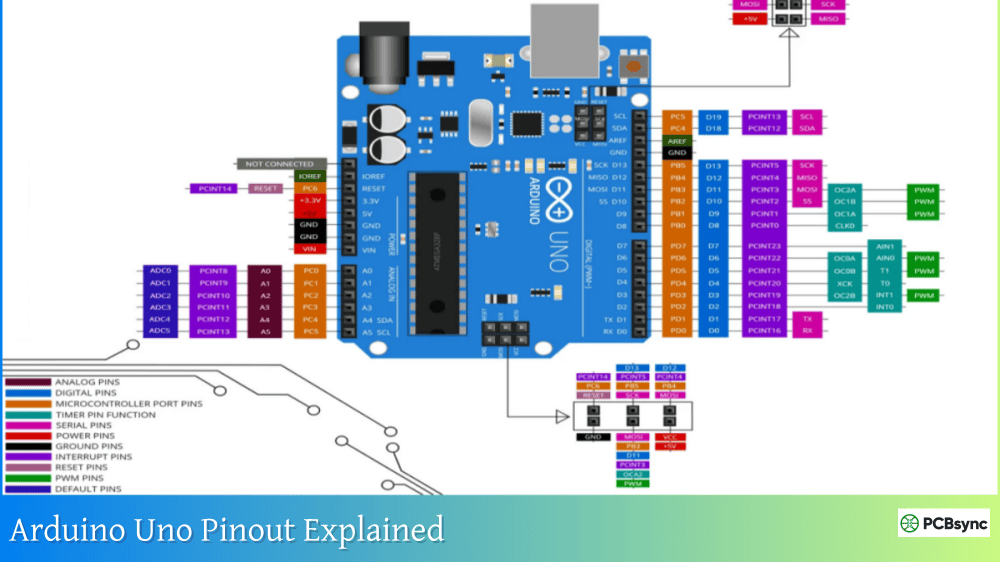
Pin Configuration and Functions
MCP2515 Pin
Arduino Uno Pin
Function
Notes
VCC
5V
Power supply
Some modules operate at 3.3V—verify your module
GND
GND
Ground
Common ground essential
SCK
Pin 13
SPI Clock
Hardware SPI on Uno/Nano
SI (MOSI)
Pin 11
SPI Data Out
Master Out Slave In
SO (MISO)
Pin 12
SPI Data In
Master In Slave Out
CS
Pin 10
Chip Select
Any digital pin works; 10 is conventional
INT
Pin 2
Interrupt
Optional; must use interrupt-capable pin
The CS (Chip Select) pin activates the MCP2515 for SPI communication—Arduino pulls it LOW when addressing the module. While you can use any digital pin for CS, pin 10 serves as the conventional choice in most libraries and examples.
The INT (Interrupt) pin signals Arduino when messages arrive in the receive buffers. Interrupt-driven reception proves more efficient than continuous polling, allowing Arduino to perform other tasks until a message requires attention. However, for simple applications, polling works adequately.
Physical Layer: Wiring Your Arduino CAN Bus Network
CAN requires differential signaling over twisted pair cable—CAN_H (CAN High) and CAN_L (CAN Low) carry complementary voltages. During recessive state (logic 1), both lines sit around 2.5V. During dominant state (logic 0), CAN_H rises to approximately 3.5V while CAN_L drops to 1.5V, creating a differential voltage of 2V.
Cable Selection and Network Topology
Use twisted pair cable with characteristic impedance near 120 ohms for all CAN installations. Standard CAT5 Ethernet cable works acceptably for short distances, though dedicated CAN cable provides better noise immunity. The twisting geometry causes interference to affect both wires equally—since receivers measure the voltage difference, common-mode interference cancels out.
Maintain linear (daisy-chain) topology—connect devices in a line, not star or tree configurations. The CAN bus should resemble a single cable with devices connected at various points along its length. Branches or stubs longer than 30 centimeters act as unterminated transmission lines causing reflections that corrupt data. If you must create branches, keep them extremely short and reduce data rates.
Network length and speed have inverse relationships. At 1 Mbps maximum speed, limit cable runs to 40 meters. At 125 kbps (common for many automotive and industrial applications), achieve up to 500 meters. At 50 kbps, reach 1000 meters. These limits stem from signal propagation delay—nodes must see bit transitions within specific time windows for arbitration to work correctly.
Termination Resistors: Non-Negotiable for Reliable Communication
CAN networks absolutely require 120-ohm termination resistors at both physical ends of the bus. These resistors match the cable’s characteristic impedance, preventing signal reflections that would corrupt messages. Without proper termination, you’ll experience intermittent failures, especially at higher speeds or longer distances.
Most MCP2515 modules include an onboard 120-ohm resistor with a jumper for enabling/disabling it. Place jumpers on modules at the network’s first and last nodes only—remove jumpers from intermediate nodes. If your module lacks built-in termination, solder 120-ohm resistors between the CAN_H and CAN_L screw terminals.
Verify termination by measuring resistance between CAN_H and CAN_L with all nodes powered off. Correct termination yields approximately 60 ohms (two 120-ohm resistors in parallel). Measuring 120 ohms indicates only one terminator present—add the second. Measuring under 50 ohms suggests three or more terminators—remove extras. This simple resistance check diagnoses most CAN bus problems before writing any code.
Programming Arduino CAN Bus with MCP2515 Libraries
Multiple Arduino libraries support the MCP2515, each with different APIs and capabilities. The two most popular are the autowp/arduino-mcp2515 library and the Sandeep Mistry CAN library.
Installing the MCP_CAN Library
Open Arduino IDE and navigate to Sketch → Include Library → Manage Libraries. Search for “mcp2515” and install the library by autowp. Alternatively, search for “CAN” and install Sandeep Mistry’s library. Both work well; examples in this guide use autowp’s library for its straightforward API.
After installation, restart Arduino IDE to see the included examples under File → Examples → mcp2515.
Basic Transmitter Code Implementation
#include <SPI.h>
#include <mcp2515.h>
struct can_frame canMsg;
MCP2515 mcp2515(10); // CS pin 10
void setup() {
Serial.begin(115200);
mcp2515.reset();
mcp2515.setBitrate(CAN_500KBPS, MCP_8MHZ);
mcp2515.setNormalMode();
Serial.println(“CAN Transmitter Ready”);
}
void loop() {
canMsg.can_id = 0x100; // Message identifier
canMsg.can_dlc = 4; // Data length (4 bytes)
canMsg.data[0] = 0xAA;
canMsg.data[1] = 0xBB;
canMsg.data[2] = 0xCC;
canMsg.data[3] = 0xDD;
mcp2515.sendMessage(&canMsg);
Serial.println(“Message sent”);
delay(1000); // Transmit every second
}
The code initializes the MCP2515 with 500 kbps bit rate and 8 MHz crystal oscillator (verify your module’s crystal frequency—some use 16 MHz). The setNormalMode() enables full CAN communication including acknowledgments. The sendMessage() function transmits the populated can_frame structure onto the bus.
Receiver Code with Message Filtering
#include <SPI.h>
#include <mcp2515.h>
struct can_frame canMsg;
MCP2515 mcp2515(10);
void setup() {
Serial.begin(115200);
mcp2515.reset();
mcp2515.setBitrate(CAN_500KBPS, MCP_8MHZ);
mcp2515.setNormalMode();
Serial.println(“CAN Receiver Ready”);
}
void loop() {
if (mcp2515.readMessage(&canMsg) == MCP2515::ERROR_OK) {
Serial.print(“ID: 0x”);
Serial.print(canMsg.can_id, HEX);
Serial.print(” DLC: “);
Serial.print(canMsg.can_dlc);
Serial.print(” Data: “);
for (int i = 0; i < canMsg.can_dlc; i++) {
Serial.print(canMsg.data[i], HEX);
Serial.print(” “);
}
Serial.println();
}
}
The receiver continuously polls for messages with readMessage(). When valid data arrives, it prints the message identifier, data length, and payload bytes. This polling approach works for moderate message rates; high-traffic networks benefit from interrupt-driven reception to avoid missing messages.
Implementing Message Filters
Real CAN networks carry hundreds of different message types. Processing every message wastes processor time and memory. The MCP2515 includes hardware filters allowing selective reception of relevant messages only.
// Accept only messages with ID 0x100
mcp2515.setFilterMask(MCP2515::MASK0, false, 0x7FF); // All 11 bits must match
mcp2515.setFilter(MCP2515::RXF0, false, 0x100); // Filter for ID 0x100
mcp2515.setFilter(MCP2515::RXF1, false, 0x100); // Second filter same ID
The mask determines which identifier bits matter—0x7FF (all bits set) means exact ID match required. Setting mask to 0x700 would match any ID with the same upper bits (0x100, 0x101, 0x102, etc.). Filters specify the IDs to accept. The MCP2515 provides six filters total, allowing reception of multiple specific IDs while blocking others.
OBD2 Vehicle Diagnostics with Arduino CAN Bus
On-Board Diagnostics (OBD2) became mandatory for all vehicles sold in the US after 1996 and Europe after 2001. The OBD2 port provides standardized access to vehicle diagnostic data over CAN bus (for CAN-based vehicles, typically 500 kbps).
Connecting to OBD2 Port
The OBD2 connector uses a standardized 16-pin layout. CAN signals appear on specific pins:
Pin 6: CAN_H (CAN High)
Pin 14: CAN_L (CAN Low)
Pin 4: Chassis Ground
Pin 16: Battery positive (12V)
Connect MCP2515 CAN_H to pin 6 and CAN_L to pin 14. Connect grounds together. For powered operation, you can draw power from pin 16 through a voltage regulator (most vehicles provide 12V, Arduino needs 5V or 3.3V depending on your board).
Many vehicles include built-in termination resistors near the OBD2 port. Verify termination resistance before enabling your MCP2515 module’s terminator—three terminators (vehicle’s built-in plus both ends of your test cable) causes problems. Measure resistance between pins 6 and 14 with ignition off; 60 ohms indicates proper existing termination.
Reading Engine RPM and Speed
void requestEngineRPM() {
canMsg.can_id = 0x7DF; // OBD2 broadcast ID
canMsg.can_dlc = 8;
canMsg.data[0] = 0x02; // Number of additional bytes
canMsg.data[1] = 0x01; // Mode 01 – current data
canMsg.data[2] = 0x0C; // PID 0x0C – Engine RPM
canMsg.data[3] = 0x00;
canMsg.data[4] = 0x00;
canMsg.data[5] = 0x00;
canMsg.data[6] = 0x00;
canMsg.data[7] = 0x00;
mcp2515.sendMessage(&canMsg);
}
void processEngineRPM() {
if (mcp2515.readMessage(&canMsg) == MCP2515::ERROR_OK) {
if (canMsg.can_id == 0x7E8) { // ECU response
if (canMsg.data[2] == 0x0C) { // RPM PID
int rpm = ((canMsg.data[3] * 256) + canMsg.data[4]) / 4;
Serial.print(“Engine RPM: “);
Serial.println(rpm);
}
}
}
}
This code requests engine RPM using standard OBD2 protocol. The request goes to ID 0x7DF (broadcast to all ECUs), and the engine control module responds on 0x7E8. The RPM calculation divides the 16-bit value by 4 per OBD2 specification.
Compatible with many existing projects and examples
Hardware Datasheets and Documentation
Resource
Description
URL/Source
MCP2515 Datasheet
Complete controller specifications
Microchip Technology website
TJA1050 Datasheet
CAN transceiver specifications
NXP Semiconductors
ISO 11898 Standard
Official CAN protocol specification
International Organization for Standardization
OBD2 PID Reference
Complete list of diagnostic PIDs
Wikipedia OBD-II PIDs page
CAN Bus Guide
Comprehensive protocol explanation
CSS Electronics CAN Bus Guide
Testing and Development Tools
CAN Bus Analyzer: Professional tools like PEAK PCAN-USB or low-cost USB analyzers let you monitor CAN traffic between your Arduino and other devices. Essential for debugging protocol issues.
OBD2 Scanner: Dedicated OBD2 scanners verify your vehicle’s CAN implementation and confirm proper data formatting before attempting Arduino communication.
Logic Analyzer: Capture SPI communication between Arduino and MCP2515 plus actual CAN bus signals. Budget analyzers like Saleae clones work well for CAN debugging.
Oscilloscope: View CAN_H and CAN_L differential voltage waveforms, verify signal quality, and diagnose electrical issues like improper termination or cable problems.
Real-World Arduino CAN Bus Applications
Automotive Data Logging
Race teams and automotive enthusiasts use Arduino CAN Bus systems to log vehicle telemetry. Engine parameters (RPM, temperature, pressure), transmission data, wheel speeds, and suspension sensors all broadcast over CAN. An Arduino with SD card shield records this data for later analysis—drivers can review performance and identify optimization opportunities.
The system operates passively in listen-only mode, monitoring traffic without transmitting. This prevents any possibility of interfering with vehicle operation while collecting comprehensive performance data.
Custom Dashboard Displays
Replacing or augmenting factory instrument clusters becomes practical with Arduino CAN Bus implementations. Extract engine RPM, speed, coolant temperature, and other parameters from CAN traffic and display them on custom TFT screens or LED arrays. Enthusiasts build shift-light systems, heads-up displays, and specialized gauges showing data the factory dashboard doesn’t provide.
These projects typically run MCP2515 in normal mode for full interaction, allowing both monitoring and potentially sending control messages (with appropriate caution and understanding of your vehicle’s CAN implementation).
Industrial Machine Control
Manufacturing equipment increasingly uses CAN for machine-to-machine communication. Arduino CAN Bus controllers monitor production equipment, collect sensor data from multiple machines, and coordinate operations across the factory floor. The protocol’s noise immunity and multi-drop capability make it ideal for industrial environments.
Arduino serves as edge devices translating between CAN networks and Ethernet/WiFi for cloud connectivity, enabling Industry 4.0 implementations in facilities with CAN-based legacy equipment.
Troubleshooting Common Arduino CAN Bus Problems
No Communication – Dead Silent Bus
Symptoms: Transmitter reports success but receiver sees nothing. No errors, just silence.
Solutions: Verify CAN_H and CAN_L connections—reversed polarity prevents communication. Confirm both devices use identical bit rates (mismatched rates cause total failure). Check termination resistors are present at both ends—measure 60 ohms between CAN_H and CAN_L with power off. Verify MCP2515 crystal frequency matches code (8MHz vs 16MHz mismatch prevents initialization). Test with devices close together initially (under 1 meter) to eliminate cable issues.
Initialization Failures
Symptoms: mcp2515.reset() or mcp2515.setBitrate() returns error codes, MCP2515 doesn’t respond.
Solutions: Check SPI wiring—MISO, MOSI, SCK, and CS must connect correctly. Verify VCC voltage matches module requirements (5V or 3.3V). Ensure common ground between Arduino and MCP2515. Try different CS pins and update code accordingly. Some modules require explicit SPI speed configuration—add SPI.setClockDivider(SPI_CLOCK_DIV8) before MCP2515 initialization if experiencing issues.
Intermittent Message Loss
Symptoms: Most messages arrive successfully but random losses occur, especially at higher data rates.
Solutions: Add or verify termination resistors—intermittent problems frequently indicate marginal termination. Reduce bit rate to 125 kbps or 250 kbps for testing—lower speeds tolerate imperfect wiring better. Check cable quality—use proper twisted pair, not random wires. Verify supply voltage remains stable under load—add bulk capacitance (100-470µF) near MCP2515 if voltage sags. Ensure no more than two terminators exist (extra terminators cause signal distortion).
Frequently Asked Questions
Q: Can I damage my car by connecting Arduino CAN Bus to the OBD2 port?
A: Passive monitoring (listen-only mode) carries minimal risk—you’re only receiving data, not transmitting. The MCP2515’s listen-only mode disables transmission and acknowledgments, making it completely non-intrusive. However, actively sending messages (normal mode) can theoretically cause problems if you transmit invalid data. Modern vehicles include robust ECU software that should ignore malformed messages, but the safest approach uses listen-only mode for learning and diagnostics. Never attempt to control critical vehicle functions (brakes, steering, acceleration) without expert knowledge of your specific vehicle’s CAN implementation and extensive testing in safe environments.
Q: What’s the difference between CAN 2.0A and CAN 2.0B?
A: CAN 2.0A supports only standard 11-bit identifiers, allowing 2,048 unique message IDs (0x000 to 0x7FF). CAN 2.0B extends this with 29-bit identifiers, providing over 500 million unique IDs. The MCP2515 implements CAN 2.0B, supporting both standard and extended frames. Most automotive and industrial networks use standard 11-bit IDs as they provide sufficient address space. Extended IDs appear in complex systems requiring many more unique message types or in networks merging multiple subsystems with potential ID conflicts. When programming Arduino CAN Bus, specify frame type using the CAN_EFF_FLAG in your can_frame structure—omit this flag for standard frames.
Q: Why does my MCP2515 module get hot during operation?
A: Slight warming is normal, but excessive heat indicates problems. The TJA1050 or MCP2551 transceiver dissipates power proportional to bus loading—high-traffic networks generate more heat. Ensure adequate ventilation and keep ambient temperature reasonable. Continuous transmission at maximum rate while connected to improperly terminated bus creates worst-case conditions. Verify termination resistance measures 60 ohms—incorrect termination increases current draw. Check for short circuits between CAN_H and CAN_L or between either signal and ground. If the MCP2515 controller (not transceiver) gets hot, suspect power supply issues—verify voltage doesn’t exceed specifications, and check for SPI communication problems causing repeated initialization attempts.
Q: Can I use Arduino CAN Bus for multiple projects simultaneously?
A: One MCP2515 module connects to one CAN bus at a time using a single CS pin. However, Arduino Mega’s multiple SPI-capable pins allow connecting several MCP2515 modules simultaneously, each with unique CS pins. This enables one Arduino to bridge between multiple CAN networks—reading from automotive CAN and translating to industrial CAN, for example. For Arduino Uno’s limited pins, consider CAN expansion shields that provide multiple interfaces, or use Arduinos in master-slave configurations where one handles CAN while others perform processing and communication via I2C or serial connections.
Q: What speeds should I use for different Arduino CAN Bus applications?
A: Match speeds to your application and network requirements. For OBD2 automotive diagnostics, use 500 kbps (standard for most vehicles, though some use 250 kbps—check your vehicle’s specifications). For custom networks over short distances (under 10 meters), 1 Mbps provides maximum throughput. Industrial applications typically standardize on 250 kbps as a balance between speed and reliability. For long-distance installations (100+ meters), use 125 kbps or lower. Agricultural or outdoor applications spanning hundreds of meters should use 50-125 kbps. When joining existing networks, always match the established bit rate—CAN nodes with different bit rates cannot communicate. The MCP2515 library supports rates from 5 kbps to 1 Mbps; choose based on distance, noise environment, and bandwidth requirements.
Conclusion
Arduino CAN Bus implementations using the MCP2515 controller unlock access to the industrial communication protocol powering modern vehicles, aircraft, and automated equipment. The combination of Arduino’s approachability and CAN’s robust, high-speed networking creates opportunities for automotive diagnostics, data logging, custom instrumentation, and industrial automation projects previously requiring expensive professional equipment.
Success demands understanding both the elegant simplicity of CAN’s message-based architecture and the critical details of physical layer implementation—proper termination, correct wiring, and matched bit rates separate working systems from frustrating failures. The MCP2515 handles protocol complexity, allowing Arduino developers to focus on application logic rather than arbitration timing and error handling.
Whether you’re reverse-engineering your car’s communication systems, building custom race telemetry, or integrating legacy industrial equipment with modern IoT infrastructure, the techniques and knowledge shared here provide the foundation for reliable implementations. Start with simple two-node experiments, master message transmission and reception fundamentals, then progress to more complex multi-device networks and protocol analysis with confidence.
Inquire: Call 0086-755-23203480, or reach out via the form below/your sales contact to discuss our design, manufacturing, and assembly capabilities.
Quote: Email your PCB files to Sales@pcbsync.com (Preferred for large files) or submit online. We will contact you promptly. Please ensure your email is correct.
Notes: For PCB fabrication, we require PCB design file in Gerber RS-274X format (most preferred), *.PCB/DDB (Protel, inform your program version) format or *.BRD (Eagle) format. For PCB assembly, we require PCB design file in above mentioned format, drilling file and BOM. Click to download BOM template To avoid file missing, please include all files into one folder and compress it into .zip or .rar format.