Inquire: Call 0086-755-23203480, or reach out via the form below/your sales contact to discuss our design, manufacturing, and assembly capabilities.
Quote: Email your PCB files to Sales@pcbsync.com (Preferred for large files) or submit online. We will contact you promptly. Please ensure your email is correct.
Notes: For PCB fabrication, we require PCB design file in Gerber RS-274X format (most preferred), *.PCB/DDB (Protel, inform your program version) format or *.BRD (Eagle) format. For PCB assembly, we require PCB design file in above mentioned format, drilling file and BOM. Click to download BOM template To avoid file missing, please include all files into one folder and compress it into .zip or .rar format.
4-Channel Relay Arduino: Multi-Device Control – Complete Engineering Guide
After designing industrial automation systems, smart home controllers, and IoT devices for over fourteen years, I’ve found that the 4-channel relay Arduino combination represents the sweet spot for multi-device control. It’s not just about switching four loads instead of one—it’s about fundamentally changing how you architect control systems. The ability to manage multiple appliances from a single Arduino board enables everything from simple sequential control to complex state machines governing entire rooms or processes.
What makes the 4-channel configuration particularly powerful is the combination of independent control with shared infrastructure. You get four completely isolated high-power switches controlled through common logic circuitry, saving both cost and board space compared to individual relay modules. In this comprehensive guide, I’ll share practical insights from real-world implementations, including proper power architecture, advanced programming techniques, and troubleshooting strategies that ensure reliable multi-device control.
The leap from single to 4-channel relay modules isn’t just quantitative—it’s qualitative. With four independent channels, you can implement control schemes impossible with single relays:
Sequential Control: Activate devices in specific order (pump → valve → mixer → heater) Interlock Logic: Prevent dangerous simultaneous activation (forward/reverse motor control) Zone Management: Control multiple rooms/areas from central controller Redundant Systems: Backup channels for critical applications State Machines: Implement complex operational modes with multiple outputs
Physical and Electrical Specifications
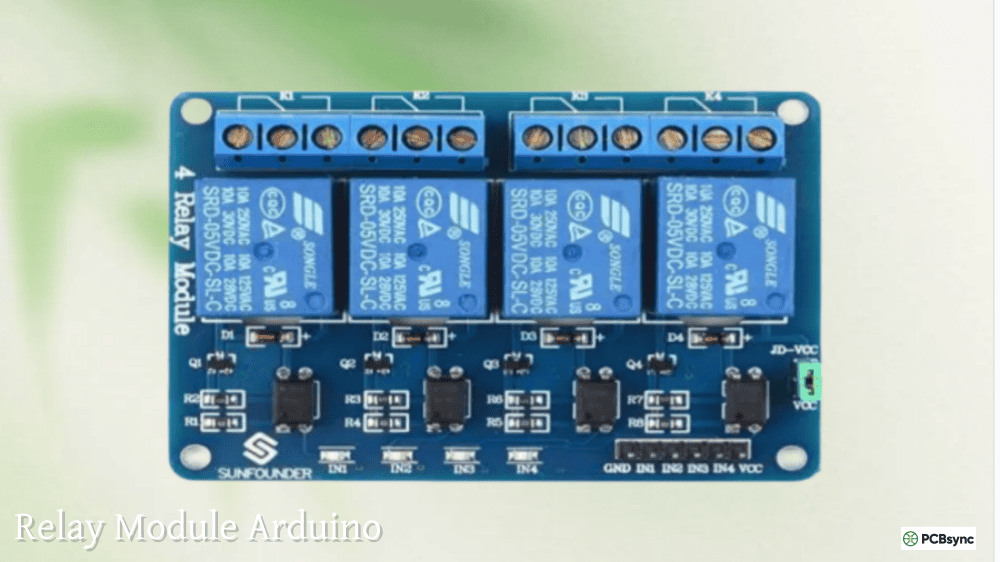
Modern 4-channel relay modules follow standardized designs, but understanding the variations helps you select the right module.
Standard Module Specifications:
Specification
Typical Value
Notes
Control Voltage
5V DC (most common)
Also available: 12V, 24V variants
Relay Type
SPDT (Single Pole Double Throw)
Each relay has COM, NO, NC terminals
Contact Rating
10A @ 250V AC<br>10A @ 30V DC
Per channel, not total
Relay Brand
Songle SRD-05VDC-SL-C
Quality varies with manufacturer
Control Current
15-20mA per channel
60-80mA total with all active
Trigger Type
Active LOW (default)
Some modules support HIGH/LOW selection
Isolation
Optocoupler per channel
PC817 or similar
Dimensions
~75mm × 55mm × 20mm
Standard form factor
Mounting
Four 3mm holes
Compatible with DIN rail mounts
Internal Circuit Components
Understanding the internal architecture helps troubleshoot issues and optimize performance.
Per-Channel Components:
Optocoupler (PC817): Provides electrical isolation between Arduino and relay coil
NPN Transistor (S8050): Amplifies optocoupler output to drive relay coil
Flyback Diode (1N4007): Protects transistor from inductive kickback
Indicator LED: Shows relay activation status (typically red)
Relay Coil: Electromagnet requiring ~70mA at 5V
Contact Assembly: SPDT mechanical switch rated for high current
Shared Components:
Power Supply Filtering: Bulk capacitors (usually 470µF or 1000µF)
Input Protection: Resistors limiting current to optocoupler LEDs
VCC/JD-VCC Jumper: Selects isolated or common power configuration
4-Channel Relay Arduino Pin Configuration
Control Side (Low Voltage) Connections
The standardized control interface makes connecting 4-channel relay modules straightforward:
Module Pin
Arduino Connection
Function
Signal Level
VCC
5V (external recommended)
Logic power
4.5-5.5V
GND
GND
Common ground
0V
IN1
Digital Pin (2-13 or A0-A5)
Relay 1 control
Active LOW default
IN2
Digital Pin
Relay 2 control
Active LOW default
IN3
Digital Pin
Relay 3 control
Active LOW default
IN4
Digital Pin
Relay 4 control
Active LOW default
Optional Pins on Advanced Modules:
JD-VCC: Isolated relay coil power (5V external when jumper removed)
Trigger Select Jumpers: Choose HIGH or LOW level triggering per channel
Understanding JD-VCC Configuration
This is the single most misunderstood feature on 4-channel relay modules.
With Jumper Installed (Simple Mode):
Arduino 5V → VCC and JD-VCC (connected via jumper)
Current Draw: All four relays active = ~280mA from Arduino 5V
Risk: Voltage drops, brownout resets on USB power
Use Case: Quick prototypes, single relay active at once
External 5V → JD-VCC (powers relay coils, up to 280mA)
Both Grounds → Common connection (MUST be tied together)
Benefit: True isolation, no voltage drops affecting Arduino
Use Case: Production systems, multiple simultaneous relays
Critical Rule: Even in isolated mode, Arduino GND and external supply GND must be connected. The optocoupler provides signal isolation, not ground isolation.
Load Side (High Voltage) Connections
Each of the four relays provides three screw terminals:
Terminal
Per-Relay Labels
Function
COM
COM1, COM2, COM3, COM4
Common contact (always connected to power)
NO
NO1, NO2, NO3, NO4
Normally Open (closed when relay active)
NC
NC1, NC2, NC3, NC4
Normally Closed (open when relay active)
Typical Wiring Example (AC Appliances):
Power Source HOT → Relay COM terminal
Relay NO terminal → Load Device HOT terminal
Power Source NEUTRAL → Load Device NEUTRAL (uninterrupted)
Power Source GROUND → Load Device GROUND (uninterrupted)
Programming 4-Channel Relay Arduino Systems
Basic Multi-Channel Control
// 4-Channel Relay Basic Control
// Active LOW triggering (most common configuration)
const int relay1 = 2;
const int relay2 = 3;
const int relay3 = 4;
const int relay4 = 5;
void setup() {
// Initialize all relay pins as outputs
pinMode(relay1, OUTPUT);
pinMode(relay2, OUTPUT);
pinMode(relay3, OUTPUT);
pinMode(relay4, OUTPUT);
// All relays OFF initially (HIGH = OFF for active LOW)
digitalWrite(relay1, HIGH);
digitalWrite(relay2, HIGH);
digitalWrite(relay3, HIGH);
digitalWrite(relay4, HIGH);
Serial.begin(9600);
Serial.println(“4-Channel Relay System Ready”);
}
void loop() {
// Activate relays sequentially
Serial.println(“Sequential Activation”);
digitalWrite(relay1, LOW); // Relay 1 ON
Serial.println(“Relay 1: ON”);
delay(1000);
digitalWrite(relay2, LOW); // Relay 2 ON
Serial.println(“Relay 2: ON”);
delay(1000);
digitalWrite(relay3, LOW); // Relay 3 ON
Serial.println(“Relay 3: ON”);
delay(1000);
digitalWrite(relay4, LOW); // Relay 4 ON
Serial.println(“Relay 4: ON”);
delay(2000);
// Deactivate all relays
Serial.println(“All OFF”);
digitalWrite(relay1, HIGH);
digitalWrite(relay2, HIGH);
digitalWrite(relay3, HIGH);
digitalWrite(relay4, HIGH);
delay(2000);
}
Array-Based Control for Cleaner Code
Managing four relays individually gets unwieldy. Array-based approaches improve maintainability:
// Array-Based 4-Channel Control
const int numRelays = 4;
const int relayPins[numRelays] = {2, 3, 4, 5};
void setup() {
Serial.begin(9600);
// Initialize all relays using loop
for(int i = 0; i < numRelays; i++) {
pinMode(relayPins[i], OUTPUT);
digitalWrite(relayPins[i], HIGH); // All OFF
}
Serial.println(“Array-Based Relay Control Ready”);
Power Supply Architecture for Multi-Channel Systems
Current Budget Calculations
Understanding total current draw prevents voltage drop issues:
Per-Relay Current Consumption:
Component
Current Draw
Notes
Optocoupler LED
5mA
Control signal path
Relay Coil
70mA
When activated
Indicator LED
10mA
Visual feedback
Total per active relay
~85mA
Rounded for safety
Worst-Case Scenario:
All 4 relays active: 4 × 85mA = 340mA
Arduino Uno baseline: ~50mA
Sensors/other components: ~50-100mA
Total System Current: ~500mA minimum
USB Power Limitation: USB provides maximum 500mA—barely sufficient for four active relays plus Arduino. Any additional load causes voltage drops and resets.
Recommended Power Solutions:
Power Source
Configuration
Capacity
Use Case
Arduino Barrel Jack
9V/1A wall adapter
1000mA @ 5V regulated
Small projects, 1-2 simultaneous relays
External 5V Supply
JD-VCC (jumper removed)
2A minimum
Production systems, all relays
Split Supplies
Separate Arduino + relay power
500mA + 1A
Critical applications, maximum isolation
Troubleshooting Common 4-Channel Issues
Problem 1: Only Some Relays Work
Symptoms: Relays 1 and 2 activate, but 3 and 4 don’t respond.
Diagnostic Steps:
Verify Wiring: Check IN3 and IN4 connections to Arduino
Test Pins: Upload test code activating each relay individually
Check Power: Measure voltage at VCC pin (should be 4.5-5.5V)
Swap Channels: Connect IN3 to working relay—if it works, Arduino pin faulty
Common Causes:
Cause
Solution
Insufficient power supply
Use external 5V supply on JD-VCC
Damaged relay module
Replace module
Pin conflict (PWM/Serial)
Use different Arduino pins
Weak solder joints
Reflow solder connections
Problem 2: Relays Activate Randomly at Startup
Root Cause: During Arduino boot, pins default to INPUT (high-impedance). Active-LOW relays interpret this as trigger signal.
Solutions:
1. Add Pull-Up Resistors (Hardware Fix):
10kΩ resistor between each IN pin and VCC
Ensures HIGH state during boot
2. Initialize Early in Code (Software Fix):
void setup() {
// Set relay pins HIGH immediately
digitalWrite(2, HIGH);
digitalWrite(3, HIGH);
digitalWrite(4, HIGH);
digitalWrite(5, HIGH);
// Then configure as outputs
pinMode(2, OUTPUT);
pinMode(3, OUTPUT);
pinMode(4, OUTPUT);
pinMode(5, OUTPUT);
}
Problem 3: Arduino Resets When Multiple Relays Switch
Cause: Current spike when multiple relay coils energize simultaneously drops Arduino voltage.
Solutions:
Remove JD-VCC Jumper: Use external 5V supply for relay coils
Add Bulk Capacitor: 470-1000µF across Arduino 5V and GND
Stagger Activation: Delay 100-200ms between relay activations
EasyButton: Debounced button inputs for manual control
ArduinoJson: Parse JSON commands from network interfaces
PubSubClient: MQTT protocol for IoT integration
Time: RTC-based scheduled relay control
Frequently Asked Questions
1. Can I safely control four 1500W heaters simultaneously with one 4-channel module?
No, this is dangerous and will likely fail. While each relay is rated 10A @ 250VAC (2500W maximum), multiple issues arise: (1) 1500W heaters draw ~6A each at 250VAC, totaling 24A for four heaters—far exceeding typical household circuit capacity (15-20A breakers). (2) Even if your circuit supports 24A, relay contacts are rated individually, not collectively. Four relays simultaneously switching 6A each creates significant heat and voltage drop in board traces. (3) The inrush current when heater elements cold can exceed 10A momentarily, potentially welding contacts. For this application, use industrial contactors rated 25-30A per channel, or split heaters across multiple circuits with separate relay modules. The 4-channel relay module works best when total combined load stays under 15-20A maximum.
2. Why do my relays click repeatedly (chatter) instead of staying closed?
Relay chattering indicates insufficient holding current, usually from voltage drop or back-EMF. Common causes include: (1) Inadequate power supply—the relay coil needs steady 70mA per channel; voltage drops below relay holding threshold cause release and immediate re-trigger cycles. Solution: Use external 5V supply on JD-VCC rated 1.5A minimum. (2) Inductive load kickback—motors and solenoids generate voltage spikes when switching; these can reset the optocoupler or transistor driver. Solution: Add snubber capacitors (0.1µF + 100Ω) across relay contacts. (3) Loose connections—poor screw terminal contact causes intermittent power to coil. Solution: Tighten all terminals and verify solid connections. (4) Defective relay—worn contacts or damaged coil cause erratic behavior. Solution: Test relay in isolated circuit; replace if faulty.
3. How do I prevent dangerous simultaneous relay activation in motor control applications?
Motor direction control requires strict interlock logic to prevent short circuits. Implement multiple safety layers: (1) Software Interlock—Before activating any relay, ensure opposite relay is OFF with mandatory delay: digitalWrite(reverseRelay, HIGH); delay(200); digitalWrite(forwardRelay, LOW);. (2) Physical Interlock—Some relay modules support mechanical interlocking where activating one relay physically prevents another from closing. (3) External Safety Relay—Industrial applications use separate safety relay that cuts power to all control relays during fault conditions. (4) Watchdog Timer—Implement timer that automatically shuts off all relays if Arduino stops responding. (5) Current Monitoring—Detect short circuit conditions (>20A typical) and immediately deactivate all relays. Never rely solely on software—hardware failures happen. Production motor controllers should combine software interlock with physical or external safety systems.
4. Can I use a 4-channel relay module to control DC motors directly?
While technically possible, this approach has significant limitations. Relay modules work for simple ON/OFF DC motor control but cannot provide: (1) Speed control—relays are binary switches; PWM speed control requires transistor-based drivers (H-bridges like L298N). (2) Direction control—requires H-bridge configuration with at least 2 relays per motor, limiting you to 2 motors maximum. (3) Rapid switching—relay contacts have limited switching lifetime (typically 100,000 cycles); motors requiring frequent direction changes wear out contacts quickly. (4) Brake control—cannot short motor terminals for dynamic braking. Best practices: Use relays for DC motors that need simple power on/off with infrequent switching (once per minute or less). For speed control, direction reversing, or frequent operation, use dedicated motor drivers (L298N, TB6612FNG, or VNH2SP30). For large DC motors (>5A), use relays to switch power to industrial motor controllers.
5. What’s the maximum wire length between Arduino and 4-channel relay module?
Wire length affects signal integrity and voltage drop. Practical limits: (1) For control signals (IN1-IN4)—up to 3 meters (~10 feet) typically works reliably with standard jumper wires. Beyond this, electromagnetic interference can false-trigger relays. Use shielded cable for lengths beyond 3m, grounding shield at one end only. For very long runs (>10m), use RS-485 converters or optocoupler repeaters. (2) For power wiring (VCC/GND)—limited by voltage drop, not signal integrity. Calculate wire resistance: 22AWG wire has ~0.05Ω/meter. At 300mA draw over 3m (6m total—there and back), voltage drop is 0.05 × 6 × 0.3 = 0.09V, which is acceptable. Beyond 5m, use 18AWG or 16AWG wire to minimize voltage drop. (3) Best practice—keep relay modules within 1-2m of Arduino for reliable operation. For remote installations, locate relay module near loads and use long control signal wiring rather than long power wiring.
Conclusion
The 4-channel relay Arduino combination transforms simple microcontroller projects into sophisticated multi-device control systems. Whether managing home automation zones, orchestrating industrial processes, or building complex agricultural automation, understanding proper power architecture and programming techniques ensures reliable operation.
Key takeaways from this comprehensive guide emphasize the critical importance of external power supplies for relay coils, proper use of the JD-VCC isolation feature, and implementing software interlocks for safety-critical applications. The array-based programming approaches demonstrated here scale easily to 8 or 16-channel modules for even more complex systems.
Remember that relay modules are mechanical devices with finite lifetimes—proper derating, avoiding frequent switching of inductive loads, and using appropriate contact protection extends operational life from thousands to hundreds of thousands of cycles. For applications requiring silent operation or extreme switching frequencies, consider solid-state relay alternatives.
Start with simple sequential control to understand the basics. Progress to state machine implementations for complex automation tasks. Add network connectivity via WiFi or Bluetooth modules for remote control capabilities. The 4-channel relay Arduino platform provides the foundation for virtually any multi-device switching application you can imagine—from simple convenience automation to life-safety critical industrial control systems.
Inquire: Call 0086-755-23203480, or reach out via the form below/your sales contact to discuss our design, manufacturing, and assembly capabilities.
Quote: Email your PCB files to Sales@pcbsync.com (Preferred for large files) or submit online. We will contact you promptly. Please ensure your email is correct.
Notes: For PCB fabrication, we require PCB design file in Gerber RS-274X format (most preferred), *.PCB/DDB (Protel, inform your program version) format or *.BRD (Eagle) format. For PCB assembly, we require PCB design file in above mentioned format, drilling file and BOM. Click to download BOM template To avoid file missing, please include all files into one folder and compress it into .zip or .rar format.