Inquire: Call 0086-755-23203480, or reach out via the form below/your sales contact to discuss our design, manufacturing, and assembly capabilities.
Quote: Email your PCB files to Sales@pcbsync.com (Preferred for large files) or submit online. We will contact you promptly. Please ensure your email is correct.
Notes: For PCB fabrication, we require PCB design file in Gerber RS-274X format (most preferred), *.PCB/DDB (Protel, inform your program version) format or *.BRD (Eagle) format. For PCB assembly, we require PCB design file in above mentioned format, drilling file and BOM. Click to download BOM template To avoid file missing, please include all files into one folder and compress it into .zip or .rar format.
The Unsung Hero of Signal Integrity: A Deep Dive into Terminating Resistors
If you have ever spent four hours in a lab chasing a “phantom” data error that only appears when you move a cable or add a node to a network, you’ve likely been haunted by the absence of a proper terminating resistor. In my years as a PCB engineer, I’ve seen more designs fail because of “simple” termination issues than because of complex logic bugs.
A terminating resistor is essentially a component used to prevent signal reflections on a transmission line. Whether you are working with a high-speed CAN bus in an automotive ECU or an RS-485 link in a factory’s industrial control system, the physics remain the same: if your electrical signal hits a “wall” (an impedance mismatch), it will bounce back and corrupt the next bit of data.
In this guide, we will break down the essential role of termination, look at specific requirements for the most common protocols, and share the layout secrets that keep signals clean.
Why We Terminate: The Physics of Signal Reflection
To understand the need for a terminating resistor, you have to stop thinking of wires as “perfect conductors” and start thinking of them as transmission lines. At low frequencies, a wire is just a wire. But when you are dealing with high-speed data or long cable runs, the signal behaves like a wave.
The Characteristic Impedance ($Z_0$)
Every cable has a characteristic impedance. This is not the DC resistance you measure with a multimeter; it is a complex value determined by the cable’s geometry, the distance between conductors, and the dielectric of the insulation. Most twisted-pair cables used in industrial networking have a $Z_0$ of approximately 100 to 120 ohms.
The Problem of the “Open End”
Imagine a wave traveling through a pipe. When it hits the end of the pipe, if that end is closed or wide open, the wave energy has nowhere to go but back where it came from. In a circuit, when a signal pulse reaches the end of an unterminated wire, it sees an “infinite” impedance. This causes the signal to reflect back toward the transmitter.
This reflection creates “ringing” or “overshoot” on the waveform. If the reflection arrives while the receiver is trying to sample the next bit, you get bit errors, CRC failures, and a very unhappy system. A terminating resistor placed at the end of the line matches the cable’s characteristic impedance, effectively “absorbing” the energy so no reflection occurs.
Mastering the Terminating Resistor CAN Bus Configuration
The Controller Area Network (CAN) is perhaps the most famous user of termination. In a standard high-speed CAN (ISO 11898) network, the termination is not just “recommended”—it is part of the electrical definition of the bus states.
Why 120 Ohms?
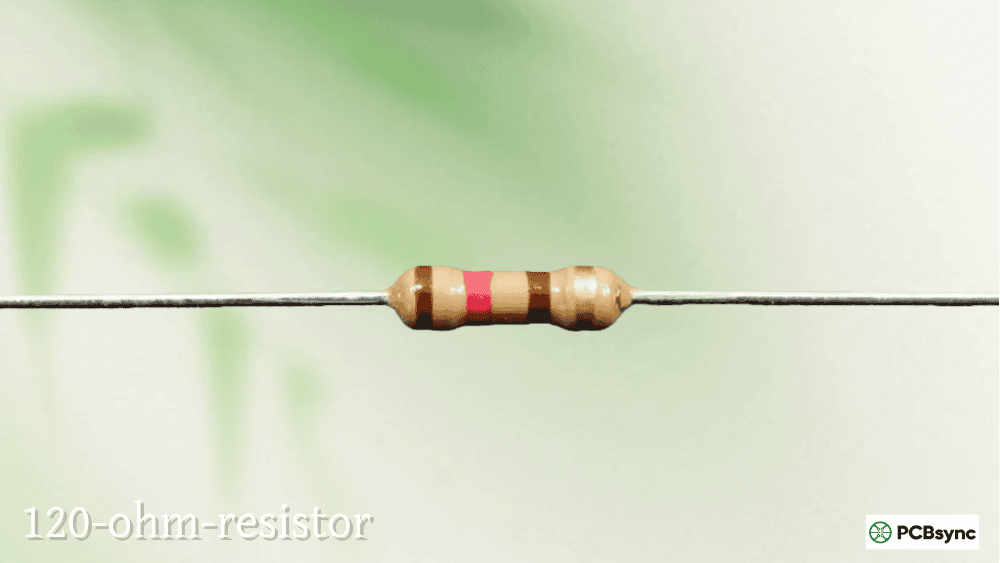
The industry standard for a terminating resistor CAN bus application is 120 ohms. This value was chosen because typical automotive-grade twisted-pair wiring has a characteristic impedance close to 120 ohms. By placing one at each end of the bus, you create a total DC load of 60 ohms ($120 \parallel 120$).
The Role in Dominant and Recessive States
CAN is a “multi-master” bus that uses differential signaling between two lines: CAN High (CAN_H) and CAN Low (CAN_L).
Dominant State (Logic 0): The transceiver actively drives a voltage difference between the lines.
Recessive State (Logic 1): The transceiver stops driving.
Here is the kicker: in the recessive state, the terminating resistor is what physically pulls the two lines back to the same voltage level. Without termination, the lines would “float” back too slowly, meaning your high-speed communication (like 500kbps or 1Mbps) would fail because the bits wouldn’t “clear” fast enough.
Placement and Topology Rules
The most common mistake I see on the floor is putting a resistor on every single node. Do not do this. 1. Exactly Two Terminators: A CAN bus should have exactly two 120-ohm resistors, one at each physical end of the main trunk.
2. Stub Lengths: Nodes branching off the main trunk should have “stubs” as short as possible (typically <0.3m for 1Mbps). Adding a resistor to a stub creates a third terminator, which drops the bus resistance below 60 ohms and overloads the transceivers.
Configuration
Total Resistance
Status
No Resistors
$\infty$ (High)
Failure: Heavy reflections, no recessive transition.
One 120Ω Resistor
120Ω
Marginal: May work at low speeds, high risk of error.
Two 120Ω Resistors
60Ω
Optimal: Correct impedance matching and load.
Three 120Ω Resistors
40Ω
Failure: Overloads the CAN transceiver drivers.
RS-485 Termination: Robustness for Long Distance
RS-485 is the workhorse of industrial automation, capable of distances up to 1,200 meters. Because of these long distances, termination is arguably even more critical here than in CAN.
The Differences in RS-485 Logic
Unlike CAN, RS-485 is often used in half-duplex configurations where one driver talks at a time. While the termination value is usually 120 ohms (matching standard Belden 9841 or similar cables), RS-485 often requires an additional feature: Fail-Safe Biasing.
Fail-Safe Biasing and Termination
When no one is talking on an RS-485 bus, the lines are “idle.” However, a 120-ohm terminating resistor will pull the differential voltage to 0V. Most RS-485 receivers are “undecided” at 0V, meaning noise could be interpreted as valid data. To fix this, we add “pull-up” and “pull-down” resistors (biasing) to ensure that when the bus is idle, the voltage remains above the receiver threshold (usually >200mV).
Topology: Daisy Chaining
In RS-485, you must follow a “Daisy Chain” topology. T-junctions and star configurations are the enemies of signal integrity.
Rule: Run the cable from the Master to Slave 1, then Slave 1 to Slave 2, and so on.
Termination: Place a terminating resistor at the Master (if it’s at an end) and the very last Slave.
Application Comparison: CAN vs. RS-485 vs. Ethernet
Different networks have different rules for where and how the terminating resistor is applied.
Feature
CAN Bus
RS-485
Ethernet (10/100/1000)
Standard Value
120Ω
120Ω (Typical)
100Ω
Placement
Both ends of trunk
Both ends of trunk
Internal (Magnetics/PHY)
Purpose
Reflection & DC Load
Reflection & Integrity
Reflection & CM Noise
Max Speed
1 Mbps (CAN FD 5+ Mbps)
10 Mbps (Distance limited)
1 Gbps+
Biasing Needs
Usually none
High (Fail-safe)
Not user-serviceable
Advanced PCB Layout Tips for Termination
As a PCB engineer, placing the resistor on the schematic is only half the battle. If you don’t lay it out correctly on the board, you might as well not have it at all.
1. Proximity to the Connector
The terminating resistor should be placed as close as physically possible to the point where the cable enters the board (the connector). If you place the resistor 2 inches away from the connector, you’ve created a 2-inch “stub” on your own PCB. At high frequencies, that stub will create its own reflections.
2. Differential Pair Routing
Keep your CAN_H/CAN_L or RS-485 A/B lines as a tight differential pair.
Trace Width/Gap: Use a PCB impedance calculator to ensure your trace impedance matches the 120-ohm target.
Symmetry: Route the traces symmetrically through the resistor pads. Don’t let one signal take a long detour around a via while the other stays straight.
3. Power Rating Matters
Don’t just grab a 0402-size resistor and hope for the best. In a fault condition (like a short to 24V), a terminating resistor can see significant current.
Calculation: If you have 12V across a 120-ohm resistor, $P = V^2 / R = 144 / 120 = 1.2W$.
Recommendation: For industrial or automotive use, I often specify a MELF resistor or a 1206/1210 package to handle transient surges and heat.
If your project is going through strict EMC testing (like CISPR 25), consider “Split Termination.” Instead of one 120-ohm resistor, use two 60-ohm resistors in series with a capacitor (usually 4.7nF to 100nF) from the center point to Ground. This provides a path for common-mode noise to exit the bus without affecting the differential data.
Useful Resources and Databases
To properly implement a terminating resistor, you need the right data. Here are the links I keep on my second monitor:
Impedance Calculators:
Saturn PCB Toolkit – The best free tool for calculating PCB trace impedance.
AppCAD – A classic RF and signal integrity tool from Avago/Broadcom.
1. Can I use a 100-ohm resistor instead of 120 ohms?
In a pinch, a 100-ohm resistor might work for a short CAN bus, but it’s not ideal. It will drop the total bus resistance to 50 ohms, which is the absolute limit for many transceivers. Stick to 120 ohms for reliability and standards compliance.
2. What happens if I have three or more terminating resistors on a CAN bus?
The total resistance will drop (e.g., three 120Ω resistors = 40Ω). Most CAN transceivers are designed to drive a minimum of 45-50 ohms. If you drop to 40 ohms, the output voltage levels will sag, and you will likely lose communication because the “Dominant” state won’t be high enough.
3. Is termination needed for very short cables?
The rule of thumb is that if the propagation delay of the cable is less than 1/10th of the signal rise time, you might get away without it. However, for a terminating resistor CAN bus setup, you should always include it. It’s cheap insurance against signal issues.
4. Why is my RS-485 network working at 9600 baud without termination but failing at 115200?
At lower speeds, the reflections have enough time to “settle” or die out before the receiver samples the bit. As you increase the speed, the bits get shorter, and those reflections start overlapping with the next bit, causing data corruption.
5. Should I terminate the Master or the Slave?
In a daisy-chain network, you terminate the physical ends. If the Master is at one end of the cable, it gets a resistor. If the Master is in the middle of a long line with Slaves on both sides, the Master does not get a resistor; the two Slaves at the far ends do.
Conclusion: Don’t Skimp on the Basics
The terminating resistor is often the smallest and cheapest component on your BOM, but it carries the heaviest load when it comes to reliability. Whether you’re dealing with the fixed 120-ohm requirements of a terminating resistor CAN bus or the complex biasing of an RS-485 network, the goal is always the same: keep the energy flowing in one direction and absorb it at the end.
As you move from schematic to layout, remember the “PCB Engineer’s Creed”: Keep stubs short, keep pairs differential, and always—always—put your terminators at the physical ends of the line. Your future self (and your tech support team) will thank you.
Would you like me to calculate the specific fail-safe biasing resistor values for your current RS-485 node count and supply voltage?
Inquire: Call 0086-755-23203480, or reach out via the form below/your sales contact to discuss our design, manufacturing, and assembly capabilities.
Quote: Email your PCB files to Sales@pcbsync.com (Preferred for large files) or submit online. We will contact you promptly. Please ensure your email is correct.
Notes: For PCB fabrication, we require PCB design file in Gerber RS-274X format (most preferred), *.PCB/DDB (Protel, inform your program version) format or *.BRD (Eagle) format. For PCB assembly, we require PCB design file in above mentioned format, drilling file and BOM. Click to download BOM template To avoid file missing, please include all files into one folder and compress it into .zip or .rar format.