Inquire: Call 0086-755-23203480, or reach out via the form below/your sales contact to discuss our design, manufacturing, and assembly capabilities.
Quote: Email your PCB files to Sales@pcbsync.com (Preferred for large files) or submit online. We will contact you promptly. Please ensure your email is correct.
Notes: For PCB fabrication, we require PCB design file in Gerber RS-274X format (most preferred), *.PCB/DDB (Protel, inform your program version) format or *.BRD (Eagle) format. For PCB assembly, we require PCB design file in above mentioned format, drilling file and BOM. Click to download BOM template To avoid file missing, please include all files into one folder and compress it into .zip or .rar format.
Every PCB I design these days uses SMD resistors almost exclusively. After fifteen years of transitioning from through-hole to surface mount technology, I can confidently say that understanding SMD resistor sizes, codes, and identification is essential knowledge for anyone working in electronics. Whether you’re debugging a prototype, selecting components for production, or repairing a failed board, knowing how to read those tiny markings can save hours of frustration.
This comprehensive guide covers everything you need to know about surface mount resistors: package sizes from tiny 01005 to power-handling 2512, all three marking systems (3-digit, 4-digit, and EIA-96), and practical identification techniques I use daily at my workbench.
An SMD resistor, also called a surface mount resistor or chip resistor, is a passive electronic component designed for surface mount technology (SMT) assembly. Unlike traditional through-hole resistors with axial wire leads, SMD resistors are compact rectangular components that solder directly onto PCB surface pads.
Surface mount resistors perform the same function as their through-hole counterparts: limiting current flow, dividing voltages, and setting bias points in circuits. The difference lies in their form factor, which enables automated assembly and dramatically higher component density.
The construction of a typical SMD resistor includes a ceramic substrate (usually alumina), a resistive element (thick film or thin film), terminations on each end for soldering, and a protective overglaze coating where markings are printed.
SMD Resistor Package Sizes Explained
Surface mount resistor sizes follow JEDEC standards, identified by four-digit codes that represent physical dimensions. The code format indicates length and width in hundredths of an inch (imperial) or tenths of a millimeter (metric).
For example, the imperial code 0805 means 0.08 inches long by 0.05 inches wide. The metric equivalent is 2012, meaning 2.0mm by 1.2mm. Most engineers use imperial codes even while working with metric dimensions in PCB software, which can cause initial confusion.
Complete SMD Resistor Size Chart
Imperial Code
Metric Code
Length (mm)
Width (mm)
Height (mm)
Typical Power Rating
01005
0402M
0.4
0.2
0.13
1/32W (0.03W)
0201
0603M
0.6
0.3
0.23
1/20W (0.05W)
0402
1005M
1.0
0.5
0.35
1/16W (0.063W)
0603
1608M
1.6
0.8
0.45
1/10W (0.1W)
0805
2012M
2.0
1.25
0.5
1/8W (0.125W)
1206
3216M
3.2
1.6
0.55
1/4W (0.25W)
1210
3225M
3.2
2.5
0.55
1/2W (0.5W)
1812
4532M
4.5
3.2
0.55
1/2W (0.5W)
2010
5025M
5.0
2.5
0.55
3/4W (0.75W)
2512
6332M
6.3
3.2
0.55
1W
Choosing the Right SMD Resistor Size
Package selection depends on several factors beyond just fitting components on the board:
Power dissipation drives size selection more than anything else. Calculate your worst-case power using P = I²R or P = V²/R, then select a package rated for at least 50% more than your calculated value. Running SMD resistors at their maximum rating causes reliability problems due to heat.
Assembly capability matters significantly. Packages smaller than 0402 require specialized pick-and-place equipment and are difficult or impossible to hand solder. If you’re prototyping by hand, stick with 0603 or larger.
Inspection and rework become challenging below 0603. Those 0402 and 0201 packages are nearly invisible without magnification, making visual inspection and manual rework extremely difficult.
Cost considerations favor common sizes. The 0402, 0603, and 0805 packages hit the sweet spot of availability, price, and handleability for most applications.
For most of my designs, I default to 0603 for general-purpose resistors and move to 0805 or 1206 when power handling matters. I only go smaller when board space absolutely demands it.
How to Read SMD Resistor Codes
Unlike through-hole resistors with color bands, surface mount resistors use alphanumeric codes printed on their top surface. Three distinct marking systems exist, and knowing which one you’re looking at is half the battle.
The 3-Digit SMD Resistor Code System
The 3-digit code is the most common marking system for standard tolerance (5%) SMD resistors. The format is simple: the first two digits are significant figures, and the third digit is the multiplier (power of ten).
Formula: Resistance = (First two digits) × 10^(Third digit)
Code
Calculation
Resistance
100
10 × 10⁰
10Ω
101
10 × 10¹
100Ω
102
10 × 10²
1kΩ
103
10 × 10³
10kΩ
104
10 × 10⁴
100kΩ
220
22 × 10⁰
22Ω
471
47 × 10¹
470Ω
682
68 × 10²
6.8kΩ
105
10 × 10⁵
1MΩ
Important: The code 220 means 22Ω, not 220Ω. The trailing zero is the multiplier (10⁰ = 1), not part of the value. This trips up many beginners.
Values Below 10 Ohms: The “R” Notation
For resistances below 10Ω, the letter “R” indicates the decimal point position:
Code
Resistance
R10
0.10Ω
R22
0.22Ω
R47
0.47Ω
1R0
1.0Ω
2R2
2.2Ω
4R7
4.7Ω
5R6
5.6Ω
Current sensing resistors often use this notation, sometimes with “M” or “L” for milliohm values (1M5 = 1.5mΩ).
The 4-Digit SMD Resistor Code System
Precision SMD resistors (1% tolerance) use a 4-digit code for greater accuracy. The first three digits are significant figures, and the fourth is the multiplier.
Formula: Resistance = (First three digits) × 10^(Fourth digit)
Code
Calculation
Resistance
1000
100 × 10⁰
100Ω
1001
100 × 10¹
1kΩ
1002
100 × 10²
10kΩ
4700
470 × 10⁰
470Ω
4701
470 × 10¹
4.7kΩ
4702
470 × 10²
47kΩ
1503
150 × 10³
150kΩ
2001
200 × 10¹
2kΩ
The 4-digit system provides three significant figures instead of two, matching the precision of 1% tolerance parts.
The EIA-96 Code System for Precision SMD Resistors
The EIA-96 system was developed for 1% tolerance resistors on smaller packages where even 4-digit codes wouldn’t fit. This system uses two digits plus a letter, requiring a lookup table.
The two-digit number (01-96) corresponds to a specific value from the E96 series. The letter indicates the multiplier.
EIA-96 Multiplier Letters:
Letter
Multiplier
Letter
Multiplier
Z
0.001
A
1
Y
0.01
B
10
X
0.1
C
100
D
1,000
E
10,000
F
100,000
Common EIA-96 Code Values (Partial Table):
Code
Base Value
Code
Base Value
Code
Base Value
01
100
25
178
49
316
02
102
26
182
50
324
03
105
27
187
51
332
04
107
28
191
52
340
05
110
29
196
53
348
06
113
30
200
54
357
07
115
31
205
55
365
08
118
32
210
56
374
EIA-96 Examples:
Marking
Calculation
Resistance
01A
100 × 1
100Ω
01B
100 × 10
1kΩ
01C
100 × 100
10kΩ
29B
196 × 10
1.96kΩ
53C
348 × 100
34.8kΩ
68X
499 × 0.1
49.9Ω
The letter in EIA-96 prevents confusion with 3-digit codes. If you see a letter at the end, you’re dealing with EIA-96.
SMD Resistor Tolerance and Temperature Coefficient
The marking code only tells you resistance value, not tolerance or temperature coefficient. These specifications depend on the resistor series and must be verified from datasheets or purchasing records.
Understanding Tolerance Markings
Some larger SMD resistors include a tolerance letter after the value code:
Letter
Tolerance
F
±1%
G
±2%
J
±5%
K
±10%
M
±20%
General rules of thumb:
3-digit codes typically indicate 5% tolerance
4-digit codes typically indicate 1% tolerance
EIA-96 codes indicate 1% tolerance
These are guidelines, not guarantees. Always verify from the component datasheet or bill of materials.
Temperature Coefficient Specifications
Temperature coefficient (TCR) describes how resistance changes with temperature, measured in parts per million per degree Celsius (ppm/°C).
Resistor Type
Typical TCR
Application
Thick film (general)
±100 to ±200 ppm/°C
General purpose
Thick film (precision)
±50 to ±100 ppm/°C
Better stability
Thin film
±5 to ±25 ppm/°C
Precision circuits
MELF (thin film)
±25 to ±50 ppm/°C
High stability
For a 10kΩ resistor with ±100 ppm/°C TCR, a 50°C temperature change causes up to 50Ω (0.5%) resistance shift. In precision analog circuits, this matters significantly.
Thick Film vs Thin Film SMD Resistors
Surface mount resistors come in two main construction types, each with distinct characteristics.
Thick Film SMD Resistors
Thick film technology uses a paste of metal oxide and glass frit screened onto a ceramic substrate, then fired at high temperature. The resistive layer is typically 10-50 micrometers thick.
Characteristics:
Lower cost
Wider resistance range (0Ω to 10MΩ+)
Higher TCR (±100 to ±200 ppm/°C typical)
Tolerances from 1% to 5%
Good for general purpose applications
Thick film dominates the market for commodity applications. The vast majority of SMD resistors you’ll encounter are thick film.
Thin Film SMD Resistors
Thin film technology deposits a metal alloy (often nichrome) onto a ceramic substrate through sputtering or evaporation. The resistive layer is under 1 micrometer thick.
Characteristics:
Higher cost (3-10× thick film)
Tighter tolerance (0.1% available)
Lower TCR (±5 to ±25 ppm/°C)
Better long-term stability
Lower noise
Thin film resistors are essential for precision measurement, instrumentation, and RF applications where stability and accuracy justify the cost premium.
Zero-Ohm Resistors (Jumpers)
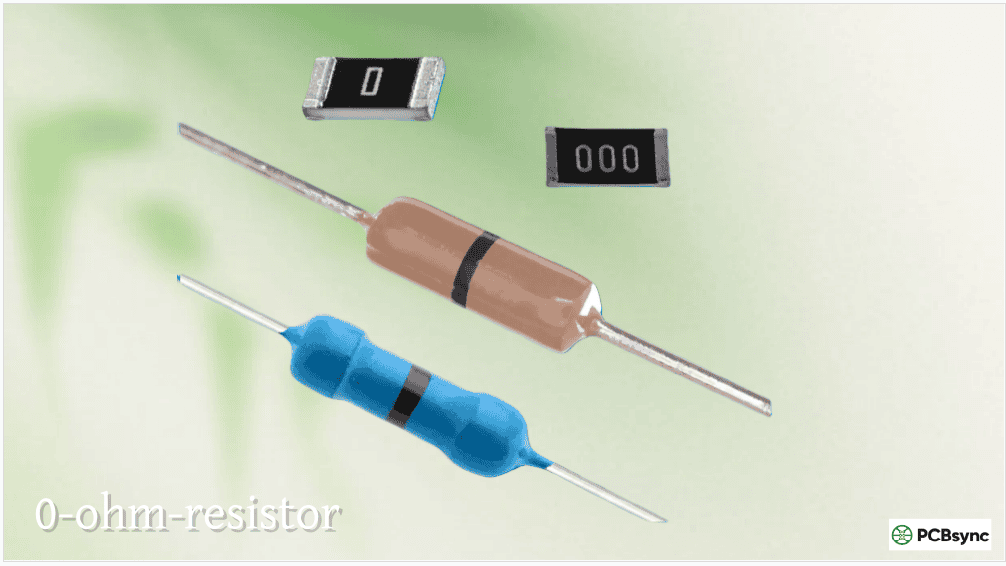
You’ll frequently encounter SMD resistors marked “0” or “000” on PCBs. These are zero-ohm jumpers, essentially wire bridges in resistor form.
Zero-ohm resistors exist because pick-and-place machines handle all SMD components the same way. Using a zero-ohm jumper instead of a wire link keeps assembly automated and consistent.
Common uses:
Routing signals between layers
Configuration options (populate or don’t populate)
Zero-ohm jumpers aren’t truly zero resistance; they typically measure 10-50 milliohms due to termination and contact resistance.
Practical SMD Resistor Identification Tips
After years of debugging boards, I’ve developed reliable methods for identifying unknown SMD resistors.
Visual Identification Workflow
Note the package size by measuring or comparing to known components
Examine the marking under magnification (10× minimum for 0603 and smaller)
Determine the code system (3-digit, 4-digit, or EIA-96)
Calculate or look up the value
Verify with a multimeter when possible
When Markings Are Unreadable
Markings fade, burn off during rework, or get obscured by conformal coating. When visual identification fails:
Use a multimeter: Remove the resistor from circuit or power down and disconnect one end. Measure resistance directly. This is the most reliable method.
Check the schematic: Cross-reference the component designator with your documentation.
Compare to known good boards: If you have a working board, measure the corresponding resistor.
Use magnification: USB microscopes work surprisingly well for reading tiny markings that appear illegible to the naked eye.
Common Identification Mistakes
Confusing 3-digit and 4-digit codes: A marking of “1001” could be 4-digit (1kΩ) or two separate components. Package size provides context.
Misreading orientation: SMD resistors are symmetrical and can be placed in either orientation. The marking should read normally left-to-right, but placement can vary.
Assuming tolerance from code type: While 3-digit usually means 5% and 4-digit means 1%, exceptions exist. Always verify critical tolerances from documentation.
Ignoring the “R” notation: Codes like “4R7” are 4.7Ω, not 47Ω or 4.7kΩ. The R marks the decimal point.
Useful Resources and Tools
These resources simplify SMD resistor identification and selection:
How do I know if an SMD resistor is 3-digit or 4-digit code?
Count the characters. Three characters without a letter at the end means 3-digit code. Four numerical characters means 4-digit code. Three characters with a letter at the end (like 01C) indicates EIA-96. Package size provides context too; very small packages (0402 and below) often use EIA-96 because there’s no room for 4-digit codes. When in doubt, measure with a multimeter.
Can I replace an 0805 SMD resistor with 0603 or 1206?
You can substitute different package sizes if the footprint allows and power ratings are adequate. An 0603 fits on most 0805 pads with careful soldering, though it’s not ideal for production. Going larger (0805 to 1206) rarely works without footprint modification. The resistance value and tolerance must match regardless of package size.
Why are some SMD resistors unmarked?
Very small packages (0201 and 01005) lack space for any marking. Some manufacturers skip markings on commodity parts to reduce cost. Unmarked resistors must be identified through measurement, documentation, or reel labels. This is why maintaining accurate BOMs and component organization is critical when working with small SMD parts.
What does a resistor marked “000” or “0” mean?
These are zero-ohm jumpers, used as wire bridges in surface mount assembly. They conduct current with minimal resistance (typically 10-50mΩ) and serve for routing, configuration options, or maintaining automated assembly processes. Zero-ohm jumpers are not actually zero resistance but are close enough for most signal routing purposes.
How accurate are SMD resistor code calculators?
Online calculators are highly accurate for standard marking systems. However, they can’t account for non-standard markings used by some manufacturers, damaged or partial markings, or unusual coding schemes on specialty resistors. Always verify critical components with a multimeter, especially when debugging a circuit that isn’t working as expected.
Wrapping Up
SMD resistors have become the standard for modern electronics manufacturing, and understanding their sizing conventions and marking codes is fundamental knowledge for any PCB engineer or electronics hobbyist. The three marking systems (3-digit, 4-digit, and EIA-96) each serve specific purposes, from general-purpose 5% parts to precision 1% components.
The key points to remember: package codes indicate physical size and power handling, marking codes indicate resistance value, and tolerance comes from the resistor series rather than the marking itself. When visual identification fails, your multimeter is the ultimate arbiter of truth.
Whether you’re designing new boards, debugging prototypes, or repairing existing equipment, this knowledge of surface mount resistor identification will serve you well throughout your electronics career. Keep a good magnifier handy, bookmark a reliable code calculator, and don’t hesitate to measure when markings are unclear.
Inquire: Call 0086-755-23203480, or reach out via the form below/your sales contact to discuss our design, manufacturing, and assembly capabilities.
Quote: Email your PCB files to Sales@pcbsync.com (Preferred for large files) or submit online. We will contact you promptly. Please ensure your email is correct.
Notes: For PCB fabrication, we require PCB design file in Gerber RS-274X format (most preferred), *.PCB/DDB (Protel, inform your program version) format or *.BRD (Eagle) format. For PCB assembly, we require PCB design file in above mentioned format, drilling file and BOM. Click to download BOM template To avoid file missing, please include all files into one folder and compress it into .zip or .rar format.