Inquire: Call 0086-755-23203480, or reach out via the form below/your sales contact to discuss our design, manufacturing, and assembly capabilities.
Quote: Email your PCB files to Sales@pcbsync.com (Preferred for large files) or submit online. We will contact you promptly. Please ensure your email is correct.
Notes: For PCB fabrication, we require PCB design file in Gerber RS-274X format (most preferred), *.PCB/DDB (Protel, inform your program version) format or *.BRD (Eagle) format. For PCB assembly, we require PCB design file in above mentioned format, drilling file and BOM. Click to download BOM template To avoid file missing, please include all files into one folder and compress it into .zip or .rar format.
smd-resistor-codeDecoding the SMD Resistor Code: A Professional Engineer’s Guide to 3 & 4 Digit Markings
As a PCB engineer, there is nothing more frustrating than staring at a handful of loose components on your workbench and wondering if that “103” is a pull-up for your I2C bus or a current limiter for an LED. In the world of Surface Mount Technology (SMT), size is everything, and space for text is a luxury.
Understanding the smd resistor marking system isn’t just about doing math; it’s about recognizing the standard “languages” (E24, E96, and EIA-96) used by manufacturers to communicate value and tolerance. In this guide, we’ll break down how to read kode resistor smd like a pro, covering everything from the standard 3-digit system to the cryptic EIA-96 codes found on precision 1% resistors.
Unlike through-hole resistors that use color bands, SMD resistors use printed alphanumeric codes. The logic is generally based on significant figures and a multiplier (power of 10).
However, as components get smaller—think 0402 or 0201 packages—there is literally no room to print anything. In those cases, you have to rely on the reel label or a digital multimeter. For the “readable” sizes like 0603, 0805, and 1206, the systems below are the industry standard.
How to Read the 3-Digit SMD Resistor Code (±5% Tolerance)
The 3-digit system is the most common kode resistor smd you will encounter. It is typically used for resistors with a ±5% tolerance (the E24 series).
First two digits: These are the significant figures (the base value).
Third digit: This is the multiplier, representing the number of zeros to add to the base value.
Examples of 3-Digit Calculations:
103: 10 followed by 3 zeros = 10,000 Ω or 10kΩ
472: 47 followed by 2 zeros = 4,700 Ω or 4.7kΩ
100: 10 followed by 0 zeros = 10Ω (A common mistake is thinking 100 is 100Ω!)
221: 22 followed by 1 zero = 220Ω
Precision Decoding: The 4-Digit SMD Resistor Code (±1% Tolerance)
When your circuit requires tighter precision (e.g., voltage dividers or feedback loops), you’ll often see a 4-digit smd resistor marking. This is the standard for ±1% tolerance resistors (E48 or E96 series).
First three digits: These are the significant figures.
Fourth digit: The multiplier (number of zeros).
Examples of 4-Digit Calculations:
1001: 100 followed by 1 zero = 1,000 Ω or 1kΩ
4992: 499 followed by 2 zeros = 49,900 Ω or 49.9kΩ
1000: 100 followed by 0 zeros = 100Ω
7500: 750 followed by 0 zeros = 750Ω
Handling Decimals and Low Resistance: The “R” Notation
What happens if the resistor value is less than 10Ω or contains a decimal? Manufacturers use the letter “R” to represent the decimal point.
Marking
Meaning
Value
4R7
4.7
4.7 Ω
0R22
0.22
0.22 Ω
R100
.100
0.1 Ω
10R0
10.0
10 Ω
The EIA-96 System: The “Cryptic” 0603 Code
As an engineer, the EIA-96 system is the one that usually sends people reaching for a datasheet. Because 0603 resistors are too small for a 4-digit code but often need 1% precision, the industry created a lookup table. This system uses two digits followed by a letter.
Look up the two-digit code in the E96 value table to find the 3-digit base.
Apply the letter multiplier from the multiplier table.
EIA-96 Multiplier Table
Letter
Multiplier (10n)
Z
0.001
Y / R
0.01
X / S
0.1
A
1
B / H
10
C
100
D
1,000
E
10,000
F
100,000
EIA-96 Value Table (Subset)
Code
Value
Code
Value
Code
Value
01
100
33
215
68
499
09
121
42
267
82
698
18
150
51
332
96
976
Example: A resistor marked 01C.
01 = 100 (from table)
C = x100 (multiplier)
Result: 10,000 Ω or 10kΩ 1%.
Special Cases: 0-Ohm Resistors and Underlines
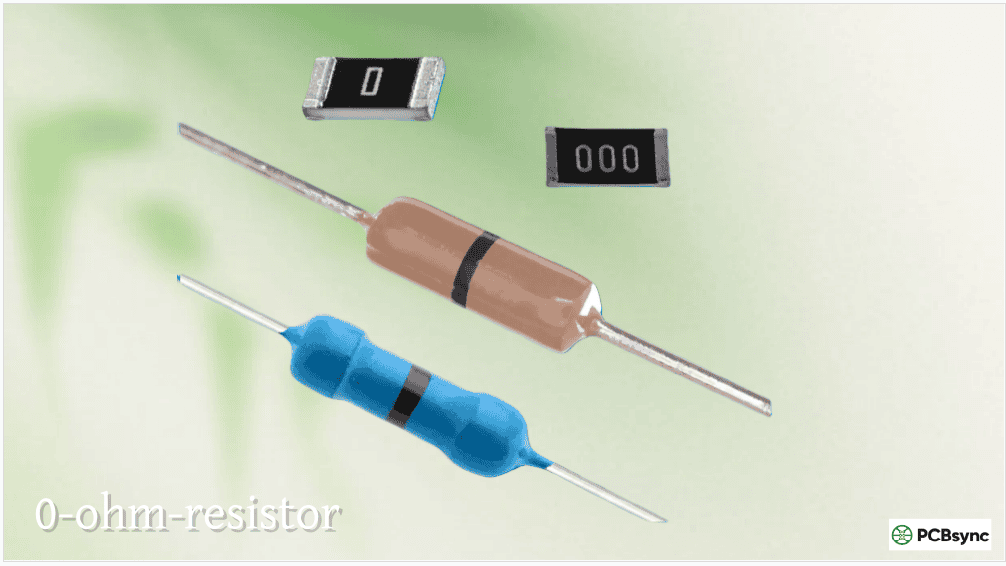
Zero-Ohm Jumpers: These are marked with a single “0” or “000”. They act as a wire link and are used to bridge traces or provide configuration options on a single PCB layout.
The Underline: Sometimes you’ll see a 3-digit code with an underline (e.g., <u>122</u>). This usually indicates that the manufacturer is using a high-precision version of a standard E24 value. In some cases, an underline on a 2-digit code helps with orientation (to distinguish 06 from 90).
Professional Engineering Tips for Component Identification
Don’t Trust Your Eyes Alone: Markings can be faded or laser-etched poorly. Always verify critical values with a multimeter before soldering.
Mind the Package Size: A 1206 resistor marked 103 can handle more power (usually 0.25W) than an 0603 resistor marked 103 (0.1W). The code only tells you the ohms, not the power rating!
Use a Microscope: For 0603 and smaller, a digital microscope is an engineer’s best friend. It’s easy to misread a “0” as an “8” or a “6” as a “5” under poor lighting.
Check the BOM: If you are doing a repair, the Board of Materials (BOM) or schematic is the ultimate source of truth. A resistor might be marked 103, but the schematic might specify a high-precision thin-film variant that looks identical to a cheap thick-film one.
Useful Resources and Tools
To make your life easier, bookmark these high-value tools used by electronics professionals:
SMD Resistor Code Calculator:DigiKey’s Online Tool – The gold standard for quick 3-digit, 4-digit, and EIA-96 conversions.
Component Search:Octopart – Use this to find datasheets based on the markings and manufacturer logos.
Frequently Asked Questions (FAQs)
1. Why do some SMD resistors have no markings?
Extremely small packages like 0402 and 0201 do not have markings because the physical surface area is too small for the laser to print legible text. You must keep these in their original labeled packaging.
2. What does a marking like “1M50” mean on a resistor?
This is typically found on current-sensing resistors. The “M” stands for milliohms. So, 1M50 would be 1.50 mΩ (milliohms).
3. Is there a difference between “100” and “101”?
Yes, a huge one! 100 is 10Ω (10 with zero 0s). 101 is 100Ω (10 with one 0). Mixing these up in a circuit can lead to blown components or incorrect logic levels.
4. Can I use a 3-digit resistor where a 4-digit one was originally?
It depends on the circuit. If it’s a simple LED current limiter, a 5% (3-digit) resistor is fine. If it’s part of an analog-to-digital converter (ADC) or a precision voltage regulator, the 1% (4-digit) precision is required for accuracy.
5. Does the “R” always mean Ohms?
In the context of smd resistor marking, yes. It represents the decimal point in the ohmic value. If you see it on a capacitor, it might mean something else, so always confirm the component type first.
Inquire: Call 0086-755-23203480, or reach out via the form below/your sales contact to discuss our design, manufacturing, and assembly capabilities.
Quote: Email your PCB files to Sales@pcbsync.com (Preferred for large files) or submit online. We will contact you promptly. Please ensure your email is correct.
Notes: For PCB fabrication, we require PCB design file in Gerber RS-274X format (most preferred), *.PCB/DDB (Protel, inform your program version) format or *.BRD (Eagle) format. For PCB assembly, we require PCB design file in above mentioned format, drilling file and BOM. Click to download BOM template To avoid file missing, please include all files into one folder and compress it into .zip or .rar format.