Inquire: Call 0086-755-23203480, or reach out via the form below/your sales contact to discuss our design, manufacturing, and assembly capabilities.
Quote: Email your PCB files to Sales@pcbsync.com (Preferred for large files) or submit online. We will contact you promptly. Please ensure your email is correct.
Notes: For PCB fabrication, we require PCB design file in Gerber RS-274X format (most preferred), *.PCB/DDB (Protel, inform your program version) format or *.BRD (Eagle) format. For PCB assembly, we require PCB design file in above mentioned format, drilling file and BOM. Click to download BOM template To avoid file missing, please include all files into one folder and compress it into .zip or .rar format.
Resistor Color Code Chart & Calculator: 4, 5, 6 Band Guide
Reading a color coded resistor is one of the first skills every electronics technician or engineer learns. Those colored bands wrapped around the resistor body aren’t decorative—they encode the resistance value, tolerance, and sometimes temperature coefficient in a standardized system that’s been used since the 1920s. Whether you’re troubleshooting a circuit board or building a project from scratch, understanding resistor colour codes saves time and prevents costly mistakes.
This guide covers everything you need to decode any color coded resistor: the complete color chart, step-by-step reading methods for 4-band, 5-band, and 6-band resistors, calculation examples, common pitfalls, and memory techniques to make identification faster.
Resistors are small components—often just a few millimeters long. Printing numerical values directly onto such tiny surfaces would be impractical and hard to read. The resistor colour coding system solves this problem by using colored bands that are easy to apply during manufacturing and visible from any angle.
The system was developed in the 1920s by the Radio Manufacturers Association (RMA) and later standardized internationally by IEC 60062. The same basic approach has remained unchanged for over a century because it works: technicians worldwide can read any color coded resistor using the same chart.
The Complete Resistor Color Code Chart
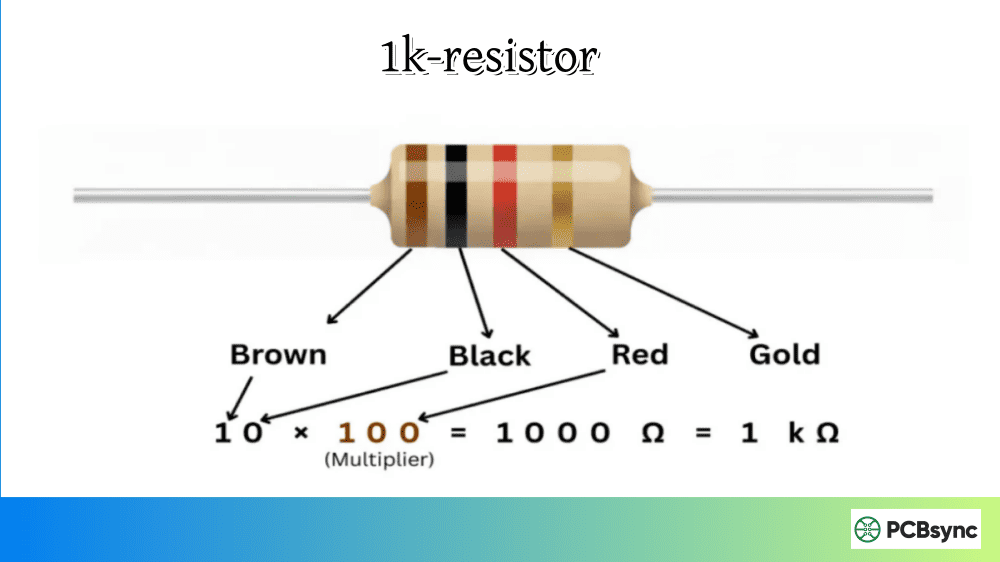
Every color in the resistor colour system has three possible meanings depending on its position: a digit value (0-9), a multiplier, or a tolerance/temperature coefficient. Here’s the complete reference chart:
Color
Digit
Multiplier
Tolerance
Temp Coefficient
Black
0
×1 (10⁰)
—
250 ppm/°C (U)
Brown
1
×10 (10¹)
±1% (F)
100 ppm/°C (S)
Red
2
×100 (10²)
±2% (G)
50 ppm/°C (R)
Orange
3
×1,000 (10³)
±0.05%
15 ppm/°C (P)
Yellow
4
×10,000 (10⁴)
±0.02%
25 ppm/°C (Q)
Green
5
×100,000 (10⁵)
±0.5% (D)
20 ppm/°C (Z)
Blue
6
×1,000,000 (10⁶)
±0.25% (C)
10 ppm/°C (Z)
Violet
7
×10,000,000 (10⁷)
±0.1% (B)
5 ppm/°C (M)
Gray
8
×100,000,000 (10⁸)
±0.05% (A)
1 ppm/°C (K)
White
9
×1,000,000,000 (10⁹)
—
—
Gold
—
×0.1 (10⁻¹)
±5% (J)
—
Silver
—
×0.01 (10⁻²)
±10% (K)
—
None
—
—
±20% (M)
—
Key observation: The multiplier exponent equals the digit value. Brown represents 1 and has a multiplier of 10¹ (10). Orange represents 3 and has a multiplier of 10³ (1,000). This pattern makes the system easier to memorize.
How to Determine Reading Direction
Before decoding any color coded resistor, you must identify which end to start from. Here are reliable methods:
Method 1: Find the tolerance band. Gold and silver bands only appear as tolerance indicators, never as digit bands. If you see gold or silver, that’s the last band—read from the opposite end.
Method 2: Look for spacing. Many resistors have a larger gap between the multiplier and tolerance bands. The grouped bands are read first.
Method 3: Check band proximity to leads. The first band is typically positioned closer to one lead than the tolerance band is to the other lead.
Method 4: Use logic. If reading one direction gives an impossible or unlikely value (like starting with silver), try the other direction.
When in doubt: Measure with a multimeter. Faded, burnt, or dirty bands can make visual identification unreliable.
Reading 4-Band Color Coded Resistors
The 4-band system is the most common resistor colour code format. It provides two significant digits plus a multiplier and tolerance.
Precision resistors use 5-band resistor colour codes with three significant digits instead of two. This allows more precise values like 147Ω or 4.99kΩ.
Some older or military-spec 5-band resistors follow a different pattern where the 4th band is tolerance and the 5th band is temperature coefficient. In this case:
Bands 1-2: Significant digits
Band 3: Multiplier
Band 4: Tolerance
Band 5: Temperature coefficient
If you encounter a 5-band color coded resistor with gold or silver in the 4th position, it likely follows this older format.
Reading 6-Band Color Coded Resistors
High-precision and professional-grade resistors add a sixth band for temperature coefficient, indicating how resistance changes with temperature.
6-Band Structure
Band Position
Meaning
1st Band
First significant digit
2nd Band
Second significant digit
3rd Band
Third significant digit
4th Band
Multiplier
5th Band
Tolerance
6th Band
Temperature Coefficient (ppm/°C)
6-Band Example
Orange-Red-Brown-Brown-Green-Red
Orange (3) + Red (2) + Brown (1) = 321
Brown multiplier = ×10
321 × 10 = 3,210Ω (3.21kΩ)
Green tolerance = ±0.5%
Red temp coefficient = 50 ppm/°C
The temperature coefficient tells you how much the resistance changes per degree Celsius. A 50 ppm/°C rating means for every 1°C temperature change, the resistance changes by 50 parts per million (0.005%).
Temperature Coefficient Reference
Color
Temp Coefficient
Black
250 ppm/°C
Brown
100 ppm/°C
Red
50 ppm/°C
Orange
15 ppm/°C
Yellow
25 ppm/°C
Green
20 ppm/°C
Blue
10 ppm/°C
Violet
5 ppm/°C
Gray
1 ppm/°C
Special Cases and Exceptions
Zero-Ohm Resistors
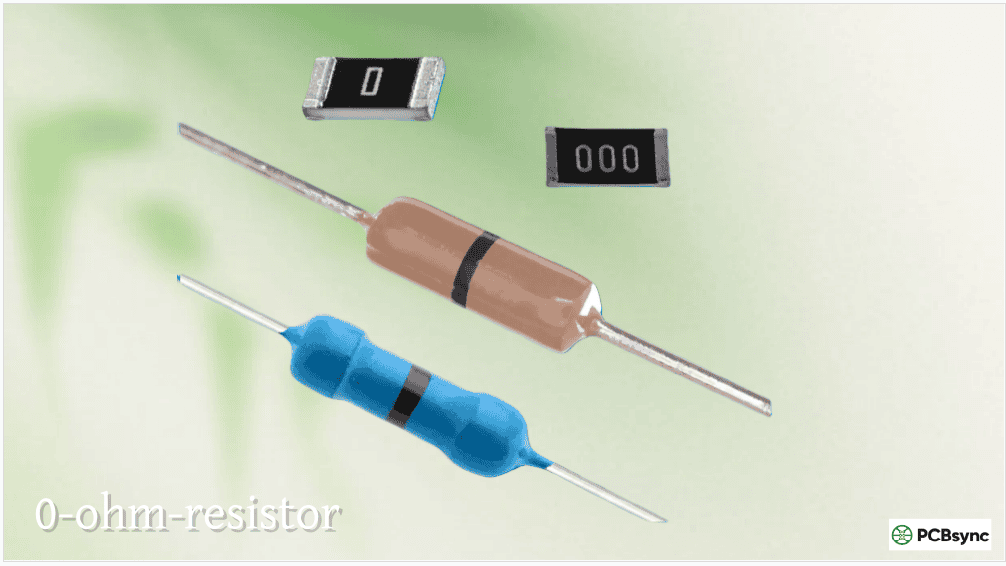
A color coded resistor with a single black band is a zero-ohm resistor—essentially a wire jumper packaged as a resistor for automated assembly. These connect PCB traces and allow the same pick-and-place equipment to install both resistors and jumpers.
3-Band Resistors
Three-band resistors omit the tolerance band entirely, defaulting to ±20% tolerance. These are rarely used today but may appear in older equipment:
Band 1: First digit
Band 2: Second digit
Band 3: Multiplier
Tolerance: Assumed ±20%
High-Voltage Resistor Color Substitutions
In high-voltage resistors, gold and silver bands are sometimes replaced with yellow and gray to prevent metallic particles in the coating. If you see unexpected yellow or gray bands in tolerance positions, the resistor may be a high-voltage type.
Wide Tolerance Band
Some manufacturers make the tolerance band 1.5 to 2 times wider than other bands to help identify reading direction. This isn’t universal, but when present, it’s a helpful indicator.
Several memory techniques help engineers quickly recall resistor colour values without constantly referencing charts.
The Rainbow Method
The digit colors from 2 (red) through 7 (violet) follow rainbow order: Red, Orange, Yellow, Green, Blue, Violet. Add black (0) and brown (1) at the beginning, then gray (8) and white (9) at the end:
Black → Brown → [Rainbow: Red through Violet] → Gray → White
Mnemonic Phrases
The classic mnemonic uses the first letter of each color in order:
Black, Brown, Red, Orange, Yellow, Green, Blue, Violet, Gray, White
Appropriate mnemonics include:
“Big Beautiful Roses Occupy Your Garden But Violets Grow Wild”
“Bad Beer Rots Our Young Guts But Vodka Goes Well”
“Better Buy Resistors Or Your Grid Bias Voltages Go West”
The Multiplier Pattern
Remember: the multiplier exponent equals the color’s digit value.
Brown = 1 = ×10¹ = ×10
Red = 2 = ×10² = ×100
Orange = 3 = ×10³ = ×1,000
This pattern eliminates memorizing multipliers separately.
Practice Makes Permanent
After sorting a few hundred resistors by value, most technicians develop automatic color-to-number recognition. The brain starts seeing “brown-black-orange” and immediately reading “10k” without conscious calculation.
Step-by-Step Color Code Calculation Process
Follow this procedure for any color coded resistor:
Step 1: Identify the number of bands (3, 4, 5, or 6).
Step 2: Determine reading direction using tolerance band position or spacing.
Step 3: For 4-band resistors:
Write down the first two digits
Apply the multiplier
Note the tolerance
Step 4: For 5-band resistors:
Write down the first three digits
Apply the multiplier (4th band)
Note the tolerance (5th band)
Step 5: For 6-band resistors:
Follow 5-band procedure
Note temperature coefficient (6th band)
Step 6: Calculate the tolerance range:
Minimum = Value – (Value × Tolerance%)
Maximum = Value + (Value × Tolerance%)
Step 7: When uncertain, verify with a multimeter.
Common Mistakes When Reading Resistor Colour Codes
Mistake 1: Reading Backwards
The most common error is starting from the wrong end. Always locate the tolerance band first (gold, silver, or precision colors) and read from the opposite end.
Mistake 2: Confusing Brown and Orange
Under certain lighting, brown and orange can look similar. Brown has a darker, more reddish tone while orange is brighter and more yellowish. If a value seems wrong, double-check these two colors.
Mistake 3: Missing the Band Count
Mistaking a 5-band resistor for a 4-band (or vice versa) gives completely wrong values. Count bands carefully before calculating.
Mistake 4: Ignoring Faded or Burnt Bands
Heat-damaged resistors may have discolored bands. If colors look unusual or the calculated value seems implausible for the circuit, measure with a multimeter instead of trusting visual identification.
Mistake 5: Forgetting Sub-Ohm Multipliers
Gold (×0.1) and silver (×0.01) multipliers create values below 10Ω. These are easy to overlook if you’re only thinking about the “add zeros” pattern.
Tolerance: What It Means for Your Circuit
The tolerance band on a color coded resistor specifies the manufacturing precision—how much the actual resistance can deviate from the marked value.
Tolerance Values and Their Meaning
Tolerance
Color
Letter Code
Actual Range for 1kΩ
±0.05%
Gray
A
999.5Ω – 1000.5Ω
±0.1%
Violet
B
999Ω – 1001Ω
±0.25%
Blue
C
997.5Ω – 1002.5Ω
±0.5%
Green
D
995Ω – 1005Ω
±1%
Brown
F
990Ω – 1010Ω
±2%
Red
G
980Ω – 1020Ω
±5%
Gold
J
950Ω – 1050Ω
±10%
Silver
K
900Ω – 1100Ω
±20%
None
M
800Ω – 1200Ω
When Tolerance Matters
For most digital circuits (pull-up resistors, LED current limiters), ±5% or even ±10% tolerance is perfectly acceptable. The exact value doesn’t significantly affect circuit operation.
For precision applications—voltage dividers, feedback networks, filters, timing circuits—tighter tolerances become important. A ±1% resistor colour specification ensures consistent circuit behavior across production units.
Rule of thumb: Default to ±1% tolerance for new designs. The cost difference from ±5% parts is negligible, and the improved precision eliminates potential issues.
Online Resistor Color Code Calculators
When speed matters or you want to verify manual calculations, online calculators provide instant results.
Recommended Calculator Tools
DigiKey Resistor Color Code Calculator: digikey.com/en/resources/conversion-calculators/conversion-calculator-resistor-color-code
All About Circuits Calculator: allaboutcircuits.com/tools/resistor-color-code-calculator/
Resistor Color Code Calc: resistorcolorcodecalc.com
Blue Point Engineering Chart (PDF): Search “resistor color code chart PDF” for downloadable reference sheets
Component Databases
DigiKey: digikey.com (parametric search by resistance value)
Mouser: mouser.com (extensive filtering options)
LCSC: lcsc.com (competitive pricing on common values)
Mobile Apps
Several smartphone apps use camera recognition to identify resistor colour codes automatically. Search “resistor color code” in your app store for current options.
The colored bands on a color coded resistor represent its electrical specifications. The first two or three bands indicate significant digits of the resistance value. The next band is a multiplier that determines the number of zeros to add. The final band shows tolerance (how much the actual value can vary from the marked value). On 6-band resistors, an additional band indicates temperature coefficient—how resistance changes with temperature.
How do I know which direction to read resistor colour codes?
Start by locating the tolerance band, which is typically gold (±5%), silver (±10%), or a precision color like brown (±1%). This band is always at one end of the color coded resistor. Read the other bands starting from the opposite end. If no gold or silver band exists, look for the larger gap between bands—the tolerance band has more spacing from its neighbor. When still uncertain, try reading both directions and see which gives a standard value from the E-series (1.0, 1.2, 1.5, 2.2, 3.3, 4.7, etc.).
What is the difference between 4-band and 5-band resistors?
Four-band resistors have two significant digits, giving values like 10Ω, 47Ω, or 100Ω. Five-band resistors have three significant digits, allowing more precise values like 102Ω, 475Ω, or 147Ω. The extra precision comes with tighter tolerance—5-band resistors are typically ±1% or better, while 4-band types are usually ±5% or ±10%. For most general-purpose circuits, 4-band resistor colour coding is sufficient. Precision analog circuits, voltage references, and measurement applications benefit from 5-band precision.
Why do some resistors have 6 color bands?
Six-band resistors include a temperature coefficient specification as the final band. This tells engineers how much the resistance value changes per degree Celsius of temperature change, measured in parts per million (ppm/°C). A color coded resistor with 50 ppm/°C (red 6th band) changes 0.005% per degree. This matters for precision circuits where temperature variations could affect performance—instrumentation, calibration equipment, and measurement systems. The lower the ppm value, the more stable the resistor across temperature ranges.
Can I trust color codes on old or damaged resistors?
Not always. Heat exposure can discolor bands, making brown look more orange or causing bands to fade entirely. Physical damage, dirt, and oxidation also affect readability. If a color coded resistor looks questionable—bands appear faded, colors seem off, or the calculated value doesn’t make sense for the circuit—use a multimeter to measure actual resistance. This is especially important for repair work where incorrect component identification could cause further problems. For critical applications, always verify with measurement rather than relying solely on visual identification.
Conclusion
The resistor colour code system has served electronics for over a century because it elegantly solves the problem of marking tiny components with readable values. Once you understand the basic structure—digit bands, multiplier, tolerance—reading any color coded resistor becomes straightforward.
Key points to remember:
Always identify the tolerance band first to establish reading direction
4-band resistors have two significant digits; 5-band have three
The multiplier exponent equals the color’s digit value
When in doubt, measure with a multimeter
Practice with real resistors accelerates recognition speed
Keep a color code chart at your workbench until the values become automatic. Most engineers reach the point where they see colored bands and immediately read the value without conscious calculation. That fluency comes from repetition, not memorization—the more resistors you handle, the faster identification becomes.
Whether you’re a student learning electronics, a hobbyist building projects, or a professional debugging circuits, mastering the resistor colour code is fundamental knowledge that you’ll use throughout your career.
Inquire: Call 0086-755-23203480, or reach out via the form below/your sales contact to discuss our design, manufacturing, and assembly capabilities.
Quote: Email your PCB files to Sales@pcbsync.com (Preferred for large files) or submit online. We will contact you promptly. Please ensure your email is correct.
Notes: For PCB fabrication, we require PCB design file in Gerber RS-274X format (most preferred), *.PCB/DDB (Protel, inform your program version) format or *.BRD (Eagle) format. For PCB assembly, we require PCB design file in above mentioned format, drilling file and BOM. Click to download BOM template To avoid file missing, please include all files into one folder and compress it into .zip or .rar format.