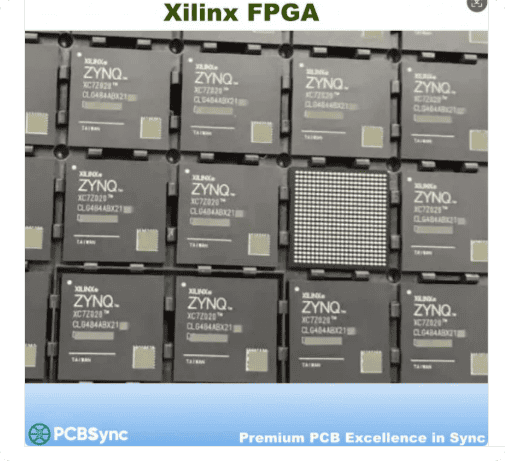
The XC2S200-6FGG887C is a powerful field programmable gate array (FPGA) from AMD Xilinx’s renowned Spartan-II family, designed to deliver exceptional performance and flexibility for complex digital logic applications. This advanced FPGA chip combines 200,000 system gates with 5,292 configurable logic cells, making it an ideal solution for telecommunications, industrial automation, embedded systems, and high-speed data processing applications.
As part of the industry-leading Spartan-II series, the XC2S200-6FGG887C represents a cost-effective alternative to traditional mask-programmed ASICs, offering designers the advantage of field-upgradeable hardware without the lengthy development cycles and high initial costs associated with custom silicon solutions. The 887-ball Fine-Pitch Ball Grid Array (FBGA) package provides robust connectivity and excellent thermal performance for demanding applications.
Key Technical Specifications of XC2S200-6FGG887C
Core Performance Features
| Specification |
Value |
Description |
| System Gates |
200,000 |
Total logic capacity for complex designs |
| Logic Cells |
5,292 |
Configurable logic elements |
| CLB Array |
28 x 42 (1,176 total CLBs) |
Configurable Logic Block grid configuration |
| Distributed RAM |
75,264 bits |
Embedded distributed memory |
| Block RAM |
56 Kbits |
Dedicated block memory resources |
| User I/O Pins |
284 maximum |
Configurable input/output connections |
| Operating Voltage |
2.5V |
Core voltage requirement |
| Speed Grade |
-6 |
Commercial temperature range performance |
| Technology Node |
0.18μm |
Advanced semiconductor process |
| Package Type |
FGG887 (887-ball FBGA) |
Fine-pitch ball grid array |
Advanced Architecture Components
The XC2S200-6FGG887C incorporates several key architectural features that enhance its versatility and performance:
- Delay-Locked Loops (DLLs): Four DLLs positioned at each corner of the die for precise clock management and distribution
- Block RAM Configuration: Two columns of block RAM strategically placed on opposite sides of the die
- Flexible Interconnect: Hierarchical routing architecture for efficient signal distribution
- Boundary Scan Support: IEEE 1149.1 JTAG-compatible for testing and programming
XC2S200-6FGG887C Package Information and Physical Characteristics
FGG887 Package Details
| Package Attribute |
Specification |
| Package Type |
Fine-Pitch Ball Grid Array (FBGA) |
| Ball Count |
887 balls |
| Ball Pitch |
Fine pitch (optimized for high-density routing) |
| Package Designation |
FGG887 |
| Thermal Performance |
Enhanced heat dissipation through ball grid |
| RoHS Compliance |
Available in both standard and lead-free options |
| Temperature Range |
Commercial (0°C to +85°C) |
The 887-ball FBGA package offers superior thermal characteristics compared to smaller packages, making it ideal for high-performance applications that require sustained operation under demanding conditions. The fine-pitch ball grid array provides excellent electrical performance with minimized inductance and optimized signal integrity.
Application Areas for XC2S200-6FGG887C FPGA
Telecommunications and Networking
The XC2S200-6FGG887C excels in telecommunications infrastructure applications where high-speed data processing and protocol implementation are critical. Its substantial logic capacity enables:
- Protocol processing and packet routing
- Digital signal processing for communication systems
- Base station signal processing
- Network interface controllers
- Data encoding and decoding circuits
Industrial Automation and Control Systems
For industrial applications, this Xilinx FPGA provides reliable and flexible control solutions:
- Motor control systems with precise timing
- Process automation controllers
- Programmable logic controllers (PLC) functionality
- Sensor interface and data acquisition
- Real-time monitoring and control systems
Embedded Systems and Digital Signal Processing
The XC2S200-6FGG887C’s architecture makes it particularly well-suited for embedded applications:
- High-speed data acquisition systems
- Image and video processing
- Digital filter implementation
- Audio processing applications
- Real-time embedded vision systems
Medical and Scientific Instrumentation
The reliability and reconfigurability of the XC2S200-6FGG887C make it ideal for medical applications:
- Medical imaging systems
- Diagnostic equipment controllers
- Patient monitoring devices
- Laboratory instrumentation
- Biometric identification systems
Memory Architecture and Resources
Distributed RAM Configuration
| Memory Type |
Capacity |
Configuration |
| Distributed RAM |
75,264 bits |
Implemented within CLB structure |
| Block RAM |
56 Kbits |
Dual-port synchronous memory |
| Total Memory |
131.3 Kbits |
Combined distributed and block RAM |
The XC2S200-6FGG887C’s dual-memory architecture provides designers with flexible options for data storage and buffering. Distributed RAM is ideal for small, fast memory structures like FIFOs and look-up tables, while block RAM offers larger capacity for data buffers and frame storage.
Design Implementation and Development Tools
Supported Development Environments
Engineers developing with the XC2S200-6FGG887C have access to comprehensive design tools:
- Vivado Design Suite: Modern FPGA design and implementation
- ISE Design Suite: Legacy support for Spartan-II family
- Synthesis Tools: Support for Verilog and VHDL
- Simulation: ModelSim, Vivado Simulator compatibility
- Programming: JTAG boundary scan programming support
Design Optimization Features
The XC2S200-6FGG887C supports various optimization techniques:
- Place and route optimization for timing closure
- Power optimization modes for reduced consumption
- Partial reconfiguration capabilities
- Clock domain crossing management
- Design constraint-driven implementation
Comparison with Other Spartan-II Family Members
Spartan-II Family Feature Comparison
| Device |
System Gates |
Logic Cells |
CLBs |
Block RAM |
Max I/O |
| XC2S50 |
50,000 |
1,728 |
384 |
32K |
176 |
| XC2S100 |
100,000 |
2,700 |
600 |
40K |
176 |
| XC2S150 |
150,000 |
3,888 |
864 |
48K |
260 |
| XC2S200 |
200,000 |
5,292 |
1,176 |
56K |
284 |
The XC2S200-6FGG887C represents the largest device in the Spartan-II family, offering maximum logic capacity and I/O resources for complex applications that demand substantial programmable logic resources.
Power Supply and Electrical Characteristics
Voltage Requirements
| Power Rail |
Voltage |
Function |
| VCCINT |
2.5V |
Internal core logic supply |
| VCCO |
1.5V to 3.3V |
I/O bank supply voltage |
| GND |
0V |
Ground reference |
Power Consumption Considerations
The XC2S200-6FGG887C offers efficient power management features:
- Dynamic power consumption based on switching activity
- Static power optimization modes
- I/O voltage flexibility for interfacing with various logic levels
- Power estimation tools for design planning
Performance Characteristics and Timing
Speed Grade -6 Performance
The -6 speed grade designation indicates this device is optimized for commercial temperature range operation with the following characteristics:
- Maximum system frequency up to 263 MHz for optimized designs
- Fast carry chain logic for arithmetic operations
- Optimized routing delays for critical path performance
- Clock-to-output delays optimized for high-speed interfaces
Timing Analysis and Optimization
Designers can leverage various timing optimization techniques:
- Static timing analysis for worst-case performance verification
- Constraint-driven design flow
- Clock domain crossing analysis
- Setup and hold time optimization
PCB Design Considerations for XC2S200-6FGG887C
Layout Guidelines
When designing printed circuit boards with the 887-ball FBGA package:
- Ball Grid Array Routing: Requires multi-layer PCB with micro-vias for optimal fanout
- Power Plane Design: Dedicated power and ground planes for stable voltage distribution
- Decoupling Capacitors: Multiple capacitors close to power pins for supply stability
- Signal Integrity: Controlled impedance routing for high-speed signals
- Thermal Management: Adequate copper pour and thermal vias for heat dissipation
Manufacturing and Assembly
The FGG887 package requires specific assembly considerations:
- Reflow Soldering: Precise temperature profile control for ball grid array
- X-ray Inspection: Recommended for verifying solder joint quality
- BGA Rework: Specialized equipment required for rework operations
- Moisture Sensitivity: Follow MSL (Moisture Sensitivity Level) handling procedures
Competitive Advantages of XC2S200-6FGG887C
Superior Alternative to ASICs
The XC2S200-6FGG887C offers significant advantages over mask-programmed ASICs:
- Zero NRE Costs: No initial engineering charges or mask costs
- Faster Time-to-Market: Immediate implementation without fabrication delays
- Field Upgradeable: Design modifications without hardware replacement
- Lower Risk: Design verification in actual hardware before commitment
- Scalability: Easy migration to larger or smaller devices in the same family
Design Flexibility Benefits
- Reconfigurable architecture for multiple applications
- In-system programming capabilities
- Prototype and production using identical silicon
- Version control through configuration updates
- Algorithm optimization in deployed systems
Quality and Reliability Standards
Manufacturing Excellence
AMD Xilinx maintains rigorous quality standards for the Spartan-II family:
- ISO 9001 certified manufacturing processes
- Comprehensive electrical testing and screening
- Automotive-grade options available
- Long-term product availability commitment
- Extensive reliability testing and qualification
Environmental Compliance
- RoHS compliant options with lead-free packaging
- REACH compliance for European markets
- Conflict minerals policy adherence
- Green packaging options available
Getting Started with XC2S200-6FGG887C Development
Evaluation and Development Resources
Engineers new to the XC2S200-6FGG887C can access various resources:
- Development boards and evaluation kits
- Reference designs and application notes
- Online training and tutorial videos
- Technical support and design assistance
- Community forums and knowledge bases
Documentation and Support
Comprehensive documentation is available for successful design implementation:
- Detailed datasheet with electrical specifications
- Package and pinout documentation
- Programming and configuration guides
- Application notes for specific use cases
- Design constraint files and timing models
Ordering Information and Part Number Decoder
Part Number Breakdown: XC2S200-6FGG887C
- XC2S200: Device family and logic capacity (Spartan-II 200K gates)
- -6: Speed grade (commercial temperature, highest performance)
- FGG: Package type (Fine-pitch Ball Grid Array)
- 887: Ball count
- C: Commercial temperature range (0°C to +85°C)
Available Package Options
While the 887-ball FBGA offers maximum I/O capability, the XC2S200 is also available in other package options:
- FG456/FGG456: 456-ball FBGA for applications requiring fewer I/Os
- PQ208/PQG208: 208-pin PQFP for standard applications
- FG256/FGG256: 256-ball FBGA for mid-range I/O requirements
Conclusion: XC2S200-6FGG887C for Next-Generation Designs
The XC2S200-6FGG887C represents an excellent choice for engineers developing sophisticated digital systems that require substantial logic resources, flexible I/O configuration, and reliable performance. Its combination of 200,000 system gates, 284 I/O pins, and the high-density 887-ball FBGA package makes it particularly well-suited for telecommunications, industrial control, embedded processing, and other demanding applications.
Whether you’re upgrading from ASIC-based designs, implementing complex digital signal processing algorithms, or building high-speed data acquisition systems, the XC2S200-6FGG887C delivers the performance, flexibility, and reliability needed for successful product development. The extensive tool support, comprehensive documentation, and strong ecosystem support ensure rapid development and seamless integration into your next innovative design.
For designers seeking maximum performance and I/O capability within the Spartan-II family, the XC2S200-6FGG887C stands as the premier choice, offering unmatched programmable logic resources in a proven, field-tested architecture.