Inquire: Call 0086-755-23203480, or reach out via the form below/your sales contact to discuss our design, manufacturing, and assembly capabilities.
Quote: Email your PCB files to Sales@pcbsync.com (Preferred for large files) or submit online. We will contact you promptly. Please ensure your email is correct.
Notes: For PCB fabrication, we require PCB design file in Gerber RS-274X format (most preferred), *.PCB/DDB (Protel, inform your program version) format or *.BRD (Eagle) format. For PCB assembly, we require PCB design file in above mentioned format, drilling file and BOM. Click to download BOM template To avoid file missing, please include all files into one folder and compress it into .zip or .rar format.
Every PCB designer eventually encounters a project that needs to sense ambient light. Whether it’s an automatic streetlight controller, a camera exposure meter, or a simple night lamp, the light dependent resistor (also called a photoresistor or light detecting resistor) becomes your go-to component. I’ve incorporated LDRs into dozens of designs over the years, from industrial light meters to hobbyist Arduino projects, and their simplicity never fails to impress me.
This guide covers everything you need to know about the light dependent resistor: how it works, the different types available, practical circuit designs, and real-world applications. I’ve included wiring diagrams, specification tables, and sample code to help you integrate LDRs into your next project successfully.
A light dependent resistor (LDR), also known as a photoresistor, photocell, or photoconductive cell, is a passive electronic component whose electrical resistance varies based on the intensity of light falling on its surface. In simple terms, more light means lower resistance, and less light means higher resistance.
Unlike photodiodes or phototransistors that generate current when exposed to light, an LDR simply changes its resistance. This makes it incredibly easy to interface with basic circuits since you can use it directly in voltage divider configurations without complex biasing requirements.
The typical light dependent resistor shows resistance ranging from about 1 MΩ or higher in complete darkness down to just a few hundred ohms in bright sunlight. This dramatic resistance swing makes LDRs excellent for detecting the presence or absence of light in threshold-based applications.
Light Dependent Resistor Symbol
In circuit schematics, the light dependent resistor symbol consists of a standard resistor symbol (either zigzag or rectangular, depending on the standard used) with two arrows pointing toward it. These arrows represent light falling on the component. The symbol clearly distinguishes an LDR from a standard fixed resistor.
Symbol Element
Meaning
Resistor body
Indicates variable resistance property
Two arrows
Represent incident light affecting resistance
No polarity marks
LDR has no specific polarity
How Does a Light Dependent Resistor Work?
The working principle of a light dependent resistor relies on photoconductivity, an optical phenomenon where a material’s electrical conductivity increases when it absorbs photons (light particles).
The Photoconductivity Principle
LDRs are constructed using semiconductor materials, most commonly cadmium sulfide (CdS) or cadmium selenide (CdSe). These materials have a specific energy gap between their valence band (where electrons normally reside) and their conduction band (where electrons can move freely and conduct electricity).
When photons with sufficient energy strike the semiconductor surface, they transfer energy to electrons in the valence band. If the photon energy exceeds the material’s bandgap energy, electrons get excited and jump to the conduction band. This increases the number of charge carriers available for conduction, effectively reducing the material’s resistance.
In darkness, very few electrons have enough energy to reach the conduction band, so resistance remains high. As light intensity increases, more photons excite more electrons, resistance drops proportionally. This inverse relationship between light intensity and resistance forms the foundation of all LDR-based circuits.
Light Dependent Resistor Specifications
When selecting an LDR for your design, these key specifications matter most:
Parameter
Typical Values
Description
Dark Resistance
1 MΩ to 10 MΩ
Resistance with no light (0 lux)
Light Resistance
100Ω to 20 kΩ
Resistance at 10 lux
Peak Wavelength
540 nm to 560 nm
Wavelength of maximum sensitivity
Rise Time
20 ms to 50 ms
Time to reach stable resistance (dark to light)
Fall Time
30 ms to 100 ms
Time to reach stable resistance (light to dark)
Max Voltage
100V to 150V
Maximum voltage across the LDR
Max Power
50 mW to 200 mW
Maximum power dissipation
The response time specifications deserve special attention. LDRs are relatively slow compared to photodiodes. The transition from bright to dark typically takes longer than dark to bright, sometimes exceeding one second. This latency makes LDRs unsuitable for applications requiring detection of rapidly changing light, like optical communication or fast-switching systems.
Types of Light Dependent Resistors
Light dependent resistors can be classified based on the semiconductor materials used and their spectral response characteristics.
Intrinsic LDRs
Intrinsic photoresistors use pure semiconductor materials without any doping. When light strikes the surface, electrons from the valence band excite directly to the conduction band. Common materials include:
Cadmium Sulfide (CdS): Most popular for visible light detection, with peak sensitivity around 540 nm (green-yellow light). Response closely matches human eye sensitivity.
Cadmium Selenide (CdSe): Higher sensitivity in the red and near-infrared spectrum compared to CdS.
Extrinsic LDRs
Extrinsic photoresistors use doped semiconductor materials. The impurities create additional energy levels between the valence and conduction bands, requiring less photon energy for electron excitation. This makes them sensitive to longer wavelengths (infrared). Common materials include:
Lead Sulfide (PbS): Used for mid-infrared detection
Indium Antimonide (InSb): Suitable for far-infrared applications
LDR Type
Material
Spectral Range
Typical Application
CdS
Cadmium Sulfide
400-700 nm (Visible)
Ambient light sensing
CdSe
Cadmium Selenide
400-800 nm
Low-light detection
PbS
Lead Sulfide
1000-3000 nm (IR)
Infrared sensing
InSb
Indium Antimonide
3000-5000 nm
Thermal imaging
RoHS Compliance Note
If you’re designing products for the European market, be aware that cadmium-based LDRs face restrictions under RoHS directives. CdS and CdSe contain cadmium, a hazardous substance. Some manufacturers offer cadmium-free alternatives, though they may have different performance characteristics. Always verify compliance requirements for your target market.
Light Dependent Resistor Circuit Designs
The beauty of LDRs lies in their simplicity. With just a few components, you can build functional light-sensing circuits.
Basic Voltage Divider Circuit
The most fundamental LDR circuit uses a voltage divider configuration. Connect the LDR in series with a fixed resistor across a power supply, and take the output voltage from their junction.
Circuit configuration:
VCC (5V or 3.3V) connects to one leg of the LDR
The other LDR leg connects to one leg of a fixed resistor (typically 10kΩ)
The remaining resistor leg connects to ground
Output voltage is measured at the LDR-resistor junction
The output voltage follows the formula:
Vout = VCC × (R_fixed / (R_LDR + R_fixed))
In bright light, the LDR resistance drops low, making Vout approach VCC. In darkness, LDR resistance increases dramatically, pulling Vout toward ground.
You can reverse this behavior by swapping the LDR and fixed resistor positions. This flexibility lets you choose whether your output goes high or low in darkness depending on your circuit requirements.
Light Dependent Resistor with Arduino
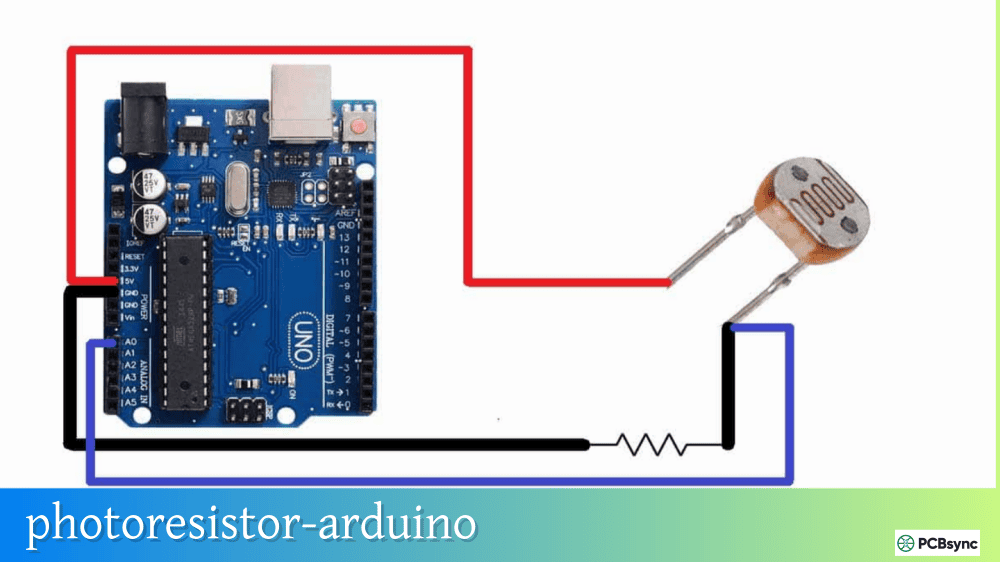
Interfacing an LDR with Arduino creates a versatile light-sensing system. The Arduino’s analog-to-digital converter reads the voltage from the LDR voltage divider, converting light intensity into a digital value.
Wiring connections:
Component
Arduino Pin
LDR (one leg)
5V
LDR (other leg)
A0 and to 10kΩ resistor
10kΩ resistor (other leg)
GND
LED positive (optional)
Digital pin 9
LED negative (optional)
GND through 220Ω resistor
Sample Arduino code:
cpp
const int ldrPin = A0;const int ledPin = 9;const int threshold = 500;void setup() { Serial.begin(9600); pinMode(ledPin, OUTPUT);}void loop() { int ldrValue = analogRead(ldrPin); Serial.print(“Light level: “); Serial.println(ldrValue); if (ldrValue < threshold) { digitalWrite(ledPin, HIGH); // Dark – turn LED on } else { digitalWrite(ledPin, LOW); // Bright – turn LED off } delay(100);}
The analogRead function returns values from 0 to 1023. Lower values indicate darkness (high LDR resistance, low voltage at the divider output), while higher values indicate brightness. Adjust the threshold value based on your specific LDR and lighting conditions.
Automatic Light Control Circuit with Transistor
For controlling higher-power loads without a microcontroller, a simple transistor-based circuit works effectively.
Components needed:
LDR
10kΩ variable resistor (for threshold adjustment)
BC547 or 2N2222 NPN transistor
1kΩ resistor (base current limiting)
Relay module (for AC loads) or LED with resistor
5V or 12V power supply
How it works: The LDR and variable resistor form a voltage divider feeding the transistor base. In darkness, LDR resistance increases, raising the base voltage above the transistor’s threshold. The transistor turns on, activating the relay or LED. During daylight, low LDR resistance keeps the base voltage below threshold, turning the transistor off.
The variable resistor lets you adjust the light level at which switching occurs, making calibration straightforward during installation.
Comparator-Based Light Detecting Circuit
For more precise switching with defined hysteresis, use an operational amplifier configured as a comparator.
Using LM393 or LM358:
Connect the LDR voltage divider output to the non-inverting input
Apply a reference voltage (from another voltage divider) to the inverting input
The output switches cleanly between high and low states
This approach eliminates the gradual transition zone that transistor circuits can exhibit, providing crisp on/off control suitable for digital logic interfaces.
Practical Applications of Light Dependent Resistors
LDRs find use across countless applications where light sensing matters.
Street Lighting Automation
Municipal street lights often use LDRs to automatically switch on at dusk and off at dawn. The simple, robust nature of LDR circuits makes them ideal for this set-and-forget application where response speed isn’t critical.
Camera Light Meters
Traditional photographic light meters employed CdS cells to measure scene brightness. The spectral response of CdS closely matches human eye sensitivity, making it suitable for determining proper exposure settings.
Security and Alarm Systems
Light-beam interruption detection uses LDRs to sense when someone breaks an invisible light barrier. Burglar alarms, visitor counters, and industrial safety systems all employ this principle.
Display Brightness Control
Smartphones, tablets, and laptops use light sensors (often more sophisticated than basic LDRs) to automatically adjust screen brightness based on ambient conditions, improving readability while conserving battery.
Agricultural Light Monitoring
Greenhouse control systems monitor light levels to manage artificial lighting for optimal plant growth. The slow response of LDRs isn’t problematic here since natural light changes gradually.
Line-Following Robots
Robotics projects use LDR pairs to detect the difference between a dark line and a light surface, enabling autonomous navigation along marked paths.
LDR vs Photodiode vs Phototransistor
Choosing between light sensors depends on your application requirements.
Parameter
LDR
Photodiode
Phototransistor
Response Time
Slow (10-100 ms)
Fast (nanoseconds)
Medium (microseconds)
Sensitivity
Moderate
High
Very High
Output
Resistance change
Current
Current (amplified)
Cost
Very Low
Low-Medium
Low-Medium
Circuit Complexity
Simple
Moderate
Simple
Best For
Ambient sensing
Optical communication
Light switching
For most ambient light sensing applications where speed doesn’t matter, the light dependent resistor wins on cost and simplicity. When you need fast response for data communication or rapid switching, photodiodes become necessary.
Advantages and Disadvantages of Light Dependent Resistors
Advantages
Low cost: LDRs remain among the cheapest light sensors available
Simple interface: No biasing or amplification required for basic circuits
Wide resistance range: Large signal swing simplifies detection
No external power required: Passive component, only needs voltage for the sensing circuit
Bidirectional: Works regardless of which way current flows
Disadvantages
Slow response: Not suitable for detecting rapidly changing light
Temperature sensitivity: Resistance varies with ambient temperature
Non-linear response: Output doesn’t change linearly with light intensity
Environmental concerns: Cadmium-based types face regulatory restrictions
Aging effects: Characteristics can drift over time with heavy use
Useful Resources for Light Dependent Resistor Projects
Datasheets and Technical Documents:
GL55 Series LDR Datasheet (Senba Optical & Electronic)
DigiKey (digikey.com) – Wide selection with detailed specifications
Mouser Electronics (mouser.com) – Technical documentation and application notes
Adafruit (adafruit.com) – Beginner-friendly tutorials and kits
SparkFun (sparkfun.com) – Hookup guides and example code
Online Tools and Calculators:
Voltage divider calculators for sizing the series resistor
LED series resistor calculators for output indicator circuits
Learning Resources:
Arduino Project Hub – LDR interfacing tutorials
Instructables – DIY light-sensing project guides
Electronics Tutorials – Photoresistor theory explanations
Frequently Asked Questions About Light Dependent Resistors
What is the difference between an LDR and a photodiode?
A light dependent resistor changes its resistance based on light intensity and requires an external voltage source to produce a measurable signal. A photodiode generates its own current when exposed to light and can operate in photovoltaic mode without external power. Photodiodes respond much faster (nanoseconds vs milliseconds) but require more complex interface circuits. For slow-changing ambient light sensing, LDRs offer simpler implementation at lower cost.
Can I use an LDR with a 3.3V microcontroller like ESP32 or Raspberry Pi Pico?
Absolutely. LDRs work with any reasonable voltage since they’re passive resistive components. Simply connect the LDR voltage divider using your 3.3V supply instead of 5V. The analog reading range will be proportionally smaller, but the circuit functions identically. Just ensure your ADC reference voltage matches your supply voltage for accurate readings.
Why does my LDR reading fluctuate even in constant light?
Several factors cause reading instability. Electrical noise from switching power supplies or nearby digital circuits can affect analog readings. Temperature changes alter LDR resistance slightly. Fluorescent and LED lighting actually flickers at mains frequency (50Hz or 60Hz), which the LDR can detect. Adding a small capacitor (0.1µF) across the voltage divider output helps smooth readings. In code, averaging multiple samples reduces noise further.
How do I choose the right fixed resistor value for my LDR circuit?
Select a fixed resistor value close to the LDR’s resistance at your target light level. For general-purpose circuits, 10kΩ works well with most common LDRs. If you need maximum sensitivity in low light conditions, use a higher value resistor (47kΩ to 100kΩ). For bright light detection, a lower value (1kΩ to 4.7kΩ) provides better resolution. A variable resistor (potentiometer) lets you fine-tune sensitivity during testing.
Are cadmium-based LDRs safe to use in my projects?
For hobbyist and prototype work, CdS LDRs pose minimal risk with normal handling. The cadmium is sealed within the component. However, for commercial products sold in regions with RoHS regulations (European Union, and increasingly other markets), cadmium-containing components face restrictions. Check compliance requirements early in your design process. Some manufacturers offer cadmium-free alternatives, though availability and performance may differ.
Wrapping Up
The light dependent resistor remains one of the most accessible entry points into electronic sensing. Its straightforward operation, minimal component requirements, and forgiving nature make it perfect for beginners while still serving experienced engineers in cost-sensitive production designs.
Whether you’re building your first Arduino night light or designing industrial light monitoring equipment, understanding how LDRs work and how to interface them properly ensures reliable results. The circuits presented here provide starting points you can adapt to your specific requirements.
Remember that while LDRs excel at detecting gradual ambient light changes, applications requiring fast response or precise measurements may need photodiodes or phototransistors instead. Match the sensor to the application, and your light-sensing projects will perform exactly as intended.
Inquire: Call 0086-755-23203480, or reach out via the form below/your sales contact to discuss our design, manufacturing, and assembly capabilities.
Quote: Email your PCB files to Sales@pcbsync.com (Preferred for large files) or submit online. We will contact you promptly. Please ensure your email is correct.
Notes: For PCB fabrication, we require PCB design file in Gerber RS-274X format (most preferred), *.PCB/DDB (Protel, inform your program version) format or *.BRD (Eagle) format. For PCB assembly, we require PCB design file in above mentioned format, drilling file and BOM. Click to download BOM template To avoid file missing, please include all files into one folder and compress it into .zip or .rar format.