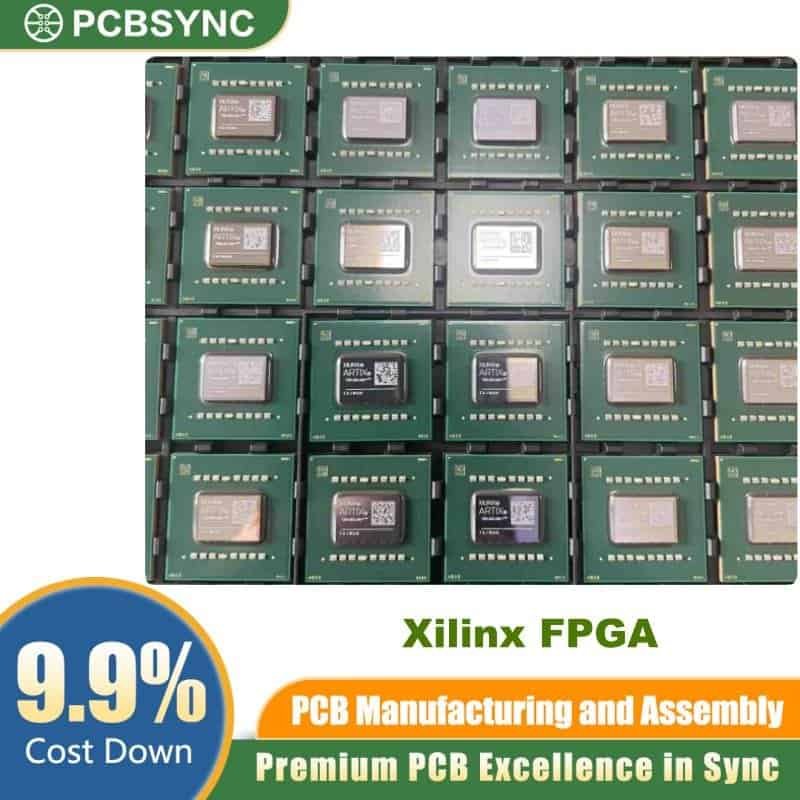
The XC5204-6TQ144C is a versatile field programmable gate array from the renowned XC5200 family, engineered by Xilinx (now AMD). This SRAM-based FPGA delivers exceptional performance with 120 configurable logic blocks, 4000 gates, and operates at speeds up to 83MHz, making it an ideal solution for embedded control systems, digital signal processing, and communication equipment.
Overview of XC5204-6TQ144C FPGA
The XC5204-6TQ144C represents a cost-effective programmable logic solution that combines robust features with design flexibility. Built on advanced 0.5µm three-layer metal CMOS process technology, this Xilinx FPGA offers engineers a reliable platform for implementing complex digital designs with reduced time-to-market.
Key Features and Benefits
The XC5204-6TQ144C incorporates several innovative technologies that set it apart in the field programmable gate array market:
- VersaBlock Logic Module: Provides flexible logic configuration with 120 configurable logic blocks (CLBs) delivering approximately 4000 usable gates for complex circuit implementation
- VersaRing I/O Interface: Enables high logic cell to I/O ratio with 117 user-programmable I/O pins for versatile connectivity options
- SRAM-Based Architecture: Allows unlimited reprogrammability for design iterations and field updates without additional programming costs
- Register-Rich Design: Optimized for applications requiring extensive data storage and sequential logic operations
- Programmable Slew Rate Control: Maximizes signal integrity while minimizing electromagnetic interference in high-speed designs
- Zero Hold Time: Simplifies system timing analysis for input registers, reducing design complexity
Technical Specifications
Electrical and Performance Characteristics
| Parameter |
Specification |
| Logic Cells |
480 cells |
| Equivalent Gates |
4000 gates (6K logic gates) |
| Configurable Logic Blocks |
120 CLBs |
| Maximum Operating Frequency |
83 MHz |
| Propagation Delay |
5.6 ns |
| Supply Voltage |
5V |
| Process Technology |
0.5µm CMOS, three-layer metal |
| User I/O Pins |
117 programmable I/O |
Package and Physical Specifications
| Specification |
Detail |
| Package Type |
TQFP (Thin Quad Flat Pack) |
| Pin Count |
144 pins |
| Package Code |
TQ144 |
| Body Thickness |
1.6 mm |
| Lead Material |
Tin/Lead (Sn85Pb15) |
| Mounting Type |
Surface Mount Technology (SMT) |
| Operating Temperature |
Commercial grade (0°C to +70°C) |
Part Number Breakdown
| Component |
Meaning |
| XC5204 |
Device family and logic capacity |
| -6 |
Speed grade (6ns delay) |
| TQ144 |
Package type and pin count |
| C |
Commercial temperature range |
Architecture and Design Resources
VersaBlock Logic Architecture
The XC5204-6TQ144C utilizes the proprietary VersaBlock architecture, which provides designers with flexible logic implementation capabilities. Each configurable logic block can be programmed to implement various combinational and sequential logic functions, including:
- Combinational logic functions with multiple inputs
- D-type flip-flops and latches for sequential operations
- Distributed RAM for small memory requirements
- Shift register implementations for data manipulation
Interconnect Hierarchy
The device features a rich hierarchy of routing resources that enable efficient signal distribution across the FPGA fabric. This interconnect structure includes:
- Local interconnects for high-speed signals between adjacent logic blocks
- General-purpose routing for medium-distance connections
- Long-line routing for global signals and clock distribution
- Dedicated carry chains for arithmetic operations
Application Areas and Use Cases
Industrial Automation and Control
The XC5204-6TQ144C excels in industrial environments where reliable programmable logic is essential. Common applications include:
- Programmable Logic Controllers (PLCs): Implementing custom control logic for manufacturing processes
- Motor Control Systems: Managing PWM generation and feedback control for servo and stepper motors
- Robotics: Providing real-time control algorithms and sensor interface logic
- State Machine Implementation: Creating complex control sequences for automated machinery
Communication Equipment
This FPGA serves as a critical component in various communication systems:
- Protocol Implementation: Custom communication protocols for industrial networks
- Data Encoding/Decoding: Manchester encoding, 8B/10B encoding for serial communications
- Interface Bridging: Converting between different communication standards
- Wired Networking: Ethernet MAC controllers and network packet processing
Digital Signal Processing Applications
The register-rich architecture makes the XC5204-6TQ144C suitable for DSP tasks:
- Digital Filtering: FIR and IIR filter implementations for signal conditioning
- FFT Processing: Fast Fourier Transform computations for frequency analysis
- Audio Processing: Digital audio effects and format conversion
- Video Processing: Basic video format conversion and signal processing
Automotive Electronics
In automotive body electronics and lighting control applications, the XC5204-6TQ144C provides:
- Lighting Control Logic: Programmable sequences for automotive lighting systems
- Sensor Interface: Processing signals from multiple automotive sensors
- CAN Bus Interface: Controller Area Network protocol implementation
- Safety-Critical Functions: Redundant logic implementation for fail-safe operations
Point of Sale and Retail
Electronic point of sale (EPOS) systems benefit from the FPGA’s flexibility:
- Peripheral Interface Management: Connecting scanners, printers, and displays
- Security Logic: Implementing encryption and secure transaction processing
- Custom Protocols: Interfacing with proprietary retail equipment
- Display Controllers: Driving custom display configurations
Design Tools and Development Support
Software Environment
The XC5204-6TQ144C is fully supported through the comprehensive Xilinx software development environment, which includes:
- Design Entry Methods: Multiple options to suit different design workflows
- Schematic capture for visual design representation
- ABEL for equation-based logic description
- VHDL for hardware description language synthesis
- Verilog HDL for industry-standard RTL design
- Logic Synthesis: Compatible with popular third-party synthesis tools for optimal design implementation
- Platform Support: Available for both workstation and PC platforms, ensuring accessibility for all development teams
Design Workflow
Engineers working with the XC5204-6TQ144C can leverage a streamlined development process:
- Design Entry: Create designs using preferred method (schematic, HDL, or netlist)
- Simulation: Verify functionality before implementation using industry-standard simulators
- Synthesis: Generate optimized netlists from high-level descriptions
- Implementation: Map, place, and route the design to specific device resources
- Timing Analysis: Verify timing constraints are met across all operating conditions
- Configuration: Program the device using standard JTAG or serial configuration methods
Comparison with Related Devices
XC5200 Family Comparison
| Part Number |
Logic Cells |
Gates |
CLBs |
I/O Pins |
Package Options |
| XC5202 |
196 |
2000 |
49 |
77 |
PQ100, TQ144 |
| XC5204 |
480 |
4000 |
120 |
117 |
PQ100, TQ144 |
| XC5206 |
784 |
6000 |
196 |
157 |
PQ160, TQ176 |
| XC5210 |
1296 |
10000 |
324 |
205 |
PQ240, BG256 |
Alternative Speed Grades
The XC5204 is available in multiple speed grades to meet different performance requirements:
- XC5204-5: Faster speed grade with 5ns delay for high-performance applications
- XC5204-6: Standard speed grade (this device) offering balanced performance and cost
- XC5204 Industrial: Extended temperature range variants for harsh environments
Ordering Information and Availability
Part Number Nomenclature
When ordering, ensure you specify the complete part number XC5204-6TQ144C to receive the correct device with:
- Standard speed grade (-6)
- 144-pin TQFP package (TQ144)
- Commercial temperature range (C)
Lifecycle Status
Important Note: The XC5204-6TQ144C is classified as an obsolete part by the manufacturer. While existing inventory may still be available through authorized distributors and specialty component suppliers, engineers should consider this when designing new products. For new designs, evaluate modern Xilinx FPGA families such as Spartan-7, Artix-7, or newer device families.
Compliance and Environmental Standards
| Standard |
Status |
| RoHS Compliant |
No (contains lead) |
| Lead-Free |
No |
| REACH Compliant |
Not compliant |
| Moisture Sensitivity Level |
MSL 3 |
Design Considerations and Best Practices
Power Supply Requirements
Proper power distribution is critical for reliable XC5204-6TQ144C operation:
- Provide stable 5V core voltage with adequate decoupling capacitors
- Place bypass capacitors (0.1µF ceramic) close to each power pin
- Use separate power planes for core and I/O supplies when possible
- Implement proper power sequencing if using multiple voltage domains
Thermal Management
For optimal reliability, consider thermal management in your design:
- Calculate power dissipation based on design utilization and switching frequency
- Provide adequate airflow for convection cooling in enclosed systems
- Consider heatsinks for high-utilization applications exceeding 2W
- Monitor junction temperature to ensure operation within specified limits
Signal Integrity Guidelines
Maintain signal integrity when designing with the XC5204-6TQ144C:
- Utilize programmable slew rate control to minimize ground bounce
- Implement proper termination for high-speed signals
- Keep trace impedances controlled for critical signal paths
- Minimize stub lengths on high-frequency nets
Configuration and Programming
The device supports multiple configuration modes:
- Master Serial Mode: FPGA controls configuration PROM
- Slave Serial Mode: External controller drives configuration
- JTAG Mode: Boundary scan and in-system programming
- SelectMAP Mode: Parallel configuration for faster programming
Support and Resources
Documentation
Engineers implementing the XC5204-6TQ144C should reference:
- XC5200 Family Datasheet for electrical specifications
- User Guide for architectural details and design guidelines
- Application notes for specific implementation techniques
- PCB layout guidelines for optimal signal integrity
Technical Support
For technical assistance and design questions:
- Consult AMD Xilinx technical support resources
- Access online forums and community knowledge bases
- Review reference designs and example projects
- Contact authorized distributors for application engineering support
Frequently Asked Questions
Q: Is the XC5204-6TQ144C suitable for new product designs?
A: Given its obsolete status, this device is not recommended for new designs. Engineers should evaluate current Xilinx FPGA families that offer better performance, lower power consumption, and guaranteed long-term availability. However, the device remains suitable for legacy product support and replacement applications.
Q: What is the difference between the -5, -6, and -7 speed grades?
A: Speed grades indicate the maximum propagation delay through the device. Lower numbers indicate faster devices: -5 (5ns) is fastest, -6 (6ns) is standard, and -7 (7ns) is slowest but typically lower cost. Choose based on your timing requirements.
Q: Can the XC5204-6TQ144C operate at 3.3V I/O levels?
A: No, this device is designed for 5V operation. For 3.3V applications, consider newer FPGA families with mixed-voltage I/O support or implement voltage level translation circuits.
Q: How many times can the device be reprogrammed?
A: As an SRAM-based FPGA, the XC5204-6TQ144C can be reprogrammed virtually unlimited times without degradation, making it ideal for development and field updates.
Q: What configuration memory size is required?
A: The XC5204 requires approximately 18 Kbits of configuration data. Standard configuration PROMs like the XC1718 provide adequate capacity.
Q: Are evaluation boards available for the XC5204-6TQ144C?
A: Due to the obsolete status, dedicated evaluation boards are no longer manufactured. Engineers may find used boards through surplus channels or can design custom evaluation platforms based on datasheet specifications.
Conclusion
The XC5204-6TQ144C field programmable gate array represents proven technology from the XC5200 family, offering 120 configurable logic blocks and 4000 gates of programmable logic in a compact 144-pin TQFP package. While classified as obsolete, this Xilinx FPGA continues to serve in legacy applications across industrial automation, communications, and embedded control systems.
For engineers maintaining existing designs, the XC5204-6TQ144C provides reliable performance with its SRAM-based architecture, comprehensive design tool support, and flexible I/O configuration. The device’s VersaBlock logic modules and VersaRing I/O interface deliver the versatility needed for diverse applications, from motor control to communication protocol implementation.
When sourcing the XC5204-6TQ144C, work with authorized distributors who can provide authentic components with proper handling and storage. For new designs, evaluate modern FPGA families that offer enhanced performance, lower power consumption, and extended product lifecycles while maintaining compatibility with current development tools and methodologies.