Inquire: Call 0086-755-23203480, or reach out via the form below/your sales contact to discuss our design, manufacturing, and assembly capabilities.
Quote: Email your PCB files to Sales@pcbsync.com (Preferred for large files) or submit online. We will contact you promptly. Please ensure your email is correct.
Notes: For PCB fabrication, we require PCB design file in Gerber RS-274X format (most preferred), *.PCB/DDB (Protel, inform your program version) format or *.BRD (Eagle) format. For PCB assembly, we require PCB design file in above mentioned format, drilling file and BOM. Click to download BOM template To avoid file missing, please include all files into one folder and compress it into .zip or .rar format.
It is a scenario every automation engineer faces eventually: You are commissioning a high-inertia load—maybe a large centrifuge, a heavy conveyor, or a hoisting crane. You command the Variable Frequency Drive (VFD) to stop. Instead of a smooth deceleration, the drive trips, the red LED flashes, and the display screams “OU” or “DC Bus Overvoltage.”
The motor is spinning too fast for the drive to control. The kinetic energy has nowhere to go. You don’t need a new drive; you need a braking resistor.
While they look like simple passive components—often just aluminum bricks or wire cages—the braking resistor is a critical protection device. It is the only thing standing between a controlled stop and a blown capacitor bank. This guide will strip away the datasheet confusion and explain the physics, the selection math, and the installation best practices for braking resistors for VFD applications.
The Physics of Regeneration: Why You Need a Resistor
To understand the resistor, you must understand the motor. An AC induction motor is a two-way device.
Motoring: Electrical Energy $\rightarrow$ Kinetic Energy (The shaft spins).
Generating: Kinetic Energy $\rightarrow$ Electrical Energy (The shaft is spun by the load).
When a VFD reduces the frequency to slow a motor down, the motor acts as a generator. If the load has high inertia (like a flywheel), it keeps spinning faster than the VFD’s synchronous frequency. This “negative slip” pumps current back up the motor leads, through the flyback diodes, and into the VFD’s DC Bus.
The DC Bus Problem
Inside a standard VFD, the DC Bus is a bank of capacitors.
Normal Operation: Rectifies AC (e.g., 480V) to DC (approx. 680V DC).
Regeneration: As energy flows back, the DC voltage rises. 680V becomes 750V, then 800V.
The Trip: Components like capacitors and IGBTs have voltage limits. To protect itself, the VFD trips on “Overvoltage” (usually around 800V-820V for a 480V drive) and lets the motor coast.
This is unacceptable for safety-critical stops. You need to drain this excess energy.
How a Dynamic Braking System Works
The Dynamic Braking (DB) system consists of two parts:
The Chopper (Transistor): A fast switch (IGBT) that monitors the DC bus voltage.
The Braking Resistor: A passive heating element.
When the DC bus hits a threshold (e.g., 780V), the Chopper turns on. It connects the braking resistor across the DC bus. Current flows through the resistor, dissipating the electrical energy as heat. The voltage drops. The Chopper turns off.
This happens hundreds of times per second (PWM), keeping the DC bus at a safe, stable level while the motor decelerates.
Types of Braking Resistors
Not all resistors can handle the brutal pulse loads of braking. We generally use three types in industrial automation.
1. Aluminum Housed Resistors
These are the most common for small to medium drives (0.5HP to 30HP).
Construction: Wire wound around a ceramic core, potted inside an aluminum extrusion.
Pros: IP-rated (often IP54 or IP65), compact, easy to mount on a heatsink.
Cons: Limited thermal mass. If you overload them, they fail internally.
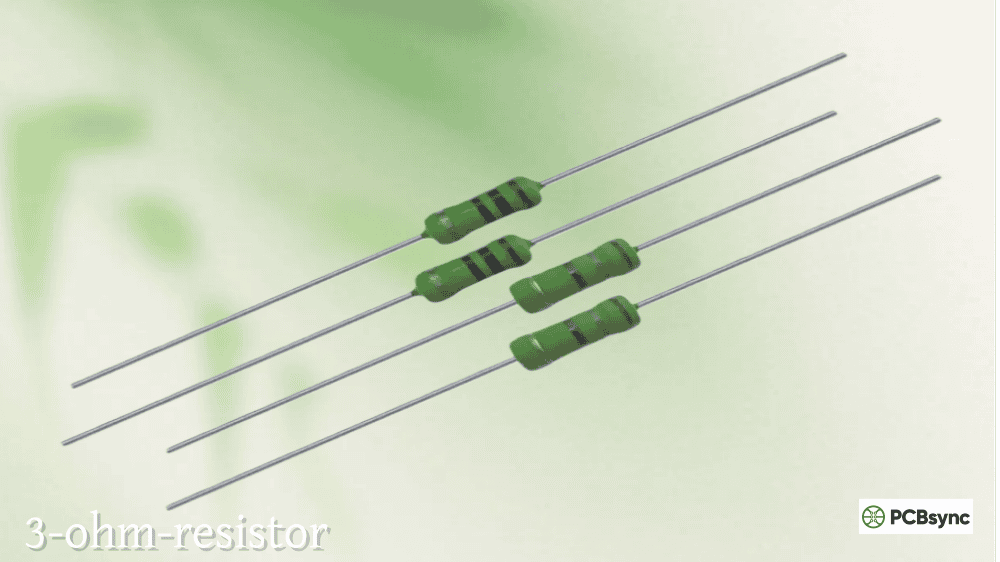
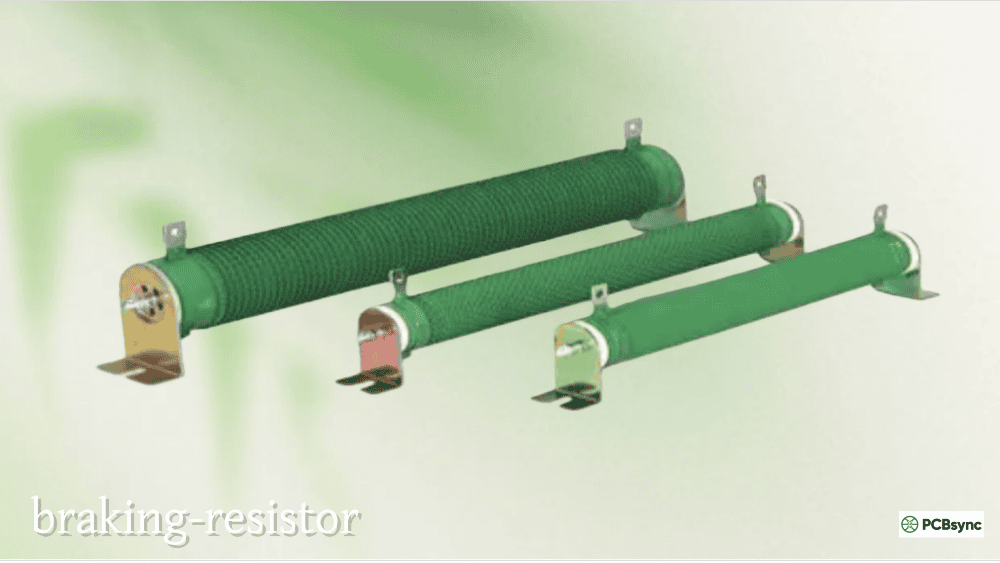
2. Wirewound / Vitreous Enamel
These are the green or brown ceramic tubes often seen in older panels.
Pros: Cheap.
Cons: Fragile. Exposed live terminals (IP00). They require a cage for safety. They are rarely used in modern IP20 cabinet designs unless enclosed.
3. Steel Grid / Ribbon Resistors
Used for high power (50HP to 1000HP+).
Construction: Stainless steel sheets stamped into a zigzag “grid” pattern and stacked.
Pros: Massive power handling. Indestructible. Air-cooled.
Cons: Huge physical footprint. They look like a space heater because, technically, they are.
Selection Guide: The Math Behind the Metal
Selecting a braking resistor for VFD usage is a two-step process. You cannot just pick a random “100 Watt” resistor. You must calculate Resistance (Ohms) and Power (Watts) separately.
Step 1: Resistance (Ohms) – The Safety Limit
The resistance value is dictated by the VFD, not the motor.
Inside the VFD is the Brake Chopper transistor. It has a maximum current rating.
If you use a resistor with too little resistance (Ohm’s Law: $I = V/R$), you will pull too much current and blow the VFD’s internal transistor.
Minimum Resistance ($R_{min}$): Found in the VFD manual. Never go below this.
Maximum Resistance: If the resistance is too high, the current flow will be too low to drain the voltage fast enough. The VFD will still trip on overvoltage.
Formula for Peak Braking Current:
$$I_{peak} = \frac{V_{bus}}{R_{resistor}}$$
Engineer’s Rule: Always stick close to the VFD manufacturer’s recommended Ohmic value. If they say “Min 40 Ohms,” using a 50 Ohm resistor is safe. Using a 30 Ohm resistor is catastrophic.
Step 2: Power (Watts) – The Application Load
The wattage is dictated by how hard you brake and how often.
A braking resistor is designed to get hot. During a full-load stop, the element temperature can reach 300°C to 600°C. Installation is a safety-critical task.
1. Mounting Orientation
Always mount resistors horizontally or vertically as specified by the datasheet to allow airflow (convection). Never mount them underneath other components like VFDs or PLCs. The rising heat will cook the electronics above.
2. Cable Sizing and Routing
The cable connecting the VFD (B+ and B- terminals) to the resistor carries high-voltage DC (up to 800V) pulsed at high frequency.
Twisted Pair: Twist the braking cables to reduce EMI (Electro-Magnetic Interference) radiation.
Short Run: Keep the cable as short as possible (ideally <10m). Long cables add inductance, which can cause voltage spikes that kill the chopper transistor.
Shielding: Use shielded cable if running near sensitive signal wires.
3. Thermal Protection (The “KLIXON”)
Most high-quality braking resistors come with a “Thermal Switch” or “Click-son” normally closed (NC) contact.
Crucial Wiring Step:
Do NOT wire this thermal switch in series with the braking power cables. It cannot handle the current.
Instead, wire this contact into the VFD’s External Fault Input or the main contactor coil control loop.
Logic: If the resistor overheats, the contact opens $\rightarrow$ The VFD trips on “External Fault” $\rightarrow$ The drive stops sending energy to the resistor.
Without this: If the chopper IGBT shorts “ON” (a common failure mode), the resistor will receive continuous current until it glows cherry red and starts a fire. The thermal switch is your last line of defense.
Troubleshooting Common Braking Issues
As a maintenance engineer, you will eventually encounter a system where the braking isn’t working.
Scenario 1: VFD still trips on Overvoltage (OU) during stop
Check: Is the resistor open circuit? Measure Ohms with a multimeter.
Check: Is the deceleration time too short? If you try to stop a 1-ton flywheel in 0.5 seconds, even the smallest resistance value might not drain the energy fast enough. You may need to increase the decel time or upsize the VFD to handle higher braking current.
Check: Is the “Brake Chopper” enabled in software? Some VFDs require you to set a parameter (e.g., “Brake Function: Enable”).
Scenario 2: Resistor is cold, but drive trips
Check: Wiring. Are you connected to the right terminals? (Usually B+ and B-, NOT DC+ and DC-).
Check: Blown Chopper. If the VFD’s internal transistor is dead, it can’t switch the resistor on.
Scenario 3: Resistor gets hot when motor is stopped
Danger: This indicates a shorted internal Chopper IGBT. Turn off power immediately. The VFD needs repair/replacement.
Useful Resources
For engineers engaging in sizing and selection, these databases and tools are standard industry references:
Yaskawa / Rockwell / ABB Manuals: Every major VFD manual has a “Braking Resistor Selection Table” in the appendix. Use this primary source first.
Cressall / Post Glover: These are the big manufacturers of industrial resistors. Their websites have “Energy Calculators” where you input inertia (J) and speed ($RPM$) to get the exact Joules required.
DigiKey / Mouser: Search for “Chassis Mount Resistors” for smaller (aluminum) braking needs.
Frequently Asked Questions (FAQ)
1. Can I connect two braking resistors in parallel?
Yes, but be careful. Connecting in parallel decreases the total resistance ($R_{total} = R/2$). You must ensure the new total resistance is not lower than the VFD’s minimum allowed resistance. If it is, you will blow the drive. Parallel connection is useful to double the wattage handling while halving the resistance.
2. Can I connect two braking resistors in series?
Yes. Connecting in series adds the resistance ($R_{total} = R1 + R2$). This increases the total resistance (safe for the drive) and adds the wattage of both resistors together. This is a common trick when you need more power handling but don’t want to lower the resistance.
3. What is the difference between a Braking Unit and a Braking Resistor?
A Braking Resistor is just the passive coil of wire.
A Braking Unit (or Chopper Module) is the active electronics (IGBT) that switches the resistor. Small VFDs (under 30HP) usually have the Braking Unit built-in, so you only need the resistor. Large VFDs (100HP+) often require an external Braking Unit module plus the resistor.
4. Why does my braking resistor measure higher Ohms than the label?
Resistors have a temperature coefficient. If you measure a resistor immediately after a stop, it will be hot, and the resistance will be higher. Always measure when cold (room temperature) to verify against the datasheet. Also, check your multimeter leads; cheap leads add resistance.
5. Can I use a light bulb as a braking resistor?
In a desperate MacGyver situation on a tiny 12V DC motor? Maybe. On an industrial VFD? Absolutely not. Light bulbs have a “Cold Resistance” that is very low (inrush current) and they cannot handle the high voltage (600V+) DC pulses. They will explode or cause the VFD to trip on short-circuit protection instantly.
Conclusion
The braking resistor is the unsung hero of high-inertia motion control. It allows machines to run faster cycles, stop precisely for safety, and prevent nuisance tripping.
However, it is also a heater capable of starting fires if respected poorly. Successful implementation requires a balance of electrical constraints (Ohmic limits of the Drive) and thermal constraints (Duty cycle of the Load). When in doubt, always oversize the Wattage—a cool resistor is a happy resistor—but never undersize the Resistance.
By following these selection guidelines and ensuring the thermal protection loop is wired correctly, you turn a potential point of failure into a robust, reliable part of your automation system.
Inquire: Call 0086-755-23203480, or reach out via the form below/your sales contact to discuss our design, manufacturing, and assembly capabilities.
Quote: Email your PCB files to Sales@pcbsync.com (Preferred for large files) or submit online. We will contact you promptly. Please ensure your email is correct.
Notes: For PCB fabrication, we require PCB design file in Gerber RS-274X format (most preferred), *.PCB/DDB (Protel, inform your program version) format or *.BRD (Eagle) format. For PCB assembly, we require PCB design file in above mentioned format, drilling file and BOM. Click to download BOM template To avoid file missing, please include all files into one folder and compress it into .zip or .rar format.