Inquire: Call 0086-755-23203480, or reach out via the form below/your sales contact to discuss our design, manufacturing, and assembly capabilities.
Quote: Email your PCB files to Sales@pcbsync.com (Preferred for large files) or submit online. We will contact you promptly. Please ensure your email is correct.
Notes: For PCB fabrication, we require PCB design file in Gerber RS-274X format (most preferred), *.PCB/DDB (Protel, inform your program version) format or *.BRD (Eagle) format. For PCB assembly, we require PCB design file in above mentioned format, drilling file and BOM. Click to download BOM template To avoid file missing, please include all files into one folder and compress it into .zip or .rar format.
300 Ohm Resistor: Complete Guide to Color Code, Specifications & Applications
As someone who has spent years designing PCBs and troubleshooting circuits, I can tell you that the 300 ohm resistor is one of those components that shows up in more designs than most engineers realize. Whether you’re limiting current to an LED, matching antenna impedance, or building audio circuits, understanding this specific resistance value is essential for any electronics project.
In this guide, I’ll walk you through everything you need to know about the 300 ohm resistor—from reading the color bands correctly to selecting the right type for your application.
A 300 ohm resistor is a passive electronic component that provides exactly 300 ohms of electrical resistance. This value sits comfortably in the E24 standard resistor series, making it widely available from virtually every electronics supplier.
The primary job of any resistor is to oppose current flow, and at 300 ohms, this component offers a moderate level of resistance suitable for many common circuit applications. When you apply Ohm’s Law (V = IR), a 300 ohm resistor will limit current to approximately 16.67mA when connected across a 5V supply—perfect for many indicator LED circuits.
300 Ohm Resistor Color Code
Reading resistor color bands correctly is a fundamental skill that saves hours of troubleshooting. Here’s how to identify a 300 ohm resistor across different band configurations:
4-Band 300 Ohm Resistor Color Code
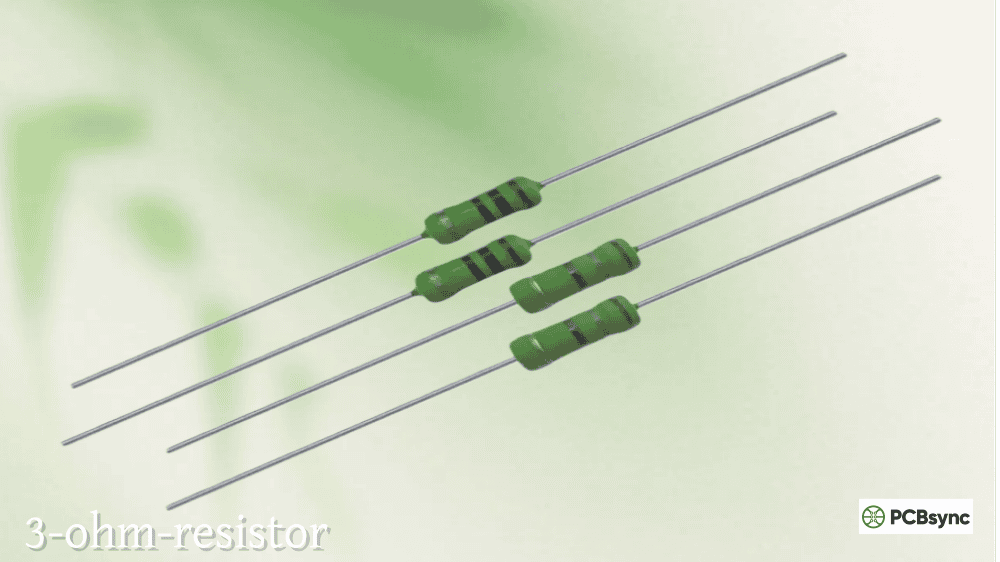
The most common through-hole resistors use four color bands. For 300 ohms:
Band Position
Color
Value
1st Band (First Digit)
Orange
3
2nd Band (Second Digit)
Black
0
3rd Band (Multiplier)
Brown
×10
4th Band (Tolerance)
Gold
±5%
Reading: 3, 0, ×10 = 300Ω ±5%
With a ±5% tolerance, the actual resistance can range from 285Ω to 315Ω.
5-Band 300 Ohm Resistor Color Code
Precision resistors often use five bands for tighter tolerances:
Band Position
Color
Value
1st Band
Orange
3
2nd Band
Black
0
3rd Band
Black
0
4th Band (Multiplier)
Black
×1
5th Band (Tolerance)
Brown
±1%
Reading: 3, 0, 0, ×1 = 300Ω ±1%
6-Band 300 Ohm Resistor Color Code
For applications requiring temperature stability, six-band resistors add a temperature coefficient:
Band Position
Color
Value
1st Band
Orange
3
2nd Band
Black
0
3rd Band
Black
0
4th Band (Multiplier)
Black
×1
5th Band (Tolerance)
Gold
±5%
6th Band (Temp Coefficient)
Black
250 ppm/K
Quick Color Code Reference Chart
Resistance
4-Band Code
5-Band Code
300Ω
Orange-Black-Brown-Gold
Orange-Black-Black-Black-Gold
220Ω
Red-Red-Brown-Gold
Red-Red-Black-Black-Gold
330Ω
Orange-Orange-Brown-Gold
Orange-Orange-Black-Black-Gold
270Ω
Red-Violet-Brown-Gold
Red-Violet-Black-Black-Gold
Types of 300 Ohm Resistors
Not all resistors are created equal. The construction material significantly impacts performance characteristics:
Carbon Film Resistors
These are the workhorses of hobby electronics. Carbon film 300 ohm resistors offer decent stability at an affordable price point. They’re suitable for general-purpose applications where precision isn’t critical. Typical specifications include ±5% tolerance and power ratings from 1/8W to 1W.
Metal Film Resistors
When your circuit demands accuracy, metal film resistors deliver tolerances as tight as ±0.1%. They also exhibit better temperature stability and lower noise than carbon film alternatives. I typically spec these for analog signal paths and precision measurement circuits.
Wirewound Resistors
For power applications, wirewound 300 ohm resistors handle significant wattage—from 5W up to 300W in industrial versions. The trade-off is higher inductance, which makes them unsuitable for high-frequency circuits. You’ll find these in power supplies, load testing equipment, and motor control circuits.
SMD (Surface Mount) Resistors
Modern PCB designs favor surface mount components. SMD 300 ohm resistors use a numeric marking system:
SMD Code
Value
301
300Ω (3-digit)
3000
300Ω (4-digit)
Common package sizes include 0402, 0603, 0805, and 1206, with power ratings ranging from 0.03W to 0.5W.
Power Ratings and Selection Guide
Choosing the correct power rating prevents resistor failure. Use this formula:
P = I² × R or P = V² / R
For a 300 ohm resistor with 10mA current: P = (0.01)² × 300 = 0.03W
A 1/4W (0.25W) resistor provides adequate headroom for this application.
Common Power Ratings for 300 Ohm Resistors
Power Rating
Typical Applications
1/8W (0.125W)
Signal circuits, low-current LED indication
1/4W (0.25W)
General purpose, breadboard prototyping
1/2W (0.5W)
Moderate power circuits, multiple LEDs
1W
Power regulation, current sensing
5W+
Load testing, power dissipation, industrial
Practical Applications of 300 Ohm Resistors
LED Current Limiting
One of the most common uses for a 300 ohm resistor is protecting LEDs from overcurrent. Here’s the calculation:
With a 5V supply and a red LED (2V forward voltage, 10mA typical current): R = (5V – 2V) / 0.01A = 300Ω
This makes the 300 ohm resistor an excellent choice for many standard LED indicator circuits.
Antenna Impedance Matching
If you’ve worked with older TV antennas or FM dipoles, you’ve encountered 300 ohm twin-lead cable. This balanced transmission line matches the impedance of folded dipole antennas (approximately 275Ω). When connecting to modern 75Ω coaxial systems, a 4:1 balun performs the impedance transformation (300/75 = 4).
300 ohm impedance appears frequently in:
FM radio antenna connections
VHF/UHF television antennas
Amateur radio dipole feedlines
Professional audio balanced line impedance
Audio and Signal Circuits
In audio equipment, 300 ohms serves as a standard impedance value for:
Headphone impedance matching
Microphone input termination
Line-level signal attenuation
Balanced audio interface design
Voltage Dividers
A 300 ohm resistor paired with other values creates precise voltage division. Combined with a 100Ω resistor in a divider fed by 5V:
Vout = 5V × (100 / (300 + 100)) = 1.25V
Transistor Biasing
Setting the proper operating point for transistor amplifiers often requires specific resistance values. 300 ohms appears in base bias networks and emitter degeneration circuits where moderate current limiting is required.
How to Verify a 300 Ohm Resistor
Color codes can fade or be difficult to read under poor lighting. Always verify resistance values with a digital multimeter before installation in critical circuits:
Set your multimeter to the appropriate resistance range (typically 2kΩ)
Touch the probes to both resistor leads
Read the displayed value
A 300 ohm resistor with ±5% tolerance should measure between 285Ω and 315Ω.
300 Ohm vs. Similar Resistance Values
Understanding when to use 300 ohms versus nearby standard values helps optimize circuit design:
Value
Current at 5V
Best For
220Ω
22.7mA
Higher-brightness LEDs, heavier loads
270Ω
18.5mA
Slightly higher current than 300Ω
300Ω
16.7mA
Standard LED circuits, moderate loads
330Ω
15.2mA
Conservative LED current, lower power
The 300 ohm resistor provides a middle-ground option when 220Ω allows too much current and 330Ω restricts it excessively.
DigiKey: Extensive selection with detailed datasheets
Mouser Electronics: Wide range of specifications and tolerances
Newark/Farnell: Industrial and precision components
LCSC: Competitive pricing for volume orders
Technical Documentation
IEC 60062: International standard for resistor color coding
EIA Resistor Series: E12, E24, E48, E96 standard values
Frequently Asked Questions
What color bands identify a 300 ohm resistor?
A standard 4-band 300 ohm resistor displays Orange-Black-Brown-Gold bands, representing 3-0-×10-±5%. For 5-band precision versions, look for Orange-Black-Black-Black followed by a tolerance band.
Can I use a 330 ohm resistor instead of 300 ohm?
In most applications, yes. A 330Ω resistor provides 10% higher resistance, slightly reducing current flow. For LED circuits, this means marginally dimmer output but increased component lifespan. Always verify the substitution doesn’t violate minimum current requirements for your specific application.
What power rating should I choose for a 300 ohm resistor?
Calculate power dissipation using P = I²R, then select a resistor rated at least 50% higher than the calculated value. For most breadboard and low-power circuits, 1/4W (0.25W) resistors provide adequate margin. High-current applications may require 1/2W, 1W, or higher ratings.
Why is 300 ohm important for antenna systems?
300 ohms is the characteristic impedance of standard twin-lead transmission line, which naturally matches folded dipole antenna impedance (approximately 275Ω). This impedance matching minimizes signal reflection and power loss in FM radio, VHF television, and amateur radio installations.
How do I read the SMD marking for a 300 ohm resistor?
Surface mount 300 ohm resistors typically display “301” (3-digit code: 30 × 10¹ = 300Ω) or “3000” (4-digit code: 300 × 10⁰ = 300Ω). Some manufacturers use “R” to indicate a decimal point—”300R” means exactly 300.0Ω.
Conclusion
The 300 ohm resistor remains a staple component in electronics design, from simple LED indicators to professional antenna systems. Understanding its color code, specifications, and applications enables you to confidently specify the right component for your project.
Whether you’re building your first breadboard circuit or designing production PCBs, knowing how to identify, calculate, and apply 300 ohms of resistance is fundamental knowledge that serves you throughout your electronics journey.
Keep a stock of various tolerances and power ratings in your parts bin—the 300 ohm resistor has a habit of appearing exactly when you need it most.
Inquire: Call 0086-755-23203480, or reach out via the form below/your sales contact to discuss our design, manufacturing, and assembly capabilities.
Quote: Email your PCB files to Sales@pcbsync.com (Preferred for large files) or submit online. We will contact you promptly. Please ensure your email is correct.
Notes: For PCB fabrication, we require PCB design file in Gerber RS-274X format (most preferred), *.PCB/DDB (Protel, inform your program version) format or *.BRD (Eagle) format. For PCB assembly, we require PCB design file in above mentioned format, drilling file and BOM. Click to download BOM template To avoid file missing, please include all files into one folder and compress it into .zip or .rar format.