Inquire: Call 0086-755-23203480, or reach out via the form below/your sales contact to discuss our design, manufacturing, and assembly capabilities.
Quote: Email your PCB files to Sales@pcbsync.com (Preferred for large files) or submit online. We will contact you promptly. Please ensure your email is correct.
Notes: For PCB fabrication, we require PCB design file in Gerber RS-274X format (most preferred), *.PCB/DDB (Protel, inform your program version) format or *.BRD (Eagle) format. For PCB assembly, we require PCB design file in above mentioned format, drilling file and BOM. Click to download BOM template To avoid file missing, please include all files into one folder and compress it into .zip or .rar format.
180 Ohm Resistor: Complete Guide to Color Code & Practical Uses
Three months ago, I was debugging an LED driver board where half the indicator LEDs were dimmer than the others. Grabbed my multimeter, expecting failed LEDs. Turned out someone had mixed 150Ω and 180 ohm resistors in the same batch—close enough that they passed visual inspection, but different enough to create noticeable brightness variation. That’s when I learned to always verify resistor values, especially mid-range values like 180Ω that don’t get as much attention as the “famous” ones like 10kΩ or 100Ω.
A 180 ohm resistor provides exactly 180Ω of resistance to current flow. It’s part of the E12 and E24 standard value series, making it readily available and commonly stocked by distributors. While not as ubiquitous as 100Ω or 1kΩ, the 180 ohm resistor fills a specific niche in electronic design—primarily LED current limiting, signal conditioning, and voltage division applications where you need something between 150Ω and 220Ω.
The 180Ω value isn’t arbitrary. It’s positioned in the standard resistor series to provide approximately 10% spacing between values, ensuring designers have appropriate resistance choices across the full range from milliohms to megaohms without requiring infinite inventory.
Why 180 Ohms Matters
At 180Ω, you’re in the sweet spot for many common circuit applications:
LED current limiting with 5V supplies
Low-impedance voltage dividers that don’t load down circuits
Signal conditioning for analog sensors
Base resistors for low-power transistor switches
Calculate current through a 180 ohm resistor with 9V applied: I = V/R = 9V / 180Ω = 50mA. That’s enough current to drive multiple LEDs in series or bias a small signal transistor without excessive power dissipation.
Decoding the 180 Ohm Resistor Color Code
Learning to read resistor color codes fast and accurately saves time during assembly and troubleshooting. The 180 ohm resistor has distinctive color patterns you’ll learn to recognize instantly.
4-Band 180 Ohm Color Code
Band Position
Color
Digit/Multiplier
Value
1st Band
Brown
First Digit
1
2nd Band
Gray
Second Digit
8
3rd Band
Brown
Multiplier
×10
4th Band
Gold
Tolerance
±5%
The standard color sequence is Brown-Gray-Brown-Gold. Read left to right: “1” and “8” give you 18, then multiply by 10 to get 180Ω. The gold band means ±5% tolerance, so your resistor measures anywhere from 171Ω to 189Ω and still meets spec.
I’ve found gray bands are the trickiest to identify under poor lighting—they can look bluish or even violet depending on the manufacturer. When in doubt, use a multimeter. A quick resistance measurement beats guessing.
5-Band Precision 180 Ohm Code
Band Position
Color
Digit/Multiplier
Value
1st Band
Brown
First Digit
1
2nd Band
Gray
Second Digit
8
3rd Band
Black
Third Digit
0
4th Band
Black
Multiplier
×1
5th Band
Brown
Tolerance
±1%
The 5-band version (Brown-Gray-Black-Black-Brown) provides tighter ±1% tolerance: 178.2Ω to 181.8Ω. For most hobbyist and general-purpose applications, you don’t need this precision. I reserve 1% resistors for analog front-ends, precision amplifiers, and instrumentation circuits where every ohm matters.
6-Band High-Reliability Code
Band Position
Color
Meaning
Value
1st Band
Brown
First Digit
1
2nd Band
Gray
Second Digit
8
3rd Band
Black
Third Digit
0
4th Band
Black
Multiplier
×1
5th Band
Brown
Tolerance
±1%
6th Band
Red
Temp Coefficient
50 ppm/°C
Six-band resistors add temperature coefficient information—the red band indicates 50 ppm/°C. Over a 100°C temperature range, your 180Ω resistor might drift by ±0.9Ω. For automotive applications or industrial equipment operating from -40°C to +85°C, temperature stability becomes critical.
Technical Specifications for 180 Ohm Resistors
Power Rating Considerations
Standard power ratings and their real-world implications:
Power Rating
Max Continuous Current
Voltage at Max Power
Common Package
1/8W (0.125W)
26mA
4.7V
0402 SMD
1/4W (0.25W)
37mA
6.7V
0603/0805 SMD
1/2W (0.5W)
53mA
9.5V
Through-hole
1W
75mA
13.4V
Through-hole
2W
106mA
19V
Through-hole
Here’s the critical calculation: Power = I² × R. If you’re running 40mA through a 180 ohm resistor, that’s P = (0.04)² × 180 = 0.288W. You need at least a 1/2W resistor for reliable continuous operation. I typically oversize by 50-100% for better thermal management—using a 1W resistor for 0.3W dissipation keeps components cool and extends life.
Never trust power ratings at face value in enclosed designs. Ambient temperature matters enormously. A 1/4W resistor rated at 70°C might only handle 1/8W at 85°C ambient inside a sealed enclosure.
Tolerance and Selection
Tolerance
Application Examples
Typical Cost Multiplier
±10% (Silver)
Non-critical, obsolete
0.5×
±5% (Gold)
General purpose, LED limiting
1× baseline
±2% (Red)
Better stability, audio circuits
1.5×
±1% (Brown)
Precision analog, measurement
2-3×
±0.5%
Instrumentation, high-end audio
5-10×
For a typical LED current limiting application, ±5% tolerance is perfect. LED brightness variation from manufacturing tolerances exceeds ±5% anyway, so using precision resistors gains nothing. Save the expensive ±1% parts for circuits where they matter—like voltage references, precision current sources, or filter networks.
Primary Applications for 180 Ohm Resistors
LED Current Limiting
This is where I use 180 ohm resistors most frequently. Let’s work through real calculations:
Red LED with 5V supply:
LED forward voltage: ~2.0V
Voltage across resistor: 5V – 2V = 3V
Current through LED: I = 3V / 180Ω = 16.7mA
Power dissipation: P = 3V × 0.0167A = 50mW
Perfect for standard 20mA LEDs—provides adequate brightness without risking burnout. A 1/4W resistor handles this comfortably.
Multiple LEDs in series (12V supply):
Three red LEDs in series: 3 × 2V = 6V
Voltage across resistor: 12V – 6V = 6V
Current: I = 6V / 180Ω = 33mA
Power: P = 6V × 0.033A = 200mW
Now you need a 1/2W or 1W resistor. The higher voltage drop means more heat.
Arduino indicator LED (5V): This is the classic Arduino/microcontroller indicator application. With a typical red or green LED dropping 2V, the 180Ω resistor limits current to a safe 17mA—well within both the LED and microcontroller output pin specifications (usually 20-40mA max).
Voltage Division Networks
The 180 ohm resistor works well in low-impedance voltage dividers where you need minimal loading effect. Consider dividing 12V to 5V for a microcontroller ADC input:
That’s close to the 3.3V logic level. Fine-tune by adjusting to 180Ω and 82Ω (standard E24 value):
Vout = 12V × (82 / 262) = 3.76V
The current through this divider is I = 12V / 262Ω = 46mA, dissipating about 0.55W total. You’d use 1W resistors for reliable operation.
Signal Conditioning for Sensors
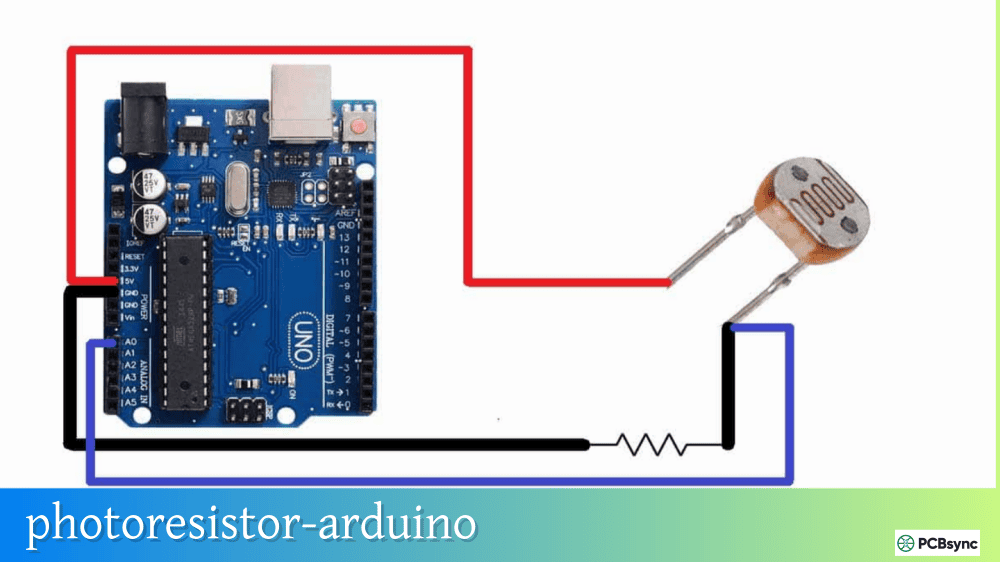
Temperature sensors, photoresistors, and other variable resistance sensors often need a fixed resistor to form a voltage divider. The 180 ohm resistor provides good sensitivity without excessive current draw.
Thermistor circuit example:
Thermistor at 25°C: 180Ω
Fixed resistor: 180Ω
Supply: 5V
Output voltage at 25°C: 2.5V
As temperature changes and thermistor resistance varies, the output voltage swings predictably. The microcontroller ADC reads this voltage and calculates temperature. Using matched 180Ω values gives maximum sensitivity at the midpoint temperature.
Pull-up and Pull-down Resistors
While 10kΩ is more common for digital logic pull-up/pull-down applications, 180 ohm resistors find use in specialized cases:
Fast-switching applications: Lower resistance means faster charging/discharging of parasitic capacitance. In high-speed digital circuits or where long cables introduce capacitance, a 180Ω pull-up provides faster edge rates than 10kΩ would.
High-drive current needs: Some interfaces require stronger pull-ups capable of sinking/sourcing more current. Open-drain outputs driving LEDs or relays might use 180Ω pull-ups to ensure adequate drive current.
Trade-off consideration: Lower resistance means higher power consumption. A 180Ω pull-up to 5V draws 28mA continuously—that’s 140mW wasted as heat. Only use low-value pull-ups where speed or drive requirements justify the power cost.
Base Resistors for Transistor Switching
When using a transistor as a switch (common in microcontroller circuits), the base resistor limits current while providing adequate base drive:
NPN transistor switch example (2N3904):
Microcontroller output: 5V (logic high)
Base-emitter voltage: 0.7V
Desired base current: 5mA (for good saturation with collector current up to 50mA)
Required resistor: (5V – 0.7V) / 0.005A = 860Ω
In practice, I’d use 820Ω or even 470Ω for margin. But for lower-power switching where 2-3mA base current suffices, 180Ω would be way too low—you’d waste power and potentially damage the microcontroller output.
However, for driving higher-power transistors or in situations where you want guaranteed hard saturation, lower base resistors like 180Ω ensure the transistor fully turns on.
Material Types and Selection
Carbon Film vs Metal Film
Property
Carbon Film
Metal Film
Cost
$
$$
Tolerance
±5% typical
±1% typical
Temperature Coefficient
±350 ppm/°C
±50 to ±100 ppm/°C
Noise
Higher
Lower
Best For
General purpose, cost-sensitive
Precision, audio, analog
For LED current limiting and non-critical applications, carbon film 180 ohm resistors work fine and cost less. For audio circuits, instrumentation, or precision voltage dividers, spend the extra money on metal film.
SMD Package Sizes
Package
Dimensions
Power (Standard)
Applications
0402
1.0mm × 0.5mm
1/16W
Compact designs, limited power
0603
1.6mm × 0.8mm
1/10W
General purpose SMD
0805
2.0mm × 1.25mm
1/8W
Hand-solderable, popular
1206
3.2mm × 1.6mm
1/4W
Higher power, easy rework
2512
6.4mm × 3.2mm
1W
Power applications
For production PCBs, I use 0805 as the smallest hand-solderable size—anything smaller requires magnification and steady hands. The 1206 size provides better power handling and easier assembly for prototypes.
Through-Hole Characteristics
Through-hole resistors are still valuable for:
Breadboarding: No need for soldering, easy to swap values
Prototyping: Quick to install and remove
Educational kits: Easier for students to handle
High power: Better thermal dissipation than small SMD
The standard 1/4W through-hole resistor is about 6mm long and handles most low-power applications. For LED circuits and voltage dividers, this size works perfectly.
When designing with LEDs, don’t just pick 180Ω because it’s “close enough.” Calculate properly:
Determine LED forward voltage from datasheet
Determine desired LED current (typically 10-20mA for indicators)
Calculate: R = (Vsupply – Vled) / Iled
Select nearest standard value that gives desired current or slightly less
If your calculation gives 165Ω, using 180Ω is fine—the LED will be slightly dimmer but safer. If you calculated 195Ω, using 180Ω might overdrive the LED. Use 220Ω instead.
Series and Parallel Combinations
Don’t have 180Ω? You can create it:
Series combinations:
150Ω + 30Ω = 180Ω (but why? Just buy 180Ω)
100Ω + 80Ω = 180Ω
Parallel combinations:
Two 360Ω resistors in parallel = 180Ω
270Ω || 540Ω = 180Ω
In production, never use combinations—use proper values. For prototyping when you don’t have the exact value, series/parallel works in a pinch.
Power Dissipation Reality Check
Always calculate actual power dissipation and derate:
Formula: P = I² × R or P = V² / R
Safety factor: Use resistors rated at least 2× calculated power for reliability.
Example: If calculating 0.2W dissipation, use a 1/2W resistor minimum, preferably 1W for margin.
Common Mistakes and Troubleshooting
Reading Color Codes Incorrectly
The biggest issue I see is confusing gray with violet. Under certain lighting, they look similar:
Gray = 8
Violet = 7
An 180Ω resistor (Brown-Gray-Brown) misread as Brown-Violet-Brown would be 170Ω. That’s only 5.5% error—within ±10% tolerance! But if you’re expecting specific current, you’ll be disappointed.
Solution: Check with a multimeter. Every. Single. Time. For critical circuits.
Insufficient Power Rating
Underestimating power dissipation is the #1 cause of resistor failure in my experience. Signs of thermal stress:
Discoloration (browning, darkening)
Burning smell
Value drift (measure out of tolerance)
Physical damage (cracking, delamination)
Solution: Oversize power ratings generously. The cost difference between 1/4W and 1/2W resistors is negligible.
Using Wrong Tolerance
Specifying ±1% resistors for LED current limiting wastes money. Conversely, using ±5% resistors in precision amplifier feedback networks creates gain errors.
Solution: Match tolerance to application requirements. Don’t over-specify or under-specify.
What’s the exact color code for a 180 ohm resistor?
The standard 4-band 180 ohm resistor color code is Brown-Gray-Brown-Gold. Brown (1), Gray (8), Brown (×10), Gold (±5%). This gives 18 × 10 = 180Ω with ±5% tolerance. For 5-band precision resistors with ±1% tolerance, the code is Brown-Gray-Black-Black-Brown.
Can I substitute 150Ω or 220Ω for 180Ω?
It depends on your application. For LED current limiting, using 220Ω instead of 180Ω makes the LED slightly dimmer but safer—generally acceptable. Using 150Ω increases current by 20%, which might exceed LED ratings and shorten lifespan. In precision circuits like instrumentation amplifiers or voltage references, even 10% deviation is unacceptable. Always calculate the impact before substituting.
How do I calculate LED current with a 180 ohm resistor?
Use Ohm’s Law: I = (Vsupply – Vled) / R. For example, with a 5V supply and red LED (2V forward voltage): I = (5V – 2V) / 180Ω = 3V / 180Ω = 16.7mA. This is perfect for standard 20mA indicator LEDs. Always check your LED’s datasheet for maximum continuous current—some small LEDs are rated for only 10-15mA.
What power rating do I need for my 180 ohm resistor?
Calculate power dissipation using P = I² × R or P = V² / R. For example, if 30mA flows through the resistor: P = (0.03A)² × 180Ω = 0.162W. You need at least a 1/4W (0.25W) resistor, but I’d use 1/2W for margin. Always oversize power ratings by at least 50-100% for reliability and longevity. Resistors running near their power limit get hot and fail prematurely.
Why do some 180 ohm resistors have 5 bands instead of 4?
Five-band resistors provide an additional significant digit, enabling tighter tolerance specifications. A 4-band resistor can only represent two digits (18 in this case), while 5-band includes three digits (180), allowing values like 181Ω or 182Ω. The fifth band is typically the tolerance: brown for ±1%, red for ±2%. Use 5-band resistors when precision matters—audio circuits, precision voltage dividers, instrumentation. For general purpose LED limiting or pull-up resistors, 4-band ±5% resistors are perfectly adequate and cost less.
Conclusion
The 180 ohm resistor might not be as famous as 10kΩ or as specialized as 50Ω, but it’s a workhorse component that deserves respect. From LED current limiting to voltage division, from sensor conditioning to transistor biasing, this mid-range value handles numerous common circuit applications.
After twenty years of PCB design, I’ve learned that success often hinges on getting the “boring” details right—correct resistor values, adequate power ratings, appropriate tolerances. The difference between a circuit that works reliably for ten years and one that fails after ten weeks often comes down to whether someone took the time to calculate power dissipation properly and select the right 180 ohm resistor.
Keep a good stock of 180Ω resistors in both through-hole 1/4W and SMD 0805 packages. You’ll use them more than you think. And always—always—verify with a multimeter before soldering, because that 180 ohm resistor in your parts bin might actually be 150Ω or 220Ω from a previous project.
Inquire: Call 0086-755-23203480, or reach out via the form below/your sales contact to discuss our design, manufacturing, and assembly capabilities.
Quote: Email your PCB files to Sales@pcbsync.com (Preferred for large files) or submit online. We will contact you promptly. Please ensure your email is correct.
Notes: For PCB fabrication, we require PCB design file in Gerber RS-274X format (most preferred), *.PCB/DDB (Protel, inform your program version) format or *.BRD (Eagle) format. For PCB assembly, we require PCB design file in above mentioned format, drilling file and BOM. Click to download BOM template To avoid file missing, please include all files into one folder and compress it into .zip or .rar format.