Inquire: Call 0086-755-23203480, or reach out via the form below/your sales contact to discuss our design, manufacturing, and assembly capabilities.
Quote: Email your PCB files to Sales@pcbsync.com (Preferred for large files) or submit online. We will contact you promptly. Please ensure your email is correct.
Notes: For PCB fabrication, we require PCB design file in Gerber RS-274X format (most preferred), *.PCB/DDB (Protel, inform your program version) format or *.BRD (Eagle) format. For PCB assembly, we require PCB design file in above mentioned format, drilling file and BOM. Click to download BOM template To avoid file missing, please include all files into one folder and compress it into .zip or .rar format.
100 Ohm Resistor: Complete Guide to Color Code, Power Rating & Practical Uses
As someone who’s spent years designing PCBs and troubleshooting circuits, I can tell you that the 100 ohm resistor is one of those components you’ll always find in my parts bin. It’s not the flashiest component, but it’s absolutely essential for countless applications from LED circuits to signal conditioning.
In this guide, I’ll walk you through everything you need to know about the 100 ohm resistor, including how to identify it using color codes, selecting the right power rating for your project, and understanding where this versatile component fits into real-world circuits.
A 100 ohm resistor is a passive electronic component that provides exactly 100 ohms (Ω) of electrical resistance. Its primary job is to limit current flow, create voltage drops, and protect sensitive components in your circuits.
The “100” in the resistance value isn’t arbitrary. It falls right in the middle of commonly used resistance ranges, making it incredibly versatile. When you apply Ohm’s Law (V = I × R), you can see why: at 5V, a 100 ohm resistor limits current to 50mA, which is perfect for many common applications.
Reading resistor color codes is a fundamental skill for anyone working with electronics. The bands printed on a resistor tell you its resistance value, tolerance, and sometimes temperature coefficient. Let me break down how to identify a 100 ohm resistor color code for different band configurations.
4-Band 100 Ohm Resistor Color Code
The 4-band system is the most common configuration you’ll encounter, especially in general-purpose applications.
Band Position
Color
Value/Function
1st Band
Brown
1 (first digit)
2nd Band
Black
0 (second digit)
3rd Band
Brown
×10 (multiplier)
4th Band
Gold
±5% tolerance
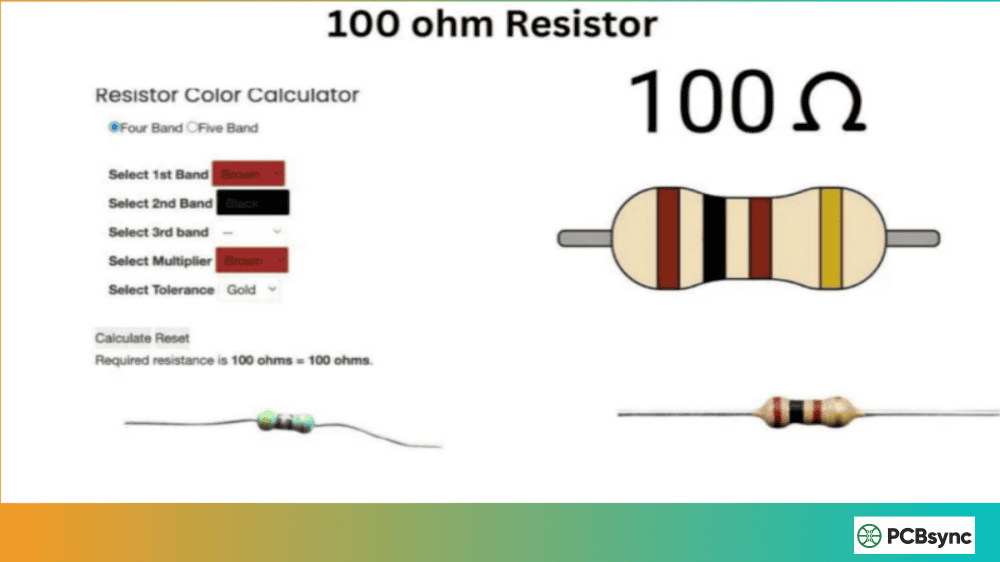
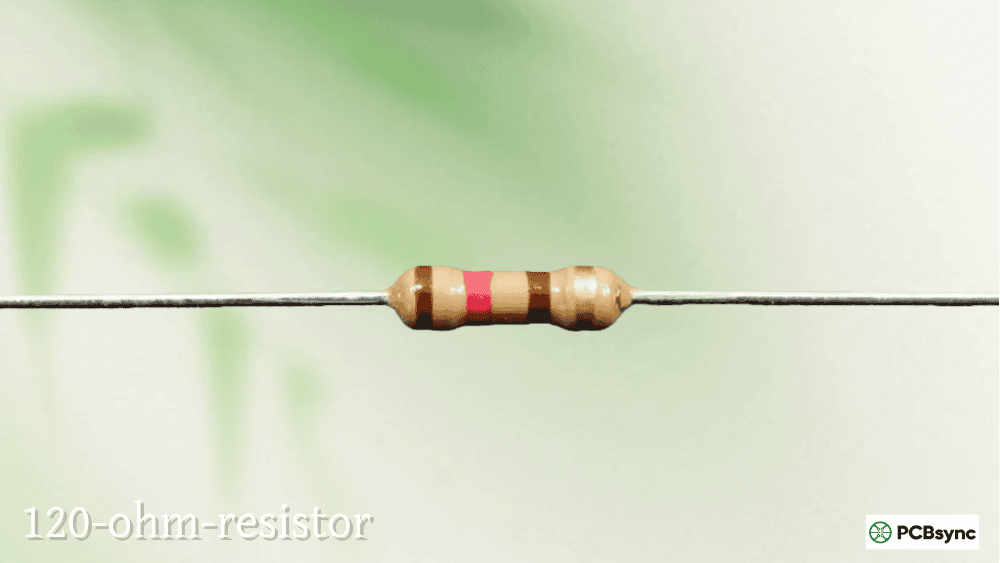
Reading the code: Brown (1) + Black (0) = 10, multiplied by Brown (×10) = 100Ω
For a 100 ohm resistor with 5% tolerance, the complete color sequence is Brown-Black-Brown-Gold.
If you encounter a 100 ohm resistor with 10% tolerance, the fourth band will be Silver instead of Gold, giving you Brown-Black-Brown-Silver.
5-Band 100 Ohm Resistor Color Code
Precision applications call for 5-band resistors, which provide tighter tolerances (typically 1% or 2%).
Band Position
Color
Value/Function
1st Band
Brown
1 (first digit)
2nd Band
Black
0 (second digit)
3rd Band
Black
0 (third digit)
4th Band
Black
×1 (multiplier)
5th Band
Brown
±1% tolerance
Reading the code: Brown (1) + Black (0) + Black (0) = 100, multiplied by Black (×1) = 100Ω
For a precision 100 ohm resistor, the color sequence is Brown-Black-Black-Black-Brown (1% tolerance) or Brown-Black-Black-Black-Red (2% tolerance).
6-Band 100 Ohm Resistor Color Code
The 6-band configuration adds a temperature coefficient band, which is critical for precision applications where temperature stability matters.
Band Position
Color
Value/Function
1st Band
Brown
1 (first digit)
2nd Band
Black
0 (second digit)
3rd Band
Black
0 (third digit)
4th Band
Black
×1 (multiplier)
5th Band
Brown
±1% tolerance
6th Band
Brown
100 ppm/°C
SMD 100 Ohm Resistor Marking Codes
Surface mount resistors use numeric codes instead of color bands. Here’s how to identify a 100 ohm SMD resistor:
SMD Code Format
Marking
Calculation
3-digit (5% tolerance)
101
10 × 10¹ = 100Ω
4-digit (1% tolerance)
1000
100 × 10⁰ = 100Ω
EIA-96 (1% tolerance)
01A
Code 01 = 100, A = ×1 = 100Ω
Pro tip: Don’t confuse “100” with “101” on SMD resistors. The code “100” actually means 10 × 10⁰ = 10Ω, while “101” means 10 × 10¹ = 100Ω. I’ve seen this mistake on production boards more times than I’d like to admit.
Quick Reference Color Code Chart
Here’s a complete reference for identifying any resistor:
Color
Digit Value
Multiplier
Tolerance
Black
0
×1
—
Brown
1
×10
±1%
Red
2
×100
±2%
Orange
3
×1,000
—
Yellow
4
×10,000
—
Green
5
×100,000
±0.5%
Blue
6
×1,000,000
±0.25%
Violet
7
×10,000,000
±0.1%
Gray
8
—
±0.05%
White
9
—
—
Gold
—
×0.1
±5%
Silver
—
×0.01
±10%
100 Ohm Resistor Power Rating
Selecting the correct power rating is just as important as getting the resistance value right. An undersized resistor will overheat, drift in value, and eventually fail. Here’s how to choose the right power rating for your 100 ohm resistor.
Understanding Power Dissipation
When current flows through a resistor, it converts electrical energy into heat. The power dissipated follows these formulas:
P = I² × R (when you know current)
P = V² / R (when you know voltage)
For a 100 ohm resistor with 10V across it: P = (10)² / 100 = 1W
This means you’d need at least a 2W resistor for safe operation (always use 2× the calculated power as a safety margin).
Common Power Ratings for 100 Ohm Resistors
Power Rating
Max Voltage at 100Ω
Max Current
Typical Applications
1/8W (0.125W)
3.5V
35mA
Low-power signal circuits
1/4W (0.25W)
5V
50mA
General purpose, LED circuits
1/2W (0.5W)
7V
70mA
Higher current applications
1W
10V
100mA
Power circuits, current sensing
2W
14V
140mA
Industrial applications
5W
22V
220mA
Power supplies, motor control
How to Calculate Required Power Rating
Here’s a practical example. Say you’re designing an LED circuit with a 12V supply and a red LED (2V forward voltage, 20mA operating current):
Voltage across resistor: 12V – 2V = 10V
Required resistance: R = V/I = 10V / 0.02A = 500Ω
Power dissipation: P = V × I = 10V × 0.02A = 0.2W
You’d need at least a 1/2W resistor for safe operation.
Now, if you specifically needed a 100 ohm resistor with a 5V supply driving an LED at 20mA:
Voltage across LED: approximately 2V
Voltage across resistor: 5V – 2V = 3V
Actual current: I = 3V / 100Ω = 30mA (slightly higher than 20mA, but acceptable for most LEDs)
Power: P = 3V × 0.03A = 0.09W
A standard 1/4W (0.25W) resistor would be more than adequate here.
Types of 100 Ohm Resistors
Different applications require different resistor technologies. Here’s a breakdown of the common types you’ll encounter:
Carbon Film Resistors
Characteristic
Value
Tolerance
±5% typical
Power Range
1/8W to 2W
Temperature Coefficient
±200 to ±500 ppm/°C
Cost
Low
Best For
General purpose, non-critical applications
Carbon film resistors are your everyday workhorses. They’re inexpensive, widely available, and perfectly suitable for most hobby projects and non-precision circuits.
When I’m designing audio equipment or measurement circuits, metal film resistors are my go-to choice. The low noise and tight tolerance make a noticeable difference in signal quality.
Wirewound Resistors
Characteristic
Value
Tolerance
±1% to ±5%
Power Range
1W to 300W+
Temperature Coefficient
±20 to ±50 ppm/°C
Inductance
Higher than film types
Best For
High power applications, current sensing, load resistors
Wirewound resistors handle serious power. The tradeoff is higher inductance, which makes them unsuitable for high-frequency applications.
SMD Chip Resistors
Package Size
Dimensions (mm)
Typical Power Rating
0402
1.0 × 0.5
1/16W
0603
1.6 × 0.8
1/10W
0805
2.0 × 1.25
1/8W
1206
3.2 × 1.6
1/4W
2010
5.0 × 2.5
1/2W
2512
6.3 × 3.2
1W
SMD resistors dominate modern PCB design. For a 100 ohm resistor in a typical circuit, I usually reach for 0805 or 1206 packages, they’re small enough for dense layouts but large enough to hand-solder if needed.
Let me walk you through the real-world applications where you’ll commonly use a 100 ohm resistor.
LED Current Limiting
This is probably the most common application for hobbyists. A 100 ohm resistor works well for driving LEDs from 5V sources:
Circuit Example:
Supply voltage: 5V
LED forward voltage: 2V (red LED)
Resistor value: 100Ω
Current through LED: (5V – 2V) / 100Ω = 30mA
This provides bright illumination for most standard LEDs. For dimmer operation or power-sensitive applications, you might choose a higher resistance value.
Pull-up and Pull-down Resistors
In digital circuits, a 100 ohm resistor can serve as a strong pull-up or pull-down, though it’s on the lower end of typical values. This lower resistance provides faster rise/fall times and better noise immunity, but draws more current when the line is pulled to the opposite state.
Signal Conditioning and Impedance Matching
In transmission line applications and high-frequency circuits, 100Ω is a common impedance value. Differential signaling standards like LVDS often use 100Ω termination resistors.
Voltage Dividers
Combining two 100 ohm resistors creates a simple 2:1 voltage divider. This configuration is useful for:
Reducing voltage levels for ADC inputs
Creating reference voltages
Signal attenuation
Current Sensing
At low current levels, a 100 ohm resistor can function as a current sense resistor. The voltage drop across it provides a measurable signal proportional to current:
10mA produces 1V drop (easily measured)
50mA produces 5V drop
However, for higher currents, lower resistance values (milliohms to single ohms) are preferred to minimize power loss.
ESD Protection
In some applications, 100 ohm resistors are placed in series with data lines to limit transient current spikes during ESD events, protecting sensitive ICs downstream.
Transistor Biasing Circuits
Amplifier and switching circuits often use 100 ohm resistors in voltage divider configurations to establish proper DC operating points for transistors.
How to Select the Right 100 Ohm Resistor
Here’s my checklist when selecting a 100 ohm resistor for a project:
Selection Criteria
Factor
Questions to Ask
Power Rating
What’s the maximum power dissipation? Add 2× safety margin.
Tolerance
Does your circuit require ±1% precision or is ±5% acceptable?
Package
Through-hole for prototyping or SMD for production?
Temperature Coefficient
Will the resistor experience temperature variations?
Cost
Is this for a one-off project or high-volume production?
Availability
Can you source this component reliably?
Tolerance Considerations
A 100 ohm resistor with ±5% tolerance can actually measure anywhere from 95Ω to 105Ω. For most applications, this is perfectly acceptable. However, precision circuits like:
Instrumentation amplifiers
Precision voltage references
Calibration equipment
Audio crossover networks
These applications typically require ±1% or better tolerance resistors.
How to Test a 100 Ohm Resistor
Always verify resistor values before installation, especially for critical applications:
Set your multimeter to resistance mode (Ω)
Select an appropriate range (200Ω or auto-range)
Connect probes to resistor leads (polarity doesn’t matter)
Read the measurement
For a 100 ohm resistor with 5% tolerance, acceptable readings fall between 95Ω and 105Ω. If the reading is significantly off, the resistor may be damaged or you may have misidentified the color code.
Pro tip: Before measuring, touch the probes together and note any offset. Subtract this from your reading for better accuracy.
Substituting a 100 Ohm Resistor
Don’t have a 100 ohm resistor on hand? Here are some alternatives:
Series Combinations
Combination
Result
47Ω + 47Ω
94Ω (close approximation)
68Ω + 33Ω
101Ω (close approximation)
50Ω + 50Ω
100Ω (exact)
82Ω + 18Ω
100Ω (exact)
Parallel Combinations
Combination
Result
200Ω ∥ 200Ω
100Ω (exact)
150Ω ∥ 300Ω
100Ω (exact)
220Ω ∥ 180Ω
99Ω (close approximation)
Remember: When combining resistors, ensure the power rating of each resistor is adequate for the power it will dissipate.
Frequently Asked Questions
What is the color code for a 100 ohm resistor?
The standard 4-band 100 ohm resistor color code is Brown-Black-Brown-Gold (for ±5% tolerance). The first brown band represents the digit 1, the black band represents 0, the second brown band is the ×10 multiplier, and the gold band indicates ±5% tolerance. For precision resistors with 1% tolerance, the 5-band code is Brown-Black-Black-Black-Brown.
What power rating do I need for a 100 ohm resistor?
The required power rating depends on the voltage across the resistor or current through it. Calculate power using P = V²/R or P = I²×R, then select a resistor rated at least 2× the calculated value. For most hobbyist applications with 5V or less, a standard 1/4W (0.25W) resistor is sufficient.
Can I use a 100 ohm resistor for LED current limiting?
Yes, a 100 ohm resistor is commonly used for LED current limiting with 5V power supplies. With a typical red LED (2V forward voltage) on a 5V supply, a 100 ohm resistor limits current to approximately 30mA, which provides good brightness while staying within safe operating limits for most standard LEDs.
What does “101” mean on an SMD resistor?
The SMD code “101” indicates a 100 ohm resistor. The first two digits (10) represent the significant figures, and the third digit (1) is the multiplier (10¹ = 10). So 10 × 10 = 100Ω. Don’t confuse this with “100” which would actually be 10 × 10⁰ = 10Ω.
What’s the difference between carbon film and metal film 100 ohm resistors?
Metal film resistors offer tighter tolerance (±1% vs ±5%), lower noise, and better temperature stability compared to carbon film resistors. Use metal film for precision applications, audio circuits, and instrumentation. Carbon film resistors are more cost-effective for general-purpose applications where precision isn’t critical.
Useful Resources
Here are some helpful tools and references for working with resistors:
IEC 60062: International standard for resistor marking
Conclusion
The 100 ohm resistor may seem like a simple component, but understanding its specifications, color codes, and applications is fundamental to successful circuit design. Whether you’re building your first LED circuit or designing professional instrumentation, knowing how to select and apply this common component will serve you well.
Key takeaways:
The 4-band color code is Brown-Black-Brown-Gold (5% tolerance)
Always calculate power requirements and add a 2× safety margin
Choose metal film for precision applications, carbon film for general use
SMD code “101” = 100Ω (don’t confuse with “100” which equals 10Ω)
Verify values with a multimeter before critical installations
With this knowledge, you’re well-equipped to confidently use 100 ohm resistors in your projects. Happy building!
Inquire: Call 0086-755-23203480, or reach out via the form below/your sales contact to discuss our design, manufacturing, and assembly capabilities.
Quote: Email your PCB files to Sales@pcbsync.com (Preferred for large files) or submit online. We will contact you promptly. Please ensure your email is correct.
Notes: For PCB fabrication, we require PCB design file in Gerber RS-274X format (most preferred), *.PCB/DDB (Protel, inform your program version) format or *.BRD (Eagle) format. For PCB assembly, we require PCB design file in above mentioned format, drilling file and BOM. Click to download BOM template To avoid file missing, please include all files into one folder and compress it into .zip or .rar format.