Inquire: Call 0086-755-23203480, or reach out via the form below/your sales contact to discuss our design, manufacturing, and assembly capabilities.
Quote: Email your PCB files to Sales@pcbsync.com (Preferred for large files) or submit online. We will contact you promptly. Please ensure your email is correct.
Notes: For PCB fabrication, we require PCB design file in Gerber RS-274X format (most preferred), *.PCB/DDB (Protel, inform your program version) format or *.BRD (Eagle) format. For PCB assembly, we require PCB design file in above mentioned format, drilling file and BOM. Click to download BOM template To avoid file missing, please include all files into one folder and compress it into .zip or .rar format.
50 Ohm Resistor: Complete Guide to Color Code & RF Applications
Last week, I spent three hours tracking down signal reflections in a Wi-Fi module design because someone used a 51Ω resistor instead of a proper 50 ohm resistor for impedance matching. That’s 2% off spec, but at 2.4 GHz, it created enough mismatch to kill our link budget. After fifteen years designing RF circuits, I can tell you the 50 ohm resistor isn’t just another component—it’s the cornerstone of the entire RF world.
Why 50 Ohms Rules the RF World
The 50 ohm standard didn’t emerge from physics equations or divine inspiration. It’s a carefully engineered compromise that emerged during World War II when engineers were developing radar and microwave systems. The story involves power handling, signal loss, and practical cable manufacturing.
For air-filled coaxial cables, minimum signal loss occurs at around 77Ω, while maximum power transfer happens at approximately 30Ω. The sweet spot between these extremes? Right around 50Ω. Add in considerations for voltage breakdown (optimized near 60Ω), and 50 ohms became the universal standard that lets us connect equipment from different manufacturers without constant impedance matching headaches.
Today, virtually every RF component—from signal generators to spectrum analyzers, from WiFi chips to cellular amplifiers—is designed around this 50 ohm impedance. Once you’re in the 50 ohm ecosystem, everything just works together. Deviate from it, and you’re asking for trouble.
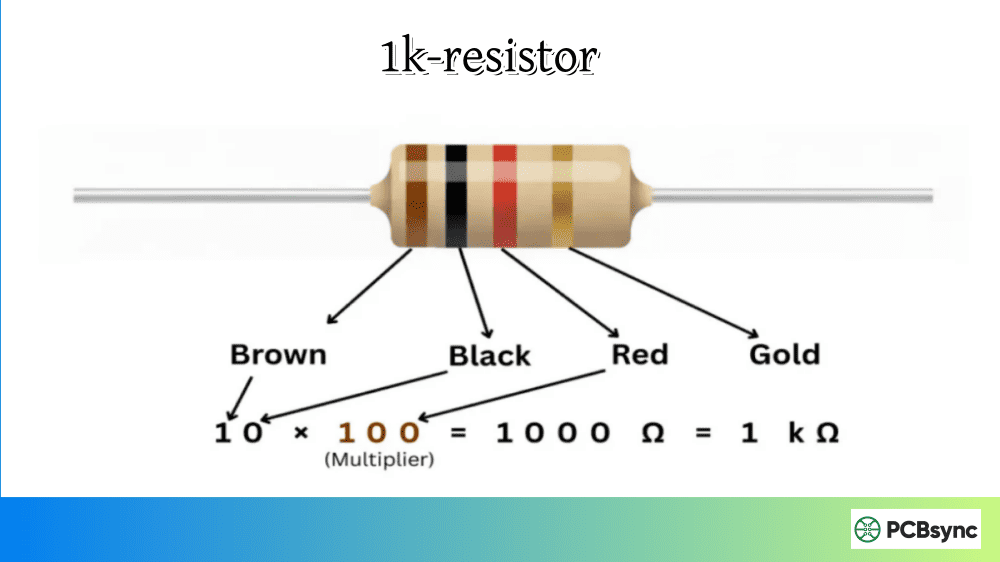
Reading color codes on through-hole resistors becomes automatic after you’ve identified a few hundred, but let me break down exactly what you’re looking at with a 50 ohm resistor.
4-Band 50 Ohm Resistor
Band Position
Color
Meaning
Value
1st Band
Green
First Digit
5
2nd Band
Black
Second Digit
0
3rd Band
Black
Multiplier
×1
4th Band
Gold
Tolerance
±5%
The classic color sequence is Green-Black-Black-Gold. First two bands give you “50,” the black multiplier means multiply by 1 (so it stays 50), and gold indicates ±5% tolerance. That means your resistor could measure anywhere from 47.5Ω to 52.5Ω and still be within spec.
For RF work, that ±5% tolerance is often acceptable for terminations and non-critical matching, but precision circuits demand tighter specs.
5-Band 50 Ohm Resistor
Band Position
Color
Meaning
Value
1st Band
Green
First Digit
5
2nd Band
Black
Second Digit
0
3rd Band
Black
Third Digit
0
4th Band
Gold
Multiplier
×0.1
5th Band
Brown
Tolerance
±1%
The 5-band version (Green-Black-Black-Gold-Brown) provides ±1% tolerance, giving you 49.5Ω to 50.5Ω. This tighter spec matters in RF matching networks, precision attenuators, and measurement equipment where every tenth of an ohm affects your VSWR.
6-Band Precision 50 Ohm Resistor
Band Position
Color
Meaning
Value
1st Band
Green
First Digit
5
2nd Band
Black
Second Digit
0
3rd Band
Black
Third Digit
0
4th Band
Gold
Multiplier
×0.1
5th Band
Brown
Tolerance
±1%
6th Band
Red
Temp Coefficient
50 ppm/°C
For high-reliability RF applications, 6-band resistors add temperature coefficient information. The red band indicating 50 ppm/°C means the resistance changes by 50 parts per million for each degree Celsius of temperature change. Over a 100°C temperature swing, your 50Ω resistor might drift by only ±0.25Ω—critical for equipment operating from Arctic to desert conditions.
Critical RF Specifications for 50 Ohm Resistors
Power Rating and RF Derating
Standard power ratings tell only part of the story for RF applications. At high frequencies, skin effect and parasitic reactance change how resistors behave.
Power Rating
DC/Low Freq Current
RF Derating Factor
Typical Package
1/8W
50mA
60-70%
0603 SMD
1/4W
71mA
60-70%
0805 SMD
1/2W
100mA
60-70%
Through-hole
1W
141mA
60-70%
Through-hole
2W
200mA
70-80%
Through-hole
5W+
316mA+
80-90%
Wirewound/Ceramic
Here’s the critical point: at RF frequencies (especially above 100 MHz), you need to derate power handling by 30-40% compared to DC ratings. I once saw a 1W resistor in a 500 MHz transmitter literally smoke because the designer calculated power dissipation assuming DC conditions. At those frequencies, use 2W or even 5W resistors for reliable operation.
Frequency Response and Parasitic Elements
Every resistor has parasitic capacitance and inductance. For DC circuits, who cares? For RF circuits operating at hundreds of MHz or GHz, these parasitics destroy performance.
Resistor Type
Usable Frequency
Parasitic C
Parasitic L
Best For
Carbon Film
DC – 100 MHz
~0.5 pF
~10 nH
General purpose
Metal Film
DC – 500 MHz
~0.3 pF
~5 nH
Precision RF
Wirewound
DC – 50 MHz
~2 pF
~50 nH
High power only
Thick Film SMD
DC – 6 GHz
~0.1 pF
~1 nH
Modern RF/microwave
Thin Film SMD
DC – 10 GHz
~0.05 pF
<1 nH
High-performance RF
For most RF work up to 2.4 GHz (WiFi, Bluetooth), standard thick film SMD resistors work fine. Push into 5G frequencies (3.5 GHz and up), and you need thin film precision types. And never, ever use wirewound resistors for RF matching—the inductance kills you above 50 MHz.
Essential RF Applications
Transmission Line Termination
This is the bread-and-butter application. When you have a 50Ω coaxial cable or microstrip transmission line, you terminate it with a 50 ohm resistor to prevent signal reflections.
Without proper termination, signals bounce back from the open end, creating standing waves that cause:
Signal nulls and peaks along the line
Increased insertion loss
Potential oscillation in amplifiers
Distorted waveforms
EMI radiation from unterminated stubs
Place a 50Ω resistor at the end of any unterminated RF transmission line. The resistor absorbs the signal energy, converting it to heat instead of reflecting it back. For BNC test equipment, feed-through terminators with built-in 50Ω resistors are standard lab equipment.
Real-world example: In my last PCB design for a cellular IoT module, we had a 15mm unused stub on the antenna feed line. Without a 50Ω termination, we saw -8dB additional loss at 1800 MHz from reflections. Added a 0402 size 50Ω resistor to ground at the stub end, and the loss dropped to less than -0.5dB.
RF Attenuators and Pads
Attenuator networks use 50 ohm resistors in specific configurations to reduce signal levels while maintaining impedance matching. The most common topologies are Pi and T networks.
3dB T-Attenuator (50Ω system):
Series resistors: 8.55Ω each
Shunt resistor: 292Ω
6dB T-Attenuator (50Ω system):
Series resistors: 16.6Ω each
Shunt resistor: 151Ω
10dB T-Attenuator (50Ω system):
Series resistors: 26.0Ω each
Shunt resistor: 96.2Ω
These aren’t precisely 50Ω resistors, but they’re calculated to present 50Ω input and output impedance. I keep a collection of pre-built attenuator circuits on my bench for quick signal level adjustments during testing.
Impedance Matching Networks
Matching a non-50Ω device (like an antenna or amplifier) to a 50Ω system often requires networks that include 50 ohm resistors. While reactive matching (using only capacitors and inductors) is lossless, sometimes you need resistive matching for:
Broadband operation (reactive matching is narrow-band)
Stabilizing potentially unstable amplifiers
Reducing VSWR when perfect matching isn’t possible
A simple resistive match from a high-impedance source to 50Ω might use a voltage divider or L-pad configuration.
Test Equipment Calibration
Signal generators, network analyzers, and spectrum analyzers all assume 50Ω at their ports. When performing measurements:
Use precision 50Ω loads for calibration
Terminate unused ports with 50Ω
Match your device-under-test to 50Ω
I keep several precision (±1%) 50 ohm resistors specifically for calibrating my test bench. These never get used in circuits—they’re reference standards only.
RF Power Measurement and Dummy Loads
High-power 50 ohm resistors (5W to 100W or more) serve as dummy loads for testing transmitters without radiating RF energy. These specialized resistors:
Include heatsinks for thermal management
Use non-inductive construction for minimal reactance
Maintain 50Ω impedance across wide frequency ranges
Feature VSWR better than 1.2:1 up to several GHz
I use a 50W dummy load when testing WiFi modules at maximum output power. It absorbs all the RF energy safely while I measure harmonic content and output power with a spectrum analyzer.
Selecting the Right 50 Ohm Resistor for Your RF Design
Through-Hole vs Surface Mount
Through-hole applications:
Lab test equipment
Prototyping
High power (>2W)
Easy rework and troubleshooting
SMD applications:
Production PCBs
High-density designs
Frequencies above 1 GHz (shorter leads = less inductance)
Automated assembly
For most modern RF work, I use 0402 or 0603 SMD resistors. They’re small enough to minimize parasitic effects but large enough to hand-solder if needed. For power handling above 1W, through-hole or larger SMD packages (1206, 2512) are required.
Material Selection for RF
Material
Max Frequency
Noise
Temperature Stability
Cost
RF Suitability
Carbon Film
100 MHz
High
Poor
$
Avoid for RF
Metal Film
500 MHz
Low
Good
$$
Good for <500 MHz
Thick Film (SMD)
6 GHz
Low
Good
$
Best general choice
Thin Film (SMD)
10+ GHz
Very Low
Excellent
$$$
Premium RF/microwave
Wirewound
50 MHz
Low
Excellent
$$
Power only, not RF matching
For a typical WiFi or Bluetooth design operating at 2.4 GHz, standard thick film SMD resistors from reputable manufacturers (Yageo, Vishay, Panasonic) work perfectly and cost just a few cents each.
Tolerance Requirements by Application
Application
Recommended Tolerance
Why
Termination loads
±5%
VSWR < 1.5:1 acceptable
Attenuator networks
±1%
Maintains attenuation accuracy
Impedance matching
±1%
Minimizes reflection coefficient
Test equipment reference
±0.5% or better
Calibration accuracy
Power measurement loads
±1%
Accurate power calculation
Don’t over-specify tolerance—it costs money. For non-critical terminations where VSWR of 1.5:1 is acceptable, ±5% works fine and costs 1/3 as much as ±1% parts.
I’ve seen designs where someone substituted 47Ω or 51Ω resistors (both E12 series standard values) because 50Ω wasn’t in stock. Here’s why that fails:
A 47Ω termination in a 50Ω system creates VSWR = 1.13:1, or about 0.5% reflection coefficient. That might sound negligible, but in a multi-stage system, those reflections add up. Plus, you’ve completely invalidated any measurements referenced to 50Ω.
Use 50.0Ω resistors for RF work. Not 49.9Ω, not 51.1Ω—actual 50Ω within tolerance.
Power Dissipation Miscalculation
Remember that reflected power adds to dissipation. If your amplifier outputs 1W into a poorly matched load, the resistor might see more than 1W due to standing waves. Always include margin—I use 2x calculated dissipation as minimum resistor rating.
Lead Length at High Frequency
A 10mm through-hole resistor lead has about 10 nH of inductance. At 1 GHz, that’s 63Ω of inductive reactance—completely swamping your 50Ω resistance. Keep leads short, or better yet, use SMD at frequencies above 100 MHz.
Practical Design Examples
WiFi Module Matching Network
Scenario: Matching a chip antenna (42Ω) to a 50Ω feed line at 2.4 GHz
Solution: Series 8Ω resistor creates resistive pad, but wastes power. Better approach: Use reactive L-match with 50Ω resistor only for DC bias or protective termination. The resistor goes in shunt to ground after the matching network to improve return loss bandwidth.
5G RF Front-End
Scenario: Multiple unused antenna ports on a beamforming array
Solution: Terminate each unused port with precision 0402 thin-film 50 ohm resistors (±1%, 1/16W). Place resistor as close as physically possible to the port—within 1mm. At 3.5 GHz, even PCB trace length matters.
Useful Resources and Tools
I rely on these resources constantly in RF design work:
MIL-PRF-55342: Military specification for precision resistors
Frequently Asked Questions
Why not 75 ohms instead of 50 ohms for RF systems?
Both standards exist, but serve different markets. 75Ω dominates video, cable TV, and terrestrial broadcast because it’s closer to the 73Ω impedance of a dipole antenna and offers slightly lower loss. The 50Ω standard won in data communications, cellular, WiFi, and most RF test equipment because it better balances power handling and loss. You pick whichever standard matches your application—but you can’t mix them without matching networks.
Can I use standard metal film resistors for RF termination?
For frequencies below 100 MHz, yes—standard 1% metal film through-hole resistors work fine. Above 100 MHz, parasitic inductance from leads becomes problematic. Switch to SMD resistors. Above 1 GHz, use RF-rated thick or thin film SMD types specifically designed for high frequency. The extra cost (often just pennies) buys you predictable impedance and lower parasitics.
What happens if I terminate with 49.9Ω instead of exactly 50Ω?
Realistically, 49.9Ω is within tolerance of most “50Ω” resistors anyway (±1% tolerance means 49.5-50.5Ω). The VSWR would be 1.002:1—essentially perfect. The real question is whether your resistor maintains that 49.9Ω across temperature and frequency. A precision resistor marked 49.9Ω at DC might drift at 2.4 GHz. For RF work, buy resistors specified for RF applications with guaranteed impedance across your frequency range.
How do I measure if my 50 ohm resistor is actually 50Ω at RF?
A standard DMM only measures DC resistance. For true RF impedance, you need a vector network analyzer (VNA). Connect the resistor to a test fixture with calibrated reference plane, measure S11 (reflection coefficient), and the VNA displays impedance directly. Without a VNA (they cost $1,000 to $100,000+), you can approximate by measuring VSWR with a directional coupler and power meter. But for production work, buy resistors from reputable manufacturers with test data—they’ve already measured them.
Should I use parallel resistors to create exactly 50Ω if I don’t have the right value?
Generally no, especially at RF. Paralleling resistors adds parasitic capacitance at the junction point. If you need 50.0Ω and only have 100Ω resistors, yes, you could parallel two of them—but the parasitic capacitance might resonate at your operating frequency. Better solution: Order proper 50Ω resistors. They’re standard, cheap, and available everywhere. The time you waste trying to parallel resistors costs more than buying the right part.
Conclusion: The 50 Ohm Foundation of Modern RF
After two decades working with RF systems from HF to millimeter-wave, I still marvel that this simple 50 ohm standard enables the entire wireless infrastructure we depend on. Your smartphone communicates with cell towers, WiFi routers connect to the internet, and GPS receivers lock to satellites—all because engineers worldwide agree on 50Ω as the reference impedance.
The 50 ohm resistor seems humble, perhaps even trivial. But choose the wrong value, ignore frequency effects, or misapply power ratings, and your RF design fails. I’ve debugged countless “mystery” RF failures that traced back to improper resistor selection—wrong tolerance, inadequate power rating, excessive parasitic reactance, or simply using 47Ω because “it’s close enough.”
Master the 50 ohm resistor—understand color codes, respect power ratings, consider frequency effects, and select appropriate materials—and you’ve mastered a fundamental building block of RF engineering. Get it wrong, and you’re debugging signal integrity issues at 2 AM before a production deadline.
Trust me, I’ve been there. Do it right the first time.
Inquire: Call 0086-755-23203480, or reach out via the form below/your sales contact to discuss our design, manufacturing, and assembly capabilities.
Quote: Email your PCB files to Sales@pcbsync.com (Preferred for large files) or submit online. We will contact you promptly. Please ensure your email is correct.
Notes: For PCB fabrication, we require PCB design file in Gerber RS-274X format (most preferred), *.PCB/DDB (Protel, inform your program version) format or *.BRD (Eagle) format. For PCB assembly, we require PCB design file in above mentioned format, drilling file and BOM. Click to download BOM template To avoid file missing, please include all files into one folder and compress it into .zip or .rar format.