Inquire: Call 0086-755-23203480, or reach out via the form below/your sales contact to discuss our design, manufacturing, and assembly capabilities.
Quote: Email your PCB files to Sales@pcbsync.com (Preferred for large files) or submit online. We will contact you promptly. Please ensure your email is correct.
Notes: For PCB fabrication, we require PCB design file in Gerber RS-274X format (most preferred), *.PCB/DDB (Protel, inform your program version) format or *.BRD (Eagle) format. For PCB assembly, we require PCB design file in above mentioned format, drilling file and BOM. Click to download BOM template To avoid file missing, please include all files into one folder and compress it into .zip or .rar format.
22K Resistor: Color Code & Applications – A PCB Engineer’s Guide
When you’re knee-deep in a board design at 2 AM debugging why your microcontroller input won’t stabilize, that little 22k resistor becomes your best friend. I’ve been designing PCBs for over a decade, and the 22k ohm resistor (or 22kΩ) remains one of those “just right” components that shows up in almost every project. Let me share what actually matters when you’re working with these components in real-world designs.
A 22k resistor provides 22,000 ohms of resistance. In practical terms, this value sits in a sweet spot for digital circuits – high enough to minimize current draw but low enough to ensure reliable signal levels. When you’re choosing between standard E12 or E24 series values, 22k appears frequently because it’s part of the E12 series, making it readily available and cost-effective.
Think of it this way: at 5V, a 22k resistor only draws about 0.23mA, which is exactly what you want for pull-up applications without wasting your power budget.
Decoding the 22K Ohm Resistor Color Code
Reading resistor color codes becomes second nature after you’ve populated a few boards, but let me break down what you’ll actually see on a 22k ohm resistor in your parts bin.
4-Band Color Code (Most Common)
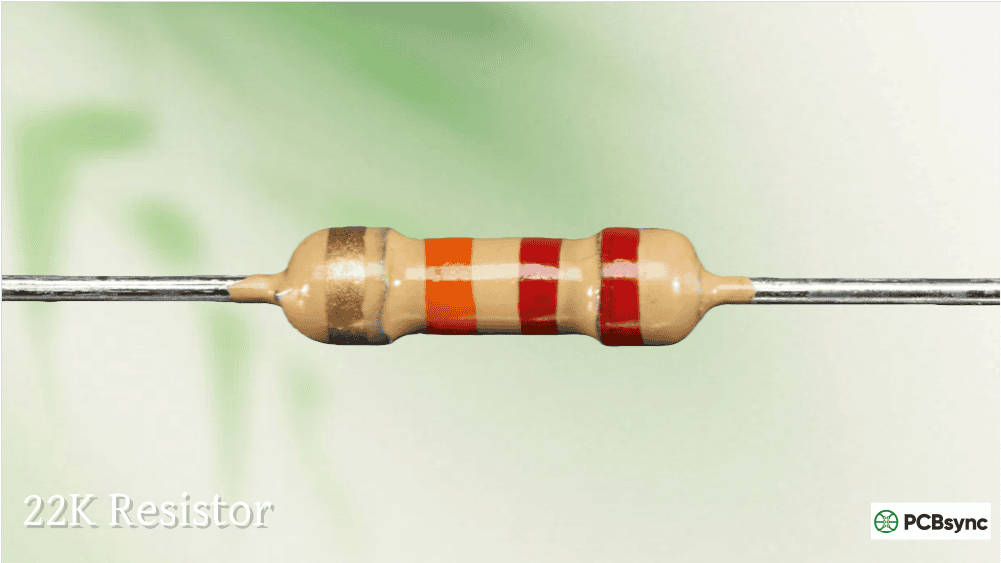
The standard 4-band 22k resistor shows:
Band Position
Color
Meaning
Value
1st Band
Red
First Digit
2
2nd Band
Red
Second Digit
2
3rd Band
Orange
Multiplier
× 1,000
4th Band
Gold
Tolerance
±5%
Calculation: 22 × 1,000 = 22,000Ω (22kΩ)
With ±5% tolerance, your actual resistance will measure between 20.9kΩ and 23.1kΩ – perfectly acceptable for most applications.
5-Band Color Code (Precision Resistors)
When you need tighter tolerances for sensitive analog circuits:
Band Position
Color
Meaning
Value
1st Band
Red
First Digit
2
2nd Band
Red
Second Digit
2
3rd Band
Black
Third Digit
0
4th Band
Red
Multiplier
× 100
5th Band
Gold/Brown
Tolerance
±5% / ±1%
Calculation: 220 × 100 = 22,000Ω (22kΩ)
The brown tolerance band (±1%) gives you a tighter range: 21.78kΩ to 22.22kΩ. I typically spec these for precision voltage dividers or audio applications where matching matters.
Quick Visual Identification Tips
From the component reel, I can spot a 22k resistor immediately: Red-Red-Orange is distinctive. The tolerance band (gold or brown) tells me if I’ve grabbed my precision stock or general-purpose parts.
For 3-band resistors (±20% tolerance), you’ll just see Red-Red-Orange with no tolerance band – avoid these for anything except basic current limiting where precision doesn’t matter.
Real-World Applications for the 22K Resistor
Here’s where theory meets the soldering iron. After hundreds of board designs, these are the applications where I reach for a 22k resistor without thinking twice.
Digital Logic Pull-Up and Pull-Down Resistors
This is hands-down the most common use. When designing microcontroller circuits, floating inputs are your enemy. A 22k resistor connected between your GPIO pin and VCC (pull-up) or GND (pull-down) ensures defined logic levels.
Why 22k specifically?
CMOS inputs have high impedance (typically 100kΩ to 1MΩ)
22k is roughly 1/10th of that impedance – perfect per design rules
Low current draw: ~0.23mA at 5V, ~0.15mA at 3.3V
Fast enough switching for most button debouncing applications
I’ve found 22k works particularly well for:
Reset button circuits
Configuration jumpers
I2C bus pull-ups (though sometimes I go lower to 4.7k for faster speeds)
Mode selection switches
Practical consideration: For high-frequency applications or fast I2C (400kHz+), 22k might be too high due to RC time constants. Drop to 4.7k or 10k if you’re seeing signal integrity issues.
Op-Amp Feedback Networks
In analog designs, 22k resistors frequently appear in operational amplifier feedback configurations. The value provides reasonable gain ranges without excessive Johnson noise (thermal noise generated by resistors).
For a non-inverting amplifier:
Feedback resistor: 22kΩ
Input resistor: 2.2kΩ
Gain = 1 + (22k/2.2k) = 11x
This configuration draws minimal bias current while maintaining good noise performance. I’ve used this exact setup in sensor conditioning circuits countless times.
Voltage Divider Circuits
When you need to scale down a voltage for ADC measurement or reference generation, 22k makes an excellent choice because:
High enough resistance to minimize loading effects
Low enough for stable voltage division
Doesn’t cause significant voltage droop
Example: Measuring a 12V battery with a 3.3V ADC
Component
Value
R1 (high side)
22kΩ
R2 (low side)
8.2kΩ
Output Voltage
~3.26V (from 12V input)
Total current draw: 12V / 30.2kΩ = 0.4mA – negligible for battery monitoring.
LED Current Limiting (With Caution)
While not the typical application, 22k resistors can work for ultra-low-power LED indicators:
5V supply with red LED (Vf ~2V): I = (5V – 2V) / 22kΩ = 0.14mA
Good for always-on power indicators
LED will be dim but visible
For standard LED brightness, you’d normally use much lower values (220Ω – 1kΩ).
Bias Resistors for Transistors
In switching circuits, 22k resistors work well as base resistors for bipolar transistor switches, especially when driving from microcontroller outputs. The high value limits base current while still providing sufficient drive for saturation.
Specifications That Actually Matter
When selecting 22k resistors for production, here’s what I check on the datasheet:
Power Rating
Rating
Typical Package
Use Case
1/8W (0.125W)
0805 SMD
Signal applications, pull-ups
1/4W (0.25W)
Through-hole
General purpose, standard boards
1/2W (0.5W)
Larger through-hole
Higher voltage dividers
Power calculation example: At 5V across a 22k resistor: P = V²/R = 25/22000 = 0.0011W (1.1mW)
A 1/8W resistor handles this with massive headroom. You’d need 236V across the resistor to reach 1/4W dissipation.
Tolerance Choices
Tolerance
Color Band
When to Use
±20%
None
Never – costs the same as ±5% now
±5%
Gold
General digital circuits, pull-ups
±1%
Brown
Precision analog, matched pairs
±0.1%
Violet
Instrumentation, critical measurements
Pro tip: ±1% resistors cost maybe 0.2 cents more than ±5% in volume. For critical designs, just specify ±1% as your standard – it’s worth it.
Temperature Coefficient
Expressed in ppm/°C (parts per million per degree Celsius):
Carbon film: 200-500 ppm/°C (budget choice)
Metal film: 25-100 ppm/°C (my standard choice)
Thin film: <25 ppm/°C (for precision work)
For a 22k metal film resistor at 50 ppm/°C over a 50°C temperature swing: Resistance change = 22000Ω × 50ppm × 50°C = 55Ω (0.25% shift)
SMD vs. Through-Hole: Practical Selection
SMD Package Options
For surface mount designs, I typically use:
Package
Dimensions
Power
Typical Use
0402
1.0×0.5mm
1/16W
Space-critical, pick-and-place
0603
1.6×0.8mm
1/10W
Hand-soldering minimum
0805
2.0×1.25mm
1/8W
My standard choice
1206
3.2×1.6mm
1/4W
Easy hand work, higher power
Hand assembly reality: I can reliably hand-solder 0603, but 0805 is far more forgiving. For prototype boards, I spec 0805 even if space isn’t tight. Production can always optimize down.
Through-Hole Options
Axial lead resistors (the classic “little cylinders”) remain excellent for:
Breadboard prototyping
High-reliability applications
Easy field repairs
Educational projects
Standard 1/4W through-hole 22k resistors cost about 1 cent in volume and are bulletproof.
Common Mistakes to Avoid
After reviewing hundreds of board designs, here are the issues I see repeatedly:
1. Wrong power rating for high-voltage dividers If you’re dividing 48V down, calculate actual power dissipation. That 22k resistor might be seeing P = V²/R that exceeds 1/4W.
2. Ignoring parasitic capacitance Long PCB traces to pull-up resistors add capacitance. At high frequencies, your 22k resistor plus 20pF trace capacitance creates RC time constant issues.
3. Using 22k for fast I2C applications I2C standard-mode (100kHz) works fine with 22k pull-ups. Fast-mode (400kHz) and Fast-mode Plus (1MHz) need 4.7k or lower, or you’ll see slow rise times and bit errors.
4. Placing resistors too close to heat sources Metal film resistors have good temperature specs, but placing them next to power MOSFETs or voltage regulators still causes drift.
Always download and archive datasheets for production designs. Manufacturers change specifications, and that datasheet might not exist in 5 years when you need to troubleshoot a field return.
For 22k resistors, look for these manufacturers:
Yageo (excellent SMD, very common)
KOA Speer (quality metal film)
Vishay (premium precision)
Panasonic (automotive-grade when needed)
PCB Design Libraries
I maintain a personal KiCAD library with verified footprints for common resistor packages. Time spent organizing your libraries pays back tenfold when you’re rushing to meet a prototype deadline.
Before releasing a design for production, verify your 22k resistor selections:
1. Measure actual resistance: Use a quality DMM set to the 20kΩ or 200kΩ range. Your $200 Fluke will show you if that “22k” resistor is actually in spec.
2. Check voltage drops in-circuit: After board assembly, measure the actual voltage at critical nodes. I’ve found 22k pull-ups that worked fine on the bench but caused intermittent issues in production due to higher-than-expected leakage currents.
3. Temperature testing: For commercial products, I always do a thermal chamber test. Watching your circuit behavior from -20°C to +70°C reveals resistor tolerance and temperature coefficient issues you’d never catch at room temperature.
4. EMC considerations: High-resistance pull-ups can act as antennas. If you’re failing EMI testing, adding a small capacitor (10-100pF) across critical 22k resistors often helps.
Frequently Asked Questions
What’s the difference between a 22k and 22.1k resistor?
In the E12 series (used for ±5% tolerance), 22k is a standard value. The E96 series (±1% tolerance) includes 22.1k as a separate standard value. For most digital applications, they’re interchangeable. For precision analog work where you’re matching ratios, stick to exact specified values.
Can I parallel two resistors to get 22k?
Absolutely. Two 44k resistors in parallel give you 22k. This is common when you don’t have the exact value in stock or need higher power handling. The formula: R_total = (R1 × R2)/(R1 + R2). Series resistance also works – two 11k resistors in series equal 22k.
Why does my multimeter show 21.8k on a 22k resistor?
That’s within spec if it’s a ±5% resistor. Also, cheaper multimeters have their own tolerance (typically ±0.5% to ±2%). A quality Fluke 87V reads my calibrated 22k reference resistor at 22.003kΩ. If you’re seeing 19k on a supposedly 22k resistor, that part is out of spec or damaged.
When should I use metal film vs. carbon film 22k resistors?
Metal film is my default choice for everything now – costs have dropped to near parity with carbon film. Metal film offers better temperature stability (50-100 ppm/°C vs. 200-500 ppm/°C), lower noise, and tighter tolerances. Carbon film only makes sense for ultra-low-cost consumer products where specs don’t matter much.
What happens if I use a 20k instead of 22k for a pull-up resistor?
For digital pull-ups, you probably won’t notice any difference. The slightly lower resistance means 10% more current draw and slightly faster rise times. Both are negligible in typical applications. However, don’t substitute randomly in precision analog circuits – those values were calculated for specific gain ratios or time constants.
Final Thoughts from the Workbench
The 22k ohm resistor exemplifies the kind of component where understanding beats memorization. You can read color bands all day, but knowing when to use 22k versus 10k or 47k separates PCB designers who ship reliable products from those who are constantly debugging field issues.
In my experience, the key is thinking about the system: What’s the input impedance? What’s my power budget? What are the environmental conditions? A 22k resistor isn’t just a component – it’s a design decision with consequences for signal integrity, power consumption, and reliability.
Keep a variety pack of through-hole 22k resistors in your lab drawer (both ±5% and ±1%), maintain good stock of 0805 SMD packages for production, and you’ll be equipped for 90% of situations where you need this value. The other 10% of the time, you’ll need to calculate carefully – and now you know how.
Inquire: Call 0086-755-23203480, or reach out via the form below/your sales contact to discuss our design, manufacturing, and assembly capabilities.
Quote: Email your PCB files to Sales@pcbsync.com (Preferred for large files) or submit online. We will contact you promptly. Please ensure your email is correct.
Notes: For PCB fabrication, we require PCB design file in Gerber RS-274X format (most preferred), *.PCB/DDB (Protel, inform your program version) format or *.BRD (Eagle) format. For PCB assembly, we require PCB design file in above mentioned format, drilling file and BOM. Click to download BOM template To avoid file missing, please include all files into one folder and compress it into .zip or .rar format.