Inquire: Call 0086-755-23203480, or reach out via the form below/your sales contact to discuss our design, manufacturing, and assembly capabilities.
Quote: Email your PCB files to Sales@pcbsync.com (Preferred for large files) or submit online. We will contact you promptly. Please ensure your email is correct.
Notes: For PCB fabrication, we require PCB design file in Gerber RS-274X format (most preferred), *.PCB/DDB (Protel, inform your program version) format or *.BRD (Eagle) format. For PCB assembly, we require PCB design file in above mentioned format, drilling file and BOM. Click to download BOM template To avoid file missing, please include all files into one folder and compress it into .zip or .rar format.
5 Ohm Resistor: Color Code & Power Applications Guide
Working on power electronics and audio circuits, I’ve found the 5 ohm resistor shows up more often than you’d expect. It’s not your typical signal-level component. This is a power resistor value, commonly found in dummy loads, amplifier testing setups, and current limiting applications where you need to dissipate real watts without generating excessive voltage drops.
This guide covers the 5 ohm resistor color code for accurate identification, power rating selection, and the real-world applications where this specific value earns its keep on the test bench.
A 5 ohm resistor provides exactly 5 ohms of electrical resistance. This relatively low value places it firmly in power electronics territory. At 5Ω, the component passes significant current at modest voltages, making power dissipation the primary design concern.
One important detail engineers should know: 5 ohm is not part of the standard E24 resistor series, which includes nearby values like 4.7Ω and 5.1Ω. However, 5.0Ω appears in the E48 and E96 precision series, and manufacturers produce it widely due to its practical utility in power applications. You’ll find 5 ohm resistors readily available from all major distributors.
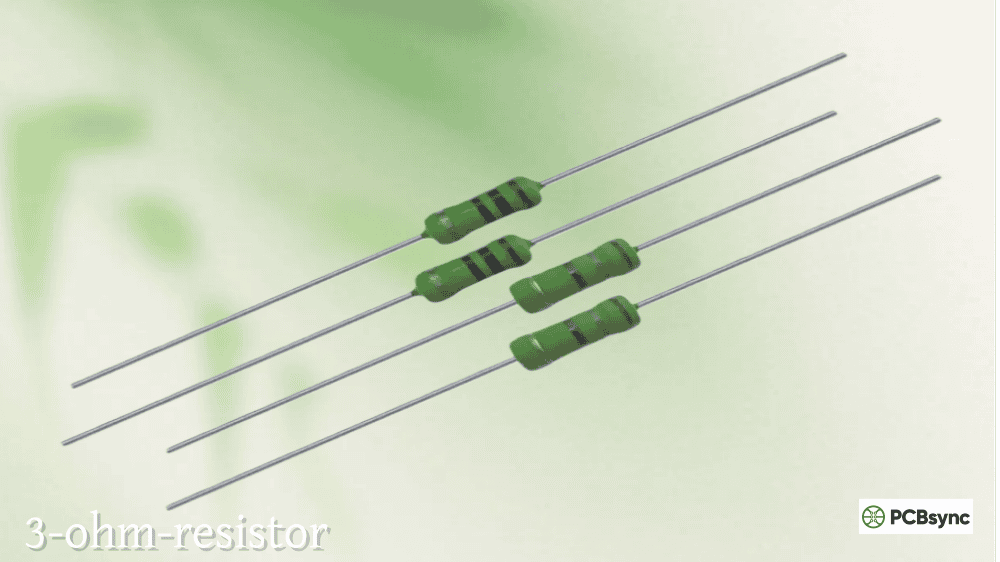
Identifying the 5 ohm resistor color code requires understanding that values under 10 ohms use the Gold multiplier band (×0.1). The Green first band is your key identifier for any resistor starting with the digit 5.
4-Band 5 Ohm Resistor Color Code
The standard 4-band configuration uses:
Band Position
Color
Meaning
1st Band (First Digit)
Green
5
2nd Band (Second Digit)
Black
0
3rd Band (Multiplier)
Gold
×0.1
4th Band (Tolerance)
Gold
±5%
Calculation: 5 + 0 = 50 × 0.1 = 5Ω ±5%
The Green-Black-Gold-Gold sequence is distinctive. Both Gold bands serve different functions: the third band multiplies by 0.1, while the fourth indicates ±5% tolerance.
5-Band 5 Ohm Resistor Color Code (Precision)
For precision applications, 5-band resistors add a third significant digit:
Band Position
Color
Meaning
1st Band
Green
5
2nd Band
Black
0
3rd Band
Black
0
4th Band (Multiplier)
Silver
×0.01
5th Band (Tolerance)
Brown
±1%
Calculation: 5 + 0 + 0 = 500 × 0.01 = 5Ω ±1%
6-Band 5 Ohm Resistor Color Code
For temperature-critical power applications:
Band
Color Sequence
Meaning
Bands 1-5
Green-Black-Black-Silver-Gold
5Ω ±5%
6th Band (TCR)
Black
250 ppm/K
Multiplier Reference for Low-Ohm Values
Multiplier Color
Value
Example Result
Black
×1
50 × 1 = 50Ω
Gold
×0.1
50 × 0.1 = 5Ω
Silver
×0.01
500 × 0.01 = 5Ω
Complete Color Code Reference Chart
Color
Digit Value
Multiplier
Tolerance
Black
0
×1
–
Brown
1
×10
±1%
Red
2
×100
±2%
Orange
3
×1,000
–
Yellow
4
×10,000
–
Green
5
×100,000
±0.5%
Blue
6
×1,000,000
±0.25%
Violet
7
–
±0.1%
Gray
8
–
±0.05%
White
9
–
–
Gold
–
×0.1
±5%
Silver
–
×0.01
±10%
Types of 5 Ohm Power Resistors
Selecting the right 5 ohm resistor type depends heavily on your power requirements and whether inductance matters for your application.
Wirewound 5 Ohm Resistors
Best for: High-power dissipation, dummy loads, DC applications
Specification
Typical Value
Power Rating
5W to 500W+
Tolerance
±1% to ±5%
TCR
20-80 ppm/°C
Inductance
Present (not suitable for RF)
Wirewound resistors handle the most power per dollar. The trade-off is inductance from the wound wire element, which matters at higher frequencies. For audio testing and DC applications, wirewound is often the economical choice.
Non-Inductive 5 Ohm Resistors
Best for: RF dummy loads, audio amplifier testing, high-frequency applications
Specification
Typical Value
Power Rating
10W to 250W
Tolerance
±1% to ±5%
Construction
Carbon composition, thick film, or bifilar wound
Frequency Range
DC to 3 GHz (depending on construction)
Non-inductive resistors maintain flat impedance across frequency, critical for accurate amplifier measurements and RF applications.
Aluminum-Clad (Chassis Mount) Resistors
Best for: High-power applications requiring heatsinking
Specification
Typical Value
Power Rating
25W to 100W+ (with heatsink)
Mounting
TO-247, TO-220, or bolt-down
Thermal Resistance
1-3°C/W (to heatsink)
Aluminum-clad resistors transfer heat efficiently to external heatsinks. The rated wattage typically assumes proper thermal management.
SMD Power Resistors
For PCB-mounted power applications:
Package Size
Power Rating
Max Current (5Ω)
1206
1/4W
224mA
2010
3/4W
387mA
2512
1W
447mA
2725
2W
632mA
Custom
5W+
1A+
Power Applications for 5 Ohm Resistors
Dummy Loads for Amplifier Testing
The most common application for a 5 ohm resistor in my workshop is amplifier dummy loads. When testing audio amplifiers, you need a resistive load that simulates speaker impedance without producing sound.
A 5Ω load works well for testing amplifiers designed for 4Ω speakers (providing a conservative margin) or creating combination loads. Many engineers build configurable dummy loads using 5Ω resistors:
Configuration
Total Resistance
Power Capacity
Single 5Ω
5Ω
Resistor rating
Two 5Ω in series
10Ω
Sum of ratings
Two 5Ω in parallel
2.5Ω
Sum of ratings
5Ω + 3Ω in series
8Ω
Limited by lower rating
Power Supply Load Testing
Testing power supply regulation requires known load resistors. A 5Ω resistor draws predictable currents:
Supply Voltage
Current Draw
Power Dissipated
5V
1A
5W
12V
2.4A
28.8W
24V
4.8A
115.2W
48V
9.6A
460.8W
These calculations show why power rating selection is critical. A 12V/5Ω test already requires a 50W minimum resistor with proper derating.
Speaker Impedance Matching
Adding a 5 ohm resistor in series with a speaker increases total impedance. This technique matches lower-impedance speakers to amplifiers requiring higher loads:
Speaker Impedance
With 5Ω Series
New Total
3Ω
+ 5Ω
8Ω
4Ω
+ 5Ω
9Ω
8Ω
+ 5Ω
13Ω
Note that series resistance reduces power delivered to the speaker and may affect frequency response.
Current Limiting Applications
Low-value resistors like 5Ω serve as current limiters in charging circuits, motor soft-start applications, and inrush current protection:
Power Dissipation Calculations for 5 Ohm Resistors
Proper power rating selection prevents resistor failure and potential fire hazards.
Power Calculation Formulas
For a 5Ω resistor:
P = I² × R simplifies to P = I² × 5
P = V²/R simplifies to P = V²/5
Power Requirements by Current Level
Current
Power Dissipated
Minimum Rating (2× safety)
100mA
0.05W
1/4W
500mA
1.25W
3W
1A
5W
10W
2A
20W
50W
5A
125W
250W
10A
500W
1000W
Always apply at least a 2× derating factor for continuous operation. For intermittent duty, you can sometimes operate closer to rated power with adequate cooling.
Thermal Considerations
Cooling Method
Typical Power Increase
Free air
Baseline rating
Forced air (fan)
1.5-2× rating
Heatsink mounting
2-4× rating
Oil immersion
3-5× rating
Water cooling
5-10× rating
Many DIY dummy load builders use oil immersion (transformer oil or mineral oil) to dramatically increase power handling of inexpensive resistors.
A 4-band 5 ohm resistor uses the color code Green-Black-Gold-Gold. Green represents 5, Black represents 0, the first Gold band is the ×0.1 multiplier, and the second Gold indicates ±5% tolerance. For precision 5-band versions with ±1% tolerance, the code is Green-Black-Black-Silver-Brown.
Is 5 ohm a standard resistor value?
While 5 ohm is not in the basic E24 series (which includes 4.7Ω and 5.1Ω), it appears in the E48 and E96 precision series. More importantly, manufacturers produce 5Ω power resistors widely because of practical demand for dummy loads and testing applications. You’ll have no trouble sourcing this value.
What power rating do I need for a 5 ohm resistor?
Calculate power using P = I² × 5 or P = V²/5. For 1A current through 5Ω, power is 5W. Always apply at least a 2× safety factor, so use a 10W minimum resistor. For 2A, power is 20W, requiring at least a 50W resistor. Include thermal management (heatsinking or airflow) for sustained high-power operation.
Can I use a 5 ohm resistor as a speaker dummy load?
Yes, a 5 ohm resistor works well as a dummy load for amplifier testing. It’s close enough to standard 4Ω or 8Ω speaker impedances for most testing purposes. For audio applications, use non-inductive types (not wirewound) to maintain flat frequency response. Ensure adequate power handling, as even a 100W amplifier can destroy an undersized resistor instantly.
Why does my 5 ohm resistor get hot during use?
Heat is the natural byproduct of power dissipation in resistors. At 5Ω, even moderate currents generate significant heat: 2A produces 20W of heat continuously. If your resistor is too hot to touch, it may be undersized for the application. Either increase the resistor’s power rating, add heatsinking, improve airflow, or reduce the current/duty cycle.
Summary
The 5 ohm resistor is a workhorse component in power electronics and testing applications. While not part of the basic E24 series, its practical utility in dummy loads, amplifier testing, and current limiting ensures wide availability across power ratings from 1W to hundreds of watts.
Remember the color code: Green-Black-Gold identifies a 5Ω value before checking the tolerance band. For power applications, always calculate actual dissipation and apply appropriate safety margins. When building dummy loads, consider whether your application requires non-inductive construction for accurate high-frequency measurements.
Whether you’re testing a guitar amplifier, loading a power supply, or building a calibration fixture, proper selection of power rating and resistor type will ensure reliable, safe operation.
Inquire: Call 0086-755-23203480, or reach out via the form below/your sales contact to discuss our design, manufacturing, and assembly capabilities.
Quote: Email your PCB files to Sales@pcbsync.com (Preferred for large files) or submit online. We will contact you promptly. Please ensure your email is correct.
Notes: For PCB fabrication, we require PCB design file in Gerber RS-274X format (most preferred), *.PCB/DDB (Protel, inform your program version) format or *.BRD (Eagle) format. For PCB assembly, we require PCB design file in above mentioned format, drilling file and BOM. Click to download BOM template To avoid file missing, please include all files into one folder and compress it into .zip or .rar format.