Inquire: Call 0086-755-23203480, or reach out via the form below/your sales contact to discuss our design, manufacturing, and assembly capabilities.
Quote: Email your PCB files to Sales@pcbsync.com (Preferred for large files) or submit online. We will contact you promptly. Please ensure your email is correct.
Notes: For PCB fabrication, we require PCB design file in Gerber RS-274X format (most preferred), *.PCB/DDB (Protel, inform your program version) format or *.BRD (Eagle) format. For PCB assembly, we require PCB design file in above mentioned format, drilling file and BOM. Click to download BOM template To avoid file missing, please include all files into one folder and compress it into .zip or .rar format.
3 Ohm Resistor: Complete Guide to Color Code & Practical Uses
Throughout my PCB design career, the 3 ohm resistor has shown up in some unexpected places. It’s one of those values that sits right between the ultra-low resistances used for current sensing and the higher values found in typical signal circuits. When you need moderate current limiting or a specific load resistance for testing, this component often becomes the solution.
This guide covers everything from correctly identifying the 3 ohm resistor color code to understanding where and why this value gets specified in real-world circuits.
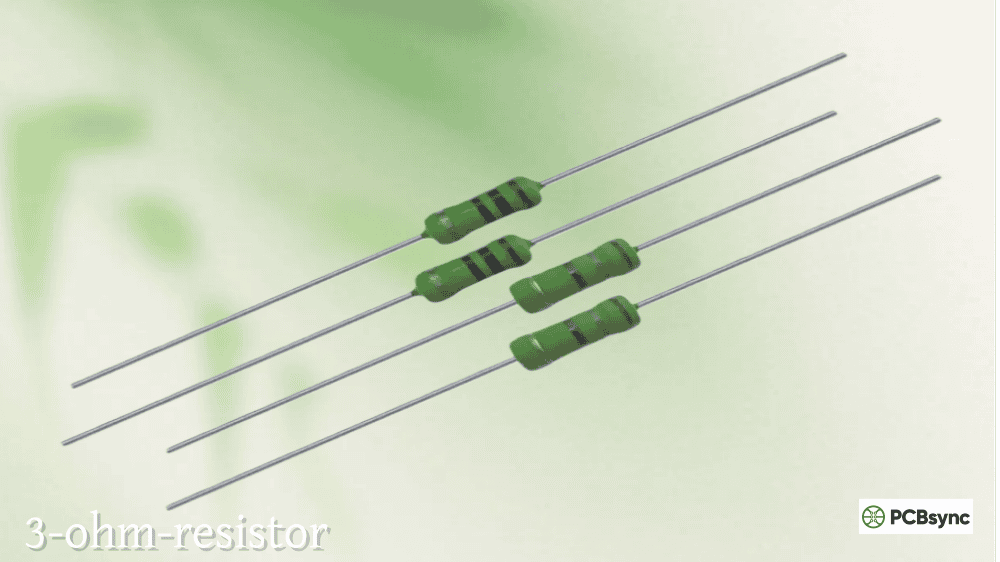
A 3 ohm resistor is a passive electronic component that provides exactly 3 ohms of electrical resistance. This relatively low value puts it in the territory of power applications, load resistors, and audio circuits rather than typical signal conditioning.
The 3Ω value is part of the E24 standard resistor series, which means it’s a readily available standard value stocked by most distributors. You won’t have to hunt through specialty catalogs or pay premium prices for precision E96 parts just to get this resistance value.
What makes the 3 ohm resistor useful is its position in the resistance spectrum. It’s low enough to pass significant current without generating excessive voltage drop, yet high enough to provide meaningful load or limiting action in many circuits.
Key Specifications of the 3 Ohm Resistor
Specification
Common Values
Resistance
3Ω (nominal)
Standard Series
E24 (also E48, E96)
Tolerance Options
±0.1%, ±0.5%, ±1%, ±2%, ±5%, ±10%
Power Ratings
1/4W, 1/2W, 1W, 2W, 3W, 5W, 10W, 25W+
Temperature Coefficient
15-250 ppm/°C
RKM Code Notation
3R0
Package Types
Axial, radial, SMD, chassis mount, wirewound
3 Ohm Resistor Color Code Explained
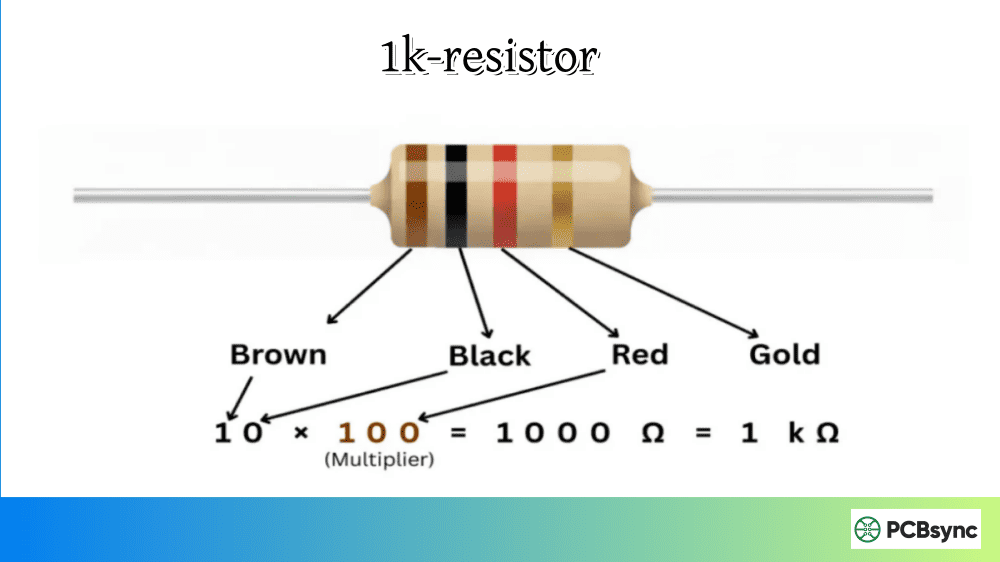
Reading the 3 ohm resistor color code requires recognizing that values below 10 ohms use the Gold multiplier band (×0.1). The first band being Orange is the key identifier for any resistor starting with the digit 3.
4-Band 3 Ohm Resistor Color Code
The standard 4-band configuration for a 3 ohm resistor is:
Band Position
Color
Meaning
1st Band (First Digit)
Orange
3
2nd Band (Second Digit)
Black
0
3rd Band (Multiplier)
Gold
×0.1
4th Band (Tolerance)
Gold
±5%
Calculation: 3 + 0 = 30 × 0.1 = 3Ω ±5%
The Orange-Black-Gold-Gold sequence is distinctive. Notice how the two Gold bands serve different purposes: the third band is the multiplier (×0.1), while the fourth indicates ±5% tolerance.
5-Band 3 Ohm Resistor Color Code (Precision)
For precision applications requiring tighter tolerances, 5-band resistors provide an extra significant digit:
Band Position
Color
Meaning
1st Band
Orange
3
2nd Band
Black
0
3rd Band
Black
0
4th Band (Multiplier)
Silver
×0.01
5th Band (Tolerance)
Brown
±1%
Calculation: 3 + 0 + 0 = 300 × 0.01 = 3Ω ±1%
6-Band 3 Ohm Resistor Color Code
For temperature-critical applications:
Band
Color Sequence
Meaning
Bands 1-5
Orange-Black-Black-Silver-Gold
3Ω ±5%
6th Band (TCR)
Black
250 ppm/K
Multiplier Reference for Low-Ohm Values
Multiplier Color
Multiplier Value
Example Result
Black
×1
30 × 1 = 30Ω
Gold
×0.1
30 × 0.1 = 3Ω
Silver
×0.01
300 × 0.01 = 3Ω
Complete Color Code Reference Chart
Color
Digit
Multiplier
Tolerance
Black
0
×1
–
Brown
1
×10
±1%
Red
2
×100
±2%
Orange
3
×1,000
–
Yellow
4
×10,000
–
Green
5
×100,000
±0.5%
Blue
6
×1,000,000
±0.25%
Violet
7
–
±0.1%
Gray
8
–
±0.05%
White
9
–
–
Gold
–
×0.1
±5%
Silver
–
×0.01
±10%
Types of 3 Ohm Resistors
Selecting the right 3 ohm resistor type depends on your application’s power requirements, precision needs, and environmental conditions.
Carbon Film 3 Ohm Resistors
Best for: General purpose, prototyping, non-critical applications
Specification
Typical Value
Power Rating
1/4W to 2W
Tolerance
±5% to ±10%
TCR
200-500 ppm/°C
Cost
Low
Carbon film resistors are economical and widely available. They work well for basic load applications and breadboard experiments where precision isn’t critical.
Metal Film 3 Ohm Resistors
Best for: Precision circuits, low-noise applications, measurement
Specification
Typical Value
Power Rating
1/8W to 2W
Tolerance
±0.1% to ±1%
TCR
25-100 ppm/°C
Noise
Low
Metal film resistors offer better stability and lower noise than carbon film. They’re the standard choice when accuracy matters but power dissipation is moderate.
Wirewound 3 Ohm Resistors
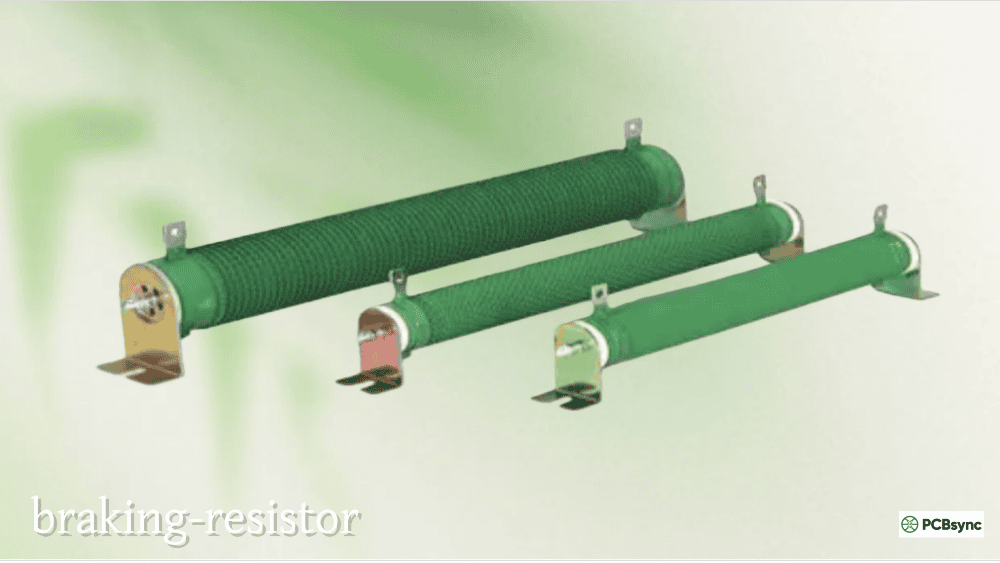
Best for: High-power applications, audio crossovers, load banks
Specification
Typical Value
Power Rating
1W to 100W+
Tolerance
±0.1% to ±5%
TCR
20-80 ppm/°C
Construction
Non-inductive available
Wirewound resistors excel in high-power scenarios. For audio applications, specify non-inductive types to avoid frequency-dependent behavior.
SMD 3 Ohm Resistors
For surface mount PCB designs:
Package Size
Power Rating
Max Current (3Ω)
0402
1/16W (0.063W)
145mA
0603
1/10W (0.1W)
183mA
0805
1/8W (0.125W)
204mA
1206
1/4W (0.25W)
289mA
2010
1/2W (0.5W)
408mA
2512
1W
577mA
Practical Uses for 3 Ohm Resistors
Load Resistors for Power Supply Testing
One of the most common uses for a 3 ohm resistor is as a load resistor when testing power supplies or amplifiers. A 3Ω load draws specific, predictable currents depending on voltage:
Supply Voltage
Current Draw
Power Dissipated
5V
1.67A
8.3W
9V
3A
27W
12V
4A
48W
24V
8A
192W
For power supply testing, you’ll typically need high-wattage wirewound or chassis-mount resistors. The 3Ω value is convenient because it provides substantial load current without requiring extremely high power ratings at lower voltages.
Speaker Crossover Networks
In audio systems, 3 ohm resistors appear in crossover networks and attenuation circuits. They work well for:
Impedance Padding: Adding a 3Ω resistor in series with a 4Ω or 8Ω speaker slightly increases the total impedance, which can help match amplifier requirements or reduce power to an overly efficient driver.
L-Pad Attenuators: Combined with other resistor values, 3Ω resistors help create fixed attenuation networks for tweeter level adjustment.
Zobel Networks: Some impedance compensation circuits use 3Ω resistors in combination with capacitors.
Current Sensing Applications
While dedicated current sense resistors typically use milliohm values, a 3 ohm resistor works for lower-current sensing where a larger voltage drop is acceptable:
Current
Voltage Drop
Power Dissipated
50mA
150mV
7.5mW
100mA
300mV
30mW
250mA
750mV
188mW
500mA
1.5V
750mW
The 3V-per-amp relationship (since V = IR and R = 3) makes mental calculations straightforward during debugging.
LED Current Limiting
For higher-voltage LED applications, a 3 ohm resistor can serve as a current limiter:
Supply Voltage
LED Vf
Current (I = (Vs-Vf)/3)
5V
2V
1A
12V
3V
3A
24V
3V
7A
These are high currents suitable only for high-power LED modules or LED strips, not individual indicator LEDs.
Amplifier Dummy Loads
When testing audio amplifiers, 3Ω dummy loads simulate real speaker impedances. This is particularly useful for car audio amplifiers, which commonly drive 2Ω or 4Ω loads.
IEC 60062: International standard for resistor color codes
IEC 60063: E-series preferred values
Frequently Asked Questions
What is the color code for a 3 ohm resistor?
A 4-band 3 ohm resistor has the color code Orange-Black-Gold-Gold. The Orange represents 3, Black represents 0, the first Gold band is the ×0.1 multiplier, and the second Gold indicates ±5% tolerance. For precision 5-band versions with ±1% tolerance, the code is Orange-Black-Black-Silver-Brown.
Is 3 ohm a standard resistor value?
Yes, 3 ohm (3.0Ω) is a standard value in the E24 series, which is the most commonly used series for 5% tolerance resistors. This means 3 ohm resistors are readily available from all major distributors at competitive prices. You won’t need to special-order precision E96 series parts to get this value.
What power rating do I need for a 3 ohm resistor?
Calculate power using P = I² × 3 (where I is current in amps). For 500mA, power is 0.75W, so use at least 2W. For 1A, power is 3W, so use at least 10W. Always apply a 2× safety factor to account for temperature rise and ensure long-term reliability.
Can I use a 3.3 ohm resistor instead of 3 ohm?
In many applications, yes. The 10% difference between 3Ω and 3.3Ω may be acceptable depending on your circuit’s tolerance requirements. For load testing or current limiting where exact values aren’t critical, either will work. For precision applications like calibrated measurement or specific filter frequencies, use the correct value.
What applications commonly use 3 ohm resistors?
Common uses include dummy loads for power supply and amplifier testing, speaker crossover networks, impedance matching in audio circuits, current sensing for moderate current levels, and LED current limiting in higher-voltage applications. The 3Ω value provides a good balance between current capacity and voltage drop for many power-related applications.
Final Thoughts
The 3 ohm resistor is a versatile component that bridges the gap between ultra-low current sensing values and standard signal-level resistances. Its inclusion in the E24 series makes it readily available and affordable, while its low resistance value suits power-related applications from load testing to audio circuits.
When selecting a 3 ohm resistor, start with your power requirements. Calculate I² × 3 for power dissipation, apply appropriate derating, then consider whether you need standard carbon film for basic work or precision wirewound for demanding applications.
Remember the color code: Orange-Black-Gold identifies a 3Ω value before you even look at the tolerance band. Keep a few different power ratings in your parts stock, and you’ll be ready for everything from prototype debugging to serious power testing.
Inquire: Call 0086-755-23203480, or reach out via the form below/your sales contact to discuss our design, manufacturing, and assembly capabilities.
Quote: Email your PCB files to Sales@pcbsync.com (Preferred for large files) or submit online. We will contact you promptly. Please ensure your email is correct.
Notes: For PCB fabrication, we require PCB design file in Gerber RS-274X format (most preferred), *.PCB/DDB (Protel, inform your program version) format or *.BRD (Eagle) format. For PCB assembly, we require PCB design file in above mentioned format, drilling file and BOM. Click to download BOM template To avoid file missing, please include all files into one folder and compress it into .zip or .rar format.