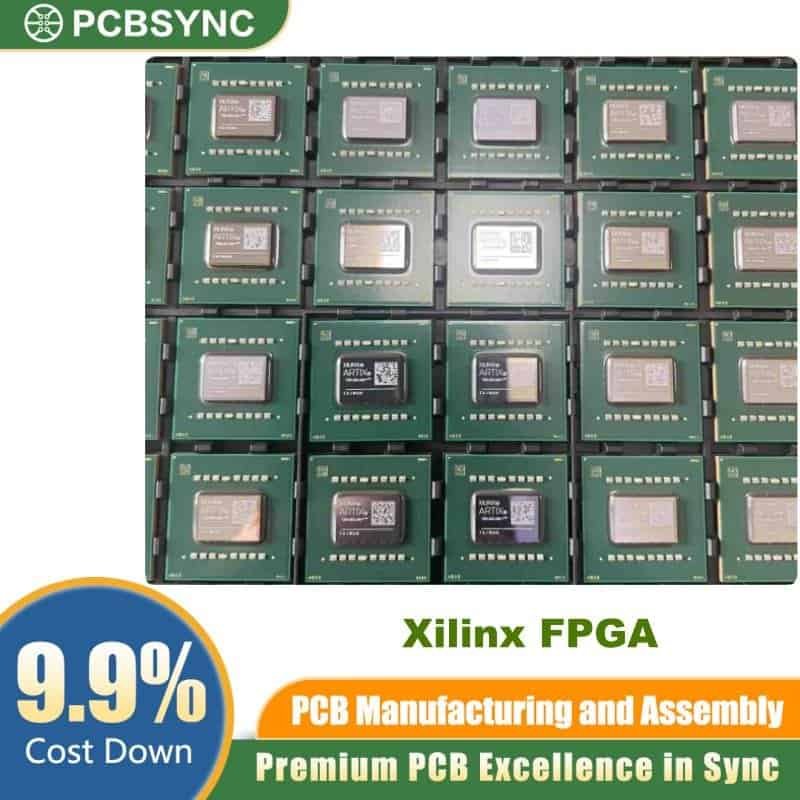
The XC5204-5PQ100C is a high-performance, low-cost Field Programmable Gate Array (FPGA) manufactured by Xilinx (now AMD). Built on the proven XC5200 family architecture, this device delivers a powerful balance of logic density, I/O flexibility, and reprogrammability — making it an ideal choice for mid-complexity embedded and digital design applications. Whether you are replacing a legacy design or selecting a reliable SRAM-based FPGA for a new project, the XC5204-5PQ100C remains a dependable and widely available option. For a broader selection of Xilinx programmable logic devices, visit Xilinx FPGA.
XC5204-5PQ100C – Quick Identification
Understanding the part number is critical before selecting or sourcing this FPGA. Each segment of XC5204-5PQ100C carries specific meaning that defines the device’s capabilities, speed, package, and temperature grade.
| Part Number Segment |
Meaning |
| XC5204 |
XC5200 family, ~6,000 equivalent gates |
| -5 |
Speed grade 5 (mid-range performance) |
| PQ100 |
100-pin Plastic Quad Flat Package (PQFP) |
| C |
Commercial temperature range (0°C to +85°C) |
Key Specifications at a Glance
The table below provides a consolidated view of the most important electrical and physical specifications for the XC5204-5PQ100C. These values are drawn directly from the Xilinx XC5200 family datasheet.
| Parameter |
Value |
| Device Family |
XC5200 |
| Equivalent Gate Count |
~6,000 Gates |
| Logic Cells (LCs) |
480 |
| Configurable Logic Blocks (CLBs) |
120 |
| User I/O Pins |
81 |
| Maximum Clock Frequency |
83 MHz |
| Supply Voltage (Vcc) |
5.0 V |
| Process Technology |
0.5 µm (500 nm), 3-layer metal CMOS |
| Package Type |
100-pin PQFP (Plastic Quad Flat Package) |
| Package Body Size |
14 mm × 14 mm |
| Lead Pitch |
0.635 mm |
| Temperature Range |
0°C to +85°C (Commercial) |
| Configuration Type |
SRAM-based (reprogrammable) |
| Lifecycle Status |
Obsolete / Legacy (still available via distributors) |
Architecture and Logic Resources
CLB and Logic Cell Structure
The XC5204-5PQ100C is organized around 120 Configurable Logic Blocks (CLBs), each containing 4 independent Logic Cells (LCs) — resulting in a total of 480 logic cells. Each logic cell consists of a 4-input Look-Up Table (LUT), a carry-chain multiplexer, and a D-type flip-flop with clock enable and asynchronous reset capability. Pairs of logic cells within the same CLB can also be combined to implement 5-input functions, increasing design flexibility without consuming extra resources.
Each CLB provides 20 independent inputs and 12 independent outputs, giving designers a rich and granular logic fabric to work with.
VersaBlock Logic Module
The XC5200 family surrounds each CLB with two layers of local interconnect — the Local Interconnect Matrix (LIM) and direct connects — forming the proprietary VersaBlock module. This architecture effectively creates a “sea of logic cells,” minimizing local routing congestion and improving overall routing efficiency. The VersaBlock connects to the General Routing Matrix (GRM) via 24 bidirectional ports and includes four 3-state buffers for driving Longlines.
Carry Chain and Arithmetic
Each CLB includes dedicated fast carry logic, enabling efficient implementation of wide adders, subtractors, comparators, and counter circuits. The carry chain propagates between adjacent CLBs through dedicated connections, making high-speed arithmetic operations straightforward to implement.
I/O Architecture – VersaRing Interface
I/O Block (IOB) Details
The XC5204-5PQ100C features 81 user I/O pins, managed through the VersaRing I/O interface. This innovative ring-based I/O architecture delivers a high logic-cell-to-I/O ratio, which is particularly advantageous for designs that demand dense peripheral connectivity.
| I/O Feature |
Detail |
| Total User I/O Pins |
81 |
| Output Drive Current |
8 mA (source and sink) |
| Input Threshold Options |
Selectable CMOS or TTL |
| Output Slew-Rate Control |
Programmable (2 modes) |
| ESD Protection |
Minimum 3 kV |
| Boundary Scan |
IEEE 1149.1 (JTAG) supported |
| Input Delay |
Programmable delay line for setup/hold timing |
Each IOB contains an input buffer (with selectable CMOS or TTL thresholds), an output buffer with programmable slew-rate control, and a 3-state control mechanism. The input buffer also includes an internal programmable delay line, which helps assure reliable chip-to-chip setup and hold times — simplifying board-level timing closure.
Note: Unlike later Xilinx families, the XC5200 IOBs do not include on-board flip-flops or latches. For high-performance I/O paths, direct connections from each IOB to CLB registers in the adjacent array are provided.
Configuration and Programming
SRAM-Based Reprogrammable Architecture
The XC5204-5PQ100C uses SRAM-based configuration, meaning the logic function is stored in static RAM cells that can be overwritten at any time without physical modification. This enables rapid prototyping, field updates, and iterative design cycles — key advantages over one-time-programmable (OTP) or antifuse-based FPGAs.
Supported Configuration Modes
| Configuration Mode |
Description |
| Master Serial |
FPGA acts as master; reads data from a serial PROM |
| Slave Serial |
External controller feeds configuration data serially |
| Slave Parallel (Express) |
High-speed parallel configuration via 8-bit data bus |
| Daisy Chain |
Multiple XC5200 devices can be chained for sequential programming |
| JTAG (Boundary Scan) |
IEEE 1149.1-compliant test and programming interface |
The device includes an internal oscillator (nominal 12 MHz) used to clock power-on reset, clear configuration memory, and source CCLK in Master configuration modes. The CCLK output frequency is user-selectable (1 MHz default, 6 MHz, or 12 MHz).
Design Entry and EDA Support
The XC5200 family is fully supported by Xilinx’s ISE (Integrated Silicon Editor) design suite. Popular design entry methods are all compatible, including:
- ABEL – for behavioral logic description
- Schematic Capture – graphical design flow
- VHDL – industry-standard HDL
- Verilog HDL – widely used hardware description language
Designers can use their existing synthesis tools without modification when targeting XC5200 devices.
Speed Grade Comparison – XC5204 Family
The XC5204 is available in multiple speed grades. The suffix number indicates relative performance, with lower numbers representing faster devices. The table below compares the available speed grades for the XC5204 in the PQ100 package.
| Part Number |
Speed Grade |
Typical tPD (ns) |
Typical fMAX (MHz) |
Temperature Range |
| XC5204-4PQ100C |
4 (Fastest) |
~5.0 ns |
~100 MHz |
0°C to +85°C |
| XC5204-5PQ100C |
5 (Mid) |
~5.6 ns |
~83 MHz |
0°C to +85°C |
| XC5204-6PQ100C |
6 (Slowest) |
~6.0 ns |
~83 MHz |
0°C to +85°C |
| XC5204-6PQ100I |
6 |
~6.0 ns |
~83 MHz |
−40°C to +85°C (Industrial) |
The “-5” speed grade in the XC5204-5PQ100C offers a strong balance between cost and performance, suitable for the majority of mid-speed embedded applications.
Absolute Maximum Ratings
Operating outside these limits may cause permanent damage to the device. Always design with appropriate margins.
| Parameter |
Minimum |
Maximum |
| Supply Voltage (Vcc) |
−0.5 V |
+6.0 V |
| Input Voltage (any pin) |
−0.5 V |
Vcc + 0.5 V |
| Output Current (per pin) |
— |
±25 mA |
| Storage Temperature |
−65°C |
+150°C |
| Junction Temperature |
— |
+125°C |
Typical Application Scenarios
The XC5204-5PQ100C is well-suited for a broad range of embedded and industrial applications where moderate logic density and flexible I/O are required.
Protocol Bridging and Interface Controllers
With 81 user I/O pins and programmable slew-rate control, the XC5204-5PQ100C can implement custom serial or parallel protocol converters — bridging between legacy bus architectures and modern interfaces.
Signal Processing and Data Acquisition
The fast carry logic and configurable LUT structure make this FPGA a capable platform for implementing small-scale digital filters, accumulators, and data formatting engines in instrumentation systems.
Industrial Automation and Control
The commercial temperature grade (0°C to +85°C) and robust CMOS architecture make the XC5204-5PQ100C a reliable choice for control logic, state machines, and supervisory systems within industrial enclosures.
Rapid Prototyping
The SRAM-based reprogrammable nature of the XC5204-5PQ100C allows engineers to iterate quickly during the design and validation phase, reducing time-to-market for custom hardware projects.
Package and Pinout Information
The XC5204-5PQ100C is housed in a 100-pin Plastic Quad Flat Package (PQFP) with a body size of 14 mm × 14 mm and a lead pitch of 0.635 mm. Pins are distributed evenly across all four sides of the package.
| Pin Category |
Count |
| User I/O Pins |
81 |
| Power Supply (Vcc) |
7 |
| Ground (GND) |
5 |
| Configuration / Special Function |
7 |
| Total Pins |
100 |
Key dedicated pins include PROG (program initiation), DONE (configuration complete indicator), INIT (initialization), and CCLK (configuration clock). Refer to the official Xilinx XC5200 datasheet for the full pin-by-pin assignment and functional diagram.
Frequently Asked Questions (FAQ)
Q: Is the XC5204-5PQ100C still in production? A: This device is classified as obsolete/legacy by AMD (formerly Xilinx). However, it remains available through specialty distributors and excess-stock suppliers for repair, maintenance, and legacy system upgrades.
Q: What is the difference between the -5 and -6 speed grade? A: The -5 speed grade offers slightly faster propagation delay (~5.6 ns) compared to the -6 grade (~6.0 ns), making it better suited for designs operating at or near the 83 MHz maximum frequency.
Q: Can this FPGA be reprogrammed in the field? A: Yes. The SRAM-based architecture allows the XC5204-5PQ100C to be reconfigured at any time using a serial PROM, parallel programmer, or JTAG interface — without replacing the chip.
Q: What design tools support the XC5204-5PQ100C? A: The device is supported by Xilinx ISE design suite and is compatible with standard HDL synthesis flows using VHDL or Verilog. Schematic capture and ABEL are also fully supported entry methods.
Q: What is the “C” suffix in XC5204-5PQ100C? A: The “C” denotes Commercial temperature grade, specifying an operating range of 0°C to +85°C. For industrial or extended-temperature applications, look for the “I” suffix variant (e.g., XC5204-5PQ100I).