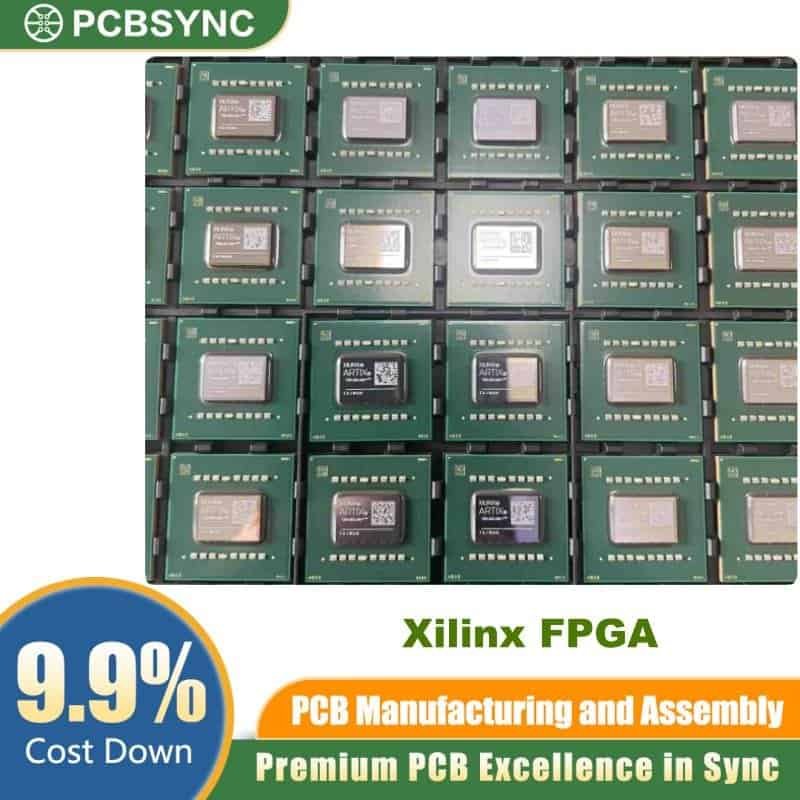
Overview of XC5210-3PQ160C FPGA
The XC5210-3PQ160C is a member of the renowned XC5200 Field Programmable Gate Array family manufactured by Xilinx (now AMD). This versatile programmable logic device delivers exceptional performance for embedded systems, telecommunications, and industrial automation applications. Built on proven 0.5µm CMOS technology, the XC5210-3PQ160C offers designers a cost-effective solution for implementing complex digital logic functions.
XC5210-3PQ160C Technical Specifications
Core FPGA Specifications
| Parameter |
Specification |
| Part Number |
XC5210-3PQ160C |
| Manufacturer |
Xilinx (AMD) |
| Product Family |
XC5200 Series FPGA |
| Logic Cells |
1,296 cells |
| Gate Count |
16,000 equivalent gates |
| Configurable Logic Blocks (CLBs) |
324 CLBs |
| Maximum I/O Pins |
133 user I/O |
| Package Type |
160-Pin PQFP (Plastic Quad Flat Pack) |
| Speed Grade |
-3 (Standard Performance) |
| Operating Voltage |
5V |
| Technology Node |
0.5µm three-layer metal CMOS |
Performance Characteristics
| Feature |
Value |
| Maximum System Frequency |
Up to 83 MHz |
| Internal Flip-Flops |
2,592 flip-flops |
| RAM Bits |
Available in CLBs |
| Configuration Memory |
SRAM-based |
| Reconfigurability |
Fully reprogrammable |
| Temperature Range |
Commercial (0°C to +85°C) |
Key Features and Benefits
Advanced VersaBlock Architecture
The XC5210-3PQ160C incorporates Xilinx’s innovative VersaBlock™ logic module, which provides:
- Register-rich design – Abundant flip-flops for sequential logic implementation
- Flexible logic resources – Configurable function generators and dedicated routing
- Enhanced density – Maximum logic utilization per silicon area
- Fast combinatorial paths – Optimized for high-speed data processing
VersaRing I/O Interface
This Xilinx FPGA features the VersaRing I/O interface system offering:
- 133 programmable I/O pins
- Multiple I/O standards support
- Programmable slew rate control
- Tri-state capability on all outputs
- Flexible pin assignment for optimal PCB layout
Hierarchical Interconnect Resources
The XC5210-3PQ160C provides six levels of programmable interconnect hierarchy:
- Single-length lines – For adjacent CLB connections
- Double-length lines – Connecting nearby CLBs
- Quad lines – Medium-distance routing
- Longlines – Full-chip routing resources
- Global clocks – Dedicated low-skew distribution
- Local feedback – Optimized critical path routing
Application Areas
Industrial Automation and Control
| Application |
XC5210-3PQ160C Advantages |
| Motor Control Systems |
High-speed PWM generation and feedback processing |
| PLC Controllers |
Flexible logic for ladder diagram implementation |
| Process Monitoring |
Multi-channel data acquisition and processing |
| Factory Automation |
Real-time control and sensor interfacing |
Communications Equipment
- Protocol converters – Flexible implementation of communication standards
- Data encryption/decryption – Hardware acceleration for security algorithms
- Signal processing – Digital filtering and modulation schemes
- Network switching – Packet routing and buffering logic
Automotive Electronics
- Body control modules
- Dashboard instrumentation
- Engine management systems
- Safety system controllers
Consumer Electronics
- Set-top boxes
- Digital signal processing
- Audio/video processing
- Interface bridging solutions
Design Tools and Development Support
Comprehensive Software Ecosystem
The XC5210-3PQ160C is fully supported by industry-standard development tools:
| Tool Category |
Supported Tools |
| Schematic Capture |
Popular EDA tools with Xilinx libraries |
| HDL Entry |
VHDL, Verilog HDL |
| Synthesis |
ABEL, third-party synthesis tools |
| Implementation |
Xilinx ISE Design Suite |
| Simulation |
ModelSim, Active-HDL, and others |
| Programming |
Standard JTAG interface |
Design Entry Methods
- Schematic-based design – Traditional graphical design entry
- VHDL synthesis – High-level hardware description
- Verilog HDL synthesis – Industry-standard RTL design
- ABEL language – Boolean equation-based design
- Mixed methodology – Combining multiple design approaches
Package Information and Pin Configuration
160-Pin PQFP Package Details
| Package Parameter |
Specification |
| Package Style |
Plastic Quad Flat Pack (PQFP) |
| Total Pins |
160 |
| Pin Pitch |
0.5mm |
| Body Size |
28mm × 28mm (nominal) |
| Package Height |
Low-profile design |
| Lead Form |
Gull-wing |
| Mounting |
Surface mount technology (SMT) |
Pin Assignment Features
- 133 user I/O pins – Maximum design flexibility
- Dedicated configuration pins – JTAG programming interface
- Power and ground pins – Distributed for optimal signal integrity
- Mode pins – Configuration mode selection
Programming and Configuration
Configuration Methods
The XC5210-3PQ160C supports multiple configuration modes:
- Master Serial Mode – FPGA controls configuration from serial PROM
- Slave Serial Mode – External processor controls configuration
- Peripheral Mode – Microprocessor-based configuration
- JTAG Boundary Scan – IEEE 1149.1 standard programming
Configuration Memory
- SRAM-based technology – Volatile configuration storage
- Fast configuration time – Rapid system startup
- Unlimited reprogramming – No wear-out mechanism
- In-system programming – Field upgradeable designs
Power Consumption and Thermal Management
Power Supply Requirements
| Supply |
Voltage |
Tolerance |
| Core Voltage (VCC) |
5.0V |
±5% |
| I/O Voltage (VCCO) |
5.0V |
±5% |
Power Optimization Features
- Selective clock gating – Reduced dynamic power
- Sleep modes – Low-power standby operation
- Optimized routing – Minimized switching activity
Quality and Reliability Standards
Manufacturing Quality
- RoHS compliant – Lead-free construction (select versions)
- Moisture sensitivity – MSL rating for proper handling
- ESD protection – Built-in protection circuits
- JEDEC standards – Compliance with industry specifications
Testing and Validation
- Comprehensive production testing
- Functional pattern verification
- Speed binning for grade certification
- Quality assurance protocols
Comparison with Related Devices
XC5200 Family Members
| Part Number |
Logic Cells |
Gates |
CLBs |
Max I/O |
| XC5202 |
256 |
3,000 |
64 |
57 |
| XC5204 |
484 |
6,000 |
121 |
89 |
| XC5206 |
784 |
9,000 |
196 |
113 |
| XC5210 |
1,296 |
16,000 |
324 |
133 |
| XC5215 |
1,936 |
23,000 |
484 |
161 |
Speed Grade Variants
- XC5210-3PQ160C – Standard performance (this model)
- XC5210-4PQ160C – Enhanced performance
- XC5210-5PQ160C – High-speed grade
- XC5210-6PQ160C – Premium performance
Design Considerations and Best Practices
PCB Layout Recommendations
- Power distribution – Use adequate decoupling capacitors near power pins
- Signal integrity – Maintain controlled impedance for high-speed signals
- Thermal management – Ensure adequate airflow and heat dissipation
- Ground planes – Continuous ground reference for signal return paths
Design Optimization Techniques
- Resource utilization – Balance logic and routing resources
- Clock domain management – Properly synchronize multiple clock domains
- I/O timing constraints – Define setup and hold time requirements
- Power estimation – Use vendor tools for power analysis
Ordering Information and Availability
Part Number Breakdown
XC5210-3PQ160C
- XC5210 – Device family and density
- 3 – Speed grade
- PQ – Package type (Plastic Quad)
- 160 – Pin count
- C – Commercial temperature range
Package Options
While the -3PQ160C variant offers standard performance in a 160-pin PQFP package, designers can select from various package options including:
- PQ100 – 100-pin PQFP
- PQ160 – 160-pin PQFP (this variant)
- PQ208 – 208-pin PQFP
- TQ144 – 144-pin TQFP
- BG225 – 225-ball BGA
Legacy Product Support and Alternatives
Product Status
Please note that the XC5200 family, including the XC5210-3PQ160C, is considered a legacy product line. While the device offers proven reliability and is still available through authorized distributors, designers starting new projects may want to consider modern FPGA alternatives with enhanced features and performance.
Migration Path
For new designs, consider evaluating:
- Spartan® series FPGAs – Cost-optimized current-generation devices
- Artix® series FPGAs – Low-power, high-performance alternatives
- Modern AMD Xilinx devices – Advanced features and tool support
Frequently Asked Questions
What is the difference between speed grades?
Speed grades (-3, -4, -5, -6) indicate the maximum operating frequency and timing performance. Higher numbers represent faster devices with tighter timing specifications.
Can I use 3.3V I/O with the XC5210-3PQ160C?
The XC5210-3PQ160C is designed for 5V operation. For 3.3V compatibility, voltage translation circuits may be required at the I/O interface.
What development tools are required?
The Xilinx ISE Design Suite provides complete design, simulation, and programming support for the XC5200 family. Legacy versions of ISE support this device family.
Is the configuration volatile?
Yes, the SRAM-based configuration is volatile and requires reconfiguration after power cycling. A configuration PROM or external processor must reload the design on startup.
Conclusion
The XC5210-3PQ160C represents a mature, reliable FPGA solution for applications requiring moderate logic density and proven performance. With 16,000 equivalent gates, 133 I/O pins, and comprehensive development tool support, this device serves industrial, communications, and embedded system designers who need dependable programmable logic capabilities.
Whether implementing custom control logic, signal processing algorithms, or interface bridging functions, the XC5210-3PQ160C delivers the flexibility and performance required for successful digital system design. Its SRAM-based architecture enables unlimited reprogramming cycles, making it ideal for both prototyping and production applications.
For detailed technical specifications, design files, and additional support resources, consult the official Xilinx documentation or contact authorized distributors for availability and pricing information.