Inquire: Call 0086-755-23203480, or reach out via the form below/your sales contact to discuss our design, manufacturing, and assembly capabilities.
Quote: Email your PCB files to Sales@pcbsync.com (Preferred for large files) or submit online. We will contact you promptly. Please ensure your email is correct.
Notes: For PCB fabrication, we require PCB design file in Gerber RS-274X format (most preferred), *.PCB/DDB (Protel, inform your program version) format or *.BRD (Eagle) format. For PCB assembly, we require PCB design file in above mentioned format, drilling file and BOM. Click to download BOM template To avoid file missing, please include all files into one folder and compress it into .zip or .rar format.
When you’re knee-deep in a PCB layout at 2 AM trying to figure out why your current sensing circuit isn’t working, the last thing you want is confusion about basic component identification. The 2.2 ohm resistor might seem straightforward, but there’s more to this low-value component than meets the eye. Let me walk you through everything you need to know from a practical engineering standpoint.
Understanding the 2.2 Ohm Resistor
A 2.2 ohm resistor provides exactly what it says on the tin – 2.2Ω of resistance. Unlike its higher-value cousins like the 2.2kΩ (2200 ohm), this low-value resistor operates in a different league entirely. In my years of designing power supplies and motor controllers, I’ve learned that these seemingly simple components can make or break your design.
The 2.2 ohm resistor belongs to the E12 and E24 series of standard resistor values. This standardization, defined by IEC 60063, ensures you can source this value from virtually any manufacturer worldwide. The E-series system uses logarithmic spacing to provide maximum coverage with minimum inventory – a practical consideration when you’re managing thousands of components.
The value 2.2 comes from the E12 series, which provides 12 standard values per decade (1.0, 1.2, 1.5, 1.8, 2.2, 2.7, 3.3, 3.9, 4.7, 5.6, 6.8, 8.2). These values are spaced geometrically by approximately 1.21x, which corresponds to ±10% tolerance overlap. The 2.2 ohm value also appears in the finer E24 series, making it available with tighter tolerances for precision applications.
2.2 Ohm Resistor Color Code
Color coding remains the universal language for through-hole resistors, despite the dominance of SMD components. Here’s what you need to know about identifying a 2.2 ohm resistor visually.
4-Band Color Code
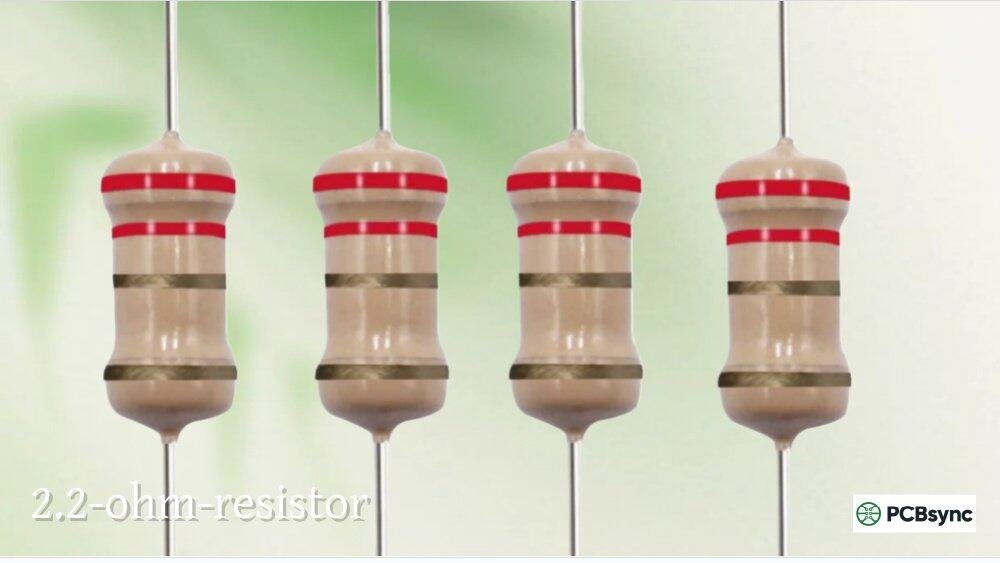
The standard 4-band 2.2 ohm resistor uses this sequence:
Band Position
Color
Meaning
Value
1st Band
Red
1st Digit
2
2nd Band
Red
2nd Digit
2
3rd Band
Gold
Multiplier
×0.1
4th Band
Gold
Tolerance
±5%
Color Code: Red-Red-Gold-Gold
The gold multiplier band might throw you off initially. Remember: gold represents 10⁻¹ or 0.1, which transforms “22” into “2.2”. This is standard notation for fractional ohm values.
5-Band Color Code
For precision applications requiring tighter tolerances, manufacturers offer 5-band variants:
Band Position
Color
Meaning
Value
1st Band
Red
1st Digit
2
2nd Band
Red
2nd Digit
2
3rd Band
Black
3rd Digit
0
4th Band
Silver
Multiplier
×0.01
5th Band
Brown/Gold
Tolerance
±1% or ±5%
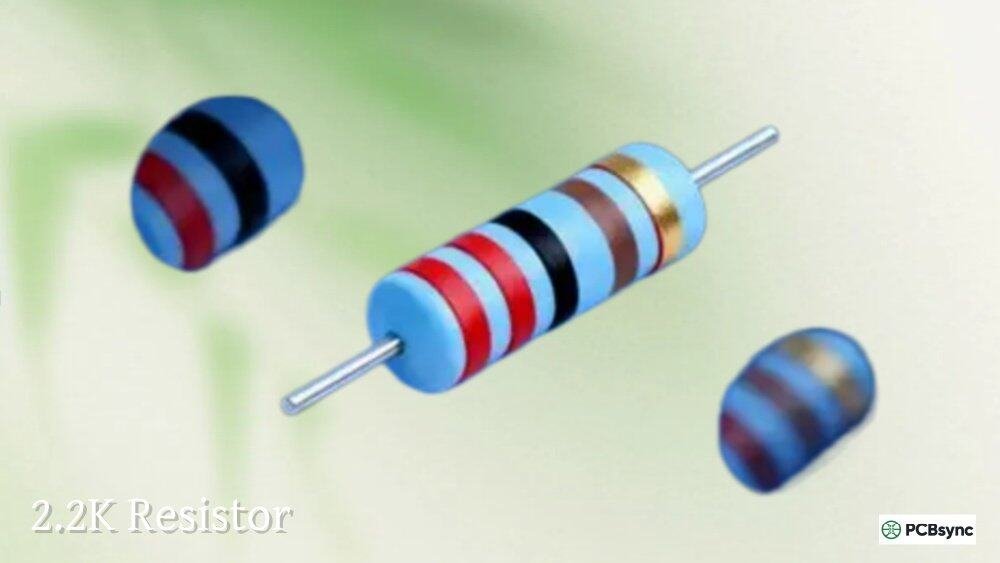
Color Code: Red-Red-Black-Silver-Brown (±1%)
The 5-band configuration provides three significant figures, offering better precision than the 4-band version. The brown tolerance band indicates ±1% tolerance – critical for current sensing applications.
6-Band Color Code
High-reliability designs sometimes specify 6-band resistors that include temperature coefficient information:
Band Position
Color
Meaning
Value
1st Band
Red
1st Digit
2
2nd Band
Red
2nd Digit
2
3rd Band
Black
3rd Digit
0
4th Band
Silver
Multiplier
×0.01
5th Band
Brown
Tolerance
±1%
6th Band
Brown/Red
Temp Coefficient
100 or 50 ppm/°C
The sixth band indicates how much the resistance changes per degree Celsius. Brown (100 ppm/°C) is common for standard metal film resistors, while red (50 ppm/°C) indicates better stability.
Quick Identification Tip
Hold the resistor with the tolerance band (usually gold, silver, or brown) on the right. Read from left to right. If you see red-red-gold as the first three bands, you’ve got yourself a 2.2 ohm resistor. Always verify with a multimeter if the color bands look faded – I’ve debugged too many circuits where someone grabbed a 22 ohm or 220 ohm resistor by mistake.
Technical Specifications
Understanding the specifications beyond just resistance value is crucial for reliable circuit design. Here’s what matters in real-world applications.
Power Ratings
The 2.2 ohm resistor comes in various power ratings, each suited for different current levels:
Power Rating
Typical Package
Max Current (approx.)
Common Use Case
1/8W (0.125W)
Axial/0805 SMD
240 mA
Signal conditioning, low-power circuits
1/4W (0.25W)
Axial/1206 SMD
340 mA
General purpose, LED current limiting
1/2W (0.5W)
Axial/2010 SMD
480 mA
Moderate power applications
1W
Axial/2512 SMD
670 mA
Current sensing, motor circuits
2W
Axial/Wire-wound
950 mA
High-power current limiting
3W
Wire-wound
1.17 A
Power supplies, charging circuits
5W
Chassis mount
1.51 A
Industrial applications
Critical Note: These current values assume you’re operating at the full power rating. In practice, derate to 50-70% of maximum power for reliability. At 2.2Ω, power dissipation follows P = I²R, so a 500mA load generates P = (0.5)² × 2.2 = 0.55W of heat.
Tolerance Options
Tolerance indicates how far the actual resistance can deviate from the nominal 2.2Ω value:
±20% (Silver band): 1.76Ω to 2.64Ω – Rarely used, mostly for non-critical pull-ups
±10% (No band): 1.98Ω to 2.42Ω – Budget-friendly for general applications
±5% (Gold band): 2.09Ω to 2.31Ω – Standard for most designs
±2% (Red band): 2.156Ω to 2.244Ω – Better precision for analog circuits
±1% (Brown band): 2.178Ω to 2.222Ω – Required for current sensing
±0.5%: 2.189Ω to 2.211Ω – High-precision instrumentation
±0.1%: 2.1978Ω to 2.2022Ω – Laboratory-grade precision
For current sensing applications, I always specify ±1% or better. The cost difference is negligible, but the measurement accuracy improvement is significant.
Temperature Coefficient (TCR)
The temperature coefficient describes resistance change with temperature, measured in parts per million per degree Celsius (ppm/°C):
Resistor Type
Typical TCR
Stability
Carbon Composition
±500 to ±1000 ppm/°C
Poor – avoid for precision
Carbon Film
±200 to ±500 ppm/°C
Acceptable for general use
Metal Film
±50 to ±100 ppm/°C
Good for most applications
Thin Film
±25 to ±50 ppm/°C
Excellent for precision
Wire-wound
±20 to ±50 ppm/°C
Excellent, handles high power
Metal Foil
±2 to ±5 ppm/°C
Laboratory-grade precision
Practical Example: A metal film 2.2Ω resistor with 100 ppm/°C TCR operating at 75°C (50°C rise from 25°C ambient):
Change = 2.2Ω × 100 ppm/°C × 50°C = 0.011Ω
Final resistance ≈ 2.211Ω
For current sensing, this 0.5% drift can introduce measureable error. Design for it or specify better TCR components.
Types of 2.2 Ohm Resistors
Through-Hole Variants
Carbon Film Resistors: The workhorse of hobbyist electronics. Cheap, widely available, but with mediocre TCR (±200-500 ppm/°C). Fine for LED current limiting or general-purpose filtering where precision doesn’t matter. I keep a drawer full of these for prototyping.
Metal Film Resistors: My go-to for production designs. Better stability (±50-100 ppm/°C), lower noise, and still reasonably priced. The slight premium over carbon film is worth it for anything going into production. Available up to 1W in standard axial packages.
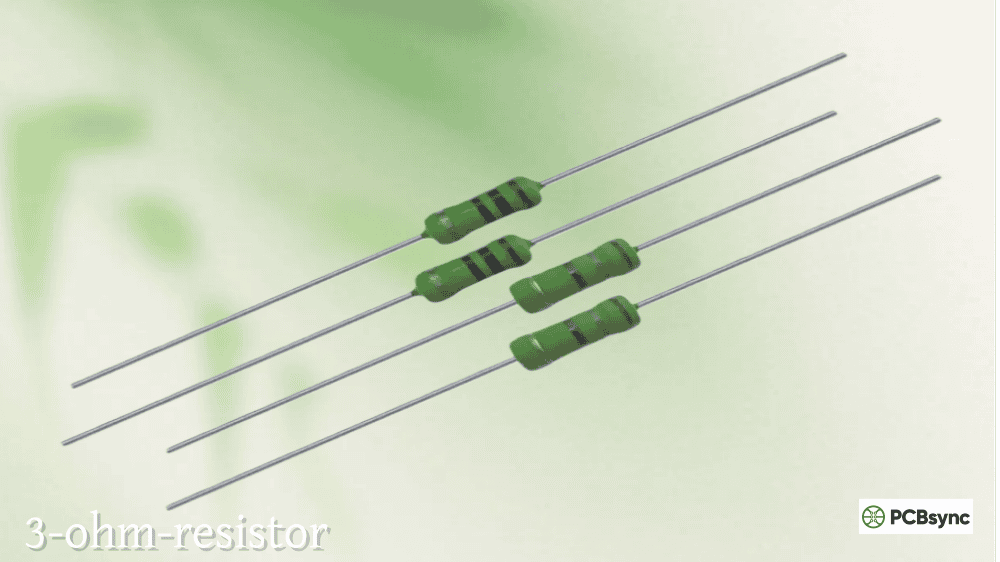
Wire-wound Resistors: When you need to handle serious power (3W+), wire-wound is your friend. They have excellent TCR and power handling but introduce inductance – typically 20-50 nH. This makes them unsuitable for high-frequency applications. I’ve used 5W wire-wound 2.2Ω resistors for motor current sensing in industrial controllers.
Surface Mount (SMD) Options
SMD resistors use numeric codes instead of color bands. A 2.2Ω resistor typically marks as:
Pro Tip: For current sensing with SMD resistors, consider using two 4.7Ω resistors in parallel instead of a single 2.2Ω. You get better power distribution and built-in redundancy. I learned this the hard way after a batch of 2512 resistors started delaminating under thermal stress.
Specialty Variants
Current Sense Resistors: Purpose-built for current measurement, these offer:
Ultra-low TCR (±50 ppm/°C or better)
Four-terminal (Kelvin) connections for accurate voltage measurement
Low inductance construction
Tight tolerance (±0.5% to ±1%)
Metal element or metal foil construction
Brands like Vishay, Bourns, and Ohmite make excellent current sense resistors. They cost more, but the measurement accuracy justifies it.
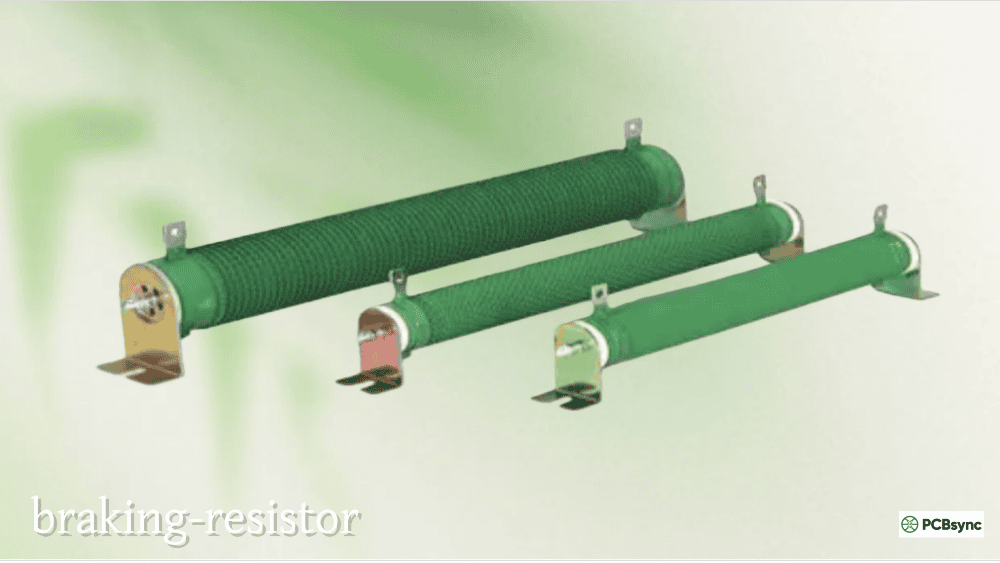
High-Power Chassis-Mount Resistors: For applications needing 10W+, chassis-mount resistors bolt directly to heatsinks. I’ve used 25W ceramic 2.2Ω resistors for regenerative braking systems where dumping 15-20A continuously was normal operation.
Real-World Applications
Current Sensing
The 2.2 ohm resistor shines in current sensing applications. Place it in series with the load, measure the voltage drop across it, and calculate current using Ohm’s law (I = V/R).
Practical Current Sensing Example:
Load current: 1A
Voltage drop: V = I × R = 1A × 2.2Ω = 2.2V
Power dissipation: P = I²R = 1² × 2.2 = 2.2W
This 2.2V drop is large enough for accurate ADC measurement but doesn’t waste excessive power. For a 12V system, you’re only losing 18% to the sense resistor.
Design Considerations:
Use ±1% tolerance for ±1% measurement accuracy
Specify low TCR (≤100 ppm/°C) for stable readings
Consider four-terminal configuration for high accuracy
Size for 2-3× expected maximum power
I once debugged a battery management system where someone used a ±5% carbon film resistor for current sensing. The readings wandered 10-15% with temperature. Swapping to ±1% metal film fixed it immediately.
Automotive Airbag Simulation
Car diagnostic systems expect to see approximately 2.2Ω when an airbag is connected. During testing, troubleshooting, or when the airbag is removed, technicians install 2.2Ω resistors to prevent the system from throwing fault codes.
These applications demand:
Precise 2.2Ω value (±5% or better)
Adequate power rating (usually 1/2W minimum)
Robust construction for automotive environment
Temperature stability
LED Current Limiting
For low-power LED circuits, a 2.2 ohm resistor can limit current effectively:
5V supply, red LED (Vf ≈ 2V): I = (5V – 2V) / 2.2Ω ≈ 1.36A – Too high! Wrong application.
3.3V supply, white LED (Vf ≈ 3.0V): I = (3.3V – 3.0V) / 2.2Ω ≈ 136mA – Reasonable for high-power LEDs
Actually, 2.2Ω is on the low end for most LED current limiting. You’ll more commonly see this value in:
High-power LED arrays with multiple series elements
LED backlighting with current regulation ICs
Automotive LED applications (12V+ systems)
Motor Control and Power Electronics
Low-value resistors like 2.2Ω appear frequently in motor control:
Gate resistors for MOSFETs: Controls switching speed, reduces ringing
Snubber circuits: Dampens oscillations in switching converters
Load balancing: Ensures equal current distribution in parallel power stages
Inrush limiting: Soft-start circuits for capacitive loads
In a recent motor controller project, I used 2.2Ω gate resistors on 30A MOSFETs. This slowed the switching edge just enough to eliminate the 50MHz ringing that was causing EMI issues.
Power Supply Circuits
Current limiting: Foldback protection circuits
Sense resistors: Overcurrent detection
Load testing: Dummy loads for power supply characterization
Bleeding resistors: Discharge paths (though higher values are more common)
Signal Conditioning
In analog circuits, 2.2Ω might appear as:
Impedance matching: Source/load matching for signal integrity
Filter networks: Low-pass or high-pass filters combined with capacitors
Damping resistors: Preventing oscillation in feedback loops
Isolation resistors: Protecting sensitive inputs
Selection Guide for PCB Design
When specifying a 2.2 ohm resistor for your PCB, consider these factors:
1. Calculate Required Power Rating
Always calculate actual power dissipation first:
P = I² × R = V² / RFor 500mA: P = (0.5)² × 2.2 = 0.55W → Use 1W or larger resistorFor 1A: P = (1)² × 2.2 = 2.2W → Use 5W resistor minimum
Apply 50-70% derating for reliability. If calculations show 1W, specify a 2W resistor.
2. Choose Appropriate Tolerance
±5% (Gold): General purpose, non-critical applications
±1% (Brown): Current sensing, precision voltage dividers
≤0.5%: Instrumentation, laboratory equipment
3. Verify Temperature Coefficient
For circuits operating across wide temperature ranges:
Standard applications: ±100-200 ppm/°C acceptable
Current sensing: ≤100 ppm/°C recommended
Precision instrumentation: ≤50 ppm/°C required
4. Consider Physical Package
Through-hole for:
Prototyping and breadboarding
High power (>1W)
Easy serviceability
Manual assembly
SMD for:
Production designs
Automated assembly
Size constraints
Cost optimization (labor savings)
5. Plan for Thermal Management
Low-value resistors carrying significant current get HOT. Design considerations:
Add thermal vias under SMD resistors (9-16 vias minimum for 1W+)
Increase copper pour thickness in high-power areas
Space heat-generating components apart
Consider forced-air cooling for >3W continuous dissipation
Use thermal relief for hand-soldering, solid connection for power
6. Account for Parasitic Effects
At 2.2Ω, parasitics usually don’t matter for DC applications, but consider:
SMD parasitic capacitance: Typically <0.5pF, negligible below 100 MHz
Lead inductance: ~20 nH per inch for through-hole resistors
PCB trace resistance: Don’t forget the trace adds series resistance
Common Mistakes and How to Avoid Them
Mistake #1: Wrong Color Code Reading
Problem: Confusing 2.2Ω with 22Ω or 220Ω.
2.2Ω: Red-Red-Gold-Gold
22Ω: Red-Red-Black-Gold
220Ω: Red-Red-Brown-Gold
Solution: Always verify with a multimeter before installing. Keep a magnifying glass handy for faded bands. When in doubt, measure it out.
Mistake #2: Insufficient Power Rating
Problem: A 1/4W resistor handling 500mA = 0.55W burns up within minutes.
Solution: Calculate I²R power, then specify 2-3× that rating. If you calculate 0.5W, use a 1W resistor minimum. It’s cheaper than rework.
Mistake #3: Ignoring Temperature Effects
Problem: Current sense readings drift 5% over temperature because you used a carbon film resistor with 500 ppm/°C TCR.
Solution: Specify metal film (≤100 ppm/°C) or better for anything temperature-sensitive. Budget an extra $0.05 per resistor – it’s worth it.
Mistake #4: Wrong E-Series Selection
Problem: You calculated 2.15Ω is perfect, but resistors don’t come in that value.
Solution: Standard values exist for a reason. Design your circuit around E12/E24 values (2.2Ω is perfect as-is). If you absolutely need 2.15Ω, parallel/series combinations work:
4.3Ω in parallel with 4.7Ω ≈ 2.24Ω
Two 1.1Ω in series = 2.2Ω exactly
Mistake #5: Forgetting Voltage Rating
Problem: Small SMD resistors have maximum working voltage limits (often 50-150V depending on package).
Solution: Check the datasheet. Most 2.2Ω applications involve low voltage, but if you’re dealing with 100V+ systems, verify the resistor can handle it.
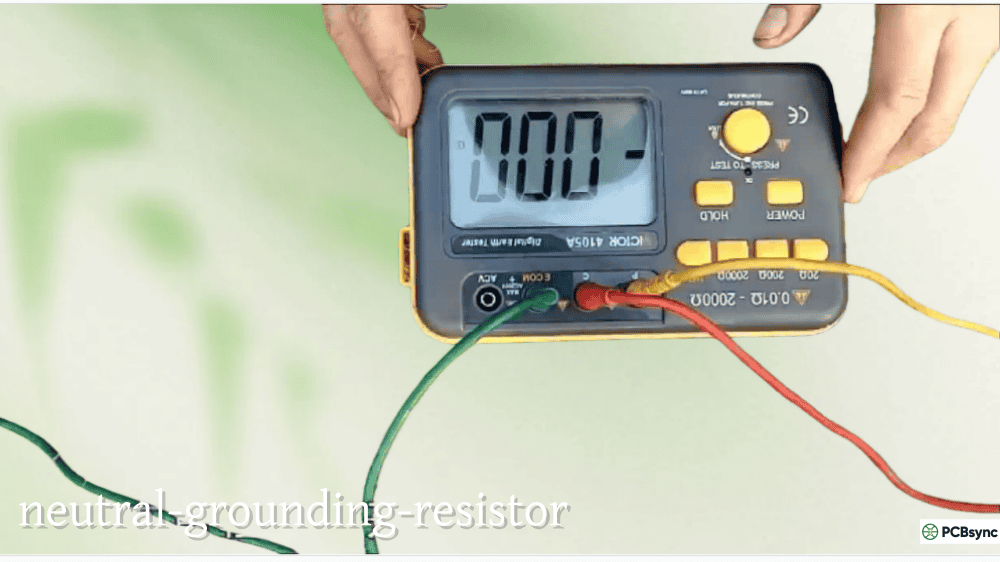
Touch probes to resistor leads (polarity doesn’t matter)
Read value – should show 2.0-2.4Ω for ±5% tolerance
Check for stability – value shouldn’t jump around
Troubleshooting Tips:
If reading shows “0” or very low: Check probe resistance, test probes are often 0.1-0.5Ω
If reading is 10-20% high: Finger pressure on leads adds resistance
If value is way off: Wrong resistor or damaged component
If reading fluctuates wildly: Poor connection or failing resistor
For accurate low-resistance measurements, use a 4-wire (Kelvin) meter if available. Standard DMM probes can add 0.2-0.5Ω error at 2.2Ω, that’s 10-20% error!
In-Circuit Testing
Testing a 2.2Ω resistor in-circuit is tricky because parallel paths affect readings. If possible:
LCSC (www.lcsc.com) – Great for Asia-based manufacturing
For Prototyping:
Amazon (mixed quality, convenient)
Jameco Electronics
SparkFun
Adafruit
Pro Tips:
Buy 50-100 pcs for prototyping, not 10 – shipping costs the same
Keep a stock of E12 values (including 2.2Ω) in your lab
Order from 2-3 sources for production to avoid supply chain issues
Check lead times – popular values ship same-day, obscure ones take weeks
Frequently Asked Questions
Can I use a 2.2 ohm resistor to replace a 2 ohm or 2.7 ohm resistor?
It depends on your application’s tolerance requirements. In non-critical applications like gate resistors or snubbers, a 2.2Ω can substitute for 2Ω (10% high) or 2.7Ω (18% low) without issues. For current sensing or precision voltage dividers, this substitution introduces significant error. Calculate the impact first: If your circuit specifies 2Ω ±5%, a 2.2Ω resistor is 10% high and outside tolerance. Design accordingly or specify the correct value.
Why does my 2.2 ohm resistor get extremely hot?
Heat generation follows P = I²R. At 2.2Ω, even moderate current creates substantial power dissipation. For example, 700mA produces P = (0.7)² × 2.2 = 1.08W of heat. If you’re using a 1/4W resistor, it’s massively overloaded (4× its rating). Solution: Calculate your actual power requirement and upsize accordingly. Use a 2W or 3W resistor, add heatsinking, or use multiple resistors in parallel to distribute power. Also verify your circuit isn’t drawing excessive current – a hot resistor might indicate a design problem.
What’s the difference between a 2.2Ω and 2.2kΩ resistor?
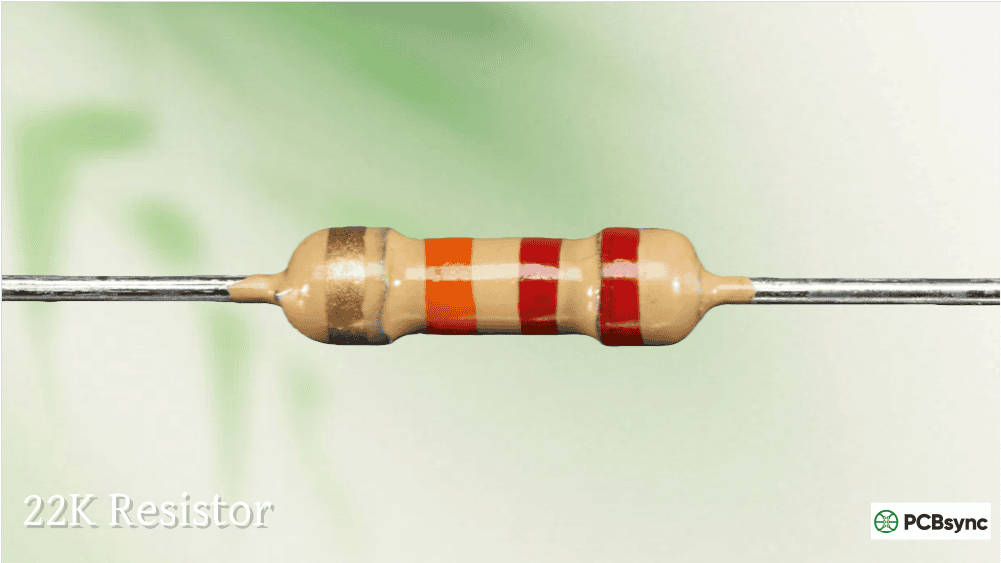
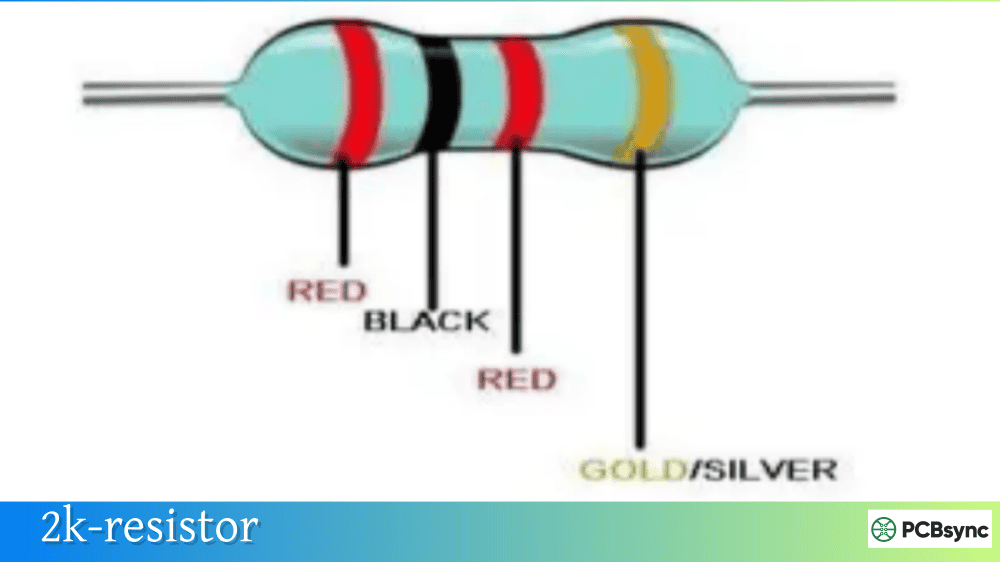
A factor of 1,000. The “k” stands for kilo, meaning thousand. A 2.2Ω resistor has 2.2 ohms of resistance, while 2.2kΩ has 2,200 ohms. This is an easy mistake to make, especially with faded color codes. The 2.2Ω resistor uses Red-Red-Gold-Gold, while 2.2kΩ uses Red-Red-Red-Gold. That third band makes all the difference. Always double-check with a multimeter. I’ve seen production runs scrapped because someone installed 2.2kΩ resistors where 2.2Ω was specified – the current was 1,000× too low and nothing worked.
Can I put two 4.4 ohm resistors in parallel to make 2.2 ohms?
Absolutely, and it’s often a better solution than a single resistor. When you parallel two identical resistors, the combined resistance is R_total = R/2. Two 4.4Ω resistors in parallel gives 2.2Ω. Benefits: (1) Power distribution – each resistor handles half the current, so two 1W resistors give you 2W capacity; (2) Redundancy – if one fails open, you still have 4.4Ω instead of infinite resistance; (3) Better thermal performance – heat spreads across a larger area. I use this technique regularly in current sensing applications. The only downside is board space and component count.
What tolerance should I choose for a 2.2 ohm resistor in current sensing?
For current sensing, specify ±1% tolerance minimum, preferably ±0.5% if accuracy matters. Here’s why: Your current measurement accuracy is directly limited by resistor tolerance. A ±5% resistor introduces ±5% current measurement error before considering ADC errors, noise, or temperature drift. If you’re measuring a 1A load with a ±1% resistor, your reading is accurate to ±10mA. With ±5%, you’re looking at ±50mA error – often unacceptable. Additionally, use a low TCR resistor (≤100 ppm/°C) because resistance drift with temperature adds another error source. The extra cost is negligible compared to the measurement quality improvement.
JLCPCB Basic Parts Library: Lists in-stock components including 2.2Ω resistors
PCBWay Assembly Components: Check availability before design finalization
Assembly Services Databases: Most fab houses provide component availability search
Summary and Best Practices
The 2.2 ohm resistor may seem basic, but proper selection and application require attention to detail. Here’s what you need to remember:
Critical Points for Design Success:
Always calculate power dissipation using P = I²R before selecting a resistor. Upsize by 2-3× for reliability.
Match tolerance to application needs. Use ±1% for current sensing, ±5% is fine for general use.
Consider temperature coefficient for circuits operating across wide temperature ranges or requiring precision.
Verify color codes with a multimeter before installation. The difference between 2.2Ω, 22Ω, and 220Ω is just one color band.
Plan for thermal management in your PCB layout. Add thermal vias under SMD resistors, increase copper pour, space components properly.
Use standard E12/E24 values in your designs. Fighting against standard values creates procurement headaches.
Stock E12 values in your lab including 2.2Ω. Having common values on hand speeds prototyping considerably.
The 2.2 ohm resistor might not be glamorous, but understanding its specifications, applications, and limitations separates experienced engineers from novices. Take the time to specify components correctly, and your designs will be more reliable, manufacturable, and cost-effective.
Remember: A $0.05 resistor incorrectly specified can cause a $50,000 production run failure. Measure twice, solder once. Or in PCB terms: simulate thoroughly, fabricate confidently.
Inquire: Call 0086-755-23203480, or reach out via the form below/your sales contact to discuss our design, manufacturing, and assembly capabilities.
Quote: Email your PCB files to Sales@pcbsync.com (Preferred for large files) or submit online. We will contact you promptly. Please ensure your email is correct.
Notes: For PCB fabrication, we require PCB design file in Gerber RS-274X format (most preferred), *.PCB/DDB (Protel, inform your program version) format or *.BRD (Eagle) format. For PCB assembly, we require PCB design file in above mentioned format, drilling file and BOM. Click to download BOM template To avoid file missing, please include all files into one folder and compress it into .zip or .rar format.