Inquire: Call 0086-755-23203480, or reach out via the form below/your sales contact to discuss our design, manufacturing, and assembly capabilities.
Quote: Email your PCB files to Sales@pcbsync.com (Preferred for large files) or submit online. We will contact you promptly. Please ensure your email is correct.
Notes: For PCB fabrication, we require PCB design file in Gerber RS-274X format (most preferred), *.PCB/DDB (Protel, inform your program version) format or *.BRD (Eagle) format. For PCB assembly, we require PCB design file in above mentioned format, drilling file and BOM. Click to download BOM template To avoid file missing, please include all files into one folder and compress it into .zip or .rar format.
1 Ohm Resistor: Complete Guide to Color Code, Power Rating & Current Sensing Applications
Working as a PCB engineer, I’ve learned that low-ohm resistors are some of the most misunderstood components in electronics. The 1 ohm resistor sits at a unique intersection where it’s low enough to function as a current sensing element yet high enough to work in standard circuit protection applications. If you’re designing power supplies, motor controllers, or battery management systems, understanding this component inside and out will save you from costly board respins.
This guide covers everything you need to know about the 1 ohm resistor, from correctly identifying its color bands to selecting the right power rating and implementing effective current sensing circuits.
A 1 ohm resistor is a passive electronic component that provides exactly 1 ohm of electrical resistance to current flow. This relatively low resistance value makes it particularly useful for applications where you need to measure current, limit inrush current, or provide minimal voltage drop while still offering circuit protection.
What sets the 1 ohm resistor apart from higher values is its dual nature. It’s low enough to pass significant current without excessive power loss, yet high enough to produce measurable voltage drops for current sensing applications. Using Ohm’s Law (V = IR), a 1 ohm resistor produces exactly 1 volt of drop for every 1 amp of current, making calculations remarkably straightforward.
Key Specifications of the 1 Ohm Resistor
Specification
Typical Values
Resistance
1Ω (nominal)
Standard Series
E6, E12, E24, E48, E96, E192
Tolerance Options
±0.1%, ±0.5%, ±1%, ±2%, ±5%, ±10%
Power Ratings
1/8W, 1/4W, 1/2W, 1W, 2W, 3W, 5W, 10W, 25W+
Temperature Coefficient
15-250 ppm/°C
Package Types
Axial through-hole, SMD (0402-2512), power packages
Construction
Carbon film, Metal film, Wirewound, Metal strip, Metal foil
1 Ohm Resistor Color Code Explained
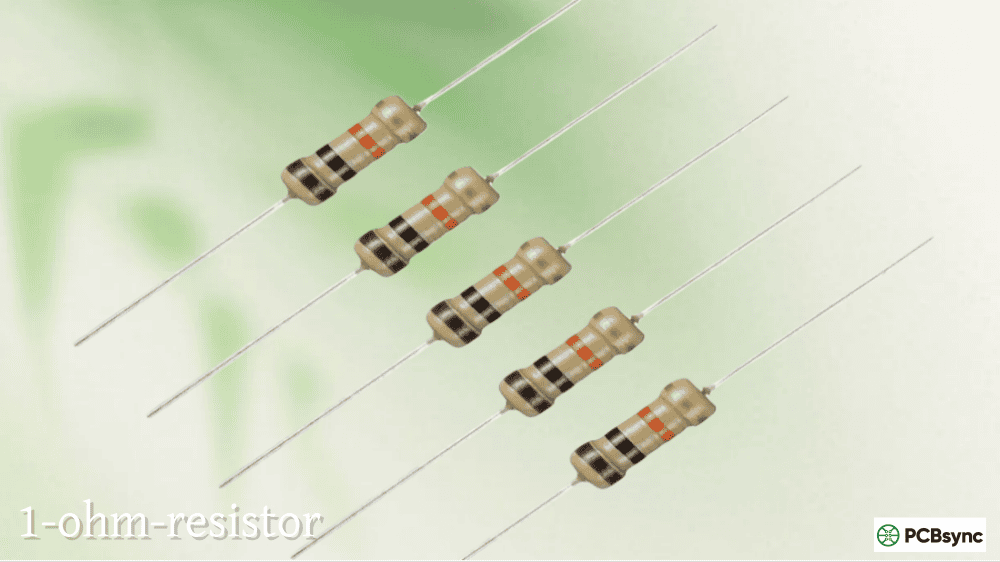
Reading the 1 ohm resistor color code requires understanding that values below 10 ohms use the Gold band as a multiplier (×0.1). This trips up many beginners since Gold typically appears only in the tolerance position for higher-value resistors.
4-Band 1 Ohm Resistor Color Code
The standard 4-band configuration for a 1 ohm resistor is:
Band Position
Color
Meaning
1st Band (First Digit)
Brown
1
2nd Band (Second Digit)
Black
0
3rd Band (Multiplier)
Gold
×0.1
4th Band (Tolerance)
Gold
±5%
Calculation: 1 + 0 = 10 × 0.1 = 1Ω ±5%
Note the two Gold bands. The third band (multiplier) being Gold indicates ×0.1, while the fourth band indicates ±5% tolerance. This can cause confusion, so always identify the tolerance band first by checking for the gap before it.
5-Band 1 Ohm Resistor Color Code (Precision)
For precision applications, 5-band resistors provide an extra significant digit:
Band Position
Color
Meaning
1st Band
Brown
1
2nd Band
Black
0
3rd Band
Black
0
4th Band (Multiplier)
Silver
×0.01
5th Band (Tolerance)
Brown
±1%
Calculation: 1 + 0 + 0 = 100 × 0.01 = 1Ω ±1%
6-Band 1 Ohm Resistor Color Code
For temperature-critical applications:
Band
Color Sequence
Meaning
Bands 1-5
Brown-Black-Black-Silver-Gold
1Ω ±5%
6th Band (TCR)
Brown
100 ppm/K
Complete Multiplier Reference for Low-Ohm Resistors
Understanding multipliers is critical for sub-10 ohm resistors:
Multiplier Color
Multiplier Value
Example Result
Black
×1
10 × 1 = 10Ω
Gold
×0.1
10 × 0.1 = 1Ω
Silver
×0.01
100 × 0.01 = 1Ω
Quick Color Code Reference Chart
Color
Digit
Multiplier
Tolerance
Black
0
×1
–
Brown
1
×10
±1%
Red
2
×100
±2%
Orange
3
×1,000
–
Yellow
4
×10,000
–
Green
5
×100,000
±0.5%
Blue
6
×1,000,000
±0.25%
Violet
7
–
±0.1%
Gray
8
–
±0.05%
White
9
–
–
Gold
–
×0.1
±5%
Silver
–
×0.01
±10%
Power Rating Selection for 1 Ohm Resistors
Power rating becomes critical with 1 ohm resistors because they often carry significant current. I’ve seen countless designs fail because engineers underestimated the power requirements.
Understanding Power Dissipation
For a 1 ohm resistor, power calculations are straightforward:
P = I²R simplifies to P = I² (since R = 1)
This means a 1 ohm resistor carrying 1 amp dissipates exactly 1 watt. Double the current to 2 amps, and you’re dissipating 4 watts.
Current Through Resistor
Power Dissipated
Minimum Rating (with 2× derating)
100mA
0.01W (10mW)
1/8W
250mA
0.0625W (62.5mW)
1/4W
500mA
0.25W
1/2W
1A
1W
2W
2A
4W
10W
3A
9W
25W
5A
25W
50W
Power Resistor Types for 1 Ohm Applications
Carbon Film (1/8W to 2W): Suitable for low-current applications and general-purpose use. Not recommended for precision current sensing due to higher TCR.
Metal Film (1/8W to 2W): Better stability and lower noise than carbon film. Good choice for precision applications with moderate power.
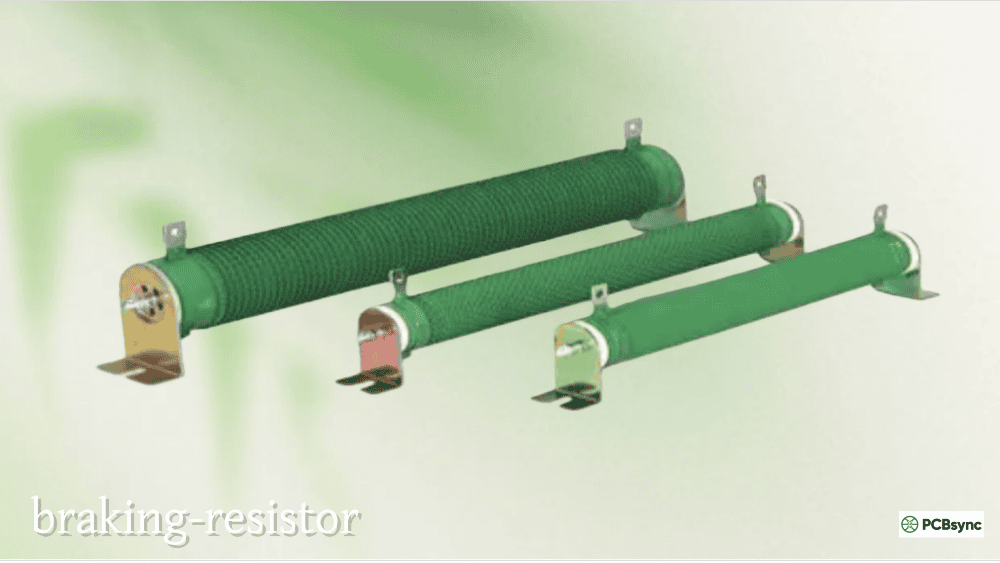
Wirewound (1W to 500W+): The go-to choice for high-power 1 ohm applications. Excellent power handling and stability, but watch for inductance in high-frequency circuits.
Metal Strip/Metal Foil: Premium choice for precision current sensing. Extremely low TCR and excellent stability under varying loads.
Surface Mount Power Ratings
Package Size
Typical Power Rating
Max Current (1Ω)
0402
1/16W (0.063W)
250mA
0603
1/10W (0.1W)
316mA
0805
1/8W (0.125W)
354mA
1206
1/4W (0.25W)
500mA
2010
1/2W (0.5W)
707mA
2512
1W
1A
Current Sensing with 1 Ohm Resistors
This is where the 1 ohm resistor really shines. Current sensing is essential for battery management, motor control, power supply feedback, and overcurrent protection.
How Current Sensing Works
A current sense resistor (also called a shunt resistor) is placed in series with the load. By measuring the voltage drop across the known resistance using Ohm’s Law, you can calculate the current:
I = V / R
For a 1 ohm resistor: I = V (current in amps equals voltage in volts)
This 1:1 relationship makes a 1 ohm resistor ideal for learning and prototyping current sensing circuits.
Current Sensing Example Calculations
Current Flow
Voltage Drop (1Ω)
Power Dissipated
10mA
10mV
0.1mW
100mA
100mV
10mW
500mA
500mV
250mW
1A
1V
1W
2A
2V
4W
High-Side vs Low-Side Current Sensing
Low-Side Sensing: The resistor is placed between the load and ground. This approach is simpler because the sense voltage is referenced to ground, making measurement straightforward. However, it interrupts the ground path, which can cause issues in some circuits.
High-Side Sensing: The resistor is placed between the power supply and the load. This maintains the ground reference but requires differential measurement or a current sense amplifier since the sense voltage rides on top of the supply rail.
Key Considerations for Current Sense Resistors
Tolerance: For accurate current measurement, use ±1% or better tolerance. A ±5% tolerance introduces up to 5% error in your current reading.
Temperature Coefficient (TCR): As resistors heat up during operation, their resistance changes. For precision applications, specify a TCR of 100 ppm/°C or lower. Metal foil resistors can achieve 15 ppm/°C or better.
Inductance: In circuits with fast-changing currents (like switching power supplies), resistor inductance can cause measurement errors. Specify low-inductance types or use 4-terminal (Kelvin) connections.
Power Derating: Current sense resistors often operate continuously near their limits. Derate by 50% or more for reliable long-term operation.
Practical Applications for 1 Ohm Resistors
Battery Management Systems (BMS)
In battery charging and monitoring circuits, 1 ohm resistors measure charge and discharge currents. The relatively high sense voltage makes ADC readings more accurate without requiring expensive precision amplifiers.
Motor Current Limiting
A 1 ohm resistor in series with a small DC motor limits inrush current and provides feedback for speed control circuits.
LED Current Measurement
When debugging LED driver circuits, a 1 ohm resistor provides an easy way to measure actual LED current with just a voltmeter.
Power Supply Load Testing
1 ohm power resistors (5W-50W) serve as dummy loads for testing power supplies and battery packs.
Overcurrent Protection
Combined with a comparator, a 1 ohm sense resistor can trigger shutdown when current exceeds safe limits.
IEC 60062: International standard for resistor color codes
IEC 60063: E-series preferred values
Frequently Asked Questions
What is the color code for a 1 ohm resistor?
A 4-band 1 ohm resistor has the color code Brown-Black-Gold-Gold. The Brown represents 1, Black represents 0, the first Gold is the ×0.1 multiplier, and the second Gold indicates ±5% tolerance. For a 5-band precision version with ±1% tolerance, the code is Brown-Black-Black-Silver-Brown.
Can I use a 1 ohm resistor for current sensing?
Yes, a 1 ohm resistor is excellent for current sensing applications, especially for learning and prototyping. It produces a 1:1 voltage-to-current ratio (1V per 1A), making calculations simple. However, for high-current applications, lower values (milliohms) are typically preferred to reduce power loss and heat generation.
What power rating do I need for a 1 ohm resistor?
Calculate power using P = I² (since R = 1 ohm). For 500mA, you need at least 0.25W; for 1A, at least 1W; for 2A, at least 4W. Always apply a 2× derating factor for reliability, so a 1A circuit should use a 2W resistor minimum.
Why does my 1 ohm resistor have two gold bands?
This is normal for low-value resistors. The third band (Gold) indicates a ×0.1 multiplier, which reduces the base value of 10 to 1 ohm. The fourth band (also Gold in 5% tolerance versions) indicates the tolerance. The gap before the tolerance band helps distinguish between them.
What’s the difference between a standard 1 ohm resistor and a current sense resistor?
While both have the same resistance value, dedicated current sense resistors are optimized for measurement applications. They feature tighter tolerances (often ±1% or better), lower temperature coefficients (TCR), lower inductance, and often include 4-terminal Kelvin connections for precise voltage sensing. Standard resistors work fine for basic applications, but precision current measurement requires purpose-built components.
Final Thoughts
The 1 ohm resistor is a versatile component that bridges the gap between standard resistance applications and precision current sensing. Its straightforward relationship between voltage and current makes it an ideal learning tool, while its availability in precision grades supports professional measurement systems.
When selecting a 1 ohm resistor, always start with your power requirements. Calculate I² to find your power dissipation, apply appropriate derating, then consider tolerance and TCR based on your accuracy needs. For current sensing, remember that the resistor itself introduces losses and voltage drop, so ensure your circuit can accommodate these effects.
Keep a variety of 1 ohm resistors in your component stock, ranging from 1/4W carbon film for general prototyping to precision 1% metal film types for measurement applications. They’re inexpensive insurance against circuit troubleshooting headaches.
Inquire: Call 0086-755-23203480, or reach out via the form below/your sales contact to discuss our design, manufacturing, and assembly capabilities.
Quote: Email your PCB files to Sales@pcbsync.com (Preferred for large files) or submit online. We will contact you promptly. Please ensure your email is correct.
Notes: For PCB fabrication, we require PCB design file in Gerber RS-274X format (most preferred), *.PCB/DDB (Protel, inform your program version) format or *.BRD (Eagle) format. For PCB assembly, we require PCB design file in above mentioned format, drilling file and BOM. Click to download BOM template To avoid file missing, please include all files into one folder and compress it into .zip or .rar format.