Inquire: Call 0086-755-23203480, or reach out via the form below/your sales contact to discuss our design, manufacturing, and assembly capabilities.
Quote: Email your PCB files to Sales@pcbsync.com (Preferred for large files) or submit online. We will contact you promptly. Please ensure your email is correct.
Notes: For PCB fabrication, we require PCB design file in Gerber RS-274X format (most preferred), *.PCB/DDB (Protel, inform your program version) format or *.BRD (Eagle) format. For PCB assembly, we require PCB design file in above mentioned format, drilling file and BOM. Click to download BOM template To avoid file missing, please include all files into one folder and compress it into .zip or .rar format.
1K Resistor: Color Code, Uses & Circuit Applications Complete Guide
The 1K resistor sits prominently in my component bins for good reason. With a resistance of 1,000 ohms, this component hits a practical sweet spot for countless circuit applications. From limiting LED current to biasing transistors and conditioning analog signals, I reach for a 1K ohm resistor more frequently than almost any other value in my daily design work.
This guide covers everything you need to identify, specify, and properly apply the 1K resistor in your electronic projects. Whether you’re protecting your first LED or designing professional-grade circuits, mastering this fundamental component will serve you throughout your engineering journey.
A 1K resistor is an electronic component that provides 1,000 ohms (1 kilohm) of electrical resistance. The “K” represents the metric prefix “kilo,” signifying 1,000. When current flows through a 1K ohm resistor, it creates a voltage drop and limits current flow according to Ohm’s Law (V = I × R).
The 1K value occupies a practical middle ground in the resistance spectrum. It’s low enough to provide adequate current for most applications yet high enough to offer meaningful protection for sensitive components. This balanced characteristic makes the 1K resistor one of the most versatile and commonly used values in electronics.
Specification
Typical Value
Resistance
1,000Ω (1kΩ)
Common Tolerances
±1%, ±5%
Power Ratings
1/8W, 1/4W, 1/2W, 1W
Temperature Coefficient
50-250 ppm/°C
Package Types
Through-hole, SMD (0402-2512)
At 5V, a 1K resistor allows 5mA of current to flow, making it perfect for LED circuits, transistor base drive, and signal conditioning applications where moderate current levels are needed.
1K Resistor Color Code Identification
Resistors use colored bands printed on their body to indicate resistance value and tolerance. Learning to read these bands quickly is essential for efficient circuit work.
4-Band 1K Resistor Color Code
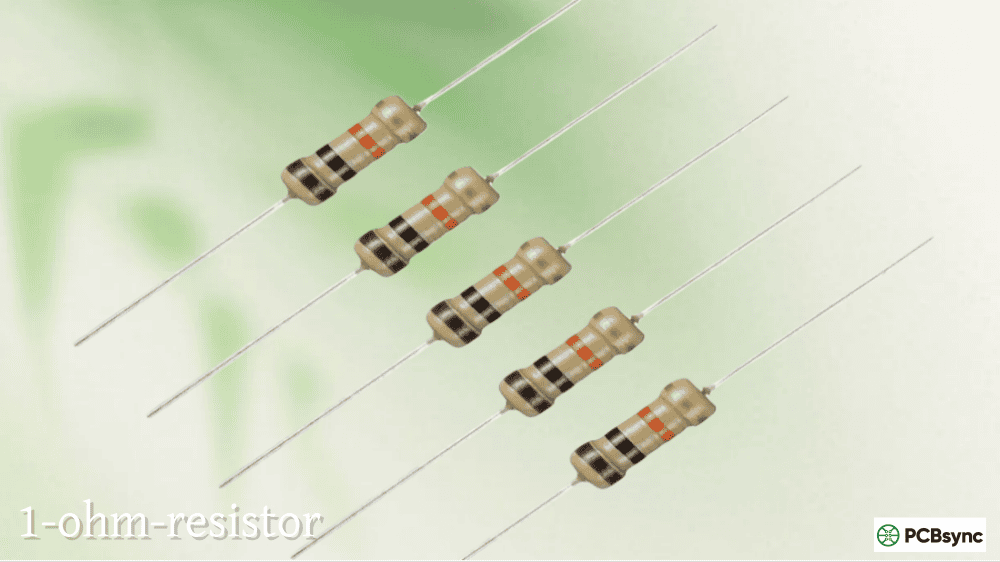
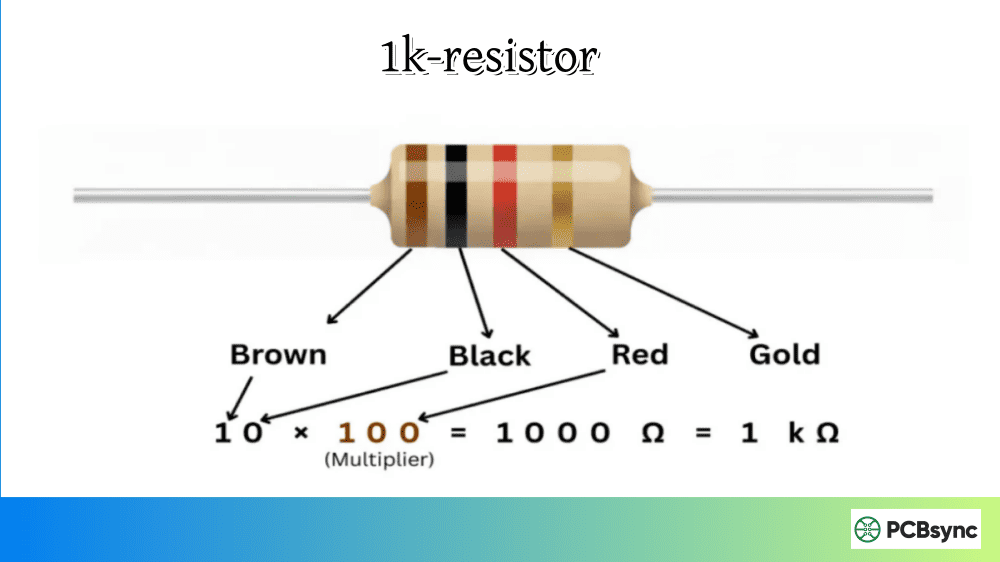
The standard 4-band color code for a 1K resistor is:
Band
Color
Value
1st Band
Brown
1 (first digit)
2nd Band
Black
0 (second digit)
3rd Band
Red
×100 (multiplier)
4th Band
Gold
±5% (tolerance)
Reading left to right: Brown (1) + Black (0) = 10, multiplied by Red (100) = 1,000 ohms. The gold tolerance band indicates the actual resistance can vary between 950Ω and 1,050Ω.
5-Band 1K Ohm Resistor Color Code
Precision resistors use five bands for tighter specifications:
Band
Color
Value
1st Band
Brown
1 (first digit)
2nd Band
Black
0 (second digit)
3rd Band
Black
0 (third digit)
4th Band
Brown
×10 (multiplier)
5th Band
Brown
±1% (tolerance)
The calculation: 100 × 10 = 1,000 ohms with ±1% tolerance. Five-band resistors provide the precision needed for sensitive analog circuits and calibration applications.
6-Band 1K Resistor Color Code
High-precision applications use 6-band resistors that include a temperature coefficient indicator:
Band
Color
Value
1st-4th Bands
Same as 5-band
Resistance value
5th Band
Brown
±1% tolerance
6th Band
Blue
10 ppm/°C TCR
The sixth band specifies resistance change per degree Celsius—critical information for precision instrumentation where temperature stability affects measurement accuracy.
SMD 1K Resistor Markings
Surface-mount 1K resistors use printed numerical codes:
Marking System
Code for 1K
Tolerance
3-Digit Code
102
±5% typically
4-Digit Code
1001
±1% typically
EIA-96 Code
01B
±1%
The 3-digit code “102” means 10 × 10² = 1,000Ω. The 4-digit code “1001” means 100 × 10¹ = 1,000Ω. Always verify SMD resistor values with a multimeter when markings are difficult to read.
1K Ohm Resistor Specifications
Selecting the correct 1K resistor requires understanding specifications beyond the resistance value.
Power Rating
The power rating determines how much energy the resistor can safely dissipate as heat without damage.
Power Rating
Through-Hole Size
SMD Package
Max Voltage (1K)
1/8W (0.125W)
Small axial
0402, 0603
~11V
1/4W (0.25W)
Standard axial
0805, 1206
~16V
1/2W (0.5W)
Large axial
1210, 2010
~22V
1W
Power resistor
2512
~32V
Calculate power dissipation using P = V²/R. For a 1K resistor at 5V: P = 25/1000 = 0.025W (25mW). A standard 1/4W resistor handles this easily with significant safety margin.
Tolerance
Tolerance specifies how much the actual resistance may deviate from the nominal 1,000Ω:
±5% (Gold band): 950Ω to 1,050Ω — adequate for LED circuits, pull resistors
±1% (Brown band): 990Ω to 1,010Ω — required for precision voltage dividers
±0.1% (Violet band): 999Ω to 1,001Ω — measurement and calibration circuits
For most hobbyist and general applications, ±5% tolerance works perfectly. Precision analog circuits and sensor interfaces benefit from tighter tolerances.
Resistor Types
Carbon Film: Economical, general-purpose, slightly higher noise Metal Film: Better precision, lower noise, excellent stability Wirewound: High power capability, precise values, more expensive Thick Film (SMD): Standard surface-mount, good balance of cost and performance
Common 1K Resistor Circuit Applications
The 1K ohm resistor appears in virtually every category of electronic circuit. Here are the applications where I use it most frequently.
LED Current Limiting
This is the classic 1K resistor application. LEDs require current limiting to prevent damage, and the 1K value works well for many common scenarios.
Using Ohm’s Law: I = (Vsupply – Vled) / R
For a typical red LED (Vf = 2V) with 5V supply: I = (5V – 2V) / 1000Ω = 3mA
This provides adequate brightness for indicator LEDs while keeping current well below the typical 20mA maximum rating. For brighter operation, use a lower resistance value like 330Ω or 220Ω.
Supply Voltage
LED Color (Vf)
Current with 1K
5V
Red (2.0V)
3.0mA
5V
Green (2.2V)
2.8mA
5V
Blue (3.2V)
1.8mA
12V
Red (2.0V)
10mA
3.3V
Red (2.0V)
1.3mA
Transistor Base Biasing
Transistors require controlled base current for proper switching or amplification. A 1K resistor commonly serves as the base resistor in BJT switching circuits.
For a transistor switch with 5V control signal and typical beta of 100: Base current = (5V – 0.7V) / 1000Ω = 4.3mA
This base current can support collector currents up to approximately 430mA (4.3mA × 100), sufficient for driving relays, motors, and other loads through the transistor.
Voltage Divider Circuits
Two resistors in series create a voltage divider. Using a 1K resistor with another value scales voltages for sensor interfaces or ADC inputs.
Vout = Vin × (R2 / (R1 + R2))
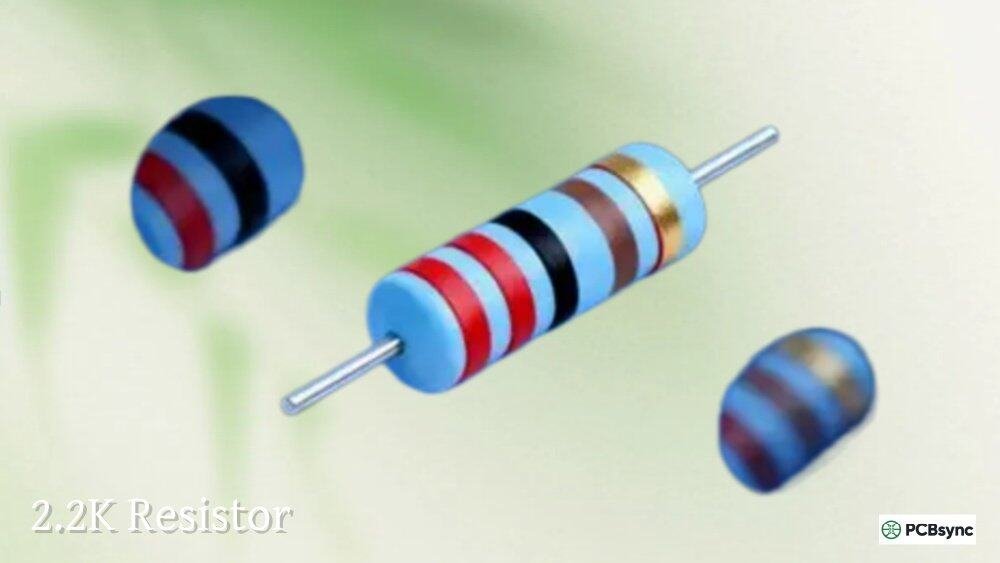
Example: 1K and 2.2K resistors with 5V input: Vout = 5V × (1000 / 3200) = 1.56V
This technique safely interfaces higher-voltage signals with lower-voltage microcontrollers or creates reference voltages for comparator circuits.
Pull-Up and Pull-Down Resistors
In digital circuits, 1K resistors ensure defined logic states on input pins. While 10K is more common for pull resistors, 1K provides stronger drive current—useful when dealing with noisy environments or long wire runs.
Pull-up: 1K connects input pin to VCC, ensuring HIGH when not driven Pull-down: 1K connects input pin to GND, ensuring LOW when not driven
The 1K value draws 5mA at 5V when the input is pulled opposite to the resistor, which is acceptable for most applications but consumes more power than higher-value pull resistors.
RC Timing Circuits
Combined with capacitors, 1K resistors set timing intervals. The time constant τ = R × C determines charge and discharge rates.
Capacitor Value
Time Constant (τ)
5τ (Full Charge)
1µF
1ms
5ms
10µF
10ms
50ms
100µF
100ms
500ms
1000µF
1s
5s
These timing relationships apply to 555 timer circuits, oscillators, debounce circuits, and filter designs.
Signal Conditioning and Filtering
A 1K resistor paired with capacitors creates low-pass or high-pass filters for signal conditioning. The cutoff frequency depends on the RC values:
fc = 1 / (2π × R × C)
With a 1K resistor and 0.1µF capacitor: fc = 1 / (6.28 × 1000 × 0.0000001) = 1,592 Hz
This simple RC filter removes high-frequency noise from analog signals before ADC conversion.
Verifying resistor values ensures circuit reliability and helps troubleshoot problems.
Multimeter Testing Procedure
Set the multimeter to resistance (Ω) mode
Select appropriate range — 2kΩ or 20kΩ range
Remove the resistor from the circuit (if installed)
Touch probes to each lead firmly
Read the display — should show approximately 1.00kΩ
A functioning 1K resistor with ±5% tolerance reads between 950Ω and 1,050Ω. Significantly different readings indicate wrong value, damage, or measurement error.
Common Testing Issues
Symptom
Likely Cause
Reading “OL” or infinity
Open resistor (failed)
Reading much lower
Parallel path in circuit
Reading much higher
Poor probe contact, oxidation
Fluctuating display
Intermittent connection
Always test resistors out-of-circuit when possible for accurate readings.
Selecting the Right 1K Resistor
Match the component specifications to your application requirements.
Selection Criteria Summary
Application
Recommended Specs
LED current limiting
1/4W, ±5%, through-hole or 0805
Transistor base drive
1/4W, ±5%, metal film preferred
Precision voltage divider
1/4W, ±1%, metal film
RC timing circuit
±1% for accurate timing
High-density PCB
1/8W, 0402 or 0603 SMD
Breadboard prototyping
1/4W, ±5%, through-hole
1K vs Other Common Values
Comparison
1K Resistor
10K Resistor
Current at 5V
5mA
0.5mA
LED brightness
Brighter
Dimmer
Power consumption
Higher
Lower
Pull resistor strength
Stronger
Weaker
Noise immunity
Better
Good
Choose 1K when you need more current or stronger signal drive. Choose 10K when minimizing power consumption matters more.
Useful Resources for 1K Resistors
Online Calculators and Tools
DigiKey Resistor Color Code Calculator (digikey.com)
LED Resistor Calculator (ohmslawcalculator.com)
Voltage Divider Calculator (allaboutcircuits.com)
RC Time Constant Calculator (electronics-tutorials.ws)
What current flows through a 1K resistor at different voltages?
Using Ohm’s Law (I = V/R), a 1K ohm resistor produces these currents: at 3.3V = 3.3mA, at 5V = 5mA, at 9V = 9mA, at 12V = 12mA. These moderate current levels make the 1K resistor ideal for LED circuits, transistor drive, and signal conditioning where you need meaningful current flow without risking component damage.
Can I use a 1K resistor instead of a 10K for pull-up applications?
Yes, but with trade-offs. A 1K pull-up draws 5mA at 5V versus 0.5mA for 10K—ten times more current. This provides stronger noise immunity and faster signal rise times but increases power consumption. For battery-powered devices, 10K is typically preferred. For noisy industrial environments or long cable runs, 1K may provide more reliable operation.
What’s the maximum voltage a 1K resistor can handle?
Maximum voltage depends on power rating, calculated using V = √(P × R). A 1/4W (0.25W) 1K resistor safely handles √(0.25 × 1000) ≈ 15.8V. A 1/2W version handles approximately 22.4V. Always maintain a 50% safety margin below these calculated maximums in your designs.
How do I choose between carbon film and metal film 1K resistors?
Metal film resistors offer better precision (±1% vs ±5%), lower noise, better temperature stability, and longer-term reliability. Carbon film resistors cost less and work fine for non-critical applications like LED current limiting or basic pull resistors. For precision voltage dividers, analog signal paths, or professional products, metal film is worth the small cost premium.
Can I combine resistors to create a 1K value if I don’t have one?
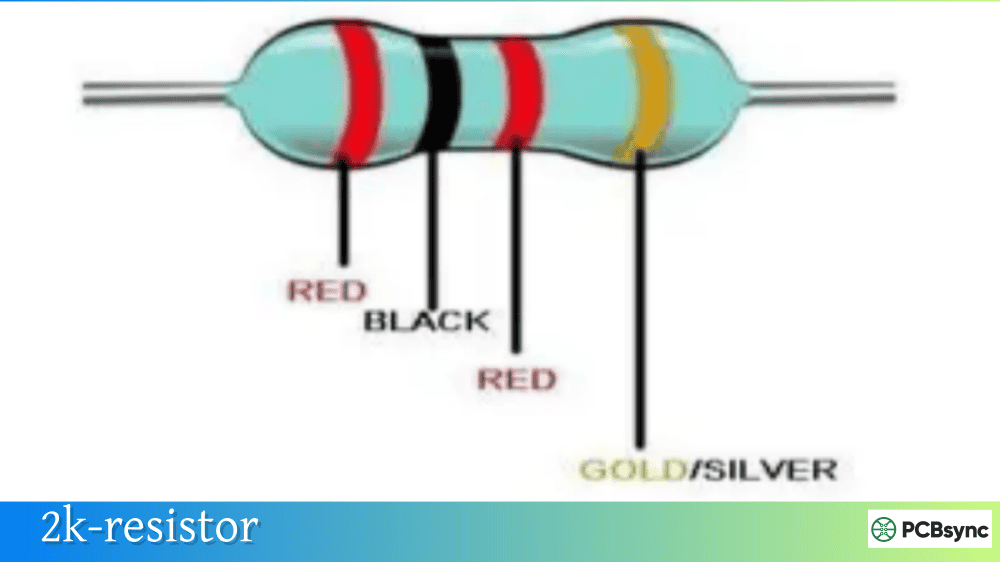
Absolutely. Two 2K resistors in parallel equal 1K. Two 500Ω resistors in series equal 1K. A 2.2K parallel with a 1.8K equals approximately 990Ω. When combining resistors, add tolerances—two ±5% resistors combined don’t guarantee ±5% final accuracy. For precision applications, use a proper 1K resistor rather than combining values.
Conclusion
The 1K resistor earns its place as an electronics staple through remarkable versatility. From the simple task of protecting an LED to the precision requirements of analog signal conditioning, this single value addresses an impressive range of circuit needs. Its balanced resistance provides enough current limitation for protection while allowing sufficient current flow for active applications.
Keep 1K resistors in multiple formats—through-hole for prototyping and various SMD sizes for production. Understanding when to choose 1K versus other values like 10K or 220Ω will develop naturally as you gain experience with different circuit requirements. For now, remember that the 1K ohm resistor excels at LED circuits, transistor switching, and applications where moderate current flow is desirable.
Inquire: Call 0086-755-23203480, or reach out via the form below/your sales contact to discuss our design, manufacturing, and assembly capabilities.
Quote: Email your PCB files to Sales@pcbsync.com (Preferred for large files) or submit online. We will contact you promptly. Please ensure your email is correct.
Notes: For PCB fabrication, we require PCB design file in Gerber RS-274X format (most preferred), *.PCB/DDB (Protel, inform your program version) format or *.BRD (Eagle) format. For PCB assembly, we require PCB design file in above mentioned format, drilling file and BOM. Click to download BOM template To avoid file missing, please include all files into one folder and compress it into .zip or .rar format.