Inquire: Call 0086-755-23203480, or reach out via the form below/your sales contact to discuss our design, manufacturing, and assembly capabilities.
Quote: Email your PCB files to Sales@pcbsync.com (Preferred for large files) or submit online. We will contact you promptly. Please ensure your email is correct.
Notes: For PCB fabrication, we require PCB design file in Gerber RS-274X format (most preferred), *.PCB/DDB (Protel, inform your program version) format or *.BRD (Eagle) format. For PCB assembly, we require PCB design file in above mentioned format, drilling file and BOM. Click to download BOM template To avoid file missing, please include all files into one folder and compress it into .zip or .rar format.
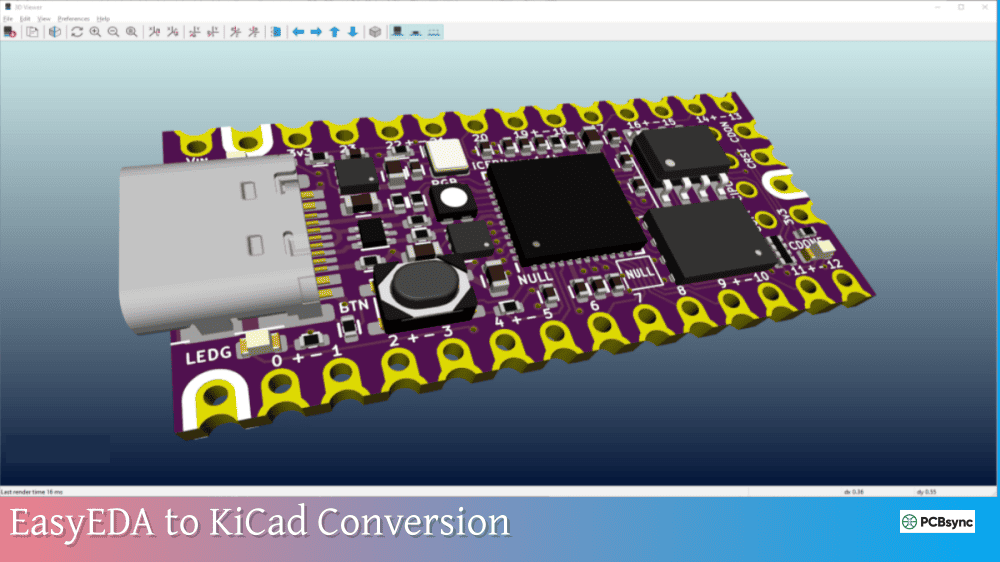
EasyEDA to KiCad Conversion: Migrate Projects Both Ways (Step-by-Step)
After working with both EasyEDA and KiCad for nearly a decade, I’ve lost count of how many times I’ve needed to move projects between these two platforms. Whether it’s collaborating with a team that uses different software, accessing LCSC component libraries in KiCad, or taking advantage of EasyEDA’s JLCPCB integration for a KiCad design—the ability to convert between EasyEDA to KiCad and KiCad to EasyEDA is an essential skill for modern PCB designers.
This guide covers every practical method for migrating projects in both directions, including the tools that actually work, the gotchas that will bite you, and the workflow I’ve refined through dozens of conversions.
Before diving into the how, let’s address the why. Both tools are excellent, but they have different strengths that make EasyEDA KiCad interoperability valuable.
When to Convert EasyEDA to KiCad
Scenario
Benefit
Complex multi-sheet designs
KiCad handles hierarchical schematics better
Team collaboration
KiCad’s local files work with Git version control
Advanced routing
KiCad’s push-and-shove router is superior
Offline work required
KiCad works without internet
Long-term archival
Open-source format ensures future access
When to Convert KiCad to EasyEDA
Scenario
Benefit
JLCPCB ordering
One-click ordering with automatic BOM/CPL
LCSC parts library
Direct access to millions of in-stock components
Quick prototyping
Cloud-based, no installation needed
Workshop/teaching
Easier for beginners to access
Cross-platform work
Works on any device with a browser
Many professional designers use both tools: KiCad for complex production designs and EasyEDA for quick prototypes destined for JLCPCB assembly. The Easy EDA to KiCad conversion capability lets you leverage each tool’s strengths.
EasyEDA to KiCad: Complete Conversion Methods
There are four main approaches for EasyEDA to KiCad conversion, each suited to different needs.
Method 1: Wokwi Online Converter (Fastest for PCB Only)
The Wokwi online tool is the quickest way to convert an EasyEDA to KiCad PCB file. It runs entirely in your browser—your files never leave your computer.
Best for: Quick PCB-only conversions when you don’t need the schematic.
Copper pours may require rebuilding (press ‘B’ in KiCad)
Method 2: easyeda2kicad Python Tool (Best for Component Libraries)
The easyeda2kicad.py Python package is the most popular tool for converting LCSC/EasyEDA components to KiCad libraries. It generates symbols, footprints, and 3D models.
Best for: Building a KiCad library from LCSC components for JLCPCB assembly.
Installation:
pip install easyeda2kicad
Basic Usage:
easyeda2kicad –full –lcsc_id=C2040
This creates:
Symbol in .kicad_sym file
Footprint in .pretty folder
3D model in .3dshapes folder (WRL and STEP formats)
For full project migration including both schematic and PCB, the easyeda2kicad6 TypeScript tool is the most comprehensive option for EasyEDA KiCad conversion.
Best for: Complete project migration when you need synchronized schematic and PCB.
Step-by-Step Workflow:
Export from EasyEDA:
Open your project in EasyEDA
For PCB: Document → Export → EasyEDA Source → save as ProjectName_PCB.json
For Schematic: Document → Export → EasyEDA Source → save as ProjectName_SCH.json
Convert PCB First:
Run: node dist/main.js “ProjectName_PCB.json”
Open the generated .kicad_pcb file in KiCad
Review conversion remarks (displayed on the PCB)
Add EasyEDA.pretty to your Footprint Libraries (Project Specific)
Go to File → Export → Export Footprints to Library
Choose “EasyEDA” as library and click OK
Convert Schematic:
Run: node dist/main.js “ProjectName_SCH.json”
Ensure the schematic file is in the same directory as the PCB
Open the .kicad_sch file in KiCad
Add the generated .sym file to Symbol Libraries
Run Tools → Annotate Schematic (keep existing annotations)
Converting KiCad to EasyEDA is more straightforward because EasyEDA has built-in import functionality.
Supported KiCad Versions
KiCad Version
EasyEDA Support
Notes
v4.x
Full support
Direct import
v5.x
Full support
Use archive function
v6.x
Full support
Requires zip packaging
v7.x
Partial
May need v6 re-save
v8.x
Check docs
Use format converter
Step-by-Step KiCad to EasyEDA Import
Prepare Your KiCad Project:
Open your project in KiCad
Go to File → Archive Project
This creates a ZIP file with all dependencies included
Alternatively, manually ZIP your .kicad_pcb, .kicad_sch, and symbol library files
Import into EasyEDA Standard:
Log into EasyEDA
Go to File → Import → KiCAD
Select your ZIP file
Wait for processing (may take a minute for large projects)
Review the imported project
Import into EasyEDA Pro:
Open EasyEDA Pro
Use the Format Converter tool (recommended for newer KiCad files)
Or import directly from the start page
Select your archived project ZIP
Common KiCad to EasyEDA Issues
Issue
Cause
Solution
Import fails
Cyrillic/special characters
Remove non-ASCII from filenames
Missing symbols
Symbols not in ZIP
Use KiCad Archive function
Power flags imported as symbols
EasyEDA interprets differently
Delete or convert manually
Design rules lost
Not supported in import
Recreate in EasyEDA
Version incompatibility
KiCad too new
Re-save in older KiCad version
Best Practices for Successful Conversion
After many EasyEDA to KiCad and KiCad EasyEDA conversions, I’ve developed these practices:
Before Any Conversion
Action
Purpose
Run DRC in source tool
Don’t import existing errors
Document component list
Track LCSC part numbers
Export fresh files
Avoid stale cached versions
Back up original
Never convert without backup
During Conversion
Practice
Reason
Convert PCB before schematic
Footprint libraries must exist first
Keep files in same folder
Tools expect co-located files
Use project-specific libraries
Avoid polluting global libraries
Note conversion remarks
Tools flag known issues
After Conversion
Verification
Method
Visual PCB comparison
Open both side-by-side
Run ERC and DRC
Let target tool catch issues
Print critical footprints 1:1
Verify dimensions physically
Check all net connections
Especially power nets
Verify copper pours
Often need rebuilding
Conversion Tools Comparison
Here’s how the main EasyEDA KiCad conversion tools compare:
Tool
Direction
Schematic
PCB
Libraries
3D Models
Difficulty
Wokwi Online
EasyEDA→KiCad
No
Yes
No
No
Easy
easyeda2kicad.py
EasyEDA→KiCad
No
No
Yes
Yes
Medium
easyeda2kicad6
EasyEDA→KiCad
Yes
Yes
Yes
No
Medium
EasyEDA Import
KiCad→EasyEDA
Yes
Yes
Yes
No
Easy
LC2KiCad
EasyEDA→KiCad
Yes
Yes
Yes
No
Advanced
Essential Resources
Here are the key resources for EasyEDA to KiCad and KiCad to EasyEDA conversion:
Resource
URL
Purpose
Wokwi Converter
wokwi.com/tools/easyeda2kicad
Online PCB conversion
easyeda2kicad.py
github.com/uPesy/easyeda2kicad.py
Component library conversion
easyeda2kicad6
github.com/yaybee/easyeda2kicad6
Full project conversion
LC2KiCad
github.com/RigoLigoRLC/LC2KiCad
Alternative converter
EasyEDA Import Docs
docs.easyeda.com/en/Import/Import-KiCAD
Official KiCad import guide
EasyEDA Pro Import
prodocs.easyeda.com/en/import-export/import-kicad
Pro version guide
PyPI Package
pypi.org/project/easyeda2kicad
Python package page
KiCad Forum
forum.kicad.info
Community support
Frequently Asked Questions
Can I convert an EasyEDA project to KiCad and maintain perfect synchronization between schematic and PCB?
Yes, but it requires careful workflow. Use easyeda2kicad6 and convert the PCB first, then the schematic. After importing both into KiCad, run “Update PCB from Schematic” with the option to relink footprints based on reference designators. This reconnects the schematic symbols to PCB footprints. However, expect to spend time manually fixing annotation mismatches and verifying all connections. The conversion isn’t perfect—always run DRC and visually inspect critical areas before trusting the result for manufacturing.
Why do my copper pours disappear or look wrong after EasyEDA to KiCad conversion?
KiCad handles copper pours (zones) differently than EasyEDA. After conversion, you often need to press ‘B’ in KiCad to rebuild all zones. If they still look wrong, check the zone priority settings—the converter may assign incorrect priorities when multiple zones overlap. Also verify that zone net assignments are correct; sometimes the conversion loses the net connection and you’ll need to reassign GND or power nets manually. For complex boards with many zones, budget extra time for zone cleanup.
Is there a way to convert just specific components from EasyEDA/LCSC to use in KiCad without converting an entire project?
Absolutely—this is actually the most common use case. Use easyeda2kicad.py with the LCSC part number to download individual components. For example, easyeda2kicad –full –lcsc_id=C2040 creates a complete KiCad library entry for the ESP32-WROOM-32 including symbol, footprint, and 3D model. You can then use this component in any KiCad project while still ordering from LCSC. Many designers maintain a personal library of converted LCSC parts specifically for this workflow—it gives you access to JLCPCB’s parts inventory without being locked into EasyEDA.
What gets lost or broken during conversion that I should watch out for?
Several things commonly need attention after conversion. Text positioning often shifts—both on silkscreen and in schematics. Multi-part components (like quad op-amps) may split into separate symbols requiring manual recombination. Design rules don’t transfer, so you’ll need to recreate your clearance and trace width rules. PCB art and logos convert to polylines that may need cleanup. Arcs in symbols sometimes malform due to format differences. And critically, always verify power connections—net names like “VCC” and “3V3” may not map correctly between tools. Never trust a conversion blindly; systematic verification is essential.
Can I go back and forth between EasyEDA and KiCad on the same project?
Technically yes, but I strongly advise against treating it as a regular workflow. Each conversion introduces small errors and losses. After a few round-trips, your design accumulates enough issues to cause real problems. Instead, pick one tool as your “source of truth” for each project. If you need to use both tools, maintain the master in one platform and treat conversions as one-way exports. If you must do round-trip development, keep meticulous notes about what changes in each conversion and manually verify everything after each direction change.
Troubleshooting Common Conversion Problems
Even with the best tools, EasyEDA to KiCad conversions can hit snags. Here are solutions to the most common issues I encounter.
Conversion Fails Completely
Symptom
Likely Cause
Fix
“Invalid JSON” error
Corrupted export
Re-export from EasyEDA
Tool crashes
File too large
Split into smaller sections
Empty output
Wrong file type
Ensure you exported “EasyEDA Source” not Gerber
Missing components
Incomplete export
Export schematic and PCB separately
Partial Conversion Issues
Problem
Cause
Solution
Footprints missing
Library not linked
Add EasyEDA.pretty to Footprint Libraries
Symbols not found
Symbol library missing
Add .sym file to Symbol Libraries
Net connectivity lost
Conversion error
Run Update PCB from Schematic
Wrong layer assignments
Layer mapping issue
Manually reassign in KiCad
Visual Differences After Conversion
Some visual differences are expected and don’t affect functionality:
Difference
Impact
Action Needed
Text position shifted
Aesthetic only
Manually adjust if needed
Silkscreen size changed
May affect readability
Verify before ordering
Via appearance
None
KiCad renders differently
Zone fill pattern
None
Press ‘B’ to rebuild
Advanced Conversion Tips
Handling Large Projects
For projects with multiple sheets or boards exceeding 100 components, I recommend this approach:
Export each schematic sheet separately
Convert PCB first to establish footprint library
Convert schematic sheets one at a time
Reassemble hierarchy in KiCad
Run comprehensive DRC after full assembly
Preserving Design Intent
To maintain design integrity across KiCad EasyEDA conversions:
Aspect
Preservation Method
Trace widths
Document before conversion, verify after
Clearances
Recreate design rules manually
Net classes
Must be recreated in target tool
Via sizes
Check and adjust if needed
Board stackup
Verify layer count and order
Version Control Integration
If you’re using Git for version control:
For EasyEDA projects: Export JSON files regularly and commit them—these are text-based and diff well.
For KiCad projects: The native .kicad_pcb and .kicad_sch files are already text-based and version-control friendly.
For converted projects: Maintain the original files alongside converted versions, with clear naming conventions indicating which is the source of truth.
Conclusion
The EasyEDA to KiCad and KiCad to EasyEDA conversion ecosystem has matured significantly over the past few years. What once required tedious manual recreation can now be accomplished with automated tools that handle most of the heavy lifting.
For component library conversion, easyeda2kicad.py is the gold standard—it lets you access the entire LCSC inventory from within KiCad. For quick PCB conversions, the Wokwi online tool can’t be beat for convenience. And for complete project migration, easyeda2kicad6 provides the most comprehensive solution, though it requires more manual cleanup afterward.
Going the other direction, EasyEDA’s built-in KiCad import works well for most projects. Just remember to use the Archive function in KiCad to ensure all dependencies are included, and watch out for special characters in filenames.
Whichever direction you’re converting, the key to success is systematic verification. Run DRC, check your power nets, verify critical footprints, and never trust a conversion for manufacturing without thorough review.
The ability to move between EasyEDA KiCad platforms gives you the flexibility to use the best tool for each situation—and that’s a competitive advantage worth having.
Inquire: Call 0086-755-23203480, or reach out via the form below/your sales contact to discuss our design, manufacturing, and assembly capabilities.
Quote: Email your PCB files to Sales@pcbsync.com (Preferred for large files) or submit online. We will contact you promptly. Please ensure your email is correct.
Notes: For PCB fabrication, we require PCB design file in Gerber RS-274X format (most preferred), *.PCB/DDB (Protel, inform your program version) format or *.BRD (Eagle) format. For PCB assembly, we require PCB design file in above mentioned format, drilling file and BOM. Click to download BOM template To avoid file missing, please include all files into one folder and compress it into .zip or .rar format.