Inquire: Call 0086-755-23203480, or reach out via the form below/your sales contact to discuss our design, manufacturing, and assembly capabilities.
Quote: Email your PCB files to Sales@pcbsync.com (Preferred for large files) or submit online. We will contact you promptly. Please ensure your email is correct.
Notes: For PCB fabrication, we require PCB design file in Gerber RS-274X format (most preferred), *.PCB/DDB (Protel, inform your program version) format or *.BRD (Eagle) format. For PCB assembly, we require PCB design file in above mentioned format, drilling file and BOM. Click to download BOM template To avoid file missing, please include all files into one folder and compress it into .zip or .rar format.
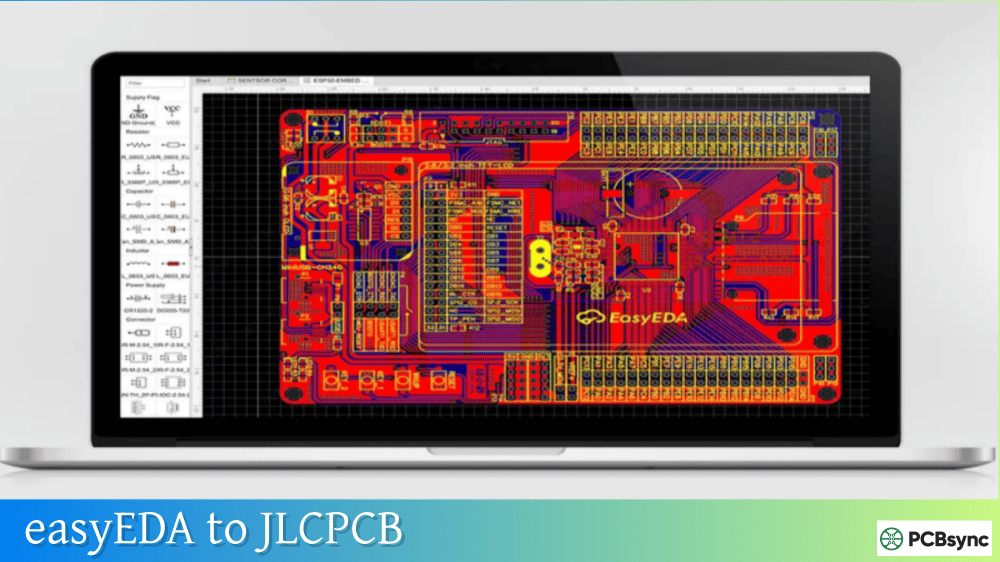
EasyEDA to JLCPCB: Complete Guide to PCB Manufacturing & SMT Assembly
I’ve been designing PCBs professionally for over eight years now, and the EasyEDA JLCPCB workflow has genuinely transformed how I approach prototyping. What used to cost hundreds of dollars and take weeks can now be done for a fraction of the price in just days. This guide covers everything you need to know about going from schematic to assembled boards using this powerful combination.
Before diving into the technical details, let me explain why this particular workflow is so popular among hobbyists and professionals alike. EasyEDA and JLCPCB are sister companies (along with LCSC for component sourcing), which means the integration between design software and manufacturing is seamless. When you design in EasyEDA using components from the LCSC library, those same components are available for JLCPCB SMT assembly without any translation headaches.
The typical workflow looks like this:
Design schematic in EasyEDA using LCSC/JLCPCB library components
No other EDA-to-manufacturer pipeline I’ve used comes this close to being truly turnkey.
Understanding the Complete EasyEDA to JLCPCB Workflow
Step 1: Setting Up Your EasyEDA Project Correctly
The key to a smooth EasyEDA to JLCPCB experience starts at the schematic stage. Here’s what I’ve learned after dozens of orders:
Always use JLCPCB/LCSC library components when possible. This is critical. When you search for components in EasyEDA’s library, look for the “JLCPCB Assembled” filter. These components have verified footprints and LCSC part numbers already attached, which eliminates guesswork later.
To find assembly-ready components:
Open the Library panel in EasyEDA
Click on “LCSC” or “JLCPCB Assembly” filter
Search for your component
Verify stock availability before placing
Check part availability before you commit to a design. There’s nothing worse than finishing a layout only to discover that key component is out of stock or not available for assembly.
Step 2: Understanding JLCPCB Part Categories
This is where many first-time users get surprised by costs. JLCPCB SMT assembly pricing depends heavily on which part categories you use.
Part Category
Description
Extra Fee
Best For
Basic Parts
Common components always loaded in machines
$0 per type
Resistors, capacitors, common ICs
Extended (Preferred)
Popular but not pre-loaded
$0 (Economic PCBA)
Common semiconductors
Extended Parts
Less common components
$3 per unique type
Specialty ICs, connectors
Pro tip from experience: Each unique Extended part adds $3 to your order. If your design uses 10 different Extended resistor values, that’s $30 in fees alone. I always try to consolidate to Basic parts where possible. For example, if my circuit needs 3.9kΩ but only 4.7kΩ is Basic, I’ll check if 4.7kΩ works for my application.
JLCPCB Basic Parts: What’s Actually Available
Here’s a quick reference of what you can typically find as Basic parts:
Component Type
Common Basic Options
Chip Resistors
0402, 0603, 0805 in E24 values
MLCC Capacitors
0402, 0603, 0805 common values
LEDs
0603, 0805 red, green, blue
Transistors
MMBT3904, MMBT3906, 2N7002
Diodes
SM4007, SS14
Voltage Regulators
AMS1117 series
Op-Amps
LM358, LM324
For anything not in this list, check the JLCPCB Parts Library directly rather than relying on EasyEDA’s database, as it’s more frequently updated.
Designing for EasyEDA SMT Assembly Success
PCB Layout Considerations
When laying out your PCB for JLCPCB assembly, keep these guidelines in mind:
Minimum component spacing: JLCPCB recommends at least 0.3mm between components for their pick-and-place machines.
Fiducial marks: While JLCPCB can add these automatically, I prefer adding them myself for better placement accuracy. Place at least two fiducials diagonally opposite on your board.
Process edges (rails): For small boards (under 70mm on any side), consider adding 5mm breakaway rails. This gives the pick-and-place machines something to grip.
Single-sided assembly (Economic): JLCPCB’s Economic PCBA service only assembles one side. If you need both sides assembled, you’ll need Standard PCBA service.
Component Orientation and Footprints
One of the most common issues with EasyEDA JLCPCB orders is component rotation. Here’s how to avoid problems:
In EasyEDA, always verify your footprint orientation matches the component datasheet
The “dot” or “band” on the 3D preview should match your schematic symbol’s pin 1
Use the CPL preview in JLCPCB’s ordering system to verify all rotations before confirming
JLCPCB’s preview system shows component orientation with a red dot indicating pin 1. I’ve caught rotation errors this way multiple times that would have resulted in non-functional boards.
Generating the Required Files for JLCPCB
The Three Essential Files
To order PCBs with assembly, you need three files:
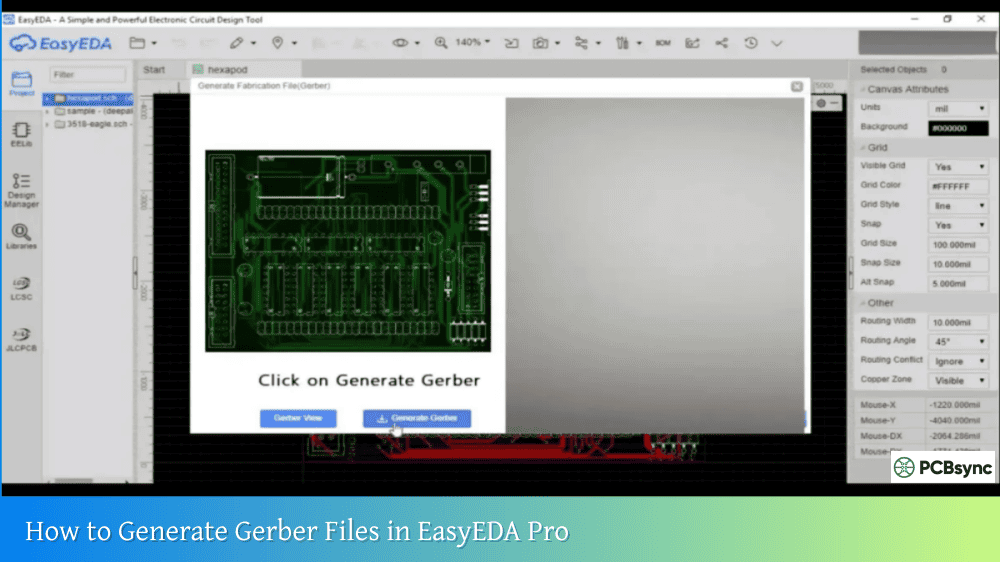
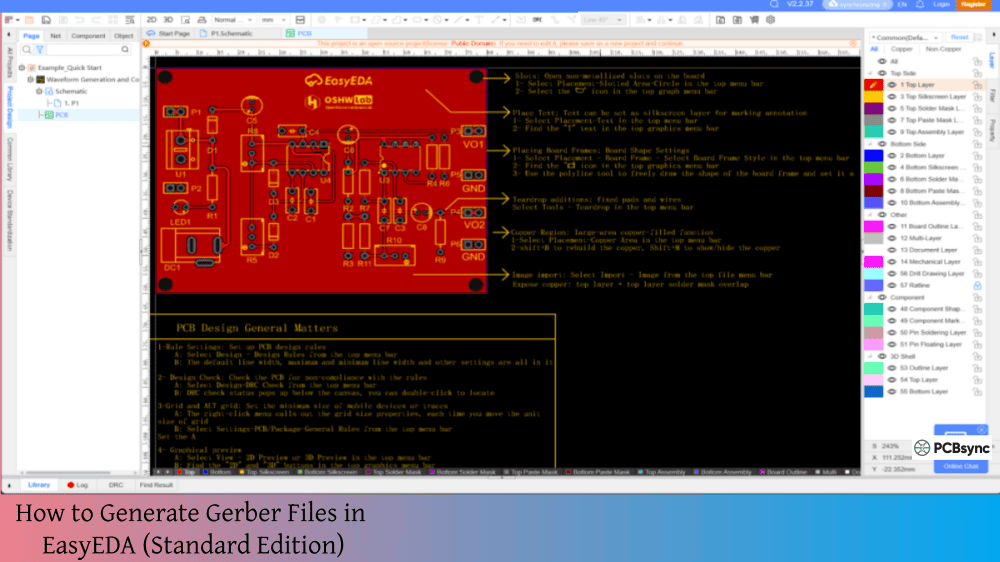
Go to Fabrication → PCB Fabrication File (Gerber) or click the Gerber icon
Review the preview to ensure all layers are correct
Click Order at JLCPCB for direct submission, or Download Gerber for the ZIP file
In EasyEDA Pro:
Open PCB design
Go to Export → PCB Fabrication File
Configure export settings (default is usually fine)
Click export
Always verify your Gerber before ordering. Use JLCPCB’s online Gerber viewer or a tool like gerbv to check that all layers align correctly and nothing is missing.
Generating BOM Files Correctly
The BOM tells JLCPCB which components to place. Here’s the critical part: every component needs an LCSC part number.
To export BOM in EasyEDA:
Open your schematic (not PCB)
Go to Fabrication → BOM or click the BOM icon
Review the LCSC Assembly column – all entries should show “Yes”
For any missing part numbers, click the assign icon to search LCSC
Export as CSV
BOM Format Requirements:
Column
Required
Description
Comment
Yes
Component value (10K, 100nF, etc.)
Designator
Yes
Reference designator (R1, C5, U3)
Footprint
Yes
Package type (0603, SOT-23)
LCSC Part #
Yes
LCSC component number (C25804)
Generating CPL/Pick-and-Place Files
The CPL file tells the assembly machine exactly where to place each component:
BOM and CPL files upload automatically when using this method
Review component matching
Complete checkout
This method eliminates most file format issues since EasyEDA and JLCPCB use the same data.
Method 2: Manual Upload
If you need more control or are working with exported files:
Go to jlcpcb.com and click Quote Now
Upload your Gerber ZIP file
Configure PCB parameters
Scroll down and enable SMT Assembly
Select assembly side (Top, Bottom, or Both)
Choose Economic or Standard PCBA
Upload BOM file
Upload CPL file
Review and confirm parts
Complete checkout
JLCPCB SMT Assembly: Economic vs Standard
Feature
Economic PCBA
Standard PCBA
Setup Fee
~$8
~$28
Assembly Side
Single side only
Both sides
Board Quantity
2-30
2-10,000+
Extended Part Fee
$3/type
$3/type
Preferred Extended Fee
$0
$3/type
Turnaround
3-5 days
3-7 days
Best For
Prototypes
Production runs
For most hobby projects and prototypes, Economic PCBA is the clear winner. I only use Standard when I need double-sided assembly or quantities over 30.
Common Issues and How to Solve Them
“Component Not Found” Errors
Problem: JLCPCB can’t match your BOM entry to their library.
Solutions:
Verify the LCSC part number is correct (format: C######)
Check if the part is in stock at jlcpcb.com/parts
Search for alternative parts with similar specifications
Remove the component from assembly and solder it manually
Rotation Errors in Preview
Problem: Components appear rotated incorrectly in JLCPCB’s preview.
Solutions:
Note the required rotation offset
Modify the CPL file’s rotation column
In EasyEDA, adjust the footprint rotation before export
For ICs, verify pin 1 orientation matches datasheet
Minimum Order Quantities
JLCPCB has minimum order quantities for components:
Component Type
Typical Minimum
Resistors, Capacitors
40 pieces
Diodes, Inductors
20 pieces
ICs
10 pieces
Tip: If you’re ordering 5 boards but need 40 resistors of one value, consider ordering 10 boards instead. The marginal cost increase is often less than paying for unused components.
The $3 per Extended part fee can add up quickly. Here’s how I minimize it:
Consolidate values: Instead of using 3.3kΩ, 3.9kΩ, and 4.7kΩ resistors, see if you can standardize on one or two values.
Use Basic alternatives: Chinese manufacturers like CJ (Changjiang) make pin-compatible alternatives to popular ICs that are often Basic parts. The CJ431 (TL431 equivalent) is a great example.
Check both categories: Sometimes the same component exists as both Basic and Extended under different manufacturer names.
Panel Pricing
For small boards, JLCPCB’s panelization can reduce per-unit costs:
Boards under 100x100mm: Special $2 pricing for 5 pieces
Panelized boards: Pay standard pricing based on panel size
For assembly, panel size limit is 250x250mm
Shipping Optimization
JLCPCB offers various shipping options. For non-urgent orders, combining with other purchases can reduce per-order shipping costs significantly.
Real-World EasyEDA to JLCPCB Example
Let me walk you through a recent project to illustrate the complete workflow:
Project: ESP32-based sensor node with power supply, sensors, and USB interface
Design phase:
Total components: 45
Basic parts: 38 (resistors, caps, LEDs, voltage regulator)
Extended parts: 7 (ESP32 module, sensor ICs, USB connector)
Cost breakdown:
Item
Cost
PCB (5 pcs, 50x40mm, 2-layer)
$2.00
SMT Assembly Setup
$8.00
Assembly Fee (~180 joints × $0.0017)
$0.31
Basic Parts
$1.24
Extended Parts (7 × $3 fee)
$21.00
Extended Part Components
$8.45
Stencil
$0 (included)
Total before shipping
$41.00
For 5 fully assembled boards with a custom design, that’s excellent value. The same order at a traditional assembly house would easily cost $200+.
Essential Resources and Links
Here are the official resources you’ll need:
Resource
URL
Purpose
EasyEDA Download
easyeda.com/page/download
Desktop client
EasyEDA Pro Editor
pro.easyeda.com/editor
Online editor
JLCPCB Order Page
jlcpcb.com/quote
Order PCBs
JLCPCB Parts Library
jlcpcb.com/parts
Search available components
JLCPCB SMT Assembly
jlcpcb.com/smt-assembly
Assembly service
EasyEDA Documentation
docs.easyeda.com
Standard edition docs
EasyEDA Pro Docs
prodocs.easyeda.com
Pro edition docs
JLCPCB Help Center
jlcpcb.com/help
FAQs and guides
Gerber Viewer
jlcpcb.com/quote (after upload)
Verify Gerber files
OSHWLab
oshwlab.com
Open source project sharing
Frequently Asked Questions
Can I use components not in JLCPCB’s library?
Yes, you have several options. You can use JLCPCB’s Global Parts Sourcing service where they’ll procure components from authorized distributors (adds time and handling fees). Alternatively, you can consign your own parts to JLCPCB’s inventory for future orders. The simplest option is to have JLCPCB assemble everything except those parts, then solder them yourself.
What’s the minimum order quantity for assembled boards?
For Economic PCBA, you can order as few as 2 assembled boards (out of a minimum 5 PCB order). For Standard PCBA, the minimum is also 2 assembled boards. However, ordering fewer assembled boards than your PCB quantity means you’ll need to manually populate the remaining boards.
How long does JLCPCB assembly take?
Typical turnaround times are 3-5 business days for Economic PCBA and 3-7 days for Standard PCBA after payment confirmation. Add shipping time based on your selected carrier. I usually receive complete orders in 7-12 days to the United States using standard shipping.
Does JLCPCB support through-hole assembly?
Yes, JLCPCB offers through-hole technology (THT) assembly using wave soldering. There’s an additional hand-soldering labor fee of $3.50 plus per-joint costs. THT assembly can be combined with SMT assembly in the same order.
What happens if a component becomes unavailable after I order?
JLCPCB will contact you with options: wait for restock, select an alternative component, or proceed without that component (with a partial refund). They won’t substitute components without your approval.
Advanced Tips for Experienced Users
Working with Multi-Board Projects
When your project involves multiple PCBs (like a main board and a daughter board), here’s how to handle the workflow efficiently:
Separate orders for different designs: JLCPCB charges a “different design” fee if you include multiple distinct PCBs in one order. For prototyping, I typically order each board separately to avoid confusion with BOM and CPL files.
Panelization for identical boards: If you need many copies of the same board, JLCPCB can panelize them for you, or you can create your own panel in EasyEDA. The key rules for SMT panelized boards:
Maximum panel size: 250×250mm
V-groove or tab-routed separation
Fiducials on the panel frame, not just individual boards
Same component orientation across all boards for efficient pick-and-place
Handling Special Components
Some components require extra attention in the EasyEDA to JLCPCB workflow:
BGA packages: JLCPCB can assemble BGA components, but they require X-ray inspection to verify solder joints. This adds to processing time and cost. Always verify your BGA is in their parts library before designing around it.
QFN/DFN packages: These leadless packages are tricky because the thermal pad underneath must be properly designed. In EasyEDA, ensure your footprint includes the correct thermal pad dimensions and that it’s connected to the appropriate net (usually ground).
Fine-pitch components: For components with 0.4mm pitch or finer, consider adding local fiducials near the component for better placement accuracy.
Connectors: Many connectors require hand soldering. Even surface-mount connectors often have through-hole mounting tabs that JLCPCB won’t populate. Factor in manual soldering time for these.
DFM Analysis: Catching Problems Before Production
JLCPCB provides a free Design for Manufacturing (DFM) analysis after you upload your Gerber files. Don’t skip reviewing this report. It catches issues like:
Trace widths that are too narrow for the selected copper weight
I’ve learned to always run EasyEDA’s built-in DRC (Design Rule Check) with JLCPCB’s design rules loaded before exporting. This catches most issues before they even get to the quote stage.
Version Control and Design Iteration
Professional PCB development rarely involves a single design spin. Here’s my approach to managing revisions:
Naming conventions: I name my Gerber exports with the project name and revision (e.g., SensorNode_v1.2_Gerber.zip). This makes it easy to track which files correspond to which JLCPCB orders.
Change documentation: Before ordering a new revision, I export the BOM and compare it against the previous version. EasyEDA Pro has built-in comparison tools, or you can use a simple diff on the CSV files.
Order notes: JLCPCB allows you to add notes to your order. I always include the revision number and any special instructions for the production team.
Understanding JLCPCB’s Manufacturing Process
Knowing what happens after you click “order” helps you design better boards and set realistic expectations.
After PCB fabrication, assembly adds these stages:
Stage
Typical Duration
What Happens
Kitting
2-4 hours
Gather all components
Solder Paste
1-2 hours
Apply via stencil
Pick and Place
1-4 hours
Machine placement
Reflow
30 min
Solder melting in oven
Inspection
1-2 hours
AOI (Automated Optical)
X-Ray (if needed)
1-2 hours
For BGA/QFN parts
Touch-up
Variable
Fix any issues
Understanding this process helps explain why “assembly” adds 2-3 days to your order.
Troubleshooting Common EasyEDA SMT Assembly Errors
“No SMD Parts Found” Error
This frustrating message usually means:
Wrong layer selected: You chose “Top” assembly but all SMD parts are on the bottom layer (or vice versa).
Through-hole only design: If your board only has THT components, you need to select THT assembly, not SMT.
CPL coordinate mismatch: The coordinates in your CPL file don’t match any pads on your board.
Fix: Re-export your CPL file ensuring you select the correct layer. In EasyEDA, double-check that component footprints are actually on the layer you think they are.
Price Discrepancies Between Quote and Checkout
If the final price is higher than expected:
Minimum order quantities: You may be paying for more components than you need.
Extended part fees: Each unique Extended part adds $3.
Feeder loading fees: Some rare components require special handling.
Solution: Review the detailed cost breakdown in the checkout process. JLCPCB itemizes every charge so you can identify unexpected costs.
Assembly Side Confusion
Problem: Components appear on the wrong side in preview.
Cause: The CPL file’s “Layer” column doesn’t match where you designed the components.
Solution: Check your footprint properties in EasyEDA. Each footprint should clearly indicate whether it’s on the Top or Bottom layer. Re-export the CPL file after verifying.
Comparing JLCPCB Assembly to Alternatives
While JLCPCB SMT assembly is my go-to for most projects, it’s worth understanding how it compares to alternatives:
Service
Setup Fee
Per-Joint Cost
Turn Time
Best For
JLCPCB
$8
$0.0017
3-5 days
Prototypes, small runs
PCBWay
$30+
~$0.002
3-5 days
Complex boards
Seeed Fusion
$15
~$0.0015
5-7 days
Maker projects
Hand Assembly
$0
Your time
Variable
Learning, urgent repairs
For most hobbyists and small-run production, JLCPCB’s pricing and EasyEDA integration make it hard to beat.
Quality Expectations and What to Inspect
When your assembled boards arrive, here’s what to check:
Occasional tombstoned 0402 components (usually still functional)
Slightly off-center placement (within spec but visible)
Flux residue around fine-pitch ICs (cosmetic only)
In over 50 assembly orders, I’ve had exactly two boards arrive with actual defects. JLCPCB’s customer service resolved both quickly with refunds.
Final Thoughts
The EasyEDA JLCPCB workflow has democratized PCB manufacturing in ways that weren’t possible even five years ago. For hobbyists, it means professional-quality boards are accessible at hobby budgets. For professionals, it means faster iteration cycles and lower prototyping costs.
My biggest advice for newcomers: start simple. Order a basic board with only Basic parts for your first assembly order. Get comfortable with the process before tackling complex designs with dozens of Extended parts. The learning curve isn’t steep, but understanding the quirks of BOM/CPL generation and part selection will save you money and frustration.
The integration between EasyEDA and JLCPCB continues to improve. Features like automatic file generation, one-click ordering, and real-time inventory checking make this workflow more seamless with each update. If you’re not already using this combination for your PCB projects, I highly recommend giving it a try on your next design.
Inquire: Call 0086-755-23203480, or reach out via the form below/your sales contact to discuss our design, manufacturing, and assembly capabilities.
Quote: Email your PCB files to Sales@pcbsync.com (Preferred for large files) or submit online. We will contact you promptly. Please ensure your email is correct.
Notes: For PCB fabrication, we require PCB design file in Gerber RS-274X format (most preferred), *.PCB/DDB (Protel, inform your program version) format or *.BRD (Eagle) format. For PCB assembly, we require PCB design file in above mentioned format, drilling file and BOM. Click to download BOM template To avoid file missing, please include all files into one folder and compress it into .zip or .rar format.