Inquire: Call 0086-755-23203480, or reach out via the form below/your sales contact to discuss our design, manufacturing, and assembly capabilities.
Quote: Email your PCB files to Sales@pcbsync.com (Preferred for large files) or submit online. We will contact you promptly. Please ensure your email is correct.
Notes: For PCB fabrication, we require PCB design file in Gerber RS-274X format (most preferred), *.PCB/DDB (Protel, inform your program version) format or *.BRD (Eagle) format. For PCB assembly, we require PCB design file in above mentioned format, drilling file and BOM. Click to download BOM template To avoid file missing, please include all files into one folder and compress it into .zip or .rar format.
EasyEDA Component Library: ATmega328P, LM2596, TP4056 & Popular Parts Guide
Finding the right component in EasyEDA’s library can feel like hunting for a needle in a haystack, especially when you’re working on a deadline. I’ve lost count of how many times I’ve typed “atmega328” into the search bar and scrolled through dozens of variations before finding the exact part I needed.
After years of working with EasyEDA on Arduino-based projects, battery-powered devices, and DC-DC converter circuits, I’ve built up a solid understanding of how to quickly locate parts like the ATmega328P, LM2596, TP4056, and even specialized components like the R_3386P_US trimmer potentiometer. This guide shares what I’ve learned, including the exact search terms that work, package variants you’ll encounter, and tips for avoiding common library pitfalls.
EasyEDA integrates multiple component sources into a single searchable database. Understanding these sources helps you find parts faster and choose the right ones for your project.
Library Sources in EasyEDA
Source
Description
Best For
LCSC
Parts directly from LCSC inventory
Production boards, JLCPCB assembly
System
EasyEDA’s built-in basic components
Quick prototyping, generic parts
User Contributed
Community-uploaded symbols/footprints
Specialty parts, modules
JLCPCB Assembled
Parts available for SMT assembly
Turn-key manufacturing
The LCSC library contains over 700,000 components, most with verified symbols and footprints. When you’re designing for JLCPCB assembly, sticking to LCSC parts saves significant time during BOM matching.
Searching the Library Effectively
Press SHIFT+F to open the library panel quickly. The search accepts:
When searching, select the correct Type (Symbol, Footprint, or both) and choose your preferred library source from the dropdown.
ATmega328P in EasyEDA: Finding the Right Variant
The ATmega328P EasyEDA library contains multiple package variants of this popular microcontroller. Choosing the wrong one means mismatched footprints and a wasted PCB order.
ATmega328P Package Options
Part Number
Package
Pin Count
Use Case
ATMEGA328P-PU
DIP-28
28
Breadboard prototyping, through-hole projects
ATMEGA328P-AU
TQFP-32
32
Surface mount, compact designs
ATMEGA328P-MU
QFN-32
32
Space-critical SMD applications
ATMEGA328P-AN
TQFP-32
32
Industrial temp range (-40 to +105°C)
For most Arduino-compatible projects, the ATMEGA328P-AU (TQFP-32) provides the best balance of compact size and solderability. The DIP package works well for prototypes where you might swap chips during development.
How to Find ATmega328P in EasyEDA Library
Open the Library panel (SHIFT+F)
Set Search Engine to “LCSC Electronics”
Type “ATMEGA328P” in the search box
Filter by package if needed (DIP, TQFP, QFN)
Check the LCSC stock number for assembly compatibility
The EasyEDA ATmega328P symbols include proper pin labeling for all GPIO, analog inputs, SPI, I2C, and UART functions. The TQFP-32 version adds two extra analog pins (ADC6, ADC7) compared to the DIP-28 package.
ATmega328P Schematic Symbol Tips
When placing the EasyEDA ATmega328P symbol, pay attention to:
Power pins (VCC, AVCC, GND, AREF)
Crystal oscillator connections (XTAL1, XTAL2)
Reset circuit requirements
Decoupling capacitor placement
The symbol in EasyEDA shows logical pin groupings, not physical pin numbers. Always verify the footprint matches your chosen package before converting to PCB.
LM2596 in EasyEDA: Buck Converter Options
The LM2596 EasyEDA library includes both standalone ICs and pre-made module footprints. Understanding the difference prevents ordering mistakes.
LM2596 Component Types
Type
What It Is
When to Use
LM2596S-5.0
IC only (TO-263-5)
Custom regulator design, tight spaces
LM2596S-ADJ
Adjustable IC
Variable output voltage needed
LM2596 Module
Pre-built converter module
Fast prototyping, non-critical space
LM2596 DC-DC Converter Footprint
Module mounting holes
Using off-shelf modules
Finding the LM2596 IC vs Module
When you search “LM2596” in EasyEDA, you’ll see both ICs and modules. Here’s how to identify each:
For the IC (surface mount design):
Search: “LM2596S” or the full part number
Package shows as TO-263-5 or similar
Requires external inductor, diode, capacitors
For module footprints:
Search: “LM2596 module” or “LM2596 buck converter”
Shows mounting hole patterns
Includes 4-pin connections (VIN+, VIN-, VOUT+, VOUT-)
LM2596 EasyEDA Design Considerations
The LM2596 runs at 150kHz switching frequency. When laying out a custom design:
Place input capacitor close to VIN
Keep the diode and inductor loop tight
Use wide traces for power paths (minimum 40 mil for 3A)
Add copper pour for thermal management
EasyEDA’s built-in module footprints work well when you’re integrating cheap Chinese modules into a larger system. The standard blue adjustable modules measure approximately 43mm x 21mm.
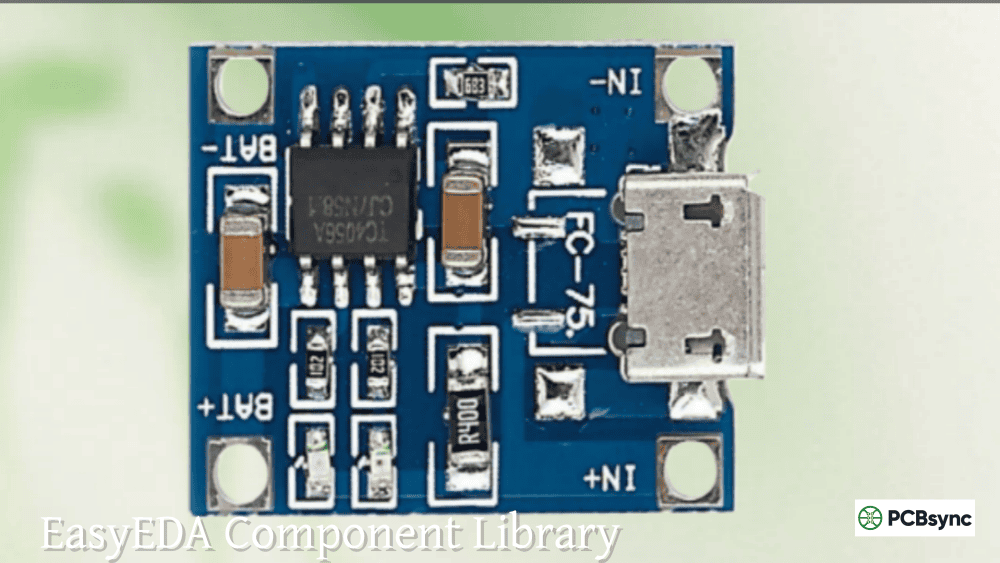
The TP4056 EasyEDA library supports both the charging IC and complete module footprints. This chip handles single-cell lithium battery charging with CC/CV methodology.
TP4056 Component Specifications
Parameter
Value
Input Voltage
4V to 8V
Charge Current
1A (programmable via resistor)
Charge Voltage
4.2V
Package
ESOP-8
Charge Termination
Current drops to 1/10th of set current
TP4056 Search Tips in EasyEDA
The TP4056 EasyEDA library contains:
TP4056 IC (ESOP-8): Search “TP4056” and filter for ESOP-8 package. LCSC part number C382139 is commonly available for JLCPCB assembly.
TP4056 Module: Search “TP4056 module” for footprints of common Chinese charging boards. These include micro-USB input and protection circuitry.
TP4056 with DW01 protection: Some user-contributed libraries include complete charging and protection circuits as reusable modules.
Many EasyEDA community projects combine the TP4056 with DW01A protection IC and FS8205A dual MOSFET for complete battery management.
R_3386P_US: The Bourns Trimmer Potentiometer
The R_3386P_US component in EasyEDA represents the Bourns 3386P series trimmer potentiometer. These precision pots are essential for adjustable voltage dividers, calibration circuits, and bias adjustments.
3386P Trimmer Specifications
Parameter
Value
Resistance Range
10Ω to 5MΩ
Power Rating
0.5W at 70°C
Tolerance
±10%
Adjustment
Top or side (depends on variant)
Size
9.53mm x 9.53mm x 4.83mm
Mounting
Through-hole (2.54mm pin spacing)
Finding R_3386P_US in EasyEDA
Search “3386P” in the EasyEDA library to find multiple resistance values. The naming convention follows:
3386P-1-502: 5kΩ
3386P-1-103: 10kΩ
3386P-1-104: 100kΩ
3386P-1-503: 50kΩ
The R_3386P_US footprint uses the standard Bourns 3386P outline with 2.54mm (100 mil) pin spacing, making it breadboard-compatible.
3386P Footprint Considerations
The 3386P series comes in several terminal configurations:
P: Inline pins
F: Gull-wing SMD
W: Side adjust with extended leads
X: Inline pins, side adjust
When selecting the R_3386P_US in EasyEDA, verify the adjustment direction (top or side) matches your enclosure requirements.
Working with JLCPCB Assembly Parts
One of EasyEDA’s strongest features is direct integration with JLCPCB’s assembly service. Understanding Basic vs Extended parts saves money.
Basic vs Extended Parts Cost Comparison
Part Type
Setup Fee
Per-Part Cost
Typical Components
Basic
$0
Component cost only
Common resistors, capacitors, diodes
Extended
$3 per unique part
Component cost + fee
Specialized ICs, modules
The ATmega328P-AU, LM2596, and TP4056 typically fall under Extended parts, adding $3 each to your assembly order. However, this is still cheaper than hand-soldering TQFP and ESOP packages.
Checking Part Availability
Before finalizing your schematic:
Visit jlcpcb.com/parts
Search for each component
Verify stock levels
Note the Basic/Extended classification
Parts showing “0 stock” in JLCPCB may still be available at LCSC but won’t be usable for assembly service.
Importing External Component Libraries
When EasyEDA’s built-in library doesn’t have your part, external sources can fill the gap.
External Library Sources
Source
Supported Formats
Best For
SnapEDA
Eagle, KiCad, EasyEDA
Popular ICs and connectors
Ultra Librarian
Multiple formats
Verified manufacturer symbols
SamacSys
KiCad, Eagle
Broad component selection
Component Search Engine
Multiple
3D models included
To import external libraries:
Download in Eagle format
In EasyEDA: File > Import > Eagle
Select the .lbr file
Check imported symbols and footprints in your personal library
Verifying Imported Components
Always verify imported footprints against manufacturer datasheets. Check:
Pad dimensions and shapes
Pin spacing
Thermal pad requirements
Silkscreen accuracy
I’ve caught several footprint errors in user-contributed libraries that would have resulted in defective boards.
How do I find the ATmega328P in EasyEDA’s library?
Press SHIFT+F to open the library panel, select “LCSC Electronics” as the search engine, and type “ATMEGA328P”. You’ll see multiple variants including the ATMEGA328P-PU (DIP-28), ATMEGA328P-AU (TQFP-32), and others. Select the package that matches your design requirements. The TQFP-32 version is most common for compact surface-mount designs.
What’s the difference between LM2596 IC and LM2596 module in EasyEDA?
The LM2596 IC (part numbers like LM2596S-5.0 or LM2596S-ADJ) is the bare switching regulator chip requiring external components like an inductor, diode, and capacitors. The LM2596 module footprints are for mounting pre-built DC-DC converter boards. Use the IC for custom designs with space constraints; use module footprints when integrating off-the-shelf converter boards.
Can I use TP4056 parts from EasyEDA with JLCPCB assembly?
Yes, the TP4056 IC (LCSC part C382139) is available in JLCPCB’s assembly parts library. It’s classified as an Extended part, so there’s a $3 setup fee per order. The ESOP-8 package is straightforward for machine placement. Module footprints are for through-hole mounting of pre-built boards and cannot be assembled by JLCPCB.
Why can’t I find the R_3386P_US potentiometer in EasyEDA?
Search for “3386P” rather than the full designator. The R_3386P_US is a user-contributed component based on the Bourns 3386P trimmer series. If you can’t find it, try searching by the specific resistance value like “3386P-1-103” for 10kΩ. Alternatively, search LCSC by the manufacturer part number and create the component from the LCSC library entry.
How do I verify a component will work with JLCPCB assembly before designing?
Before starting your schematic, visit jlcpcb.com/parts and search for each major component. Check that the part is in stock and note whether it’s Basic or Extended. In EasyEDA, use the “JLCPCB Assembled” filter in the library search to see only assembly-compatible parts. This prevents surprises when you generate your BOM.
Making the Most of EasyEDA’s Library System
The component library is arguably EasyEDA’s strongest feature for production-oriented designers. With direct LCSC integration and seamless JLCPCB assembly support, you can go from schematic to manufactured board faster than with most other tools.
For projects using the ATmega328P, LM2596, TP4056, or similar popular parts, the library almost always has what you need. The key is knowing where to look and which variant to choose. When the built-in library falls short, external sources like SnapEDA and Ultra Librarian provide manufacturer-verified alternatives.
Take time to verify footprints against datasheets, especially for user-contributed components. One misplaced pad can turn a promising design into an expensive lesson. Build your personal library with verified parts you use frequently, and your future projects will move even faster.
Inquire: Call 0086-755-23203480, or reach out via the form below/your sales contact to discuss our design, manufacturing, and assembly capabilities.
Quote: Email your PCB files to Sales@pcbsync.com (Preferred for large files) or submit online. We will contact you promptly. Please ensure your email is correct.
Notes: For PCB fabrication, we require PCB design file in Gerber RS-274X format (most preferred), *.PCB/DDB (Protel, inform your program version) format or *.BRD (Eagle) format. For PCB assembly, we require PCB design file in above mentioned format, drilling file and BOM. Click to download BOM template To avoid file missing, please include all files into one folder and compress it into .zip or .rar format.