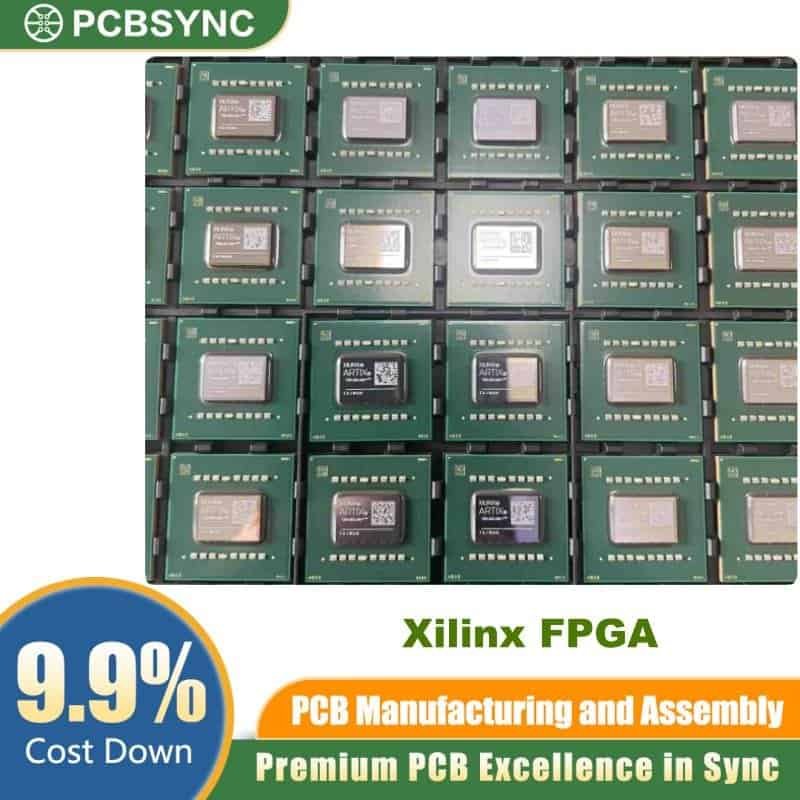
The XA3S500-4FT256Q is a robust automotive-qualified field-programmable gate array from the Xilinx FPGA XA Spartan-3 family, specifically designed for high-reliability automotive electronics and industrial applications. This programmable logic device delivers 500,000 system gates with proven 90nm technology to ensure dependable performance in demanding automotive environments.
Overview of XA3S500-4FT256Q FPGA
The XA3S500-4FT256Q represents Xilinx’s automotive excellence, providing designers with an AEC-Q100 qualified solution for safety-critical applications. Based on the reliable Spartan-3 architecture, this FPGA offers superior cost-performance balance for automotive infotainment, body electronics, powertrain control, and industrial automation systems.
Key Features of XA3S500-4FT256Q
This automotive-grade FPGA delivers exceptional capabilities for demanding applications:
- System Gates: 500,000 gates for complex logic implementations
- Logic Cells: 11,776 configurable logic cells
- Operating Frequency: Up to 326MHz system performance
- Process Technology: Proven 90nm CMOS technology
- Supply Voltage: 1.2V core voltage for efficient operation
- Package Type: 256-pin Fine-Pitch Ball Grid Array (FTBGA)
- Temperature Grade: Q-Grade (-40°C to +125°C TJ) for automotive
- AEC-Q100 Qualified: Full automotive certification
Technical Specifications Table
| Specification |
Value |
| Part Number |
XA3S500-4FT256Q |
| Family |
XA Spartan-3 Automotive |
| System Gates |
500K (500,000) |
| Logic Cells |
11,776 |
| Equivalent Logic Cells |
10,656 |
| CLB Array |
46 x 34 (1,564 CLBs) |
| Maximum Frequency |
326 MHz |
| Block RAM |
360 Kb |
| Distributed RAM |
73 Kb |
| Multipliers |
20 dedicated 18×18 multipliers |
| DCMs |
4 Digital Clock Managers |
| User I/Os |
190 |
| Differential Pairs |
77 |
| Package |
256-pin FTBGA |
| Package Size |
17mm x 17mm |
| Ball Pitch |
1.0mm |
| Core Voltage |
1.2V |
| Auxiliary Voltage |
2.5V |
| Process Technology |
90nm CMOS |
| Operating Temperature |
-40°C to +125°C (Q-Grade) |
| Compliance |
RoHS, AEC-Q100, Lead-Free |
Logic and Memory Resources
| Resource Type |
Quantity |
Details |
| Configurable Logic Blocks (CLBs) |
1,564 |
46 x 34 array |
| Slices per CLB |
4 |
6,256 total slices |
| LUTs |
12,512 |
4-input Look-Up Tables |
| Flip-Flops |
12,512 |
D-type registers |
| Block RAM Blocks |
20 |
18 Kb each |
| Total Block RAM |
360 Kb |
Dual-port configuration |
| Distributed RAM |
73 Kb |
From LUTs |
| 18×18 Multipliers |
20 |
Dedicated DSP blocks |
| Digital Clock Managers |
4 |
Advanced clock management |
XA3S500-4FT256Q Applications
Automotive Electronics Applications
The XA3S500-4FT256Q excels in automotive applications requiring extended temperature ranges and high reliability:
- Powertrain Control: Engine management, transmission control, and fuel injection systems
- Body Electronics: Lighting control, HVAC systems, power windows, and door modules
- Infotainment Systems: Audio processing, display controllers, and connectivity interfaces
- Driver Assistance: Sensor processing, camera interfaces, and radar signal processing
- Instrument Clusters: Digital dashboards, gauge control, and display management
- Gateway Modules: Network bridging, protocol conversion, and data routing
- Telematics: GPS interfaces, cellular communication, and vehicle tracking
Industrial Control Applications
Beyond automotive, this FPGA serves demanding industrial environments:
- Motor Control: Precision motor drives and servo control systems
- Factory Automation: PLC replacement and industrial controllers
- Process Control: Temperature, pressure, and flow control systems
- Machine Vision: Image acquisition and real-time processing
- Communications: Protocol converters and network interfaces
- Test Equipment: Instrumentation and measurement systems
Why Choose XA3S500-4FT256Q?
AEC-Q100 Automotive Qualification
The XA3S500-4FT256Q carries full AEC-Q100 qualification, ensuring reliability in harsh automotive environments. This certification validates the device’s ability to withstand automotive stress conditions including:
- Temperature cycling from -40°C to +125°C junction temperature
- High humidity and moisture resistance
- Mechanical shock and vibration
- Electromagnetic compatibility (EMC)
- Long-term reliability testing
Proven Spartan-3 Architecture
The XA Spartan-3 family builds on the highly successful commercial Spartan-3 architecture, providing:
- Mature, proven technology with extensive field history
- Comprehensive design tools and IP support
- Large installed base reducing development risk
- Well-documented architecture and design guidelines
Cost-Effective Solution
The XA Spartan-3 family delivers exceptional value by:
- Maximizing logic per dollar for high-volume production
- Reducing BOM costs through integration
- Eliminating high ASIC non-recurring engineering costs
- Providing field-upgradeable functionality
Design Flexibility and Future-Proofing
Unlike fixed-function ASICs, the XA3S500-4FT256Q offers:
- Complete programmability for design modifications
- Field upgrades without hardware changes
- Quick response to changing requirements
- Reduced time-to-market for new features
I/O Standards and Interface Support
| I/O Standard |
Support Level |
| LVTTL |
3.3V, 2.5V, 1.8V, 1.5V |
| LVCMOS |
3.3V, 2.5V, 1.8V, 1.5V, 1.2V |
| PCI |
33MHz and 66MHz compliant |
| LVDS |
Yes, high-speed differential |
| RSDS |
Reduced Swing Differential |
| HSTL |
1.8V Classes I, III, IV |
| SSTL |
2.5V and 1.8V Classes I, II |
| GTL/GTL+ |
Yes |
| ULVDS |
Ultra Low Voltage Differential |
| Digitally Controlled Impedance (DCI) |
Yes, on-chip termination |
Configuration and Programming
The XA3S500-4FT256Q supports multiple configuration modes for flexible system integration:
Configuration Modes
- Master Serial Mode: Direct connection to SPI flash or Platform Flash PROM
- Slave Serial Mode: Configuration from external microcontroller or processor
- Master SelectMAP Mode: 8-bit parallel configuration interface
- Slave SelectMAP Mode: Parallel configuration from system processor
- JTAG Mode: IEEE 1149.1 boundary scan configuration and debugging
- Boundary Scan: Full JTAG support for board-level testing
Configuration Memory Options
| Memory Type |
Description |
Typical Use |
| Platform Flash PROM |
Xilinx XCFxxS series |
Dedicated configuration storage |
| SPI Flash |
Standard serial flash devices |
Cost-effective option |
| Parallel Flash |
NOR flash memories |
High-speed configuration |
| System Memory |
Processor-based systems |
Flexible software control |
Development Tools and Software Support
ISE Design Suite
The XA3S500-4FT256Q is fully supported by Xilinx ISE Design Suite, providing:
- Synthesis: XST synthesis for HDL designs
- Simulation: ModelSim integration for verification
- Implementation: Place-and-route optimization
- Timing Analysis: Static timing analysis tools
- BitGen: Configuration bitstream generation
- ChipScope Pro: Internal logic analysis
HDL Language Support
- VHDL: Full IEEE 1076 support
- Verilog: IEEE 1364 compliant
- SystemVerilog: Modern verification features
- Mixed Language: VHDL and Verilog in same design
IP Core Library
Access to extensive Xilinx IP core libraries:
- Communication Protocols: PCI, Ethernet, USB, CAN
- DSP Functions: FIR filters, FFTs, NCOs
- Memory Controllers: SDRAM, DDR, SRAM interfaces
- Video Processing: Color space conversion, scaling
- Embedded Processors: MicroBlaze soft processor
Package Information and Pinout
| Package Detail |
Specification |
| Package Type |
Fine-Pitch Ball Grid Array (FTBGA) |
| Total Pins |
256 |
| Body Size |
17mm x 17mm |
| Body Thickness |
1.2mm typical |
| Ball Pitch |
1.0mm |
| Ball Diameter |
0.45mm ±0.05mm |
| Package Height |
1.7mm maximum |
| Solder Ball Material |
SAC305 (lead-free) |
| Moisture Sensitivity |
MSL3 (168 hours at 30°C/60% RH) |
Clock Management Features
The XA3S500-4FT256Q includes four Digital Clock Managers (DCMs) with advanced capabilities:
DCM Functions
- Clock Deskew: Eliminates clock distribution delays
- Frequency Synthesis: Multiply and divide clock frequencies
- Phase Shifting: Fine-grained phase control (±5ps resolution)
- Clock Conditioning: Duty cycle correction and jitter filtering
- Multiple Outputs: Simultaneous generation of multiple clock domains
Clock Multiplication and Division
| Function |
Range |
| Clock Multiplication |
2x to 32x |
| Clock Division |
/1, /1.5, /2, /2.5, … /16 |
| Phase Shift |
±360° in 256 steps |
| Duty Cycle Correction |
50% ±5% |
Power Management
Supply Voltage Requirements
| Rail |
Voltage |
Tolerance |
Function |
| VCCINT |
1.2V |
±5% |
Core logic power |
| VCCAUX |
2.5V |
±5% |
Auxiliary circuits and DLLs |
| VCCO |
1.2V to 3.3V |
±5% |
I/O bank power (user-selectable) |
Power Consumption Estimates
| Operating Mode |
Typical Current |
Conditions |
| Static Power |
50-150mA @ VCCINT |
No switching activity |
| Dynamic Power |
Device and design dependent |
Use XPower tools for estimation |
Environmental Compliance and Reliability
The XA3S500-4FT256Q meets stringent environmental and reliability standards:
Compliance Standards
- RoHS Directive: Lead-free construction
- REACH: EU chemical regulations compliant
- Conflict Minerals: Compliant with regulations
- Halogen-Free: Available upon request
- AEC-Q100 Grade 1: -40°C to +125°C qualification
- JEDEC Standards: Package and reliability testing
Reliability Features
- ESD Protection: Human Body Model (HBM) >2000V
- Latchup Immunity: >200mA on all pins
- Single Event Upset (SEU): Triple-mode redundancy support
- Configuration Memory: SRAM-based with CRC checking
Design Considerations for XA3S500-4FT256Q
Thermal Management
Proper thermal design ensures reliable operation:
- Junction Temperature: Monitor and maintain within -40°C to +125°C
- Thermal Resistance: Consider θJA and θJC values
- Heat Dissipation: Use thermal vias and copper pours
- Airflow: Provide adequate ventilation for higher power designs
- Thermal Simulations: Use CFD tools for validation
Power Distribution Network
The 256-pin FTBGA requires robust power delivery:
- Power Planes: Dedicate separate planes for VCCINT and VCCAUX
- Decoupling Capacitors: Follow Xilinx recommendations (typically 0.1µF and 10µF per supply)
- Via Stitching: Connect power and ground planes frequently
- Power Sequencing: VCCINT and VCCAUX can power up simultaneously; VCCO follows
- Current Monitoring: Implement power supply monitoring for safety-critical applications
PCB Layout Best Practices
For successful XA3S500-4FT256Q implementation:
- BGA Fanout: Use dogbone or via-in-pad routing
- Signal Integrity: Maintain controlled impedance for high-speed signals (typically 50Ω single-ended, 100Ω differential)
- Layer Stackup: Minimum 6-layer PCB recommended (signal-ground-power-power-ground-signal)
- Trace Routing: Keep clock and critical signals on inner layers when possible
- Via Design: Use 8-10mil drilled vias for fanout
- Ground Planes: Provide continuous ground reference under FPGA
Configuration Design
- Configuration Source: Select appropriate non-volatile memory
- Mode Selection: Use mode pins (M0, M1, M2) correctly
- JTAG Chain: Follow chain ordering and bypass recommendations
- Pull-ups/Pull-downs: Apply to configuration pins as specified
- Power-on Behavior: Understand I/O state during configuration
Comparison: XA3S500 vs XA3S500E
| Feature |
XA3S500-4FT256Q (Spartan-3) |
XA3S500E-4FT256Q (Spartan-3E) |
| Architecture |
Spartan-3 |
Spartan-3E (Enhanced) |
| Logic Cells |
11,776 |
10,476 |
| System Gates |
500K |
500K |
| Block RAM |
360 Kb |
360 Kb |
| Multipliers |
20 |
20 |
| DCMs |
4 |
4 |
| Maximum Frequency |
326 MHz |
572 MHz (higher in 3E) |
| User I/Os |
190 |
190 |
| Package Options |
FT256, FG456, FG676 |
FT256, PQ208, FG320, FG400 |
| Target Applications |
General automotive |
Consumer/cost-optimized |
Part Number Decoder
Understanding XA3S500-4FT256Q
Breaking down the part number:
- XA: Automotive qualified (AEC-Q100)
- 3S: Spartan-3 family
- 500: 500,000 system gates
- -4: Speed grade (-4, faster than -5)
- FT: Fine-pitch BGA, thin package
- 256: 256-pin package
- Q: Q-Grade temperature (-40°C to +125°C TJ)
Available Variations
| Part Number |
Speed Grade |
Temp Range |
Package |
| XA3S500-4FT256Q |
-4 (fastest) |
Q-Grade |
256-FTBGA |
| XA3S500-4FT256I |
-4 |
I-Grade (-40 to 100°C) |
256-FTBGA |
| XA3S500-5FT256Q |
-5 (slower) |
Q-Grade |
256-FTBGA |
Ordering and Availability
Where to Buy XA3S500-4FT256Q
The XA3S500-4FT256Q is available through:
- Authorized Xilinx (now AMD) distributors
- Major electronics distributors (Mouser, Digi-Key, Arrow)
- Automotive-qualified component suppliers
- Regional electronics distribution channels
Lead Time Considerations
- Standard Lead Time: 12-16 weeks typical for automotive-grade parts
- Last Time Buy: Check with manufacturer for product lifecycle status
- Automotive Grade: Longer lead times compared to commercial parts
- Minimum Order Quantities: May apply for automotive qualification
Frequently Asked Questions
What is the difference between XA and XC Spartan devices?
XA devices are automotive-qualified with AEC-Q100 certification and extended temperature ranges (-40°C to +125°C), while XC devices are commercial-grade products for standard operating conditions (0°C to +85°C).
Is the XA3S500-4FT256Q pin-compatible with commercial Spartan-3 devices?
Yes, the XA3S500-4FT256Q is pin-compatible with the commercial XC3S500-4FT256C, allowing development on commercial boards before transitioning to automotive-qualified components for production.
What configuration memory should I use?
For automotive applications, use automotive-qualified Platform Flash PROMs (XCFxxS-VO series) or automotive-grade SPI flash devices that support the extended temperature range.
Can I use ISE Design Suite for development?
Yes, ISE Design Suite fully supports the XA Spartan-3 family. Download the latest version from the AMD (Xilinx) website. Note that Vivado Design Suite does not support Spartan-3 devices.
Does the XA3S500-4FT256Q support partial reconfiguration?
No, the Spartan-3 family does not support partial reconfiguration. For applications requiring this feature, consider newer Xilinx families like 7-Series or UltraScale.
What is the expected lifetime of automotive-qualified FPGAs?
Automotive-qualified FPGAs are designed for 15-20 year operational lifetimes under automotive conditions. However, product availability depends on manufacturer lifecycle policies.
How do I handle SEU (Single Event Upset) in safety-critical designs?
Implement Triple Modular Redundancy (TMR) using Xilinx TMRTool, add configuration memory scrubbing, use CRC checking, and implement watchdog circuits for critical functions.
What development boards are available?
While dedicated XA3S500 automotive boards are rare, you can use commercial Spartan-3 development boards (like the Xilinx Spartan-3 Starter Kit) for initial development, as XA and XC devices are pin-compatible.
Conclusion
The XA3S500-4FT256Q delivers automotive-grade reliability combined with the proven Spartan-3 FPGA architecture. Its combination of 500,000 gates, 11,776 logic cells, and full AEC-Q100 qualification makes it an excellent choice for demanding automotive and industrial applications. Whether you’re designing powertrain control systems, body electronics, infotainment modules, or industrial automation systems, this Xilinx FPGA provides the performance, reliability, and flexibility needed for successful deployment.
With comprehensive I/O support, robust clock management, and extensive development tool support, the XA3S500-4FT256Q enables rapid development while ensuring long-term automotive reliability. Its extended temperature range (-40°C to +125°C) and automotive qualification provide confidence for mission-critical applications where failure is not acceptable.
The mature Spartan-3 architecture, backed by years of field deployment and extensive documentation, reduces development risk while providing a clear migration path for future designs. Combined with the flexibility of FPGA technology, the XA3S500-4FT256Q offers a compelling alternative to fixed-function ASICs with significantly reduced development costs and time-to-market.