Inquire: Call 0086-755-23203480, or reach out via the form below/your sales contact to discuss our design, manufacturing, and assembly capabilities.
Quote: Email your PCB files to Sales@pcbsync.com (Preferred for large files) or submit online. We will contact you promptly. Please ensure your email is correct.
Notes: For PCB fabrication, we require PCB design file in Gerber RS-274X format (most preferred), *.PCB/DDB (Protel, inform your program version) format or *.BRD (Eagle) format. For PCB assembly, we require PCB design file in above mentioned format, drilling file and BOM. Click to download BOM template To avoid file missing, please include all files into one folder and compress it into .zip or .rar format.
How to Export Assembly Drawing Files: Complete Guide for PCB Manufacturing
When I send boards out for assembly, the files that generate the most questions from contract manufacturers aren’t the Gerbers or even the BOM—they’re the assembly drawings. A well-prepared assembly drawing can eliminate dozens of clarification emails and prevent costly placement errors. A poorly prepared one (or worse, a missing one) can lead to misoriented ICs, backwards diodes, and expensive rework.
Assembly drawings serve as the visual blueprint that tells assemblers exactly how your board should look when complete. They show component placement, reference designators, polarity markings, and special assembly instructions that can’t be conveyed through coordinate files alone. This guide covers how to export these critical documents from major PCB design tools, what information to include, and how to format them for professional results.
What Are Assembly Drawing Files and Why Do They Matter?
Assembly drawings are documentation files that provide a visual representation of your PCB showing where every component should be placed, its orientation, and any special assembly requirements. Unlike pick-and-place files that give machines coordinate data, assembly drawings are primarily for human reference—used by operators, quality inspectors, and rework technicians.
A complete assembly drawing serves multiple purposes throughout the manufacturing process. During machine setup, operators verify that programmed placements match the designer’s intent. During inspection, technicians use the drawing to confirm component orientation and polarity. During rework and repair, these drawings become essential for identifying and replacing failed components.
Key Elements of a Professional Assembly Drawing
Every effective assembly drawing should include these essential elements:
Element
Purpose
Location
Board outline
Shows physical shape and dimensions
Background layer
Component outlines
Indicates placement boundaries
On component footprints
Reference designators
Identifies each component
Inside or adjacent to outline
Polarity markings
Shows orientation for polarized parts
Pin 1 dots, cathode marks
Assembly notes
Conveys special instructions
Title block or margins
Revision information
Tracks document version
Title block
Scale indicator
Confirms drawing magnification
Title block
The drawing should clearly distinguish between top and bottom assemblies, with bottom views typically mirrored so the viewer sees components as they would appear looking through the board from above.
Assembly Drawing vs. Fabrication Drawing
These two document types serve different purposes and go to different recipients:
Most projects require both drawings, though some manufacturers can work from comprehensive fabrication drawings that include assembly information.
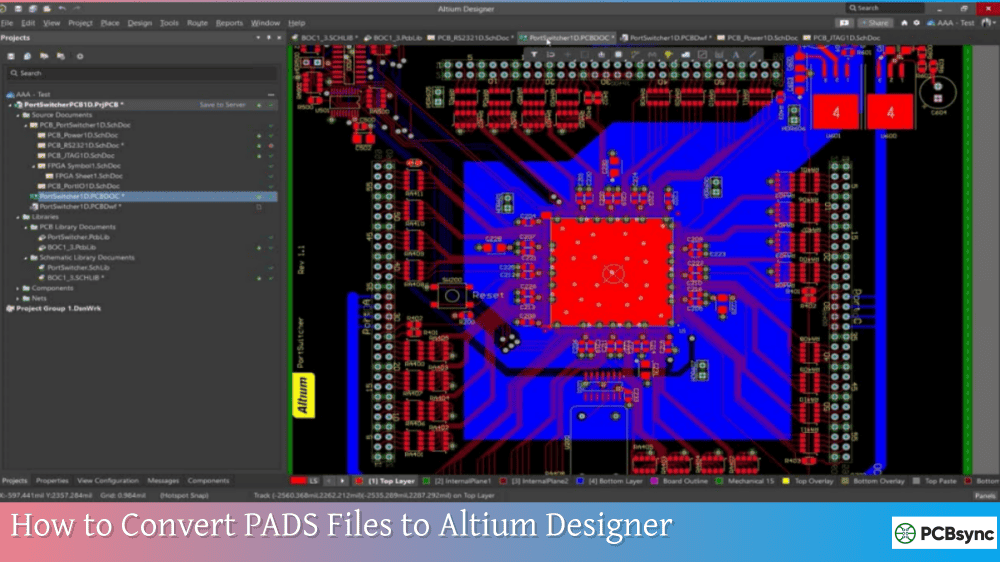
Exporting Assembly Drawings from Altium Designer
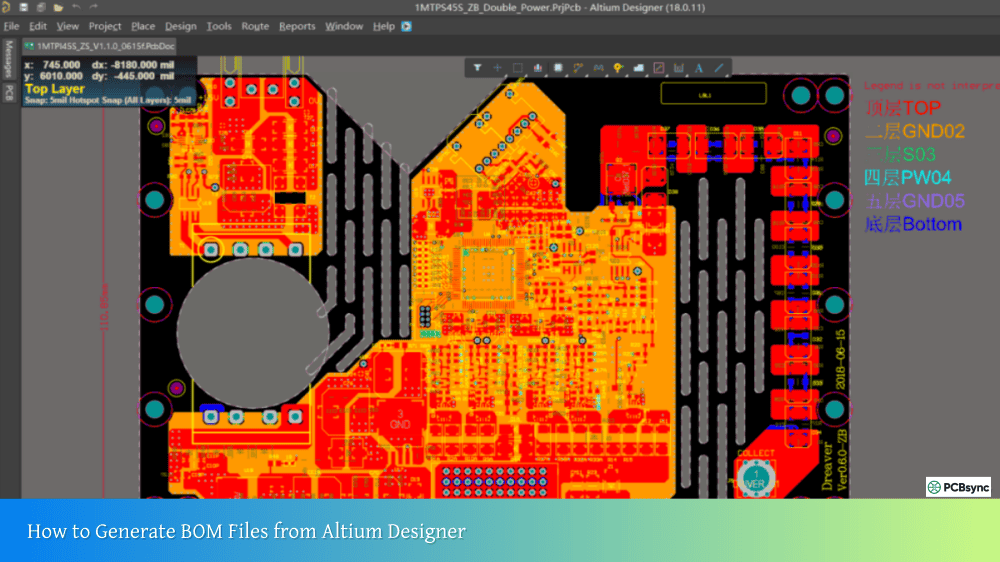
Altium Designer offers two distinct approaches to creating assembly drawings: the quick direct export method and the more powerful Draftsman application. I use the direct method for simple boards and Draftsman for anything going to a professional assembly house.
Method 1: Direct Assembly Drawing Export
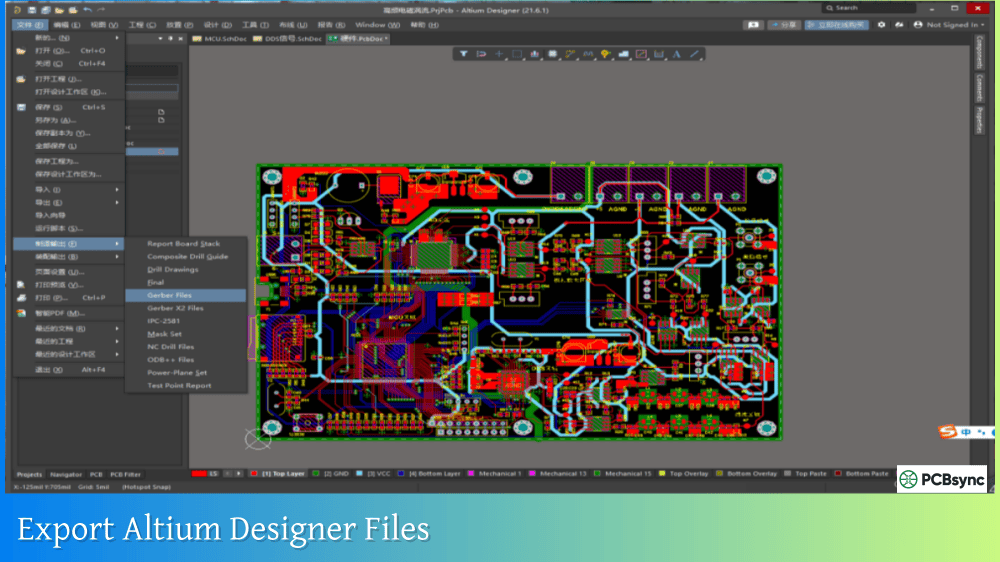
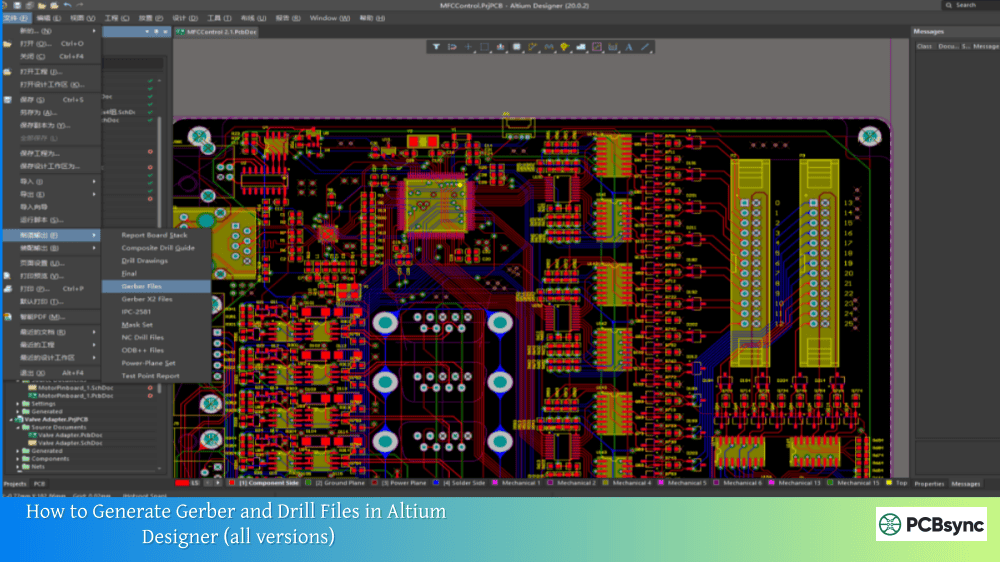
This is the fastest approach for generating basic assembly documentation. Open your PCB document (.PcbDoc) and navigate to File → Assembly Outputs → Assembly Drawings.
A preview window appears showing your board layout. Before exporting, right-click on the preview and select Configuration to specify exactly which layers appear in the output.
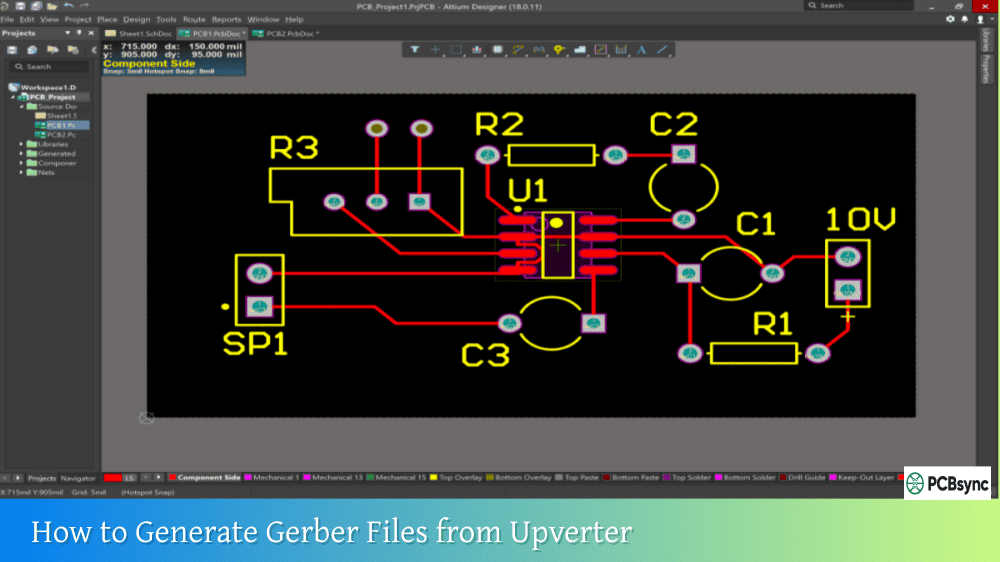
For a typical top-side assembly drawing, enable these layers: Top Overlay (silkscreen), Top Assembly, Mechanical 1 (board outline), and keep designators visible. Disable inner layers, bottom layers, and any mechanical layers not relevant to assembly.
After configuring layers, save your settings and select File → Export to PDF to generate the final document. Altium creates a PDF showing component placements with reference designators visible.
Method 2: Using Altium Draftsman for Professional Drawings
Draftsman is Altium’s dedicated documentation tool, and it produces dramatically better assembly drawings than the direct export method. The extra setup time pays off in clearer, more professional documentation.
Create a new Draftsman document by selecting File → New → Draftsman Document. Choose a template that matches your documentation standards, or start with the default and customize.
Place a Board Assembly View using Place → Board Assembly View from the menu. Click to position the view on your sheet. With the view selected, configure these properties in the Properties panel:
Scale: Set an appropriate magnification—2:1 or 4:1 for small boards, 1:1 for larger ones.
View Side: Select Top or Bottom depending on which assembly side you’re documenting.
Component Body: Choose “Assembly” display type for clean component outlines rather than 3D projections.
Add reference designators, dimensions, and any special callouts using Draftsman’s annotation tools. The resulting document can be exported to PDF via File → Export to PDF or added to an Output Job file for automated generation.
Including Draftsman in Output Jobs
For repeatable documentation generation, add your Draftsman file to an Output Job. Open or create an Output Job file (.OutJob), then under Documentation Outputs, select Add New Documentation Output → PCB Drawing and choose your Draftsman file.
Assign the output to a PDF container by selecting the PDF option and checking the Enable circle next to your drawing. Configure page setup by right-clicking and selecting Page Setup—ensure the Color Set is “Color” rather than grayscale.
When you generate outputs, the assembly drawing is created automatically alongside your other manufacturing files, ensuring consistency across revisions.
Exporting Assembly Drawings from KiCad
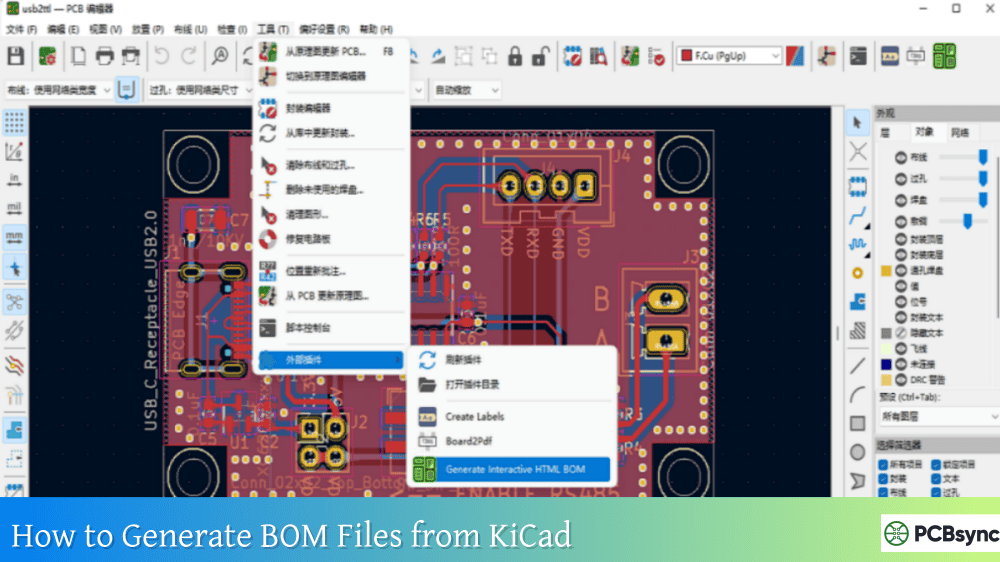
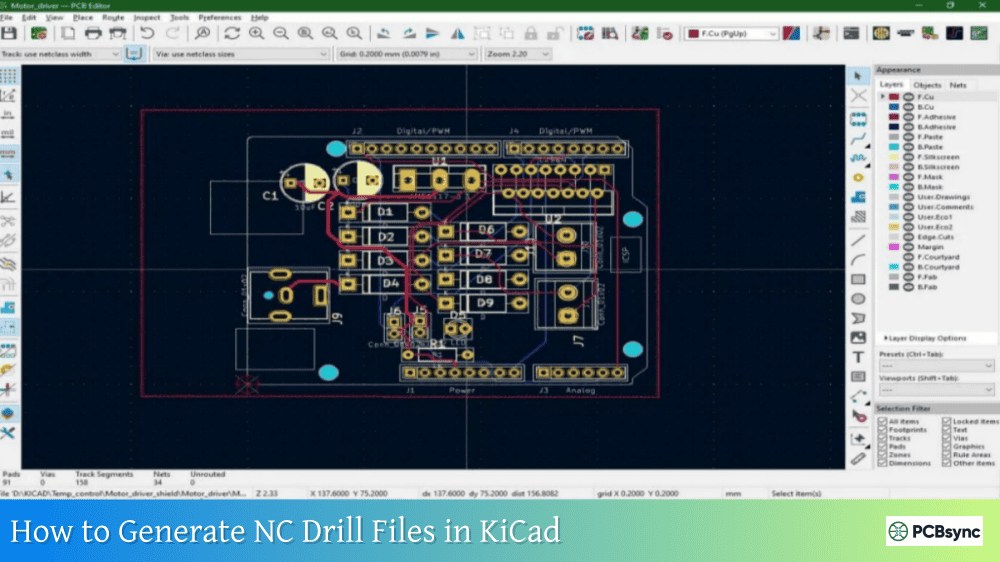
KiCad doesn’t include a dedicated assembly drawing tool like Altium’s Draftsman, but you can create effective assembly documentation using the Plot function and fabrication layers.
Using Fabrication Layers for Assembly Drawings
KiCad’s F.Fab and B.Fab layers are specifically designed for fabrication and assembly documentation. When footprints include proper fabrication layer graphics, these layers produce clean assembly drawings.
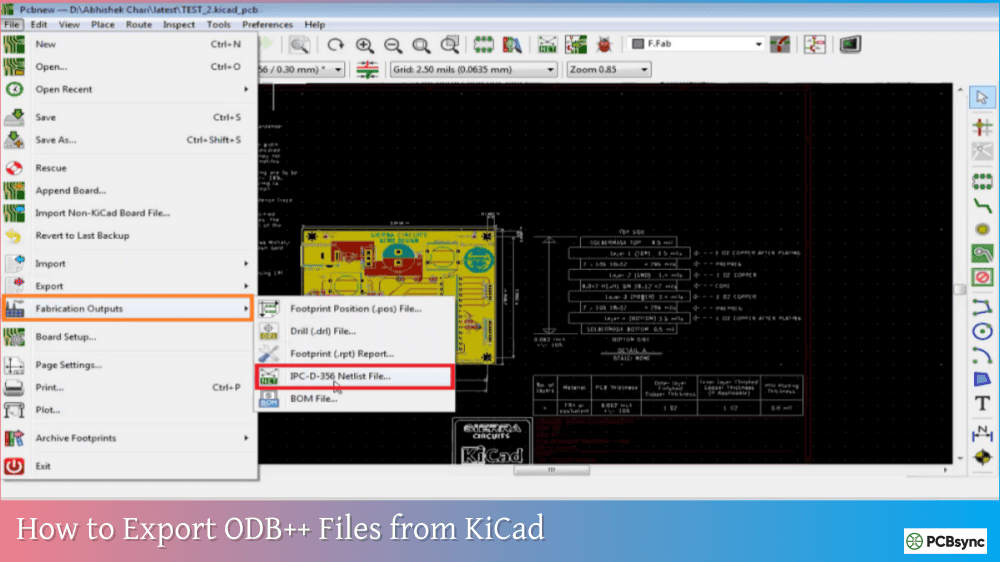
Open your PCB layout and select File → Plot from the menu. Configure these settings:
Plot format: PDF
Output directory: Specify where to save the files
Include Layers: Select F.Fab (front fabrication) for top assembly, B.Fab for bottom
Plot on All Layers: Enable Edge.Cuts to include the board outline
General Options: Check “Plot border and title block”, “Plot footprint values”, and “Plot footprint references”
Click Plot to generate the PDF. KiCad creates separate files for each layer, which you can combine using PDF editing software if needed.
Enhancing KiCad Footprints for Better Assembly Drawings
The quality of your assembly drawings depends heavily on how your footprints are designed. For the best results, each footprint should include fabrication layer graphics showing a clear component outline with pin 1 or polarity indication, and a “%R” text element that displays the reference designator.
If your current footprints don’t include fabrication layer graphics, you can add them in the Footprint Editor. Draw the component outline on the F.Fab layer using lines or rectangles, and add a text field with “%R” that will be replaced with the actual reference designator when placed.
Automating with KiBot
For production workflows, KiBot automates assembly drawing generation along with all other manufacturing outputs. A typical KiBot configuration for assembly drawings looks like:
KiBot generates consistent documentation every time you update your design, eliminating manual export steps.
Exporting Assembly Drawings from Cadence Allegro
Allegro provides robust assembly drawing capabilities through its artwork generation system.
Generating Assembly Artwork
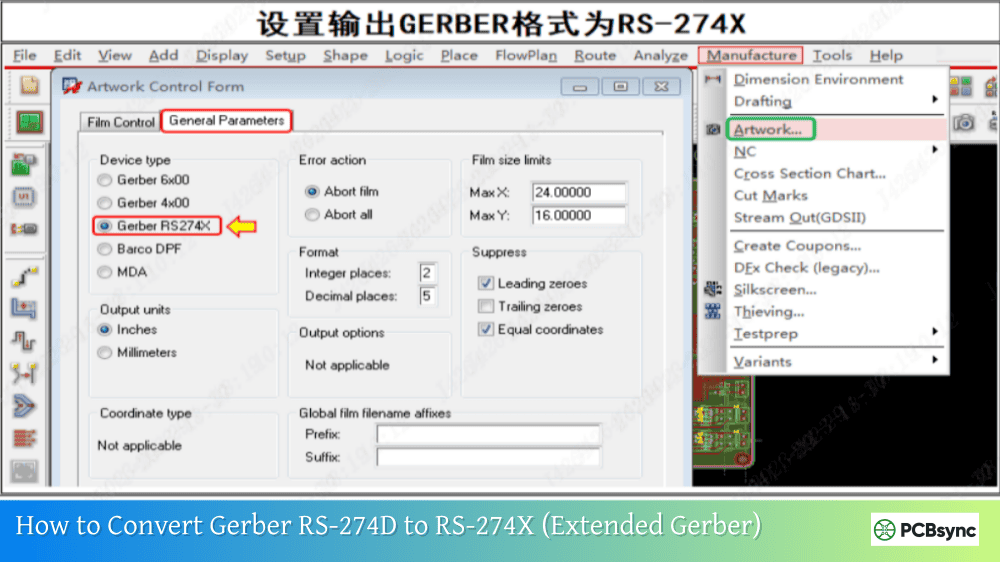
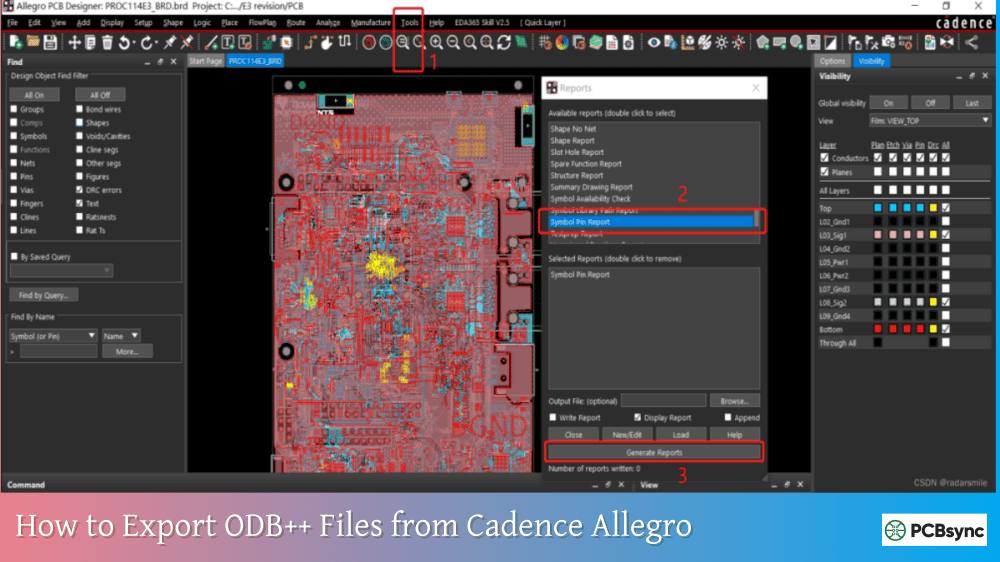
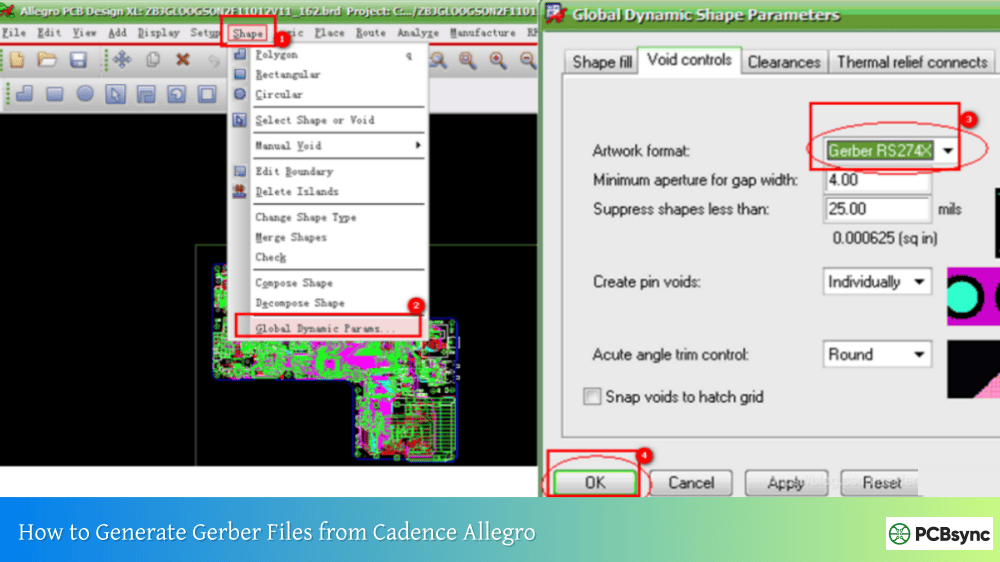
In the PCB Editor, navigate to Manufacture → Artwork to access the artwork generation dialog. Under Available Films, locate or create your assembly film definitions.
Click Apertures → Edit → Edit Aperture station → Auto → Without rotation and confirm. This ensures proper aperture definitions for the export.
Select the layers needed for assembly drawings—typically the package geometry layer, assembly layer, and board outline. Configure Film Options with appropriate line widths (4 mils is common for documentation).
Select your assembly films and click Create Artwork to generate the output files.
Exporting to PDF
After generating artwork, you can export to PDF using File → Export → PDF. In the export dialog, choose the assembly film from Available Films and specify your output location.
Select the assembly layer, click Export, and Allegro generates a PDF document. Repeat for top and bottom assemblies as needed.
Read more How to convert PCB Files in different Design software:
Eagle doesn’t have a dedicated assembly drawing feature, but you can create effective documentation by exporting specific layers to PDF.
Layer-Based PDF Export
Open your board layout and select File → Print or use the CAM Processor. Configure the print settings to include the tPlace layer (top placement/silkscreen), tNames (component names), and Dimension layer (board outline).
Set the output to PDF rather than a physical printer. Eagle generates a document showing component outlines with reference designators.
For bottom-side assembly, select the corresponding bottom layers (bPlace, bNames) and enable the Mirror option to show the view as seen from the top.
Improving Eagle Assembly Drawing Quality
The default Eagle output may need enhancement for professional use. Consider these improvements: add polarity markings to your library components that appear on placement layers, ensure all reference designators are positioned clearly (not overlapping component outlines), and include a title block with revision information.
Some engineers export from Eagle to a vector format (PDF or DXF) and then use external tools like Adobe Illustrator or Inkscape to add professional title blocks and annotations.
Best Practices for Assembly Drawing Documentation
After creating assembly drawings for hundreds of projects, these practices consistently reduce manufacturing issues:
Always include both sides. Even if your board only has components on one side, include a drawing showing the blank side. This confirms to the assembler that no components are missing from their data.
Use consistent scaling. Keep the same scale across all pages of a multi-page drawing. If you zoom in on details, clearly indicate the magnification change.
Mirror bottom views appropriately. Convention varies by manufacturer—some prefer bottom views mirrored (as if looking through the board from above), others prefer unmirrrored. Confirm with your assembly house and clearly label which convention you’ve used.
Mark polarized components prominently. Add explicit callouts for ICs (pin 1), diodes (cathode), LEDs, tantalum capacitors, and electrolytic capacitors. Never assume the assembler will figure it out from context.
Include special assembly notes. Document any unusual requirements: components that must be installed in specific sequence, height restrictions, keep-out zones during assembly, or thermal concerns.
Match revision with other files. Your assembly drawing revision should match your Gerbers, BOM, and pick-and-place file. Mismatched revisions cause confusion and potential assembly errors.
Assembly Drawing File Format Recommendations
Different manufacturers have different preferences for assembly drawing formats:
Format
Pros
Cons
Best For
PDF
Universal, preserves formatting
Not editable
Standard submissions
DXF
Editable, importable to CAD
May lose formatting
When modification needed
Gerber
Native to PCB workflow
Requires viewer
Some automated systems
PNG/JPEG
Simple viewing
Resolution limits
Quick reference only
PDF is the most widely accepted format. When exporting to PDF, ensure you’re using vector output (not rasterized images) so the drawing remains sharp at any zoom level.
Common Assembly Drawing Mistakes to Avoid
These errors frequently cause assembly problems:
Missing reference designators. If a component shows on the drawing but has no visible designator, assemblers can’t verify correct placement. Ensure every component is labeled.
Illegible text. Tiny reference designators that can’t be read without extreme magnification are useless. Scale your drawing appropriately or pull out detailed views for dense areas.
Outdated drawings. Using assembly drawings from an old revision while other files are current causes placement errors. Regenerate all documentation together.
Missing polarity. Assuming polarity is “obvious” leads to backwards components. Explicitly mark every polarized part.
Wrong layer visibility. Including inner copper layers or other irrelevant data clutters the drawing and obscures important assembly information.
Useful Resources for Assembly Drawing Documentation
Here are tools and references that help with assembly drawing creation:
What file format should I use for assembly drawings?
PDF is the most universally accepted format for assembly drawings. It preserves formatting exactly as intended, can be viewed on any computer without special software, and maintains vector quality for sharp printing at any scale. Some manufacturers accept DXF files if they need to import the drawing into their own systems, but PDF should be your default choice unless specifically requested otherwise.
Do I need separate assembly drawings for top and bottom layers?
Yes, you should create separate drawings for each side that contains components. Each drawing should clearly show only the components on that side, with appropriate layer visibility configured. Bottom-side drawings are typically mirrored to show the view as seen from above (looking through the board), but confirm your manufacturer’s preference as conventions vary.
How do I show component polarity on assembly drawings?
Mark polarity explicitly using standard conventions: pin 1 dots or chamfers for ICs, cathode bands for diodes, positive terminal indicators for tantalum and electrolytic capacitors, and anode/cathode markings for LEDs. Include these marks on your footprint’s fabrication layer, add callout annotations pointing to critical polarized components, and include a note in your assembly instructions specifying the polarity convention used.
Should assembly drawings include dimensions?
Assembly drawings typically include overall board dimensions and major feature locations, but detailed dimensioning belongs on the fabrication drawing. The primary purpose of the assembly drawing is component placement visualization, not dimensional specification. Include enough dimensional reference that an assembler can verify they have the correct board, but don’t clutter the drawing with measurements that obscure component information.
How do I handle densely populated areas where reference designators overlap?
For areas where components are too close for readable designators, use detail views or breakout sections. Create an enlarged view of the crowded area at 2:1 or 4:1 scale, place it adjacent to the main view, and connect it with a leader line. Alternatively, use a reference table that lists designator locations by coordinates, or create multiple pages with different component groups highlighted on each.
Final Thoughts on Assembly Drawing Export
Assembly drawings bridge the gap between your design intent and the physical assembly process. While coordinate files tell machines where to place components, assembly drawings tell humans what the finished board should look like—and humans make the final verification decisions.
Invest time in creating clear, complete assembly drawings. The few minutes spent configuring proper layer visibility, adding polarity callouts, and including assembly notes saves hours of back-and-forth communication with your assembly house and prevents costly placement errors.
Whether you’re using Altium’s powerful Draftsman tool, KiCad’s plot-to-PDF workflow, or any other method, the principles remain the same: show every component clearly, mark all polarities explicitly, and include any information the assembler needs to build your board correctly the first time.
Your assembly drawings are the last opportunity to communicate your design intent before boards go into production. Make them count.
Inquire: Call 0086-755-23203480, or reach out via the form below/your sales contact to discuss our design, manufacturing, and assembly capabilities.
Quote: Email your PCB files to Sales@pcbsync.com (Preferred for large files) or submit online. We will contact you promptly. Please ensure your email is correct.
Notes: For PCB fabrication, we require PCB design file in Gerber RS-274X format (most preferred), *.PCB/DDB (Protel, inform your program version) format or *.BRD (Eagle) format. For PCB assembly, we require PCB design file in above mentioned format, drilling file and BOM. Click to download BOM template To avoid file missing, please include all files into one folder and compress it into .zip or .rar format.