Inquire: Call 0086-755-23203480, or reach out via the form below/your sales contact to discuss our design, manufacturing, and assembly capabilities.
Quote: Email your PCB files to Sales@pcbsync.com (Preferred for large files) or submit online. We will contact you promptly. Please ensure your email is correct.
Notes: For PCB fabrication, we require PCB design file in Gerber RS-274X format (most preferred), *.PCB/DDB (Protel, inform your program version) format or *.BRD (Eagle) format. For PCB assembly, we require PCB design file in above mentioned format, drilling file and BOM. Click to download BOM template To avoid file missing, please include all files into one folder and compress it into .zip or .rar format.
How to View Gerber Files with ViewMate (Free): Complete PCB Engineer’s Guide
If you’ve ever sent Gerber files to a PCB manufacturer and crossed your fingers hoping everything was correct, you understand why verifying your files before production matters. After more than a decade of designing circuit boards, I’ve learned that a reliable Gerber viewer isn’t just nice to have—it’s essential. ViewMate from PentaLogix has been my trusted companion for pre-production verification, and the best part? The basic viewer is completely free. This guide walks you through everything you need to know about using ViewMate to view Gerber files effectively.
ViewMate is a free Gerber file viewer developed by PentaLogix that has earned the trust of over 200,000 PCB designers and engineers worldwide over the past 35 years. Unlike online viewers or stripped-down alternatives, ViewMate provides professional-grade viewing capabilities without requiring a paid license for basic inspection tasks.
ViewMate Free Version Capabilities
The free ViewMate viewer offers surprisingly robust functionality for a no-cost tool. You can view virtually any Gerber file format, inspect individual PCB layers with full visibility control, measure distances and verify dimensions, import and overlay Excellon drill files, edit D-Code definitions for proper aperture display, and print your designs at scale or fit-to-page.
What makes ViewMate particularly valuable is its ability to read problematic files that other viewers struggle with. I’ve personally encountered situations where expensive CAM software choked on customer data, but ViewMate handled it without complaint.
For most PCB designers doing pre-production verification, the free version provides everything needed. The paid versions add editing, export, and advanced DFM capabilities that become valuable as your workflow matures.
How to Download and Install ViewMate Free
Getting ViewMate onto your system takes just a few minutes, though you’ll need to register with PentaLogix to receive the download link.
Step-by-Step Download Process
Step 1: Navigate to the PentaLogix website at pentalogix.com and locate the ViewMate Viewer download page.
Step 2: Fill in the registration form with your name, email address, and company information. Use a valid email address because they’ll send the download link there.
Step 3: Submit the form and check your inbox. You should receive an email containing the download password within a few minutes.
Step 4: Use the provided credentials to access the download page and retrieve the installer file.
Step 5: Run the self-installing executable file. ViewMate installs cleanly on Windows systems from XP through Windows 11.
System Requirements
Requirement
Specification
Operating System
Windows XP, Vista, 7, 8, 10, 11
Processor
Any modern x86/x64 processor
RAM
512 MB minimum (2 GB recommended)
Disk Space
Approximately 50 MB
Display
1024×768 minimum resolution
The installation creates a ViewMate.cfg file in your home folder that stores your preferences and settings between sessions.
Importing Gerber Files into ViewMate
Loading Gerber files into ViewMate follows a specific workflow that differs slightly from some other viewers. Understanding this process helps avoid confusion, especially when working with complete fabrication packages.
Loading Gerber Layers
Step 1: Launch ViewMate from your Start menu or desktop shortcut.
Step 2: Navigate to File → Import → Gerber from the menu bar.
Step 3: Browse to the directory containing your Gerber files. Most Gerber files use extensions like .gbr, .ger, .gtl (top layer), .gbl (bottom layer), .gts (top solder mask), .gbs (bottom solder mask), .gto (top silkscreen), .gbo (bottom silkscreen), and .gko or .gm1 (board outline).
Step 4: Select multiple files at once by typing *.gbr in the filename box, then using Shift+Click or Ctrl+Click to select the files you want.
Step 5: Click the Import button to load all selected files.
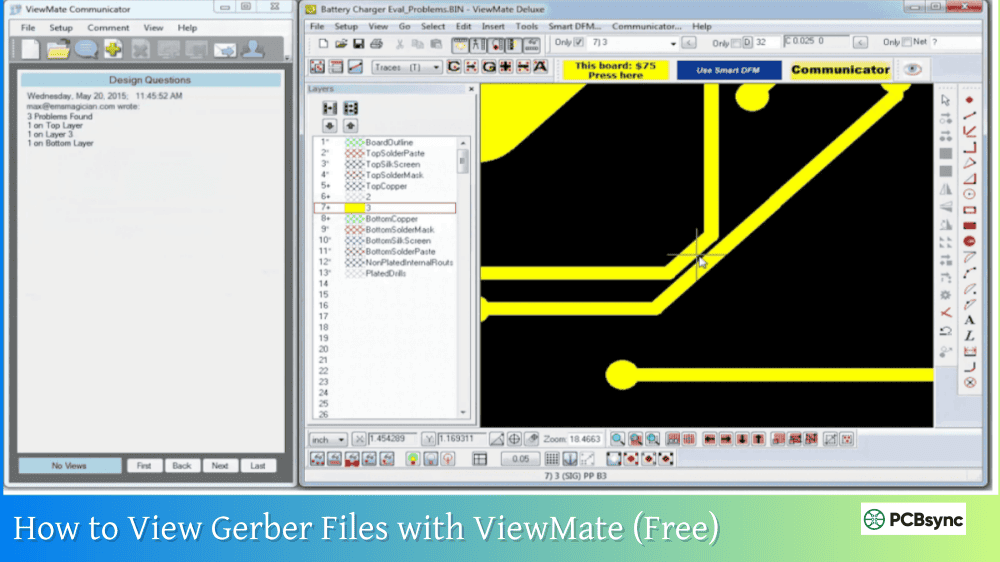
Each file loads into its own layer within ViewMate. The layers appear as colored rectangles in the vertical strip along the left side of the screen.
ViewMate excels at reading RS-274X files, which contain embedded aperture information. Older RS-274D files require separate aperture definitions, which ViewMate can also import.
Importing Excellon Drill Files
Drill files require separate import from Gerber layers—a point that trips up many first-time ViewMate users. The drill data uses a different format (Excellon) and needs specific handling.
Loading Drill and Route Data
Step 1: With your Gerber layers already loaded, go to File → Import → Drill & Route.
Step 2: Navigate to your drill files. Common extensions include .drl, .drd, .exc, .xln, and .nc.
Step 3: Before clicking Import, press the Options button at the bottom of the dialog. This step is critical for proper drill file interpretation.
Step 4: Configure the drill file options to match your CAD software’s output format.
Drill File Import Options Explained
Option
Description
Common Settings
Units
Inches or Millimeters
Match your CAD export
Format (Left of Decimal)
Integer digits before decimal point
Typically 2
Format (Right of Decimal)
Digits after decimal point
Typically 3-5
Leading Zeros
Whether leading zeros are suppressed
Often suppressed
Trailing Zeros
Whether trailing zeros are suppressed
Usually not suppressed
Coordinates
Absolute or Incremental
Almost always Absolute
The most common issue with drill files appearing at wrong scale or position stems from incorrect format settings. If your drill holes appear 10x too large or too small, the decimal format is likely wrong. For most CAD tools exporting in inches, try “2/4” or “2/5” format with leading zeros suppressed.
Troubleshooting Drill File Scale Issues
When drill holes don’t align with copper pads, work through this checklist:
First, verify the units match between your Gerber and drill exports. A common mistake is exporting Gerbers in millimeters but drill files in inches.
Second, adjust the decimal format. If holes appear roughly 25x too small, you likely have a metric file being read as imperial. If holes are approximately 10x off, the decimal point position is wrong.
Third, check the zero suppression settings. Leading zero suppression is common, but trailing zero suppression can cause coordinate misinterpretation.
Navigating and Viewing Gerber Data
Once your files are loaded, ViewMate provides powerful tools for examining your PCB design in detail.
Layer Visibility and Color Control
The layer toolbar along the left edge of the screen controls which layers display. Each colored rectangle represents one loaded file. Double-click a rectangle to toggle that layer’s visibility. Hover over a rectangle to see the filename in a tooltip.
To change layer colors for better contrast, right-click on a layer rectangle and select color options. I recommend using contrasting colors for copper layers (red for top, blue for bottom) and distinct colors for solder mask and silkscreen layers.
Zoom and Pan Controls
Action
Method
Zoom In
Click magnifying glass, drag rectangle around area
Zoom Out
Right-click to step back, or use View menu
Zoom to Fit
View → Zoom → All, or press Home key
Pan
Arrow keys, or click and drag with middle mouse button
Zoom Window
Click zoom tool, drag rectangle around region of interest
ViewMate also supports stepping through the design systematically using the “Next Screen” and “Next Screen Up” buttons, which move the view by screen increments in X and Y directions.
Display Modes
ViewMate offers different rendering modes accessible through the View menu:
Filled Mode shows apertures as solid shapes, representing how the actual copper will appear on the manufactured board.
Centerline Mode displays traces and pads as outlines with centerlines, making it easier to see overlapping features and verify trace routing.
Toggle between these modes by clicking the icon that looks like a red circle with a vertical line extending downward.
Measuring Distances and Dimensions
Accurate measurements are essential for verifying your design meets specifications. ViewMate includes several measurement tools.
Using the Distance Measurement Tool
Access measurement functions through View → Distance in the menu. The Edge to Edge Distance Tool displays the gap between the edges of two elements—perfect for checking clearances between traces or pads.
To measure, click on the first element, then click on the second. ViewMate displays the distance in the current unit setting (visible in the lower-left corner of the screen). You can switch between mils, inches, millimeters, and centimeters using the unit selector.
When verifying drill alignment, overlay the drill layer on copper and measure from hole center to pad center. Any offset indicates a potential registration problem that should be investigated before manufacturing.
Read more How to convert PCB Files in different Design software:
D-Codes define the shapes and sizes of apertures used to create Gerber artwork. Understanding them helps troubleshoot display problems.
Viewing D-Code Information
Press F5 to open the D-Code Setup table, which lists all apertures defined in the loaded files. Each row shows the D-Code number, shape type (round, square, rectangle, oblong, etc.), dimensions, and which layers use that aperture.
The “Layers” command in the D-Code table shows which layers use individual D-Codes—useful when tracking down aperture-related display issues.
Common D-Code Problems and Solutions
Problem
Symptom
Solution
Missing apertures
Features appear as dots or missing
Import aperture file separately
Wrong aperture sizes
Pads/traces appear too large or small
Edit D-Code dimensions in F5 table
Unknown aperture type
Question marks on display
Define aperture shape manually
Duplicate D-Codes
Conflicting definitions
Check layer aperture assignments
For RS-274D files lacking embedded aperture data, you’ll need to import an aperture list file. Go to File → Import → Apertures and select the appropriate aperture definition file from your CAD tool.
Printing Gerber Files from ViewMate
ViewMate includes capable printing functions for creating hardcopy documentation or film output.
Print Options and Settings
Access printing through File → Print. The print dialog offers several important options:
Scale options let you print at 100% (actual size) for film output or scaled to fit the page for documentation purposes.
Layer selection determines which layers appear on the printed output. You can print all visible layers combined or select specific layers.
Color vs. Black & White output suits different purposes—color for review, black and white for film or cost savings.
Add layer info line option prints layer names and types in the margin for reference.
Creating Print Documentation
For design reviews, I typically print each layer separately on its own page with the layer name clearly labeled. This creates a paper trail useful for engineering sign-offs and manufacturing communication.
For checking alignment, print the top copper, bottom copper, and drill layers on transparent film at 100% scale. Stacking these films reveals any registration issues before committing to fabrication.
ViewMate Free vs Paid Versions
Understanding what the free version can and cannot do helps you decide whether upgrading makes sense for your workflow.
Feature Comparison
Feature
Free ViewMate
ViewMate Essentials
ViewMate Pro
View Gerber files
Yes
Yes
Yes
View Excellon drill
Yes
Yes
Yes
Measure distances
Yes
Yes
Yes
Print designs
Yes
Yes
Yes
Save/Export files
No
Yes
Yes
Edit Gerber data
Limited
Yes
Yes
Smart DFM checks
No
Yes
Yes
DXF conversion
No
No
Yes
Panelization
No
No
Yes
Layer comparison
Visual only
Automated
Automated
When to Upgrade
The free ViewMate handles verification and inspection adequately for most designers. Consider upgrading to ViewMate Essentials if you need automated DFM checking to catch manufacturing issues, the ability to save modified files, PCB Navigator for component-level inspection, or professional layer organization tools.
ViewMate Pro becomes worthwhile when your workflow requires DXF conversion for mechanical integration, panel layout and stencil design capabilities, or netlist extraction and verification.
Can ViewMate Free save or export edited Gerber files?
No, the free version of ViewMate is specifically designed as a viewer and does not include save or export functionality. You can view, measure, and print files, and you can make temporary edits for inspection purposes, but those changes cannot be saved. If you need to modify and save Gerber files, you’ll need to upgrade to ViewMate Essentials or ViewMate Pro, which include full editing and export capabilities. Many engineers use the free viewer for verification and return to their original CAD software for any necessary changes.
Why do my drill holes appear at the wrong scale in ViewMate?
This almost always stems from incorrect drill file import options. When you import Excellon drill files, click the Options button before importing and verify the format settings match your CAD tool’s output. Most CAD software exports drill files in 2.4 or 2.5 format with leading zeros suppressed. If your holes appear approximately 25 times too small or large, you likely have a metric/imperial mismatch. If they’re about 10 times off, the decimal format is wrong. Experiment with the “Left of Decimal” and “Right of Decimal” settings until the drill data aligns with your copper layers.
How do I view multiple Gerber layers simultaneously with transparency?
ViewMate displays all visible layers overlaid on each other automatically. Control which layers display by double-clicking the colored rectangles in the layer toolbar on the left side of the screen. For better differentiation, right-click on layer rectangles to change their colors. Using contrasting colors (like red, blue, and green) helps distinguish overlapping features. The filled/centerline toggle (the icon with a red circle and vertical line) also helps when examining how layers interact—centerline mode makes overlapping features more visible.
Does ViewMate support the latest Gerber X2 and X3 formats?
Yes, ViewMate supports Gerber X2 format files, which include embedded metadata about layer functions, aperture attributes, and other information that helps the software correctly interpret the file contents. When importing directories or zip files containing Gerber X2 data, ViewMate preserves the proper layer order specified in the metadata. Gerber X3 support for net and pin information is available in the paid versions. For most PCB verification tasks, the free viewer handles standard Gerber X2 files without issues.
What’s the difference between ViewMate and ViewMate Pro?
ViewMate (free) is a viewer-only application focused on inspection, measurement, and printing—you cannot save or export files. ViewMate Pro is a full CAM editor that includes everything in the free version plus Gerber and drill editing capabilities, DXF import/export for mechanical integration, layer comparison tools, stencil aperture generation, Smart DFM checking, and the ability to save modified files. ViewMate Essentials sits between them, offering editing and DFM features without the advanced CAM automation of Pro. Choose based on whether you need to modify files or just verify them.
Best Practices for Gerber Verification with ViewMate
Over years of using ViewMate for pre-production checks, I’ve developed a systematic approach that catches most issues before they become expensive problems.
Always load all layers together. Import every Gerber file in your fabrication package, not just the ones you think are important. Missing layers often don’t become apparent until you’re looking at the complete stackup.
Verify drill-to-copper alignment first. Load drill files over copper layers and zoom in on several vias and through-hole pads across the board. Any systematic offset indicates an export or origin problem that affects the entire design.
Check solder mask openings against pads. The solder mask layers should have openings slightly larger than the copper pads. If mask covers pads or openings are excessively large, investigate your CAD settings.
Measure critical dimensions. Don’t assume your design rule checks caught everything. Use ViewMate’s measurement tools to verify trace widths, clearances, and board dimensions against your specifications.
Compare top and bottom symmetry. For designs with mirrored features, toggle between top and bottom views to verify the expected symmetry. Unexpected differences might indicate component placement errors.
Print a composite view. Before sending files to fabrication, print all layers combined on a single page. This physical representation often reveals issues that aren’t obvious when viewing layers individually on screen.
ViewMate has proven itself as a reliable Gerber viewer over 35 years of development and refinement. While the free version lacks export capabilities, it provides everything most PCB engineers need for thorough pre-production verification. The few minutes spent checking your files in ViewMate before ordering can save days of delay and hundreds of dollars in re-spin costs.
Inquire: Call 0086-755-23203480, or reach out via the form below/your sales contact to discuss our design, manufacturing, and assembly capabilities.
Quote: Email your PCB files to Sales@pcbsync.com (Preferred for large files) or submit online. We will contact you promptly. Please ensure your email is correct.
Notes: For PCB fabrication, we require PCB design file in Gerber RS-274X format (most preferred), *.PCB/DDB (Protel, inform your program version) format or *.BRD (Eagle) format. For PCB assembly, we require PCB design file in above mentioned format, drilling file and BOM. Click to download BOM template To avoid file missing, please include all files into one folder and compress it into .zip or .rar format.