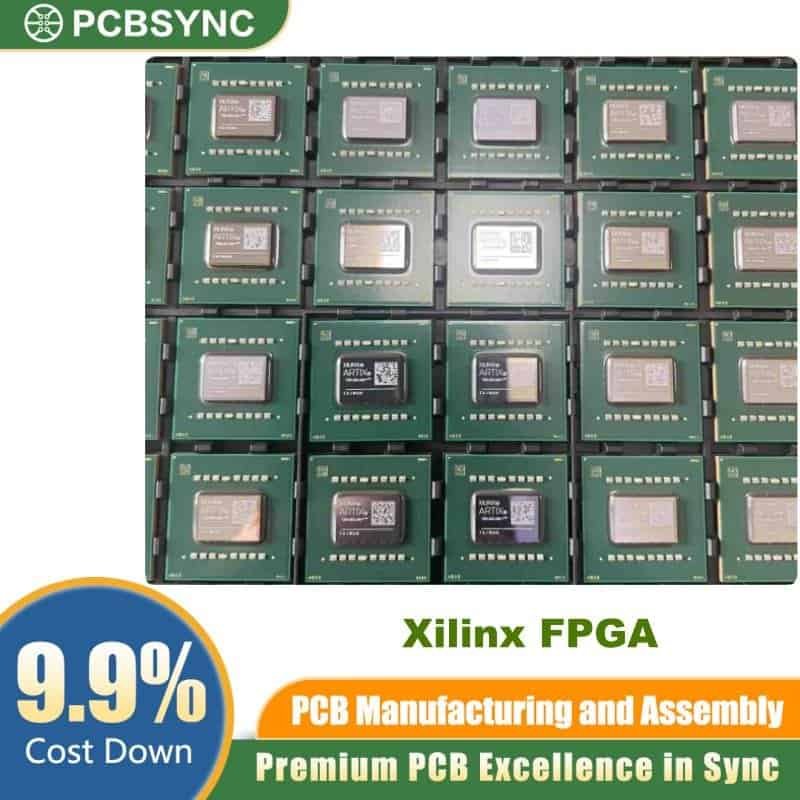
The XC2S200-6FGG809C is a powerful field-programmable gate array from AMD’s (formerly Xilinx) acclaimed Spartan-II family, designed to deliver exceptional performance and versatility for complex digital designs. This 809-pin Fine-Pitch Ball Grid Array (FBGA) device offers engineers a cost-effective solution for high-density programmable logic applications across telecommunications, industrial automation, and embedded systems.
Overview of XC2S200-6FGG809C FPGA Technology
The XC2S200-6FGG809C represents the pinnacle of the Spartan-II series, featuring 200,000 system gates and 5,292 logic cells in a robust 809-ball FBGA package. Built on proven 0.18-micron CMOS technology, this FPGA provides designers with unlimited reprogrammability and streamlined features derived from the renowned Virtex architecture.
Key Features and Specifications
| Feature |
Specification |
| Logic Cells |
5,292 |
| System Gates |
200,000 |
| CLB Array Configuration |
28 x 42 (1,176 total CLBs) |
| Maximum User I/O |
284 pins |
| Distributed RAM |
75,264 bits |
| Block RAM |
56 Kbits |
| Package Type |
809-Ball Fine-Pitch BGA (FGG809) |
| Speed Grade |
-6 (High Performance) |
| Operating Voltage |
2.5V (2.375V ~ 2.625V) |
| Technology Node |
0.18μm CMOS |
| Operating Temperature |
0°C ~ 85°C (Commercial) |
Technical Architecture and Performance
Advanced Logic Capacity
The XC2S200-6FGG809C delivers substantial logic density with its 1,176 Configurable Logic Blocks (CLBs) arranged in a 28×42 array. Each CLB contains four logic slices, providing the flexibility needed for complex digital signal processing, custom computing engines, and sophisticated control algorithms.
Memory Resources and Configuration
This Spartan-II FPGA integrates hierarchical memory architecture optimized for diverse application requirements:
| Memory Type |
Capacity |
Configuration |
| Distributed RAM |
75,264 bits |
16 bits per LUT |
| Block RAM |
56 Kbits |
Configurable 4K-bit blocks |
| Total RAM |
131,328 bits |
Flexible allocation |
The dual-port block RAM enables efficient buffer implementation, FIFO queues, and lookup table storage, while distributed RAM provides fast local storage within logic resources.
XC2S200-6FGG809C Package and Pin Configuration
FGG809 Package Advantages
The 809-ball Fine-Pitch Ball Grid Array package provides exceptional I/O density and thermal performance characteristics:
- Maximum I/O Availability: 284 user-programmable I/O pins
- Enhanced Signal Integrity: Fine-pitch ball spacing reduces parasitic effects
- Thermal Management: Large package footprint enables efficient heat dissipation
- PCB Integration: Compatible with modern high-density circuit board designs
Speed Grade -6 Performance Benefits
The -6 speed grade designation indicates this device operates at the highest performance level within the Spartan-II family, supporting system frequencies up to 200 MHz for internal logic and 263 MHz for dedicated routing resources.
Applications and Use Cases
Industrial Automation and Control Systems
The XC2S200-6FGG809C excels in industrial applications requiring real-time processing and extensive I/O interfacing:
- Motor control and drive systems
- Programmable logic controllers (PLC)
- Machine vision processing
- Sensor fusion and data acquisition
- Process monitoring and control
Telecommunications and Networking
With its robust logic capacity and memory resources, this FPGA serves telecommunications infrastructure:
- Protocol conversion and bridging
- Digital signal processing for baseband
- Network packet processing
- Channel encoding/decoding
- Interface adaptation modules
Embedded Systems Development
Engineers leverage the XC2S200-6FGG809C for embedded applications demanding customizable hardware acceleration:
- Custom peripheral controllers
- Hardware encryption engines
- Video/audio processing pipelines
- Real-time data streaming
- System-on-chip prototyping
Design Resources and Development Tools
Compatible Development Software
| Tool Category |
Supported Software |
| Design Entry |
ISE Design Suite, Schematic Editor |
| Synthesis |
XST (Xilinx Synthesis Technology) |
| Simulation |
ModelSim, ISim |
| Implementation |
Place and Route Tools |
| Programming |
iMPACT, ChipScope Pro |
System-Level Features
The XC2S200-6FGG809C incorporates advanced system-level capabilities that simplify complex design implementation:
- Four Delay-Locked Loops (DLLs): Positioned at die corners for precise clock management and de-skewing
- SelectRAM™ Technology: Hierarchical memory architecture with flexible configuration options
- Boundary Scan Support: IEEE 1149.1 JTAG for testing and programming
- Unlimited Reprogrammability: In-system reconfiguration enables field upgrades
- Hot-Swappable I/O: Supports live insertion in active systems
Electrical Characteristics and Power Consumption
Operating Conditions
| Parameter |
Minimum |
Typical |
Maximum |
Unit |
| Core Voltage (VCCINT) |
2.375 |
2.5 |
2.625 |
V |
| I/O Voltage (VCCO) |
1.14 |
Various |
3.465 |
V |
| Junction Temperature |
0 |
25 |
85 |
°C |
| Static Power |
– |
TBD |
– |
mW |
| Dynamic Power |
Varies with design activity |
|
|
mW |
Power Management Considerations
Designers should account for both static and dynamic power consumption when implementing the XC2S200-6FGG809C. Power consumption varies based on:
- Toggle rates and switching activity
- Clock frequency and distribution
- I/O standards and drive strength
- Block RAM utilization
- Global routing resources usage
Comparison with Alternative Package Options
The XC2S200 device family offers multiple package configurations to suit different design requirements:
| Package Type |
Ball/Pin Count |
Max I/O |
Typical Applications |
| PQ208/PQG208 |
208 |
140 |
Compact designs, basic I/O |
| FG256/FGG256 |
256 |
176 |
Medium-density projects |
| FGG809 |
809 |
284 |
Maximum I/O, complex systems |
The FGG809 package provides the highest I/O count, making it ideal for applications requiring extensive external interfacing, such as multi-channel data acquisition systems, complex communication protocols, and high-bandwidth processing modules.
Design Considerations and Best Practices
PCB Layout Guidelines
When designing with the XC2S200-6FGG809C, engineers should observe these critical layout practices:
- Power Distribution: Implement robust power planes with adequate decoupling capacitors near the package
- Signal Routing: Maintain controlled impedance for high-speed signals and differential pairs
- Thermal Management: Ensure sufficient airflow or heatsinking for thermal dissipation
- BGA Escape Routing: Utilize microvias for efficient ball-out routing from the fine-pitch array
- Ground Integrity: Establish solid ground reference planes to minimize noise and EMI
Configuration and Programming
The XC2S200-6FGG809C supports multiple configuration modes:
- Master Serial Mode: FPGA controls external PROM
- Slave Serial Mode: External controller provides configuration data
- JTAG Boundary Scan: IEEE 1149.1 programming and debugging
- SelectMAP Mode: High-speed parallel configuration interface
Reliability and Quality Standards
Manufacturing and Testing
AMD (Xilinx) manufactures the XC2S200-6FGG809C using mature 0.18-micron CMOS process technology with comprehensive quality assurance:
- 100% Functional Testing: Every device undergoes complete functional verification
- Burn-in Testing: Extended temperature cycling for enhanced reliability
- RoHS Compliance: Lead-free package options available (FGG809 designation)
- Industry Standards: Meets or exceeds JEDEC specifications
Environmental Compliance
| Standard |
Compliance Status |
| RoHS |
Compliant (Pb-free option) |
| REACH |
Registered |
| Conflict Minerals |
Compliant |
| Halogen-Free |
Available on request |
Purchasing and Availability
Part Number Decode
Understanding the XC2S200-6FGG809C part number nomenclature:
- XC2S200: Device type (Spartan-II, 200K gates)
- -6: Speed grade (highest performance)
- FGG809: Package type (Fine-pitch BGA, 809 balls)
- C: Commercial temperature range (0°C to 85°C)
Authorized Distribution Channels
The XC2S200-6FGG809C is available through authorized Xilinx FPGA distributors and electronic component suppliers worldwide. When sourcing this device, verify:
- Authentic AMD/Xilinx manufacturing
- Proper moisture sensitivity level (MSL) handling
- Date code and lot traceability
- Warranty and return policies
- Technical support availability
Technical Support and Documentation
Essential Reference Materials
| Document Type |
Description |
| Datasheet DS001 |
Complete electrical and functional specifications |
| User Guide |
Detailed architecture and feature descriptions |
| Packaging Specification |
Mechanical dimensions and handling requirements |
| Application Notes |
Design guidelines and reference implementations |
| Errata |
Known issues and workarounds |
Migration and Upgrade Paths
For designers considering future-proofing their designs, AMD offers upgrade paths to newer FPGA families while maintaining architectural compatibility:
- Spartan-3 Series: Enhanced logic density and lower power
- Spartan-6 Series: 45nm technology with improved performance
- Artix-7 Series: Modern 28nm architecture with DSP blocks
Competitive Advantages
Why Choose XC2S200-6FGG809C?
The XC2S200-6FGG809C stands out in the programmable logic market through several distinctive advantages:
- Proven Technology: Mature, reliable architecture with extensive design heritage
- Cost-Effective: Competitive pricing for 200K gate capacity
- Maximum I/O: 284 pins provide unmatched connectivity in the Spartan-II family
- Design Reuse: Extensive IP library and reference designs available
- Long-Term Availability: Continued support for legacy applications
- Low-Risk Implementation: Well-characterized performance and behavior
Value Proposition for Design Engineers
The XC2S200-6FGG809C delivers exceptional value across multiple dimensions:
- Faster Time-to-Market: Proven tools and mature development flow
- Flexibility: Unlimited reprogrammability enables iterative refinement
- Integration: Single-chip solution reduces BOM cost and board complexity
- Scalability: Easy migration within Spartan family for production optimization
- Support: Comprehensive documentation and active design community
Frequently Asked Questions
What is the main difference between speed grades?
The -6 speed grade in the XC2S200-6FGG809C indicates the fastest performance tier, supporting higher clock frequencies and shorter propagation delays compared to -5 or -4 speed grades. This enables more aggressive timing closure for demanding applications.
Can the XC2S200-6FGG809C operate at industrial temperatures?
The “C” suffix designates commercial temperature range (0°C to 85°C). For industrial applications requiring -40°C to 100°C operation, alternative grade devices with “I” suffix would be appropriate, though the -6 speed grade is exclusively available in the commercial range.
What programming cables are compatible?
The XC2S200-6FGG809C supports standard Xilinx programming cables including Platform Cable USB, Platform Cable II, and JTAG programming via third-party boundary scan tools implementing IEEE 1149.1 protocol.
How does block RAM differ from distributed RAM?
Block RAM consists of dedicated 4K-bit memory blocks ideal for large buffers and FIFOs, while distributed RAM utilizes LUT resources for smaller, faster-access memory structures distributed throughout the logic fabric.
Is the device 5V tolerant on I/O pins?
Spartan-II devices are not inherently 5V tolerant. However, with appropriate series resistors and current-limiting techniques, interface to 5V systems can be achieved following guidelines in the datasheet.
Summary and Recommendations
The XC2S200-6FGG809C represents a mature, reliable FPGA solution for applications demanding substantial logic resources, extensive I/O connectivity, and proven performance. Its 809-ball FBGA package maximizes the available 284 user I/O pins, making it particularly suitable for complex interfacing requirements in industrial control, telecommunications infrastructure, and high-channel-count data acquisition systems.
Engineers selecting the XC2S200-6FGG809C benefit from decades of design knowledge, extensive reference implementations, and a robust ecosystem of development tools. While newer FPGA families offer enhanced capabilities, the Spartan-II architecture continues to serve applications where reliability, cost-effectiveness, and design heritage are paramount considerations.
For detailed technical specifications, ordering information, and design resources, consult the official AMD documentation or contact authorized Xilinx FPGA distributors to ensure authentic components and comprehensive technical support for your next programmable logic project.